PUBLISHER: Global Market Insights Inc. | PRODUCT CODE: 2038696

PUBLISHER: Global Market Insights Inc. | PRODUCT CODE: 2038696
Logistics Automation Market Opportunity, Growth Drivers, Industry Trend Analysis, and Forecast 2026 - 2035
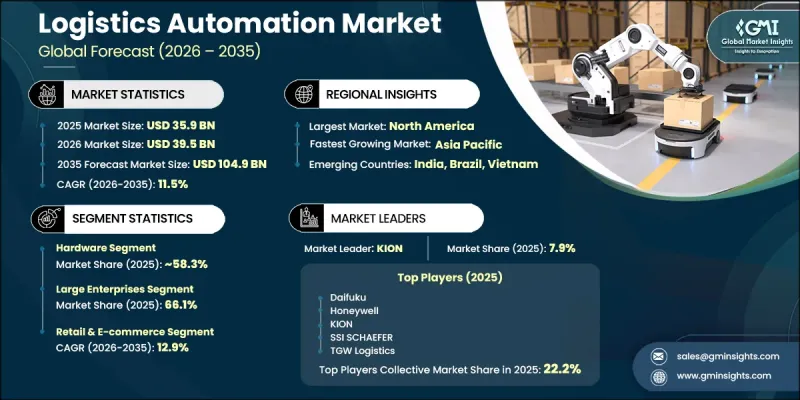
The Global Logistics Automation Market was valued at USD 35.9 billion in 2025 and is estimated to grow at a CAGR of 11.5% to reach USD 104.9 billion by 2035.
The market expansion is influenced by the strategic importance of logistics in national economies, as it significantly contributes to gross domestic product (GDP) across multiple countries. Governments and private stakeholders are increasingly investing in upgrading logistics infrastructure to improve productivity, efficiency, and global competitiveness. Logistics and transportation also form a core component of economic output in the United States, as highlighted by federal statistical authorities responsible for national economic data tracking. Modern logistics operations are rapidly shifting toward intelligent automation, where AI and machine learning technologies are evolving from isolated optimization tools into fully integrated orchestration systems. These platforms now manage end-to-end workflows by coordinating inventory, labor, and transportation in real time. Warehouse management and execution systems dynamically assign tasks across autonomous mobile robots, manual workers, and automated stations based on operational demand and system load. Transportation management systems are increasingly using live data inputs such as traffic conditions and carrier availability to optimize routing decisions. Research findings also indicate that higher levels of automation and robotics density significantly improve operational efficiency when supported by effective system integration and workforce adaptation.
| Market Scope | |
|---|---|
| Start Year | 2025 |
| Forecast Year | 2026-2035 |
| Start Value | $35.9 Billion |
| Forecast Value | $104.9 Billion |
| CAGR | 11.5% |
The hardware segment accounted for 58.3% share in 2025, generating USD 21 billion attributed to the capital-intensive nature of physical automation infrastructure, including conveyors, automated storage and retrieval systems, palletizing units, autonomous mobile robots, automated guided vehicles, and robotic lift equipment. Hardware remains the foundational layer of logistics automation, requiring significant upfront investment before software integration. These systems are closely integrated with warehouse control and execution platforms, which increasingly incorporate artificial intelligence to enhance routing efficiency, workload distribution, and predictive maintenance capabilities.
The large enterprises segment held a 66.1% share in 2025, valued at USD 23.8 billion. This leadership position is driven by the high capital requirements associated with large-scale automation deployments, which are typically accessible to financially strong organizations. Major adopters include global retail chains, e-commerce leaders, and third-party logistics providers that operate across multiple facilities. These enterprises are better positioned to manage long investment cycles and implement advanced automation technologies across distributed warehouse networks, giving them a clear advantage over smaller market participants.
U.S. Logistics Automation Market reached USD 10.9 billion in 2025 and is projected to grow at a CAGR of 12.3% from 2026 to 2035. The country's highly developed logistics ecosystem continues to attract strong investments in automation technologies. Growth is supported by rapid expansion of e-commerce, increasing labor shortages in warehouse operations, and widespread adoption of robotics and AI-driven systems. Industry surveys indicate that a significant share of logistics decision-makers in the region expect growing reliance on artificial intelligence while also highlighting rising concerns around cybersecurity risks in automated supply chains.
Key companies operating in the Logistics Automation Industry include ABB, Honeywell, Daifuku, KION (Dematic), SSI SCHAEFER, KUKA, Korber, KNAPP, TGW Logistics, and Symbotic. Companies in the Logistics Automation Market are focusing on expanding their technology portfolios by integrating advanced artificial intelligence, machine learning, and robotics into end-to-end supply chain solutions. Many players are investing heavily in scalable automation systems that support flexible warehouse configurations and real-time decision-making capabilities. Strategic partnerships with e-commerce platforms, logistics service providers, and industrial operators are helping firms expand deployment opportunities across multiple sectors. Companies are also prioritizing software-hardware integration to improve system interoperability and operational efficiency. In addition, continuous investment in predictive analytics, digital twin technologies, and cloud-based warehouse management systems is strengthening performance optimization.
Table of Contents
Chapter 1 Methodology
- 1.1 Research approach
- 1.2 Quality Commitments
- 1.2.1 GMI AI policy & data integrity commitment
- 1.3 Research Trail & Confidence Scoring
- 1.3.1 Research Trail Components
- 1.3.2 Scoring Components
- 1.4 Data Collection
- 1.5 Data mining sources
- 1.5.1 Paid sources
- 1.6 Base estimates and calculations
- 1.6.1 Base year calculation for any one approach
- 1.7 Forecast
- 1.7.1 Quantified market impact analysis
- 1.8 Research transparency addendum
- 1.8.1 Source attribution framework
- 1.8.2 Quality assurance metrics
- 1.8.3 Our commitment to trust
Chapter 2 Executive Summary
- 2.1 Industry 360° synopsis
- 2.2 Key market trends
- 2.2.1 Regional
- 2.2.2 Component
- 2.2.3 Application
- 2.2.4 Organization Size
- 2.2.5 End Use
- 2.3 TAM analysis, 2026-2035
- 2.4 CXO perspectives: Strategic imperatives
Chapter 3 Industry Insights
- 3.1 Industry ecosystem analysis
- 3.1.1 Supplier landscape
- 3.1.2 Profit margin
- 3.1.3 Cost structure
- 3.1.4 Value addition at each stage
- 3.1.5 Factor affecting the value chain
- 3.1.6 Disruptions
- 3.2 Industry impact forces
- 3.2.1 Growth drivers
- 3.2.1.1 E-Commerce Growth & Last-Mile Delivery Demands
- 3.2.1.2 Labor Shortage & Rising Operational Costs
- 3.2.1.3 Need for Real-Time Visibility & Supply Chain Resilience
- 3.2.1.4 Advancements in AI, IoT & Robotics Technologies
- 3.2.2 Industry pitfalls and challenges
- 3.2.2.1 High Initial Capital Investment & ROI Uncertainties
- 3.2.2.2 Integration Complexity with Legacy Systems
- 3.2.3 Market opportunities
- 3.2.3.1 Emerging Markets Adoption in Asia Pacific & Latin America
- 3.2.3.2 SME Market Penetration Through Cloud-Based Solutions
- 3.2.3.3 Autonomous Vehicles & Drone Delivery Integration
- 3.2.1 Growth drivers
- 3.3 Technology and innovation landscape
- 3.3.1 Current technologies
- 3.3.1.1 Radio Frequency Identification (RFID)
- 3.3.1.2 Automated Storage and Retrieval Systems (AS/RS)
- 3.3.1.3 Robotic Process Automation (RPA)
- 3.3.2 Emerging technologies
- 3.3.2.1 Autonomous Mobile Robots (AMRs)
- 3.3.2.2 Artificial Intelligence (AI)-Driven Predictive Logistics Platforms
- 3.3.2.3 Drone-Based Delivery Systems
- 3.3.2.4 Digital Twins for Supply Chain Optimization
- 3.3.1 Current technologies
- 3.4 Growth potential analysis
- 3.5 Regulatory landscape
- 3.5.1 North America
- 3.5.1.1 US - Federal Motor Carrier Safety Administration (FMCSA)
- 3.5.1.2 US - Occupational Safety and Health Administration (OSHA)
- 3.5.1.3 Canada - Transport Canada
- 3.5.2 Europe
- 3.5.2.1 EU - Directorate-General for Mobility and Transport (DG MOVE)
- 3.5.2.2 Germany - Federal Ministry for Digital and Transport (BMDV)
- 3.5.3 Asia Pacific
- 3.5.3.1 China - China Federation of Logistics & Purchasing (CFLP)
- 3.5.3.2 India - Directorate of Logistics (DoL)
- 3.5.4 Latin America
- 3.5.4.1 Brazil - National Land Transport Agency (ANTT)
- 3.5.4.2 Mexico - General Bureau of Standards
- 3.5.5 Middle East & Africa
- 3.5.5.1 UAE - National Association of Freight and Logistics (NAFL)
- 3.5.5.2 Saudi Arabia - The Ministry of Transport and Logistics Services
- 3.5.1 North America
- 3.6 Porter's analysis
- 3.7 PESTEL analysis
- 3.8 Patent landscape (Driven by Primary Research)
- 3.9 Investment & funding analysis
- 3.10 Cost breakdown analysis
- 3.10.1 Research & development costs
- 3.10.2 Manufacturing & hardware production costs
- 3.10.3 Software development & licensing costs
- 3.10.4 Deployment, installation & customer integration costs
- 3.11 Intermodal Logistics Integration
- 3.11.1 Multi-modal transportation automation
- 3.11.2 Port & terminal automation integration
- 3.11.3 Rail-road-air connectivity & data interoperability
- 3.11.4 Cross-border logistics automation challenges
- 3.12 Cybersecurity & Data Infrastructure
- 3.12.1 Cybersecurity risks in automated logistics networks
- 3.12.2 Cloud infrastructure and secure data integration
- 3.12.3 IoT security challenges in smart logistics operations
- 3.13 Impact of AI & Generative AI on the Market
- 3.13.1 AI-driven disruption of existing business models
- 3.13.2 GenAI use cases & adoption roadmap by segment
- 3.13.3 Risks, limitations & regulatory considerations
- 3.14 Forecast assumptions & scenario analysis (Driven by Primary Research)
- 3.14.1 Base Case - key macro & industry variables driving CAGR
- 3.14.2 Optimistic Scenarios - Favorable macro and industry tailwinds
- 3.14.3 Pessimistic Scenario - Macroeconomic slowdown or industry headwinds
Chapter 4 Competitive Landscape, 2025
- 4.1 Introduction
- 4.2 Company market share analysis
- 4.2.1 North America
- 4.2.2 Europe
- 4.2.3 Asia Pacific
- 4.2.4 LATAM
- 4.2.5 MEA
- 4.3 Competitive analysis of major market players
- 4.4 Competitive positioning matrix
- 4.5 Key developments
- 4.5.1 Mergers & acquisitions
- 4.5.2 Partnerships & collaborations
- 4.5.3 New product launches
- 4.5.4 Expansion plans and funding
- 4.6 Company tier benchmarking
- 4.6.1 Tier classification criteria & qualifying thresholds
- 4.6.2 Tier positioning matrix by revenue, geography & innovation
Chapter 5 Market Estimates and Forecast, By Component, 2022 - 2035 ($ Mn)
- 5.1 Key trends
- 5.2 Hardware
- 5.2.1 Autonomous Robots
- 5.2.2 Automated Storage & Retrieval Systems (AS/RS)
- 5.2.3 Automated Sorting Systems
- 5.2.4 Conveyor Systems
- 5.2.5 De-palletizing/Palletizing Systems
- 5.2.6 Automatic Identification & Data Collection (AIDC)
- 5.3 Software
- 5.3.1 Warehouse Management System (WMS)
- 5.3.2 Transportation Management System (TMS)
- 5.4 Services
- 5.4.1 Consulting
- 5.4.2 Deployment & Integration
- 5.4.3 Support & Maintenance
Chapter 6 Market Estimates and Forecast, By Application, 2022 - 2035 ($ Mn)
- 6.1 Key trends
- 6.2 Warehouse & Storage Management
- 6.3 Transportation Management
Chapter 7 Market Estimates and Forecast, By Organization Size, 2022 - 2035 ($ Mn)
- 7.1 Key trends
- 7.2 Large Enterprises
- 7.3 Small & Medium Enterprises (SMEs)
Chapter 8 Market Estimates and Forecast, By End Use, 2022 - 2035 ($ Mn)
- 8.1 Key trends
- 8.2 Manufacturing
- 8.3 Retail & E-Commerce
- 8.4 Food & Beverage
- 8.5 Healthcare & Pharmaceuticals
- 8.6 Automotive
- 8.7 Post & Parcel
- 8.8 Oil & Gas
- 8.9 Others
Chapter 9 Market Estimates & Forecast, By Region, 2022 - 2035 ($Mn)
- 9.1 Key trends
- 9.2 North America
- 9.2.1 US
- 9.2.2 Canada
- 9.3 Europe
- 9.3.1 Germany
- 9.3.2 UK
- 9.3.3 France
- 9.3.4 Italy
- 9.3.5 Spain
- 9.3.6 Russia
- 9.3.7 Netherlands
- 9.3.8 Norway
- 9.3.9 Sweden
- 9.4 Asia Pacific
- 9.4.1 China
- 9.4.2 Japan
- 9.4.3 South Korea
- 9.4.4 India
- 9.4.5 Australia
- 9.4.6 Indonesia
- 9.4.7 Singapore
- 9.4.8 Vietnam
- 9.4.9 Philippines
- 9.5 Latin America
- 9.5.1 Brazil
- 9.5.2 Mexico
- 9.5.3 Argentina
- 9.5.4 Chile
- 9.6 MEA
- 9.6.1 South Africa
- 9.6.2 Saudi Arabia
- 9.6.3 UAE
Chapter 10 Company Profiles
- 10.1 Global players
- 10.1.1 Daifuku
- 10.1.2 KION Group
- 10.1.3 Honeywell
- 10.1.4 SSI SCHAEFER Group
- 10.1.5 Toyota Industries
- 10.1.6 Rockwell Automation
- 10.1.7 KNAPP
- 10.1.8 KUKA Global (Midea)
- 10.1.9 ABB
- 10.1.10 Beumer Group
- 10.1.11 Korber
- 10.1.12 TGW Logistics
- 10.2 Regional players
- 10.2.1 FORTNA
- 10.2.2 WITRON
- 10.2.3 Fives Group
- 10.2.4 SAVOYE
- 10.2.5 FANUC
- 10.3 Emerging players
- 10.3.1 Locus Robotics
- 10.3.2 GreyOrange
- 10.3.3 Symbotic

