PUBLISHER: Global Market Insights Inc. | PRODUCT CODE: 2038698

PUBLISHER: Global Market Insights Inc. | PRODUCT CODE: 2038698
Automated Parcel Delivery Terminals Market Opportunity, Growth Drivers, Industry Trend Analysis, and Forecast 2026 - 2035
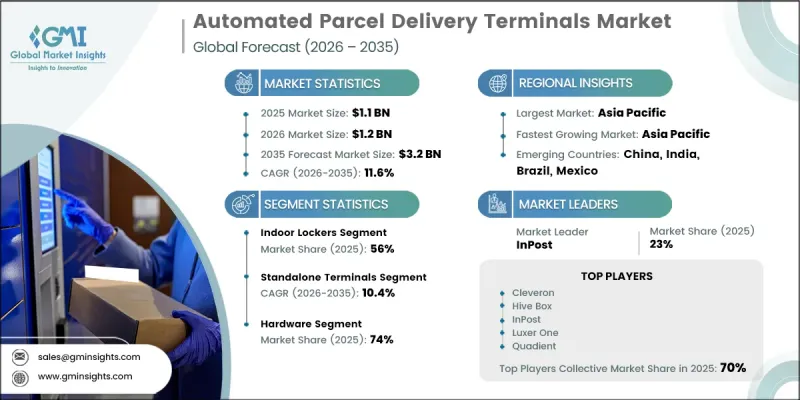
The Global Automated Parcel Delivery Terminals Market was valued at USD 1.1 billion in 2025 and is estimated to grow at a CAGR of 11.6% to reach USD 3.2 billion by 2035.
Market expansion is driven by the rapid rise in e-commerce activity, which has significantly increased parcel volumes worldwide and strengthened demand for efficient last-mile delivery solutions. The growing preference for automated locker systems is reshaping logistics networks by reducing dependency on traditional courier-based home deliveries. Rising urbanization is further intensifying the need for compact and space-efficient delivery infrastructure, particularly in densely populated cities where centralized pickup points improve delivery efficiency. Automated parcel terminals are gaining popularity due to their ability to provide secure, self-service access for parcel pickup and drop-off, reducing wait times and improving convenience for end users. Logistics providers are increasingly adopting these systems to optimize operational costs by minimizing repeated delivery attempts and reducing labor and fuel expenses. The integration of smart technologies, including digital authentication and real-time tracking, is further enhancing operational efficiency. As consumer expectations continue to evolve toward faster, safer, and more flexible delivery options, automated parcel terminals are becoming a key component of modern logistics ecosystems.
| Market Scope | |
|---|---|
| Start Year | 2025 |
| Forecast Year | 2026-2035 |
| Start Value | $1.1 Billion |
| Forecast Value | $3.2 Billion |
| CAGR | 11.6% |
The indoor lockers segment accounted for 56% share in 2025 and is expected to grow at a CAGR of 11.3% from 2026 to 2035. This segment is gaining traction due to its seamless integration within residential and commercial environments. Indoor locker systems are increasingly incorporated into smart infrastructure setups, enabling improved coordination with building access systems and delivery management platforms. Their ability to support secure, automated parcel handling while optimizing space usage makes them highly suitable for high-density environments. Growing demand for flexible and scalable locker configurations is further driving adoption across urban developments.
The standalone terminals segment held 57.4% share in 2025 and is projected to grow at a CAGR of 10.4% through 2035. This segment is widely adopted due to its operational flexibility and ease of deployment across multiple locations. Standalone systems support rapid expansion of delivery networks by enabling logistics providers to install and relocate units based on demand patterns. These terminals are equipped with independent power systems and remote connectivity features, allowing efficient monitoring and maintenance. Their adaptability and scalability make them a preferred solution for expanding last-mile delivery infrastructure.
U.S. Automated Parcel Delivery Terminals Market reached USD 168.7 million in 2025. Market growth in the country is supported by increasing adoption of omnichannel retail strategies and the integration of automated pickup solutions into modern retail ecosystems. The expansion of smart logistics infrastructure is improving fulfillment efficiency and reducing last-mile delivery costs. The use of advanced software systems with enhanced security and real-time tracking capabilities is further strengthening operational performance and supporting wider adoption across commercial and residential sectors.
Key players operating in the Automated Parcel Delivery Terminals Market include InPost, Quadient, Cleveron, KEBA, Bell and Howell, Hive Box, Luxer One, Parcel Port, Shenzhen Zhilai, and TZ. Companies in the Automated Parcel Delivery Terminals Market are focusing on technological innovation, network expansion, and strategic partnerships to strengthen their market position. Investments in smart locker systems with enhanced digital authentication, real-time monitoring, and cloud-based management platforms are improving operational efficiency. Firms are expanding deployment networks across urban and commercial locations to increase accessibility and service coverage. Collaboration with e-commerce platforms and logistics providers is enabling seamless integration into last-mile delivery systems. Businesses are also prioritizing modular and scalable designs to support flexible installation across diverse environments. Additionally, advancements in energy-efficient systems and remote management capabilities are helping companies improve cost efficiency while enhancing service reliability and user convenience.
Table of Contents
Chapter 1 Methodology
- 1.1 Research approach
- 1.2 Quality commitments
- 1.3 GMI AI policy & data integrity commitment
- 1.4 Research trail & confidence scoring
- 1.4.1 Research trail components
- 1.4.2 Scoring components
- 1.5 Data collection
- 1.5.1 Partial list of primary sources
- 1.6 Data mining sources
- 1.6.1 Paid sources
- 1.7 Base estimates and calculations
- 1.7.1 Base year calculation
- 1.8 Forecast model
- 1.9 Research transparency addendum
Chapter 2 Executive Summary
- 2.1 Industry 360° synopsis
- 2.2 Key market trends
- 2.2.1 Regional
- 2.2.2 System
- 2.2.3 Terminal
- 2.2.4 Component
- 2.2.5 Deployment location
- 2.2.6 End use
- 2.3 TAM analysis, 2026-2035
- 2.4 CXO perspectives: Strategic imperatives
Chapter 3 Industry Insights
- 3.1 Industry ecosystem analysis
- 3.1.1 Terminal manufacturers
- 3.1.2 Component suppliers
- 3.1.3 Software & platform providers
- 3.1.4 System integrators
- 3.1.5 End use operators
- 3.2 Industry impact forces
- 3.2.1 Growth drivers
- 3.2.1.1 E-commerce growth
- 3.2.1.2 Last-mile delivery cost reduction
- 3.2.1.3 Urbanization & population density
- 3.2.1.4 Contactless delivery demand
- 3.2.2 Industry pitfalls and challenges
- 3.2.2.1 High initial investment
- 3.2.2.2 Regulatory & zoning challenges
- 3.2.3 Market opportunities
- 3.2.3.1 Integration with smart cities
- 3.2.3.2 Expansion in emerging markets
- 3.2.3.3 Collaboration with retail & logistics players
- 3.2.3.4 Advanced IoT & AI-enabled lockers
- 3.2.1 Growth drivers
- 3.3 Growth potential analysis
- 3.4 Regulatory landscape
- 3.4.1 North America
- 3.4.1.1 United States Postal Service (USPS) & Federal Communications Commission (FCC)
- 3.4.1.2 Americans with Disabilities Act (ADA) Compliance Standards
- 3.4.2 Europe
- 3.4.2.1 European Commission - General Data Protection Regulation (GDPR)
- 3.4.2.2 European Committee for Standardization (CEN) - Postal Services Standards
- 3.4.3 Asia Pacific
- 3.4.3.1 Ministry of Industry and Information Technology (MIIT), China
- 3.4.3.2 Ministry of Land, Infrastructure, Transport and Tourism (MLIT), Japan
- 3.4.4 Latin America
- 3.4.4.1 Agencia Nacional de Transportes Terrestres (ANTT), Brazil
- 3.4.4.2 Secretaria de Infraestructura, Comunicaciones y Transportes (SICT), Mexico
- 3.4.5 Middle East & Africa
- 3.4.5.1 Emirates Authority for Standardization and Metrology (ESMA)
- 3.4.5.2 South African Bureau of Standards (SABS)
- 3.4.1 North America
- 3.5 Porter's analysis
- 3.6 PESTEL analysis
- 3.7 Technology and innovation landscape
- 3.7.1 Current technological trends
- 3.7.2 Emerging technologies
- 3.8 Pricing analysis (Driven by Primary Research)
- 3.8.1 Historical price trend analysis
- 3.8.2 Pricing strategy by player type (premium / value / cost-plus)
- 3.9 Cost breakdown analysis
- 3.10 Patent analysis (Driven by Primary Research)
- 3.11 Sustainability and environmental aspects
- 3.11.1 Sustainable practices
- 3.11.2 Waste reduction strategies
- 3.11.3 Energy efficiency in production
- 3.11.4 Eco-friendly initiatives
- 3.11.5 Carbon footprint considerations
- 3.12 Impact of AI & Generative AI on the Market
- 3.12.1 AI-driven disruption of existing business models
- 3.12.2 Gen AI use cases & adoption roadmap by segment
- 3.12.3 Risks, limitations & regulatory considerations
- 3.13 Trade data analysis (Driven by paid database)
- 3.13.1 Import/export volume & value trends
- 3.13.2 Key trade corridors & tariff impact
- 3.14 Forecast assumptions & scenario analysis (Driven by primary research)
- 3.14.1 Base Case - key macro & industry variables driving CAGR
- 3.14.2 Optimistic Scenarios - Favorable macro and industry tailwinds
- 3.14.3 Pessimistic Scenario - Macroeconomic slowdown or industry headwinds
Chapter 4 Competitive Landscape, 2025
- 4.1 Introduction
- 4.2 Company market share analysis
- 4.2.1 North America
- 4.2.2 Europe
- 4.2.3 Asia Pacific
- 4.2.4 LATAM
- 4.2.5 MEA
- 4.3 Competitive analysis of major market players
- 4.4 Competitive positioning matrix
- 4.5 Key developments
- 4.5.1 Mergers & acquisitions
- 4.5.2 Partnerships & collaborations
- 4.5.3 New product launches
- 4.5.4 Expansion plans and funding
Chapter 5 Market Estimates & Forecast, By System, 2022 - 2035 ($Mn, Units)
- 5.1 Key trends
- 5.2 Indoor lockers
- 5.3 Outdoor lockers
Chapter 6 Market Estimates & Forecast, By Terminal, 2022 - 2035 ($Mn, Units)
- 6.1 Key trends
- 6.2 Standalone terminals
- 6.3 Integrated terminals
Chapter 7 Market Estimates & Forecast, By Component, 2022 - 2035 ($Mn, Units)
- 7.1 Key trends
- 7.2 Hardware
- 7.2.1 Locker units & enclosures
- 7.2.2 Touchscreen interfaces & displays
- 7.2.3 Sensors & cameras
- 7.2.4 Smart locks & access control devices
- 7.2.5 Power supply & environmental control systems
- 7.3 Software
- 7.3.1 Locker management platforms
- 7.3.2 User access & authentication software
- 7.3.3 Tracking & notification systems
- 7.3.4 Analytics & reporting dashboards
- 7.3.5 API & integration tools
- 7.4 Services
- 7.4.1 Installation & commissioning
- 7.4.2 Maintenance & technical support
- 7.4.3 Monitoring & remote management
- 7.4.4 Consulting & system design
Chapter 8 Market Estimates & Forecast, By Deployment Location, 2022 - 2035 ($Mn, Units)
- 8.1 Key trends
- 8.2 Retail stores
- 8.3 Residential complexes
- 8.4 Corporate offices
- 8.5 Public spaces
- 8.6 Others
Chapter 9 Market Estimates & Forecast, By End Use, 2022 - 2035 ($Mn, Units)
- 9.1 Key trends
- 9.2 E-commerce & retail companies
- 9.3 Logistics & courier services
- 9.4 Property management companies
- 9.5 Others
Chapter 10 Market Estimates & Forecast, By Region, 2022 - 2035 ($Mn, Units)
- 10.1 Key trends
- 10.2 North America
- 10.2.1 U.S.
- 10.2.2 Canada
- 10.3 Europe
- 10.3.1 Germany
- 10.3.2 UK
- 10.3.3 France
- 10.3.4 Italy
- 10.3.5 Spain
- 10.3.6 Nordics
- 10.3.7 Russia
- 10.3.8 Poland
- 10.3.9 Romania
- 10.4 Asia Pacific
- 10.4.1 China
- 10.4.2 India
- 10.4.3 Japan
- 10.4.4 South Korea
- 10.4.5 ANZ
- 10.4.6 Vietnam
- 10.4.7 Indonesia
- 10.4.8 Philippines
- 10.5 Latin America
- 10.5.1 Brazil
- 10.5.2 Mexico
- 10.5.3 Argentina
- 10.6 MEA
- 10.6.1 South Africa
- 10.6.2 Saudi Arabia
- 10.6.3 UAE
Chapter 11 Company Profiles
- 11.1 Global players
- 11.1.1 Bell and Howell
- 11.1.2 Cleveron
- 11.1.3 InPost
- 11.1.4 KEBA
- 11.1.5 Luxer One
- 11.1.6 Pitney Bowes
- 11.1.7 Quadient
- 11.1.8 Thinventory
- 11.2 Regional players
- 11.2.1 Cainiao
- 11.2.2 Danby Appliances
- 11.2.3 Hive Box
- 11.2.4 LockTec
- 11.2.5 Parcel Port
- 11.2.6 Renz
- 11.2.7 Shenzhen Zhilai Sci & Tech Co
- 11.2.8 TZ
- 11.3 Emerging players
- 11.3.1 ENGY
- 11.3.2 Pakpobox
- 11.3.3 Smartbox Ecommerce Solutions
- 11.3.4 Winsen Industry

