PUBLISHER: Global Market Insights Inc. | PRODUCT CODE: 2038730

PUBLISHER: Global Market Insights Inc. | PRODUCT CODE: 2038730
Educational Toys Market Opportunity, Growth Drivers, Industry Trend Analysis, and Forecast 2026 - 2035
The Global Educational Toys Market was valued at USD 30.3 billion in 2025 and is estimated to grow at a CAGR of 6.9% to reach USD 59.3 billion by 2035.
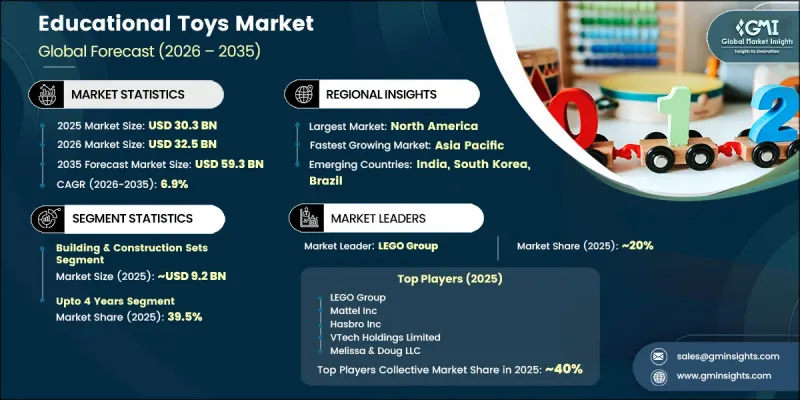
The market is experiencing strong growth as educational toys become increasingly important in early childhood learning and structured education systems worldwide. These products are designed to combine entertainment with skill development, supporting cognitive growth, creativity, and problem-solving abilities. The category includes a wide range of learning tools such as STEM-based kits, construction sets, puzzles, arts and crafts materials, interactive digital learning solutions, language development tools, musical learning instruments, and role-play toys. Growing investment in children's cognitive development, along with rising parental awareness of skill-based learning, is significantly boosting demand. The integration of advanced technologies such as artificial intelligence and augmented and virtual reality is further transforming product innovation and enhancing engagement levels. Increasing emphasis on STEM education across academic curricula is also driving higher adoption of robotics and coding-based toys. At the same time, sustainability concerns and strict regulatory standards are reshaping manufacturing practices, particularly in developed markets. Regulatory bodies are enforcing stringent safety requirements that limit harmful substances, pushing manufacturers toward safer and eco-friendly materials. These combined factors are supporting continuous expansion of the educational toys market across both developed and emerging economies globally.
| Market Scope | |
|---|---|
| Start Year | 2025 |
| Forecast Year | 2026-2035 |
| Start Value | $30.3 Billion |
| Forecast Value | $59.3 Billion |
| CAGR | 6.9% |
The building and construction sets segment generated USD 9.2 billion in 2025 and is projected to grow at a CAGR of 7.4% from 2026 to 2035. This segment continues to lead due to its strong contribution to skill development in children. These toys are widely recognized for enhancing spatial reasoning, fine motor coordination, logical thinking, creativity, and structured problem-solving abilities. Growing alignment between educational curricula and STEM-based learning approaches is further increasing the use of construction-focused toys as effective tools for teaching engineering and scientific concepts in an engaging manner.
United States Educational Toys Market was valued at USD 9 billion in 2025. Market growth in the country is driven by rising investments in STEM education infrastructure, including upgraded learning facilities and laboratory environments. The increasing shift toward online retail channels is also reshaping distribution, offering greater product accessibility and variety. Additionally, rising demand for premium educational and smart toys among high-income consumers is supporting market expansion. Growing adult interest in hobby-based and construction-oriented learning products is further contributing to sustained demand in the region.
LEGO Group, Mattel, Inc, Spin Master Corp, Hasbro, Inc, VTech Holdings Ltd, Ravensburger AG, Clementoni S.p.A, TOMY Company, Melissa & Doug, Hape Holding, KiwiCo, Inc, Learning Resources, Smartivity, Lovevery, and Osmo are among the key companies operating in the educational toys market. Companies in the Educational Toys Market are focusing on product innovation and technology integration to strengthen their competitive position. They are increasingly incorporating digital learning features such as AI-driven personalization and interactive applications to enhance user engagement. Expansion of STEM-focused product portfolios is a key strategy, along with collaborations with educators and schools to align products with curriculum requirements. Manufacturers are also investing in sustainable materials and eco-friendly production processes to meet growing environmental expectations. Strong emphasis is being placed on e-commerce expansion and direct-to-consumer sales channels to improve market reach.
Table of Contents
Chapter 1 Research Methodology
- 1.1 Research approach
- 1.2 Quality Commitments
- 1.2.1 GMI AI policy & data integrity commitment
- 1.2.1.1 Source consistency protocol
- 1.2.1 GMI AI policy & data integrity commitment
- 1.3 Research Trail & Confidence Scoring
- 1.3.1 Research Trail Components
- 1.3.2 Scoring Components
- 1.4 Data Collection
- 1.4.1 Partial list of primary sources
- 1.5 Data mining sources
- 1.5.1 Paid sources
- 1.5.1.1 Sources, by region
- 1.5.1 Paid sources
- 1.6 Base estimates and calculations
- 1.6.1 Base year calculation
- 1.7 Forecast model
- 1.7.1 Quantified market impact analysis
- 1.7.1.1 Mathematical impact of growth parameters on forecast
- 1.7.1 Quantified market impact analysis
- 1.8 Research transparency addendum
- 1.8.1 Source attribution framework
- 1.8.2 Quality assurance metrics
- 1.8.3 Our commitment to trust
Chapter 2 Executive Summary
- 2.1 Industry 360° synopsis
- 2.2 Key market trends
- 2.2.1 Regional
- 2.2.2 Product type
- 2.2.3 Age group
- 2.2.4 Price range
- 2.2.5 Distribution channel
Chapter 3 Industry Insights
- 3.1 Industry ecosystem analysis
- 3.1.1 Supplier landscape
- 3.1.2 Profit margin analysis
- 3.1.3 Value addition at each stage
- 3.1.4 Factor affecting the value chain
- 3.2 Industry impact forces
- 3.2.1 Growth drivers
- 3.2.1.1 Rising parental investment in cognitive development
- 3.2.1.2 E-commerce channel expansion and digital marketing innovation
- 3.2.1.3 Government STEM education mandates and institutional procurement
- 3.2.2 Industry pitfalls & challenges
- 3.2.2.1 Screen time health concerns and digital toy backlash
- 3.2.2.2 High cost of advanced STEM and smart toys limiting mass adoption
- 3.2.1 Growth drivers
- 3.3 Growth potential analysis
- 3.4 Future market trends
- 3.5 Technology and innovation landscape
- 3.5.1 Current technological trends
- 3.5.2 Emerging technologies
- 3.6 Price trends
- 3.6.1 By region
- 3.6.2 By type
- 3.7 Regulatory landscape
- 3.7.1 Standards and compliance requirements
- 3.7.2 Regional regulatory frameworks
- 3.7.3 Certification standards
- 3.8 Consumer behavior analysis
- 3.8.1 Purchasing patterns
- 3.8.2 Preference analysis
- 3.8.3 Regional variations in consumer behavior
- 3.9 Porter's analysis
- 3.10 PESTEL analysis
- 3.11 Impact of AI & generative AI on the market
- 3.11.1 AI-driven disruption of existing business models
- 3.11.2 GenAI use cases & adoption roadmap by segment
- 3.11.3 Risks, limitations & regulatory considerations
Chapter 4 Competitive Landscape, 2025
- 4.1 Introduction
- 4.2 Company market share analysis
- 4.2.1 By Region
- 4.2.1.1 North America
- 4.2.1.2 Europe
- 4.2.1.3 Asia Pacific
- 4.2.1.4 Latin America
- 4.2.1.5 Middle East & Africa
- 4.2.1 By Region
- 4.3 Company matrix analysis
- 4.4 Competitive analysis of major market players
- 4.5 Competitive positioning matrix
- 4.6 Key developments
- 4.6.1 Mergers & acquisitions
- 4.6.2 Partnerships & collaborations
- 4.6.3 New product launches
- 4.6.4 Expansion plans
Chapter 5 Market Estimates & Forecast, By Product Type, 2022 - 2035, (USD Billion) (Units)
- 5.1 Key trends
- 5.1.1 Art & crafts
- 5.1.2 Games & puzzles
- 5.1.3 Building and construction sets
- 5.1.4 Musical toys
- 5.1.5 STEM toys
- 5.1.6 Role play toys
- 5.1.7 Others
Chapter 6 Market Estimates & Forecast, By Age Group, 2022 - 2035, (USD Billion) (Units)
- 6.1 Key trends
- 6.2 Upto 4 years
- 6.3 5 to 8 years
- 6.4 Above 8 years
Chapter 7 Market Estimates & Forecast, By Price Range, 2022 - 2035, (USD Billion) (Units)
- 7.1 Key trends
- 7.2 Low
- 7.3 Medium
- 7.4 High
Chapter 8 Market Estimates & Forecast, By Distribution Channel, 2022 - 2035, (USD Billion) (Units)
- 8.1 Key trends
- 8.2 Online
- 8.2.1 E-commerce platforms
- 8.2.2 Brand websites
- 8.3 Offline
- 8.3.1 Supermarkets and hypermarkets
- 8.3.2 Specialty stores
- 8.3.3 Others
Chapter 9 Market Estimates & Forecast, By Region, 2022 - 2035, (USD Billion) (Units)
- 9.1 Key trends
- 9.2 North America
- 9.2.1 U.S.
- 9.2.2 Canada
- 9.3 Europe
- 9.3.1 Germany
- 9.3.2 UK
- 9.3.3 France
- 9.3.4 Italy
- 9.3.5 Spain
- 9.4 Asia Pacific
- 9.4.1 China
- 9.4.2 India
- 9.4.3 Japan
- 9.4.4 South Korea
- 9.4.5 Australia
- 9.5 Latin America
- 9.5.1 Brazil
- 9.5.2 Mexico
- 9.5.3 Argentina
- 9.6 MEA
- 9.6.1 Saudi Arabia
- 9.6.2 UAE
- 9.6.3 South Africa
Chapter 10 Company Profiles
- 10.1 Clementoni S.p.A
- 10.2 Hape Holding
- 10.3 Hasbro, Inc
- 10.4 KiwiCo, Inc
- 10.5 Learning Resources
- 10.6 LEGO Group
- 10.7 Lovevery
- 10.8 Mattel, Inc
- 10.9 Melissa & Doug
- 10.10 Osmo
- 10.11 Ravensburger AG
- 10.12 Smartivity
- 10.13 Spin Master Corp
- 10.14 TOMY Company
- 10.15 VTech Holdings Ltd

