PUBLISHER: Global Market Insights Inc. | PRODUCT CODE: 2038766

PUBLISHER: Global Market Insights Inc. | PRODUCT CODE: 2038766
Low Sodium Sea Salt Market Opportunity, Growth Drivers, Industry Trend Analysis, and Forecast 2026 - 2035
The Global Low Sodium Sea Salt Market was valued at USD 132.9 million in 2025 and is estimated to grow at a CAGR of 7.2% to reach USD 265.4 million by 2035.
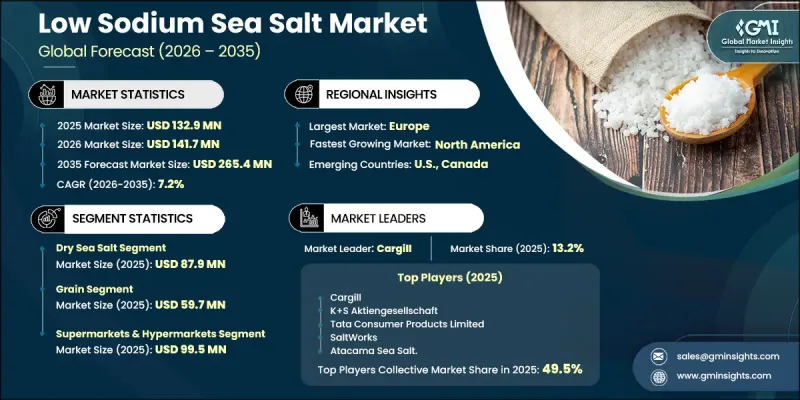
The industry is gaining steady traction as consumers increasingly prioritize healthier dietary choices and seek alternatives that help reduce sodium intake without compromising flavor. Low sodium sea salt is derived from seawater and processed or naturally balanced to contain reduced sodium levels compared to traditional salt, while still retaining beneficial minerals. This makes it an appealing option for individuals aiming to maintain nutritional balance alongside taste preferences. The product is widely used across both household kitchens and commercial food production environments, where maintaining flavor consistency while adhering to dietary guidelines is essential. Its availability in various textures supports diverse culinary applications, contributing to its growing demand. Rising awareness around clean-label ingredients and minimally processed foods is further driving market expansion. Continuous improvements in refining techniques, mineral composition balancing, and blending processes are enhancing product quality, ensuring consistent taste and performance across different food applications.
| Market Scope | |
|---|---|
| Start Year | 2025 |
| Forecast Year | 2026-2035 |
| Start Value | $132.9 Million |
| Forecast Value | $265.4 Million |
| CAGR | 7.2% |
The dry low sodium sea salt segment accounted for USD 87.9 million in 2025. Its popularity continues to rise due to its ease of storage, extended shelf life, and versatility in packaged and processed food applications. The stable nature of this format supports its use across seasoning mixes, snack production, and routine cooking needs, sustaining demand across retail, foodservice, and industrial sectors.
The supermarkets and hypermarkets segment reached USD 99.5 million in 2025. These retail formats remain the preferred purchasing points as they offer a wide range of options, easy accessibility, and competitive pricing, making them convenient for everyday consumer needs.
North America Low Sodium Sea Salt Market is projected to grow from USD 35.4 million in 2025 to USD 70.1 million by 2035. Increasing consumer inclination toward healthier salt alternatives and naturally sourced ingredients is fueling demand across the region. Greater product visibility through retail outlets and digital platforms is further supporting market growth as awareness of reduced-sodium options continues to rise.
Key players operating in the Global Low Sodium Sea Salt Market include Cargill, Tata Consumer Products Limited, SaltWorks, K+S Aktiengesellschaft, A&B Ingredients, Inc, THE LOW SODIUM SEA SALT COMPANY, Atacama Sea Salt, Merisal Sea Salt, Ahir Salt Industries, and Krishna Group. Companies in the Low Sodium Sea Salt Market are reinforcing their market position through product innovation and the development of formulations that balance taste with reduced sodium content. Investment in advanced processing technologies is helping improve product consistency and mineral composition. Strategic distribution partnerships are being expanded to increase product availability across retail and online channels. Businesses are also focusing on branding and marketing strategies that highlight health benefits and clean-label attributes to attract health-conscious consumers. Additionally, companies are strengthening supply chains and exploring new regional markets to enhance their reach.
Table of Contents
Chapter 1 Methodology & Scope
- 1.1 Market scope and definition
- 1.2 Research design
- 1.2.1 Research approach
- 1.2.2 Data collection methods
- 1.3 Data mining sources
- 1.3.1 Global
- 1.3.2 Regional/Country
- 1.4 Base estimates and calculations
- 1.4.1 Base year calculation
- 1.4.2 Key trends for market estimation
- 1.5 Primary research and validation
- 1.5.1 Primary sources
- 1.6 Forecast model
- 1.7 Research assumptions and limitations
Chapter 2 Executive Summary
- 2.1 Industry 360° synopsis
- 2.2 Key market trends
- 2.2.1 Product Type
- 2.2.2 Form
- 2.2.3 Distribution Channel
- 2.2.4 Regional
- 2.3 TAM Analysis, 2026-2035
- 2.4 CXO perspectives: Strategic imperatives
- 2.5 Future outlook and strategic recommendations
Chapter 3 Industry Insights
- 3.1 Industry ecosystem analysis
- 3.1.1 Supplier landscape
- 3.1.2 Profit margin
- 3.1.3 Value addition at each stage
- 3.1.4 Factor affecting the value chain
- 3.1.5 Disruptions
- 3.2 Industry impact forces
- 3.2.1 Growth drivers
- 3.2.1.1 Rising demand for reduced-sodium diets
- 3.2.1.2 Growing awareness of heart health
- 3.2.1.3 Increasing use in packaged foods
- 3.2.2 Pitfalls/challenge
- 3.2.2.1 Higher price than regular salt
- 3.2.2.2 Limited awareness in rural markets
- 3.2.3 Opportunities
- 3.2.3.1 Expansion into functional wellness products
- 3.2.3.2 Growing interest in mineral-rich alternatives
- 3.2.1 Growth drivers
- 3.3 Growth potential analysis
- 3.4 Regulatory landscape
- 3.4.1 North America
- 3.4.2 Europe
- 3.4.3 Asia Pacific
- 3.4.4 Latin America
- 3.4.5 Middle East & Africa
- 3.5 Porter's analysis
- 3.6 PESTEL analysis
- 3.7 Technology and innovation landscape
- 3.7.1 Current technological trends
- 3.7.2 Emerging technologies
- 3.8 Price trends
- 3.8.1 By region
- 3.8.2 By product type
- 3.9 Future market trends
- 3.10 Technology and innovation landscape
- 3.10.1 Current technological trends
- 3.10.2 Emerging technologies
- 3.11 Patent landscape
- 3.12 Trade statistics (HS code)
- 3.12.1 Major importing countries
- 3.12.2 Major exporting countries
- 3.13 Sustainability and environmental aspects
- 3.13.1 Sustainable practices
- 3.13.2 Waste reduction strategies
- 3.13.3 Energy efficiency in production
- 3.13.4 Eco-friendly initiatives
- 3.14 Carbon footprint consideration
Chapter 4 Competitive Landscape, 2025
- 4.1 Introduction
- 4.2 Company market share analysis
- 4.2.1 By region
- 4.2.1.1 North America
- 4.2.1.2 Europe
- 4.2.1.3 Asia Pacific
- 4.2.1.4 LATAM
- 4.2.1.5 MEA
- 4.2.1 By region
- 4.3 Company matrix analysis
- 4.4 Competitive analysis of major market players
- 4.5 Competitive positioning matrix
- 4.6 Key developments
- 4.6.1 Mergers & acquisitions
- 4.6.2 Partnerships & collaborations
- 4.6.3 New product launches
- 4.6.4 Expansion plans
Chapter 5 Market Estimates and Forecast, By Product Type, 2022-2035 (USD Million) (Kilo Tons)
- 5.1 Key trends
- 5.2 Wet sea salt
- 5.3 Dry sea salt
Chapter 6 Market Estimates and Forecast, By Form, 2022-2035 (USD Million) (Kilo Tons)
- 6.1 Key trends
- 6.2 Grain
- 6.3 Flakes
- 6.4 Spray
Chapter 7 Market Estimates and Forecast, By Distribution Channel, 2022-2035 (USD Million) (Kilo Tons)
- 7.1 Key trends
- 7.2 Supermarkets & hypermarkets
- 7.3 Convenience stores
- 7.4 Online retailers
- 7.5 Specialty stores
- 7.6 Others
Chapter 8 Market Estimates and Forecast, By Region, 2022-2035 (USD Million) (Kilo Tons)
- 8.1 Key trends
- 8.2 North America
- 8.2.1 U.S.
- 8.2.2 Canada
- 8.3 Europe
- 8.3.1 Germany
- 8.3.2 UK
- 8.3.3 France
- 8.3.4 Spain
- 8.3.5 Italy
- 8.3.6 Rest of Europe
- 8.4 Asia Pacific
- 8.4.1 China
- 8.4.2 India
- 8.4.3 Japan
- 8.4.4 Australia
- 8.4.5 South Korea
- 8.4.6 Rest of Asia Pacific
- 8.5 Latin America
- 8.5.1 Brazil
- 8.5.2 Mexico
- 8.5.3 Argentina
- 8.5.4 Rest of Latin America
- 8.6 Middle East and Africa
- 8.6.1 Saudi Arabia
- 8.6.2 South Africa
- 8.6.3 UAE
- 8.6.4 Rest of Middle East and Africa
Chapter 9 Company Profiles
- 9.1 A&B Ingredients, Inc
- 9.2 Atacama Sea Salt.
- 9.3 Cargill
- 9.4 K+S Aktiengesellschaft
- 9.5 SaltWorks
- 9.6 Tata Consumer Products Limited
- 9.7 THE LOW SODIUM SEA SALT COMPANY
- 9.8 Ahir Salt Industries
- 9.9 Krishna Group
- 9.10 Merisal Sea Salt

