PUBLISHER: Global Market Insights Inc. | PRODUCT CODE: 2038773

PUBLISHER: Global Market Insights Inc. | PRODUCT CODE: 2038773
Natural Chelating Agents Market Opportunity, Growth Drivers, Industry Trend Analysis, and Forecast 2026 - 2035
The Global Natural Chelating Agents Market was valued at USD 3.1 billion in 2025 and is estimated to grow at a CAGR of 5.9% to reach USD 5.5 billion by 2035.
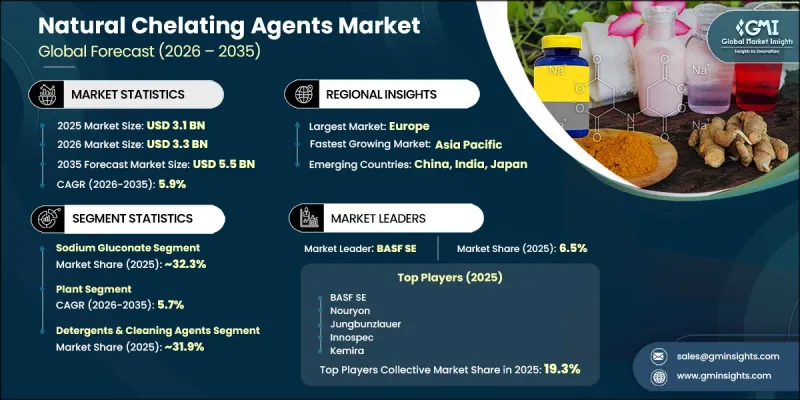
The market is gaining traction due to the rising shift toward sustainable, bio-based, and environmentally safe chemical solutions across multiple industries. Natural chelating agents are derived from renewable sources and are designed to bind metal ions, enabling their stabilization, removal, or neutralization. These compounds are widely used in agriculture, water treatment, personal care formulations, and industrial cleaning applications. Their primary function involves binding metals such as calcium, magnesium, iron, and other heavy metals that contribute to scaling, corrosion, and toxicity-related issues. Growing environmental awareness and tightening regulatory frameworks against synthetic chelating agents are accelerating the adoption of natural alternatives. Their biodegradability and lower toxicity profile make them a preferred choice compared to conventional synthetic options. In addition, their ability to enhance cleaning efficiency, improve soil quality, and support effective water purification is further strengthening demand. The market is also benefiting from increasing consumer preference for eco-friendly ingredients and sustainable industrial practices across global end-use sectors.
| Market Scope | |
|---|---|
| Start Year | 2025 |
| Forecast Year | 2026-2035 |
| Start Value | $3.1 Billion |
| Forecast Value | $5.5 Billion |
| CAGR | 5.9% |
The sodium gluconate segment accounted for 32.3% share in 2025 and is expected to grow at a CAGR of 5% through 2035. This segment remains widely adopted due to its cost efficiency, stable performance, and suitability for large-scale industrial applications. Its strong compatibility with alkaline environments and reliable chelation properties continue to support its use across various end-use industries.
The plant-based segment held a 43.1% share in 2025 and is projected to grow at a CAGR of 5.7% through 2035. This segment benefits from established agricultural sourcing systems and relatively lower production costs, making it a widely used production route. However, it is influenced by fluctuations in raw material availability and competition from other biomass applications. Despite this, plant-derived solutions remain a key contributor to market expansion due to their sustainability advantages.
North America Natural Chelating Agents Market accounted for 27% share in 2025. Growth in the region is driven by rising demand for eco-friendly cleaning solutions and personal care products. Increasing environmental awareness and stricter regulations on synthetic chemical usage are further supporting market adoption. Expanding applications in the food processing and water treatment industries are also contributing to consistent regional growth.
Major companies operating in the Global Natural Chelating Agents Industry include Nouryon, BASF SE, Kemira, Lanxess, Corbion, Jungbunzlauer, Innospec, Itaconix Corporation, Nippon Shokubai, Roquette Freres, PMP Fermentation Products, Shandong Fuyang Biotech, Yuanlian Chemical. Companies in the Natural Chelating Agents Market are focusing on strengthening their competitive position through expansion of bio-based product portfolios and investment in sustainable production technologies. They are increasingly adopting fermentation-based and plant-derived manufacturing processes to improve product efficiency and environmental performance. Strategic collaborations with agricultural suppliers and industrial end users are helping secure stable raw material supply chains and expand application reach. Firms are also investing in research and development to improve chelation efficiency, stability, and cost competitiveness across different pH conditions. Expansion into emerging markets and development of application-specific formulations for water treatment, personal care, and cleaning industries are further supporting growth.
Table of Contents
Chapter 1 Methodology & Scope
- 1.1 Market scope and definition
- 1.2 Research design
- 1.2.1 Research approach
- 1.2.2 Data collection methods
- 1.3 Data mining sources
- 1.3.1 Global
- 1.3.2 Regional/Country
- 1.4 Base estimates and calculations
- 1.4.1 Base year calculation
- 1.4.2 Key trends for market estimation
- 1.5 Primary research and validation
- 1.5.1 Primary sources
- 1.6 Forecast model
- 1.7 Research assumptions and limitations
Chapter 2 Executive Summary
- 2.1 Industry 360° synopsis
- 2.2 Key market trends
- 2.2.1 Regional
- 2.2.2 Product
- 2.2.3 Source
- 2.2.4 Application
- 2.3 TAM Analysis, 2026-2035
- 2.4 CXO perspectives: Strategic imperatives
- 2.4.1 Executive decision points
Chapter 3 Industry Insights
- 3.1 Industry ecosystem analysis
- 3.1.1 Supplier landscape
- 3.1.2 Profit margin
- 3.1.3 Value addition at each stage
- 3.1.4 Factor affecting the value chain
- 3.1.5 Disruptions
- 3.2 Industry impact forces
- 3.2.1 Growth drivers
- 3.2.2 Industry pitfalls and challenges
- 3.2.3 Market opportunities
- 3.3 Growth potential analysis
- 3.4 Regulatory landscape
- 3.4.1 North America
- 3.4.2 Europe
- 3.4.3 Asia Pacific
- 3.4.4 Latin America
- 3.4.5 Middle East & Africa
- 3.5 Porter's analysis
- 3.6 PESTEL analysis
- 3.7 Price trends
- 3.7.1 By region
- 3.7.2 By type
- 3.8 Future market trends
- 3.9 Technology and Innovation landscape
- 3.9.1 Current technological trends
- 3.9.2 Emerging technologies
- 3.10 Patent Landscape
- 3.11 Trade statistics (HS code)
- 3.11.1 Major importing countries
- 3.11.2 Major exporting countries
- 3.12 Sustainability and environmental aspects
- 3.12.1 Sustainable practices
- 3.12.2 Waste reduction strategies
- 3.12.3 Energy efficiency in production
- 3.12.4 Eco-friendly initiatives
- 3.13 Carbon footprint consideration
Chapter 4 Competitive Landscape, 2025
- 4.1 Introduction
- 4.2 Company market share analysis
- 4.2.1 By region
- 4.2.1.1 North America
- 4.2.1.2 Europe
- 4.2.1.3 Asia Pacific
- 4.2.1.4 LATAM
- 4.2.1.5 MEA
- 4.2.1 By region
- 4.3 Company matrix analysis
- 4.4 Competitive analysis of major market players
- 4.5 Competitive positioning matrix
- 4.6 Key developments
- 4.6.1 Mergers & acquisitions
- 4.6.2 Partnerships & collaborations
- 4.6.3 New Product Launches
- 4.6.4 Expansion Plans
Chapter 5 Market Estimates and Forecast, By Product, 2022-2035 (USD Billion) (Kilo Tons)
- 5.1 Key trends
- 5.2 Sodium Gluconate
- 5.3 Ethylene diamine disuccinate (EDDS)
- 5.4 Glutamic acid diacetate (GLDA)
- 5.5 Iminodisuccinic acid (IDSA)
- 5.6 Methylglycine Diacetic Acid (MGDA)
- 5.7 Others (N-Diacetic Acid Tetrasodium Salt (ASDA), Glucoheptonates)
Chapter 6 Market Estimates and Forecast, By Source, 2022-2035 (USD Billion) (Kilo Tons)
- 6.1 Key trends
- 6.2 Plants
- 6.3 Microbial fermentation
- 6.4 Chemical synthesis from bio-based feedstocks
Chapter 7 Market Estimates and Forecast, By Application, 2022-2035 (USD Billion) (Kilo Tons)
- 7.1 Key trends
- 7.2 Detergents & cleaning agents
- 7.3 Personal care & cosmetics
- 7.4 Pulp and paper
- 7.5 Agrichemicals
- 7.6 Food and beverage
- 7.7 Water treatment
- 7.8 Others (photography, pharmaceuticals, cements, Therapeutics)
Chapter 8 Market Estimates and Forecast, By Region, 2022-2035 (USD Billion) (Kilo Tons)
- 8.1 Key trends
- 8.2 North America
- 8.2.1 U.S.
- 8.2.2 Canada
- 8.3 Europe
- 8.3.1 Germany
- 8.3.2 UK
- 8.3.3 France
- 8.3.4 Spain
- 8.3.5 Italy
- 8.3.6 Rest of Europe
- 8.4 Asia Pacific
- 8.4.1 China
- 8.4.2 India
- 8.4.3 Japan
- 8.4.4 Australia
- 8.4.5 South Korea
- 8.4.6 Rest of Asia Pacific
- 8.5 Latin America
- 8.5.1 Brazil
- 8.5.2 Mexico
- 8.5.3 Argentina
- 8.5.4 Rest of Latin America
- 8.6 Middle East and Africa
- 8.6.1 Saudi Arabia
- 8.6.2 South Africa
- 8.6.3 UAE
- 8.6.4 Rest of Middle East and Africa
Chapter 9 Company Profiles
- 9.1 BASF SE
- 9.2 Corbion
- 9.3 Innospec
- 9.4 Itaconix Corporation
- 9.5 Jungbunzlauer
- 9.6 Kemira
- 9.7 Lanxess
- 9.8 Nippon Shokubai
- 9.9 Nouryon
- 9.10 PMP Fermentation Products
- 9.11 Roquette Freres
- 9.12 Shandong Fuyang Biotech
- 9.13 Yuanlian Chemical

