PUBLISHER: Global Market Insights Inc. | PRODUCT CODE: 2038780

PUBLISHER: Global Market Insights Inc. | PRODUCT CODE: 2038780
Sustainable Clothing Market Opportunity, Growth Drivers, Industry Trend Analysis, and Forecast 2026 - 2035
The Global Sustainable Clothing Market was valued at USD 8.6 billion in 2025 and is estimated to grow at a CAGR of 15.7% to reach USD 39 billion by 2035.
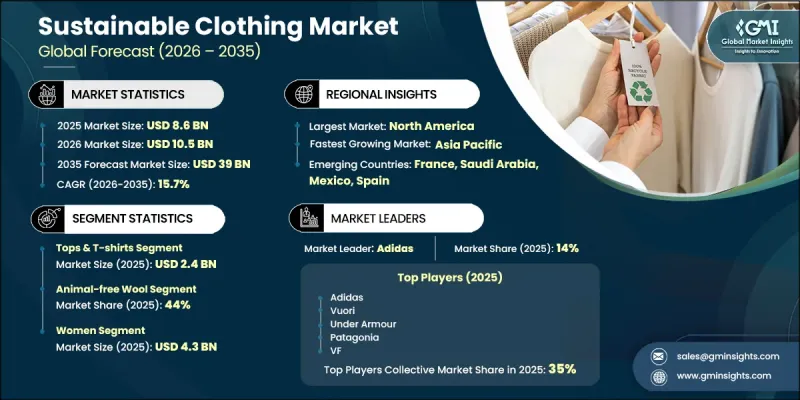
Market growth is strongly influenced by increasing consumer awareness regarding the environmental and social consequences associated with apparel production and consumption. Buyers are becoming more informed about resource-intensive manufacturing processes, rising textile waste, carbon emissions, and ethical concerns across supply chains, which is reshaping purchasing behavior. This shift is encouraging a transition away from conventional fast fashion toward responsibly manufactured garments that prioritize eco-conscious materials and fair labor practices. Sustainable fashion is no longer viewed as a niche category but as a defining factor in brand credibility and long-term competitiveness. The market is also benefiting from the rising adoption of circular economy principles, innovation in eco-friendly fabrics, and increasing emphasis on transparency across production cycles. As sustainability continues to shape consumer preferences, brands are aligning their product strategies to deliver environmentally responsible offerings that meet evolving expectations while maintaining quality and design appeal.
| Market Scope | |
|---|---|
| Start Year | 2025 |
| Forecast Year | 2026-2035 |
| Start Value | $8.6 Billion |
| Forecast Value | $39 Billion |
| CAGR | 15.7% |
Younger demographics play a pivotal role in accelerating demand, as they demonstrate a strong preference for ethical consumption and value-driven purchasing decisions. These consumers actively seek transparency in sourcing, production, and distribution processes, placing importance on accountability and brand authenticity. Their buying behavior prioritizes durability, responsible material selection, and ethical manufacturing standards rather than short-term fashion trends. As awareness continues to expand, companies are under growing pressure to clearly communicate their sustainability initiatives and validate their commitments through measurable actions. This shift is fostering a more competitive landscape, where brands must differentiate through credible sustainability practices and consistent messaging.
In 2025, the tops and t-shirts segment generated USD 2.4 billion, establishing itself as a leading category within the sustainable clothing market. This segment benefits from its high usage frequency and universal consumer appeal, making it a key entry point for individuals transitioning toward environmentally responsible apparel choices. Everyday wear items provide an effective platform for brands to introduce sustainable materials and production methods, encouraging broader adoption among consumers. The focus on reducing environmental impact through responsible sourcing and efficient manufacturing processes is strengthening the segment's position. As consumer awareness continues to grow, this category remains central to driving overall market expansion.
The animal-free wool segment accounted for 44% share in 2025, reflecting strong consumer preference for alternatives that align with ethical and cruelty-free values. Demand is driven by the need for materials that offer warmth, comfort, and performance while eliminating concerns associated with animal-derived products. This segment appeals to individuals seeking products that combine functionality with ethical responsibility, supporting a growing movement toward vegan and cruelty-free fashion. Continuous innovation in material development is enhancing product quality and expanding application possibilities, reinforcing the segment's leading share.
United States Sustainable Clothing Market held a 64.5% share in 2025, generating USD 2.3 billion. The region's leadership is supported by high consumer awareness, strong alignment with ethical consumption values, and early adoption of sustainable fashion concepts. Consumers increasingly prioritize transparency, responsible sourcing, and ethical labor practices when making purchasing decisions. Demand is particularly strong among urban populations and younger audiences who seek a balance between style, comfort, and sustainability. In response, brands are expanding their eco-friendly product lines and strengthening communication around their environmental and social commitments to meet evolving expectations.
Major players operating in the Global Sustainable Clothing Industry include ABLE, Adidas, Afends, EILEEN FISHER, Everlane, Hanesbrands, Nike, Outerknown, Pact, PANGAIA, Patagonia, Tentree, Under Armour, VF, and Vuori. Companies operating in the Global Sustainable Clothing Market are implementing a range of strategic initiatives to strengthen their market position and expand their global reach. Key strategies include investing in sustainable material innovation, adopting circular economy practices, and enhancing supply chain transparency. Brands are increasingly focusing on certifications, traceability systems, and digital platforms to build consumer trust and demonstrate accountability. Collaborations with sustainable material providers and technology firms are helping accelerate product development and improve efficiency. Additionally, companies are expanding direct-to-consumer channels and leveraging digital marketing to engage environmentally conscious audiences. Emphasis on eco-friendly packaging, ethical sourcing, and long-term sustainability goals is further enabling companies to differentiate themselves and secure a competitive advantage in a rapidly evolving market landscape.
Table of Contents
Chapter 1 Methodology and Scope
- 1.1 Market scope and definition
- 1.2 Research design
- 1.2.1 Research approach
- 1.2.2 Data collection methods
- 1.3 Data mining sources
- 1.3.1 Global
- 1.3.2 Regional/Country
- 1.4 Base estimates and calculations
- 1.4.1 Base year calculation
- 1.4.2 Key trends for market estimation
- 1.5 Primary research and validation
- 1.5.1 Primary sources
- 1.6 Forecast model
- 1.7 Research assumptions and limitations
Chapter 2 Executive Summary
- 2.1 Industry 360° synopsis
- 2.2 Key market trends
- 2.2.1 Regional
- 2.2.2 Type
- 2.2.3 Material
- 2.2.4 Price
- 2.2.5 End use
- 2.2.6 Distribution channel
Chapter 3 Industry Insights
- 3.1 Industry ecosystem analysis
- 3.1.1 Supplier landscape
- 3.1.2 Profit margin
- 3.1.3 Value addition at each stage
- 3.1.4 Factor affecting the value chain
- 3.2 Industry impact forces
- 3.2.1 Growth drivers
- 3.2.1.1 Rising consumer awareness & ethical consumption
- 3.2.1.2 Innovation in sustainable materials & processes
- 3.2.1.3 Regulatory & policy pressure
- 3.2.2 Industry pitfalls & challenges
- 3.2.2.1 High production & compliance costs
- 3.2.2.2 Greenwashing & consumer skepticism
- 3.2.3 Opportunities
- 3.2.3.1 Circular fashion business models
- 3.2.3.2 Digital traceability & product transparency
- 3.2.1 Growth drivers
- 3.3 Growth potential analysis
- 3.4 Future market trends
- 3.5 Technology and innovation landscape
- 3.5.1 Current technological trends
- 3.5.2 Emerging technologies
- 3.6 Price trends
- 3.6.1 By region
- 3.6.2 By type
- 3.7 Regulatory landscape
- 3.7.1 Standards and compliance requirements
- 3.7.2 Regional regulatory frameworks
- 3.7.3 Certification standards
- 3.8 Porter's analysis
- 3.9 PESTEL analysis
- 3.10 Pricing analysis
- 3.10.1 Historical price trend analysis (driven by primary research) (2022-2025)
- 3.10.2 Pricing strategy by player type (premium / value / mass-market)
- 3.10.3 Price premium analysis (sustainable vs. Conventional)
- 3.10.4 Cost structure breakdown
- 3.10.5 Price elasticity & consumer sensitivity
- 3.11 Trade data analysis - HS Code: 6109 (knitted T-shirts) (driven by paid database)
- 3.11.1 Import/export volume & value trends (2022-2025)
- 3.11.2 Key trade corridors & tariff impact
- 3.12 Impact of AI & generative AI on the market
- 3.12.1 AI-driven disruption of existing business models
- 3.12.2 GenAI use cases & adoption roadmap by segment
- 3.12.3 Risks, limitations & regulatory considerations
- 3.13 Distribution infrastructure & channel penetration landscape (driven by primary research)
- 3.13.1 Channel coverage by format (online vs offline, modern vs. traditional trade)
- 3.13.2 Last-mile infrastructure gaps & emerging channel shifts
Chapter 4 Competitive Landscape, 2025
- 4.1 Introduction
- 4.2 Company market share analysis
- 4.2.1 By region
- 4.2.1.1 North America
- 4.2.1.2 Europe
- 4.2.1.3 Asia Pacific
- 4.2.1.4 Latin America
- 4.2.1.5 Middle East and Africa
- 4.2.1 By region
- 4.3 Company matrix analysis
- 4.4 Competitive analysis of major market players
- 4.5 Competitive positioning matrix
- 4.5.1 Price vs. sustainability positioning
- 4.5.2 Product range vs. market penetration
- 4.5.3 Innovation vs. scale matrix
- 4.6 Key developments
- 4.6.1 Mergers & acquisitions
- 4.6.2 Partnerships & collaborations
- 4.6.3 New product launches
- 4.6.4 Expansion plans
Chapter 5 Market Estimates and Forecast, By Type, 2022 - 2035 (USD Billion) (Thousand Units)
- 5.1 Key trends
- 5.2 Tops & t-shirts
- 5.3 Bottoms
- 5.4 Sweaters & knitwear
- 5.5 Swimwear
- 5.6 Activewear & performance wear
- 5.7 Loungewear & sleepwear
- 5.8 Outerwear
- 5.9 Others
Chapter 6 Market Estimates and Forecast, By Material, 2022 - 2035 (USD Billion) (Thousand Units)
- 6.1 Key trends
- 6.2 Cruelty-free leather
- 6.3 Vegan fur made
- 6.4 Animal-free wool
- 6.5 Cruelty-free silk
- 6.6 Eco-friendly rubber
- 6.7 Others
Chapter 7 Market Estimates and Forecast, By Price, 2022 - 2035 (USD Billion) (Thousand Units)
- 7.1 Key trends
- 7.2 Low
- 7.3 Medium
- 7.4 High
Chapter 8 Market Estimates and Forecast, By End Use, 2022 - 2035 (USD Billion) (Thousand Units)
- 8.1 Key trends
- 8.2 Men
- 8.3 Women
- 8.4 Kids
- 8.5 Unisex
Chapter 9 Market Estimates and Forecast, By Distribution Channel, 2022 - 2035 (USD Billion) (Thousand Units)
- 9.1 Key trends
- 9.2 Online
- 9.2.1 E-commerce platforms
- 9.2.2 Company websites
- 9.3 Offline
- 9.3.1 Supermarkets/hypermarkets
- 9.3.2 Specialty Stores
- 9.3.3 Others (Retail Stores, etc.)
Chapter 10 Market Estimates and Forecast, By Region, 2022 - 2035 (USD Billion) (Thousand Units)
- 10.1 Key trends
- 10.2 North America
- 10.2.1 U.S.
- 10.2.2 Canada
- 10.3 Europe
- 10.3.1 Germany
- 10.3.2 UK
- 10.3.3 France
- 10.3.4 Italy
- 10.3.5 Spain
- 10.4 Asia Pacific
- 10.4.1 China
- 10.4.2 Japan
- 10.4.3 India
- 10.4.4 Australia
- 10.4.5 South Korea
- 10.5 Latin America
- 10.5.1 Brazil
- 10.5.2 Mexico
- 10.5.3 Argentina
- 10.6 Middle East and Africa
- 10.6.1 South Africa
- 10.6.2 Saudi Arabia
- 10.6.3 UAE
Chapter 11 Company Profiles
- 11.1 ABLE
- 11.2 Adidas
- 11.3 Afends
- 11.4 EILEEN FISHER
- 11.5 Everlane
- 11.6 Hanesbrands
- 11.7 Nike
- 11.8 Outerknown
- 11.9 Pact
- 11.10 PANGAIA
- 11.11 Patagonia
- 11.12 Tentree
- 11.13 Under Armour
- 11.14 VF
- 11.15 Vuori

