
PUBLISHER: Global Market Insights Inc. | PRODUCT CODE: 2038794

PUBLISHER: Global Market Insights Inc. | PRODUCT CODE: 2038794
Ethernet Switch Market Opportunity, Growth Drivers, Industry Trend Analysis, and Forecast 2026 - 2035
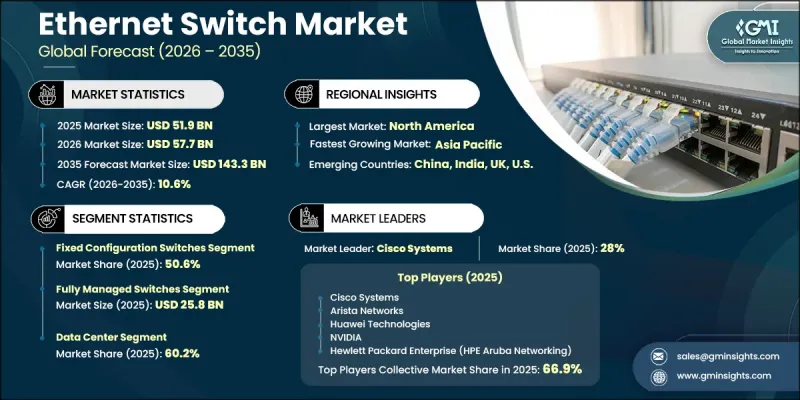
The Global Ethernet Switch Market was valued at USD 51.9 billion in 2025 and is estimated to grow at a CAGR of 10.6% to reach USD 143.3 billion by 2035.
The market is witnessing growth driven by the rapid expansion of hyperscale and colocation data centers, rising adoption of high-speed Ethernet technologies, and the increasing shift of enterprises toward cloud-based and hybrid IT environments. The growing deployment of edge computing and 5G infrastructure is further accelerating demand for advanced networking solutions. The surge in AI workloads and high-performance computing is significantly increasing the need for high-capacity, low-latency switching architectures within modern data center ecosystems. At the same time, enterprises are increasingly adopting network automation and intent-based networking to simplify operations and reduce manual intervention. The transition toward AI-driven orchestration and self-healing network capabilities is improving operational efficiency and enabling faster network provisioning cycles. Continuous modernization of enterprise IT infrastructure, combined with rising data traffic volumes, is strengthening the adoption of scalable and programmable Ethernet switching solutions across industries.
| Market Scope | |
|---|---|
| Start Year | 2025 |
| Forecast Year | 2026-2035 |
| Start Value | $51.9 Billion |
| Forecast Value | $143.3 Billion |
| CAGR | 10.6% |
The fixed configuration switches segment accounted for 50.6% share in 2025, supported by strong demand in enterprise access and edge network environments. These switches are widely preferred due to their cost-effectiveness, simplified deployment, and predefined port structures that suit small and mid-sized network setups. Their reliability and ease of management make them suitable for campus networks, branch offices, and other distributed enterprise environments where stable connectivity is required with minimal complexity.
The fully managed switches segment reached USD 25.8 billion in 2025. This segment continues to dominate due to its extensive deployment in enterprise networks and data centers that require advanced traffic control, security features, and performance optimization. Fully managed switches support capabilities such as network monitoring, VLAN configuration, quality of service controls, and automation integration, making them essential for complex IT infrastructures. Their compatibility with software-defined networking environments further enhances their importance in modern network architectures.
North America Ethernet Switch Market held a 47.9% share in 2025, driven by strong investments in hyperscale data centers, AI infrastructure development, and rapid cloud computing expansion across the region. Increasing adoption of high-speed Ethernet solutions is supporting the growing demand for data-intensive applications and distributed network environments. The region is also witnessing significant deployment of software-defined networking, edge computing systems, and next-generation 5G infrastructure. Continued investments from both public and private sectors are strengthening digital transformation initiatives and supporting large-scale network modernization.
Key companies operating in the Global Ethernet Switch Market include Cisco Systems, Arista Networks, Juniper Networks, Huawei Technologies, Hewlett Packard Enterprise (HPE Aruba Networking), Dell Technologies, Nokia, Extreme Networks, Allied Telesis, Belden Inc. (Hirschmann), Edgecore Networks, D-Link Corporation, Fortinet, H3C, FS.com, NETGEAR, TP-Link, Siemens, Moxa, and ZTE Corporation. Companies in the Ethernet Switch Market are focusing on strengthening their competitive position through continuous innovation in high-speed networking technologies and advanced software integration. Many players are investing in scalable architectures that support cloud, edge, and hybrid IT environments while enhancing performance and flexibility. Expansion of AI-driven network automation and intent-based networking solutions is a key strategy to improve operational efficiency and reduce network complexity. Firms are also prioritizing the development of high-capacity switches that support increasing data traffic demands from AI and hyperscale data centers. Strategic partnerships with cloud service providers and data center operators are helping expand market reach. Additionally, companies are enhancing cybersecurity capabilities within switching systems to support secure enterprise networks. Continuous R&D investment, along with advancements in programmable networking and software-defined infrastructure, is further strengthening long-term market competitiveness and global positioning.
Table of Contents
Chapter 1 Methodology and Scope
- 1.1 Market scope and definition
- 1.2 Research design
- 1.2.1 Research approach
- 1.2.2 Data collection methods
- 1.3 Data mining sources
- 1.3.1 Global
- 1.3.2 Regional/Country
- 1.4 Base estimates and calculations
- 1.4.1 Base year calculation
- 1.4.2 Key trends for market estimation
- 1.5 Primary research and validation
- 1.5.1 Primary sources
- 1.6 Forecast model
- 1.7 Research assumptions and limitations
Chapter 2 Executive Summary
- 2.1 Industry 360° synopsis, 2022 - 2035
- 2.2 Key market trends
- 2.2.1 Switch type trends
- 2.2.2 Management capability trends
- 2.2.3 Switching layer capability trends
- 2.2.4 Port speed trends
- 2.2.5 End-use application trends
- 2.2.6 Regional trends
- 2.3 TAM Analysis, 2026-2035
- 2.4 CXO perspectives: Strategic imperatives
Chapter 3 Industry Insights
- 3.1 Industry ecosystem analysis
- 3.1.1 Supplier Landscape
- 3.1.2 Profit Margin
- 3.1.3 Cost structure
- 3.1.4 Value addition at each stage
- 3.1.5 Factor affecting the value chain
- 3.1.6 Disruptions
- 3.2 Industry impact forces
- 3.2.1 Growth drivers
- 3.2.1.1 Hyperscale data center expansion for AI workloads
- 3.2.1.2 Rapid adoption of 400G and 800G switching
- 3.2.1.3 Enterprise migration to cloud-based infrastructure
- 3.2.1.4 Growth of edge computing deployments globally
- 3.2.1.5 5G network rollout increasing backhaul demand
- 3.2.2 Industry pitfalls and challenges
- 3.2.2.1 High upfront cost of high-speed switches
- 3.2.2.2 Supply chain volatility in semiconductor components
- 3.2.3 Market opportunities
- 3.2.3.1 AI-driven networking requiring ultra-low latency switching
- 3.2.3.2 Expansion of data centers in emerging markets
- 3.2.1 Growth drivers
- 3.3 Growth potential analysis
- 3.4 Regulatory landscape
- 3.4.1 North America
- 3.4.2 Europe
- 3.4.3 Asia Pacific
- 3.4.4 Latin America
- 3.4.5 Middle East & Africa
- 3.5 Porter's analysis
- 3.6 PESTEL analysis
- 3.7 Technology and Innovation landscape
- 3.7.1 Current technological trends
- 3.7.2 Emerging technologies
- 3.8 Price trends
- 3.8.1 By region
- 3.8.2 By product
- 3.9 Pricing Strategies
- 3.10 Emerging Business Models
- 3.11 Compliance Requirements
- 3.12 Patent and IP analysis
Chapter 4 Competitive Landscape, 2025
- 4.1 Introduction
- 4.2 Company market share analysis
- 4.2.1 By region
- 4.2.1.1 North America
- 4.2.1.2 Europe
- 4.2.1.3 Asia Pacific
- 4.2.1.4 Latin America
- 4.2.1.5 Middle East & Africa
- 4.2.2 Market concentration analysis
- 4.2.1 By region
- 4.3 Competitive benchmarking of key players
- 4.3.1 Financial performance comparison
- 4.3.1.1 Revenue
- 4.3.1.2 Profit margin
- 4.3.1.3 R&D
- 4.3.2 Product portfolio comparison
- 4.3.2.1 Product range breadth
- 4.3.2.2 Technology
- 4.3.2.3 Innovation
- 4.3.3 Geographic presence comparison
- 4.3.3.1 Global footprint analysis
- 4.3.3.2 Service network coverage
- 4.3.3.3 Market penetration by region
- 4.3.4 Competitive positioning matrix
- 4.3.4.1 Leaders
- 4.3.4.2 Challengers
- 4.3.4.3 Followers
- 4.3.4.4 Niche players
- 4.3.5 Strategic outlook matrix
- 4.3.1 Financial performance comparison
- 4.4 Key developments
- 4.4.1 Mergers and acquisitions
- 4.4.2 Partnerships and collaborations
- 4.4.3 Technological advancements
- 4.4.4 Expansion and investment strategies
- 4.4.5 Digital transformation initiatives
- 4.5 Emerging/ startup competitors landscape
Chapter 5 Market Estimates and Forecast, By Switch Type, 2022 - 2035 (USD Million)
- 5.1 Key trends
- 5.2 Modular switches
- 5.3 Fixed configuration switches
- 5.4 Stackable switches
Chapter 6 Market Estimates and Forecast, By Management Capability, 2022 - 2035 (USD Million)
- 6.1 Key trends
- 6.2 Unmanaged switches
- 6.3 Smart switches
- 6.4 Fully managed switches
Chapter 7 Market Estimates and Forecast, By Switching Layer Capability, 2022 - 2035 (USD Million)
- 7.1 Key trends
- 7.2 Layer 2 (L2) switches
- 7.3 Layer 3 (L3) switches
Chapter 8 Market Estimates and Forecast, By Port Speed, 2022 - 2035 (USD Million)
- 8.1 Key trends
- 8.2 Fast ethernet (Up to 100 Mbps)
- 8.3 gigabit ethernet (1 Gbps)
- 8.4 10 gigabit ethernet (10 Gbps)
- 8.5 25/40 gigabit ethernet (25-40 Gbps)
- 8.6 200/400 gigabit ethernet (200-400 Gbps)
- 8.7 800 gigabit & above (≥800 Gbps)
Chapter 9 Market Estimates and Forecast, By End-Use Application, 2022 - 2035 (USD Million)
- 9.1 Key trends
- 9.2 Data center
- 9.3 Enterprise networks
- 9.4 Industrial & manufacturing
- 9.5 Telecom/service provider
Chapter 10 Market Estimates and Forecast, By Region, 2022 - 2035 (USD Million)
- 10.1 Key trends
- 10.2 North America
- 10.2.1 U.S.
- 10.2.2 Canada
- 10.3 Europe
- 10.3.1 Germany
- 10.3.2 UK
- 10.3.3 France
- 10.3.4 Spain
- 10.3.5 Italy
- 10.4 Asia Pacific
- 10.4.1 China
- 10.4.2 India
- 10.4.3 Japan
- 10.4.4 Australia
- 10.4.5 South Korea
- 10.5 Latin America
- 10.5.1 Brazil
- 10.5.2 Mexico
- 10.6 Middle East and Africa
- 10.6.1 South Africa
- 10.6.2 Saudi Arabia
- 10.6.3 UAE
Chapter 11 Company Profiles
- 11.1 Global Key Players
- 11.1.1 Cisco Systems
- 11.1.2 Huawei Technologies
- 11.1.3 Hewlett Packard Enterprise (HPE Aruba Networking)
- 11.1.4 Arista Networks
- 11.1.5 Juniper Networks
- 11.1.6 Nokia
- 11.1.7 Dell Technologies
- 11.2 Regional key players
- 11.2.1 North America
- 11.2.1.1 Extreme Networks
- 11.2.1.2 NETGEAR
- 11.2.1.3 Fortinet
- 11.2.2 Asia Pacific
- 11.2.2.1 H3C
- 11.2.2.2 ZTE Corporation
- 11.2.2.3 TP-Link
- 11.2.3 Europe
- 11.2.3.1 Siemens
- 11.2.3.2 Belden Inc. (Hirschmann)
- 11.2.1 North America
- 11.3 Niche Players/Disruptors
- 11.3.1 FS.com
- 11.3.2 Edgecore Networks
- 11.3.3 Allied Telesis
- 11.3.4 Moxa
- 11.3.5 D-Link Corporation

