PUBLISHER: Global Market Insights Inc. | PRODUCT CODE: 2045658

PUBLISHER: Global Market Insights Inc. | PRODUCT CODE: 2045658
Dewatering Pumps in Mining Market Opportunity, Growth Drivers, Industry Trend Analysis, and Forecast 2026 - 2035
The Global Dewatering Pumps in Mining Market was valued at USD 3.5 billion in 2025 and is estimated to grow at a CAGR of 5.5% to reach USD 6 billion by 2035.
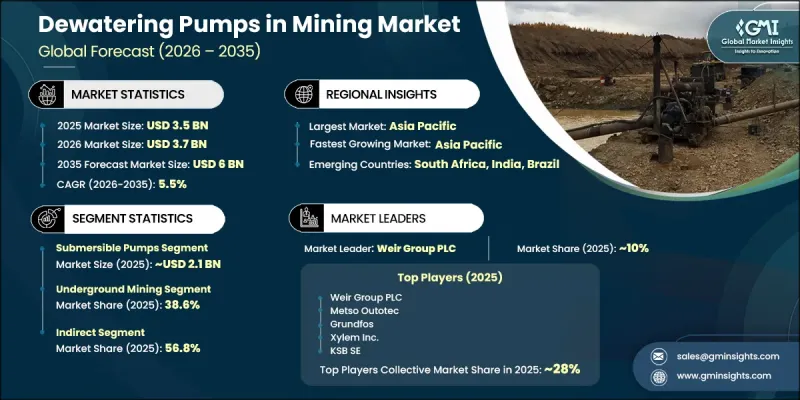
Growing mining activities at deeper excavation levels continue to drive the demand for reliable dewatering systems across the industry. Efficient water removal solutions remain essential for ensuring worker safety, maintaining operational continuity, and supporting productivity in challenging environments. Raising emphasis on water conservation and sustainable mining practices is further encouraging the adoption of advanced dewatering technologies. Mining operators are increasingly investing in systems that support water reuse, improve resource management, and lower environmental impact. Modern dewatering pumps are now designed with intelligent monitoring systems, automated controls, and energy-saving capabilities to optimize operational efficiency and reduce overall power consumption. The incorporation of connected technologies and real-time performance tracking is also improving predictive maintenance capabilities and minimizing unexpected equipment failures. These innovations are helping mining companies improve equipment longevity, reduce operational interruptions, and enhance overall efficiency worldwide.
| Market Scope | |
|---|---|
| Start Year | 2025 |
| Forecast Year | 2026-2035 |
| Start Value | $3.5 Billion |
| Forecast Value | $6 Billion |
| CAGR | 5.5% |
The submersible pumps segment generated USD 2.1 billion in 2025 and is forecast to grow at a CAGR of 5.5% from 2026 to 2035. Submersible pumps continue to account for a major share of the Dewatering Pumps in Mining Market due to their ability to operate efficiently while fully immersed in water. Their strong operational performance in flooded mining sites and underground applications makes them highly suitable for demanding mining conditions. These pumps are widely preferred because of their compact structure, high pumping efficiency, and capability to handle water containing abrasive particles and solids. Their ability to deliver uninterrupted dewatering performance in rugged mining environments further strengthens their adoption across global mining projects.
The underground mining segment accounted for 38.6% share in 2025. Water intrusion from underground sources and surrounding geological formations remains a major operational challenge in underground mines, creating consistent demand for high-performance dewatering systems. Effective water management solutions are critical for maintaining structural stability, ensuring worker safety, and sustaining operational efficiency in underground mining operations. Increasing exploration and extraction activities at greater depths are also contributing to the growing requirement for durable and high-capacity pumps capable of operating under extreme environmental conditions and within limited underground spaces.
U.S. Dewatering Pumps in Mining Market reached USD 600 million in 2025 and is anticipated to grow at a CAGR of 5.3% between 2026 and 2035. Demand for dewatering pumps in the United States is supported by ongoing activities in the metal, coal, and industrial mineral mining sectors. Water management systems play a crucial role in both underground and surface mining operations by controlling groundwater accumulation and supporting compliance with strict safety and environmental standards. Expanding mine depths and the modernization of existing mining infrastructure are further contributing to the need for efficient and reliable pumping solutions. The U.S. market is also witnessing increasing adoption of advanced technologies, including automated systems, digitally connected monitoring platforms, and energy-efficient pump designs that enhance operational performance and reduce maintenance requirements.
Key companies operating in the Global Dewatering Pumps in Mining Market include major global participants such as Weir Group PLC, Xylem Inc., Sulzer Ltd, KSB SE & Co. KGaA, Grundfos, Metso Outotec, Flowserve Corporation, ITT Goulds Pumps, and FLSmidth. Prominent regional manufacturers include Tsurumi Manufacturing, Gorman-Rupp Company, Cornell Pump Company, Kirloskar Brothers Limited, Pentair, Wilo SE, ABEL Pumps, and Thompson Pump. Emerging market participants include Toyo Pumps North America, Grindex AB, Ebara Corporation, and Excellence Pump Industry. Companies operating in the Dewatering Pumps in Mining Market are focusing on several strategic initiatives to strengthen their market position and expand their global presence. Manufacturers are prioritizing product innovation by developing energy-efficient and high-capacity pumping systems equipped with advanced automation and smart monitoring technologies. Businesses are also investing heavily in digital solutions that improve predictive maintenance, remote monitoring, and operational reliability. Strategic partnerships with mining operators and engineering firms are helping companies secure long-term supply agreements and expand project portfolios. In addition, market participants are increasing investments in research and development to enhance pump durability, efficiency, and performance in harsh mining environments.
Table of Contents
Chapter 1 Methodology & Scope
- 1.1 Market scope & definitions
- 1.2 Research design
- 1.2.1 Research approach
- 1.2.2 Data collection methods
- 1.3 Base estimates and calculations
- 1.3.1 Base year calculation
- 1.3.2 Market estimates & forecasts parameters
- 1.4 Forecast Model
- 1.4.1 Key trends for market estimates
- 1.4.2 Quantified market impact analysis
- 1.4.2.1 Mathematical impact of growth parameters on forecast
- 1.4.3 Scenario analysis framework
- 1.5 Primary research and validation
- 1.5.1 Some of the primary sources (but not limited to)
- 1.6 Data mining sources
- 1.6.1 Paid Sources
- 1.7 Primary research and validation
- 1.7.1 Primary sources
- 1.8 Research Trail & confidence scoring
- 1.8.1 Research trail components
- 1.8.2 Scoring components
- 1.9 Research transparency addendum
- 1.9.1 Source attribution framework
- 1.9.2 Quality assurance metrics
- 1.9.3 Our commitment to trust
- 1.10 Market Definitions
Chapter 2 Executive Summary
- 2.1 Industry 360° synopsis
- 2.2 Key market trends
- 2.2.1 Regional
- 2.2.2 Type
- 2.2.3 Mining type
- 2.2.4 Mineral type
- 2.2.5 Distribution channel
Chapter 3 Industry Insights
- 3.1 Industry ecosystem analysis
- 3.1.1 Supplier landscape
- 3.1.2 Profit margin
- 3.1.3 Value addition at each stage
- 3.1.4 Factor affecting the value chain
- 3.2 Industry impact forces
- 3.2.1 Growth drivers
- 3.2.1.1 Increasing depth of mining operations requiring advanced dewatering systems
- 3.2.1.2 Growing emphasis on water reuse & resource recovery in mining
- 3.2.1.3 Expansion of underground & open pit mining activities globally
- 3.2.2 Industry pitfalls & challenges
- 3.2.2.1 High energy costs for dewatering operations
- 3.2.2.2 Corrosion & abrasion issues from acid mine drainage (AMD) & contaminated water
- 3.2.3 Opportunities
- 3.2.3.1 Development of energy-efficient & variable speed drive (VSD) pump technologies
- 3.2.3.2 Integration of IoT & remote monitoring for predictive maintenance
- 3.2.3.3 Growing demand in emerging mining regions
- 3.2.1 Growth drivers
- 3.3 Growth potential analysis
- 3.4 Future market trends
- 3.5 Technology and innovation landscape
- 3.5.1 Current technological trends
- 3.5.2 Emerging technologies
- 3.6 Pricing analysis (Driven by Primary Research)
- 3.6.1 Historical price trend analysis
- 3.6.2 Regional price variations
- 3.7 Regulatory landscape
- 3.8 Porter's analysis
- 3.9 PESTEL analysis
- 3.10 Trade Data Analysis (Driven by Paid Data Base) (HS code - 8413)
- 3.10.1 Import/export volume & value trends
- 3.10.2 Key trade corridors & tariff impact
- 3.10.3 Regional trade balance
- 3.10.4 Impact of trade agreements
- 3.11 Impact of AI & generative AI on the market
- 3.11.1 AI-driven disruption of existing business models
- 3.11.2 GenAI use cases & adoption roadmap by segment
- 3.11.2.1 Predictive maintenance applications
- 3.11.2.2 Design optimization & simulation
- 3.11.2.3 Supply chain intelligence
- 3.11.3 Risks, limitations & regulatory considerations
- 3.12 Capacity & production landscape (driven by primary research)
- 3.12.1 Installed capacity by region & key producer
- 3.12.2 Capacity utilization rates & expansion pipelines
Chapter 4 Competitive Landscape, 2025
- 4.1 Introduction
- 4.2 Company market share analysis
- 4.2.1 By Region
- 4.2.1.1 North America
- 4.2.1.2 Europe
- 4.2.1.3 Asia Pacific
- 4.2.1.4 Latin America
- 4.2.1.5 Middle East & Africa
- 4.2.1 By Region
- 4.3 Company matrix analysis
- 4.4 Competitive analysis of major market players
- 4.5 Competitive positioning matrix
- 4.6 Key developments
- 4.6.1 Mergers & acquisitions
- 4.6.2 Partnerships & collaborations
- 4.6.3 New product launches
- 4.6.4 Expansion plans
Chapter 5 Market Estimates & Forecast, By Type, 2022 - 2035, (USD Billion) (Thousand Units)
- 5.1 Key trends
- 5.2 Submersible pumps
- 5.3 Non-submersible/surface pumps
Chapter 6 Market Estimates & Forecast, By Mining Type, 2022 - 2035, (USD Billion) (Thousand Units)
- 6.1 Key trends
- 6.2 Underground mining
- 6.3 Surface mining
- 6.4 Quarrying
- 6.5 Solution mining
Chapter 7 Market Estimates & Forecast, By Mineral Type, 2022 - 2035, (USD Billion) (Thousand Units)
- 7.1 Key trends
- 7.2 Coal mining
- 7.3 Metal mining
- 7.4 Diamond & gemstone mining
- 7.5 Other minerals (uranium, etc.)
Chapter 8 Market Estimates & Forecast, By Distribution Channel, 2022 - 2035, (USD Billion) (Thousand Units)
- 8.1 Key trends
- 8.2 Direct sales
- 8.3 Indirect sales
Chapter 9 Market Estimates & Forecast, By Region, 2022 - 2035, (USD Billion) (Thousand Units)
- 9.1 Key trends
- 9.2 North America
- 9.2.1 U.S.
- 9.2.2 Canada
- 9.3 Europe
- 9.3.1 Germany
- 9.3.2 UK
- 9.3.3 France
- 9.3.4 Italy
- 9.3.5 Spain
- 9.4 Asia Pacific
- 9.4.1 China
- 9.4.2 India
- 9.4.3 Japan
- 9.4.4 South Korea
- 9.4.5 Australia
- 9.5 Latin America
- 9.5.1 Brazil
- 9.5.2 Mexico
- 9.5.3 Argentina
- 9.6 MEA
- 9.6.1 Saudi Arabia
- 9.6.2 UAE
- 9.6.3 South Africa
Chapter 10 Company Profiles
- 10.1 Global Players
- 10.1.1 Weir Group PLC
- 10.1.2 Xylem Inc.
- 10.1.3 Sulzer Ltd
- 10.1.4 KSB SE & Co. KGaA
- 10.1.5 Grundfos
- 10.1.6 Metso Outotec
- 10.1.7 Flowserve Corporation
- 10.1.8 ITT Goulds Pumps
- 10.1.9 FLSmidth
- 10.2 Regional players
- 10.2.1 Tsurumi Manufacturing
- 10.2.2 Gorman-Rupp Company
- 10.2.3 Cornell Pump Company
- 10.2.4 Kirloskar Brothers Limited
- 10.2.5 Pentair
- 10.2.6 Wilo SE
- 10.2.7 ABEL Pumps (ABEL GmbH)
- 10.2.8 Thompson Pump
- 10.3 Emerging players
- 10.3.1 Toyo Pumps North America
- 10.3.2 Grindex AB
- 10.3.3 Ebara Corporation
- 10.3.4 Excellence Pump Industry

