PUBLISHER: Global Market Insights Inc. | PRODUCT CODE: 2045665

PUBLISHER: Global Market Insights Inc. | PRODUCT CODE: 2045665
North America Wearable Market Opportunity, Growth Drivers, Industry Trend Analysis, and Forecast 2026 - 2035
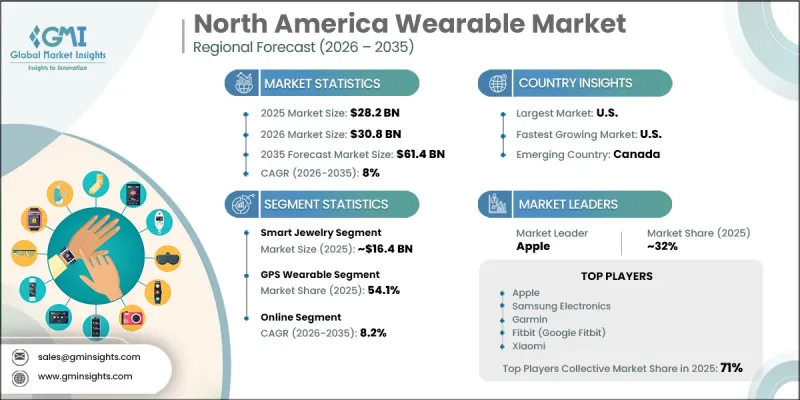
North America Wearable Market was valued at USD 28.2 billion in 2025 and is estimated to grow at a CAGR of 8% to reach USD 61.4 billion by 2035.
Increasing emphasis on personal wellness is encouraging consumers to adopt wearable devices that deliver real-time insights and consistent performance. Users are seeking dependable solutions capable of accurately capturing health data while maintaining seamless connectivity. Wearable technology is becoming an essential part of everyday life, offering continuous access to important health-related information. Growing interest in preventive care and fitness-oriented routines is further accelerating demand across the region. At the same time, evolving healthcare frameworks are supporting broader adoption of these devices. Manufacturers are focusing on delivering enhanced functionality, improved user experience, and diverse product options to meet varying consumer expectations. The availability of a wide range of wearable devices is enabling both individuals and healthcare providers to select solutions that align with specific monitoring and lifestyle requirements, strengthening the overall growth trajectory of the North America wearable market.
| Market Scope | |
|---|---|
| Start Year | 2025 |
| Forecast Year | 2026-2035 |
| Start Value | $28.2 Billion |
| Forecast Value | $61.4 Billion |
| CAGR | 8% |
Rising consumer focus on maintaining health and improving physical performance is contributing to increased adoption of wearable technology. Modern devices are designed to deliver high levels of functionality and reliability, ensuring consistent monitoring and user engagement. Continuous innovation is enabling improved performance, while evolving healthcare policies are further encouraging widespread usage. The market continues to require a broad selection of products to address diverse consumer needs, ensuring sustained demand across different user groups.
The smart jewelry segment generated USD 16.4 billion in 2025 and is expected to grow at a CAGR of 8.1% from 2026 to 2035. This segment holds a leading position due to its ability to combine aesthetic appeal with advanced functionality. Smart jewelry provides discreet monitoring capabilities while maintaining comfort and design versatility. Products within this segment integrate tracking features and wireless connectivity, allowing users to stay informed without compromising style. The combination of technology and wearable design continues to drive strong adoption.
The GPS wearable segment accounted for 54.1% share in 2025 and is projected to grow at a CAGR of 7.4% through 2035. This segment remains dominant due to increasing demand for accurate tracking and performance monitoring. Devices equipped with location-based technology provide reliable data related to movement and activity. Enhanced tracking accuracy and real-time performance insights support consistent usage, while reduced reliance on external connectivity strengthens their appeal.
United States Wearable Market held a 77% share in 2025 and expected to grow at a CAGR of 8.2% from 2026 to 2035. Market leadership is supported by strong consumer spending on advanced technologies and widespread awareness of health and fitness. Access to innovative products and comprehensive support services enhances user adoption. A large consumer base supports extensive product availability and integrated service ecosystems. Continuous improvements in device features and ongoing software enhancements further reinforce demand, maintaining the country's dominant position.
Key companies operating in the North America Wearable Industry include Amazfit, Apple, Boat, Fitbit (Google Fitbit), Garmin, Noise, Oura, Philips, Samsung Electronics, Sony, Ultrahuman, Vuzix, Whoop, Withings, and Xiaomi. Companies in the North America Wearable Market are strengthening their position through continuous innovation, product diversification, and strategic expansion initiatives. Businesses are investing in advanced technologies to improve device accuracy, battery efficiency, and user experience. Many players are focusing on integrating health monitoring capabilities with digital ecosystems to enhance functionality and customer engagement. Expanding distribution networks and strengthening online presence are helping companies reach a broader audience. Strategic collaborations and partnerships support product development and market penetration. Additionally, brands are emphasizing design, comfort, and customization to appeal to diverse consumer preferences, while ongoing software updates and service enhancements help maintain long-term customer loyalty and competitive advantage.
Table of Contents
Chapter 1 Methodology and Scope
- 1.1 Market scope and definition
- 1.2 Research design
- 1.2.1 Research approach
- 1.2.2 Data collection methods
- 1.3 Data mining sources
- 1.3.1 Global
- 1.3.2 Regional/Country
- 1.4 Base estimates and calculations
- 1.4.1 Base year calculation
- 1.4.2 Key trends for market estimation
- 1.5 Primary research and validation
- 1.5.1 Primary sources
- 1.6 Forecast model
- 1.7 Research assumptions and limitations
Chapter 2 Executive Summary
- 2.1 Industry 360° synopsis, 2022-2035
- 2.2 Key market trends
- 2.2.1 Region
- 2.2.2 By product type
- 2.2.3 By technology
- 2.2.4 By price
- 2.2.5 By end user
- 2.2.6 By distribution channel
Chapter 3 Industry Insights
- 3.1 Industry ecosystem analysis
- 3.1.1 Supplier landscape
- 3.1.1.1 Component Sourcing & Manufacturing Footprint
- 3.1.1.2 Nearshoring & Mexico Manufacturing Trends
- 3.1.1.3 U.S.-China Trade Relations Impact
- 3.1.1.4 USMCA Implications for Wearable Trade
- 3.1.2 Factor affecting the value chain
- 3.1.3 Profit margin analysis
- 3.1.4 Disruptions
- 3.1.5 Future outlook
- 3.1.6 Value addition at each stage
- 3.1.7 Distributors
- 3.1.1 Supplier landscape
- 3.2 Industry Impact forces
- 3.2.1 Growth drivers
- 3.2.2 Industry pitfalls & challenges
- 3.2.3 Opportunities
- 3.3 Growth potential analysis
- 3.4 Technology and innovation landscape
- 3.4.1 Current technological trends In North America
- 3.4.2 Emerging Technologies & R&D Hotspots
- 3.4.3 U.S. Innovation Centers & Research Institutions
- 3.5 Price trends Pricing Analysis (Driven by Primary Research)
- 3.5.1 Historical Price Trend Analysis (Driven by Primary Research)
- 3.5.2 Pricing Strategy by Player Type (Premium / Value / Cost-plus) (Driven by Primary Research)
- 3.5.3 Regional Price Variations(U.S. vs Canada vs Mexico) (Driven by Primary Research)
- 3.6 Regulatory landscape
- 3.6.1 FDA regulations for medical wearable (Driven by Primary Research)
- 3.6.2 FCC compliances Part 15/18 for Wireless Devices
- 3.6.3 Health Canada Medical Device Regulations
- 3.6.4 COFEPRIS Requirements (Mexico)
- 3.6.5 Privacy & Data Protection Laws
- 3.7 Porter's analysis
- 3.8 PESTEL analysis
- 3.9 Trade statistics (Driven by paid source)
- 3.9.1 Import/Export Volume & Value Trends (Driven by Primary Research)
- 3.9.2 Key Trade Corridors & Tariff Impact (Driven by Primary Research)
- 3.9.3 U.S. HS Code Classification (9102, 8517, 9021) (Driven by Primary Research)
- 3.9.4 Cross-Border Trade Flows (U.S.-Mexico, U.S.-Canada) (Driven by Primary Research)
- 3.10 Consumer behaviour analysis
- 3.10.1 Purchasing patterns
- 3.10.2 Preference analysis
- 3.10.3 Regional variations in consumer behaviour
- 3.10.4 Impact of e-commerce on buying decisions
- 3.11 Impact of AI & Generative AI on the Market
- 3.11.1 AI-Driven Disruption of Existing Business Models
- 3.11.2 GenAI Use Cases & Adoption Roadmap by Segment
- 3.11.3 AI-Powered Personalization & Insights Generation
- 3.11.4 Risks, Limitations & Regulatory Considerations
- 3.12 Infrastructure & Deployment Landscape - North America (Driven by Primary Research)
- 3.12.1 Deployment Penetration by Region & Buyer Segment (Driven by Primary Research)
- 3.12.2 Scalability Constraints & Infrastructure Investment Trends (Driven by Primary Research)
Chapter 4 Competitive Landscape, 2025
- 4.1 Introduction
- 4.2 Company market share analysis
- 4.2.1 By Country
- 4.2.1.1 U.S.
- 4.2.1.2 Canada
- 4.2.1 By Country
- 4.3 Strategic outlook matrix
- 4.4 Company matrix analysis
- 4.5 Competitive analysis of major market players
- 4.6 Key developments
- 4.6.1 Mergers & acquisitions
- 4.6.2 Partnerships & collaborations
- 4.6.3 New Product Launches
- 4.6.4 Expansion Plans
Chapter 5 Market Estimates & Forecast, By Product Type, 2022 - 2035 (USD Billion, Million Units)
- 5.1 Key trends
- 5.2 Smart jewelry
- 5.2.1 Smartwatch
- 5.2.2 Smart ring
- 5.2.3 Smart bracelet
- 5.2.4 Others (smart necklaces etc.)
- 5.3 Fitness apparel
- 5.3.1 Smart pants
- 5.3.2 Smart socks
- 5.3.3 Smart shirt
- 5.3.4 Smart shoes
- 5.3.5 Others (smart belt etc.)
- 5.4 Health monitoring devices
- 5.4.1 Wearable biosensors
- 5.4.2 Wearable defibrillators
- 5.4.3 Wearable ECG monitors
- 5.4.4 Others (continuous glucose monitors etc.)
- 5.5 Smart glasses
- 5.5.1 Augmented reality glasses
- 5.5.2 Virtual reality glasses
- 5.5.3 Others (mixed reality glasses etc.)
- 5.6 Others (smart hearables etc.)
Chapter 6 Market Estimates & Forecast, By Technology, 2022 - 2035 (USD Billion, Million Units)
- 6.1 Key trends
- 6.2 GPS wearable
- 6.3 Bluetooth wearable
- 6.4 LTE wearable
- 6.5 Wi-Fi wearable
- 6.6 NFC
- 6.7 Others (LoRa wearable etc.)
Chapter 7 Market Estimates & Forecast, By Price, 2022 - 2035 (USD Billion, Million Units)
- 7.1 Key trends
- 7.2 Low
- 7.3 Medium
- 7.4 High
Chapter 8 Market Estimates & Forecast, By End Use, 2022 - 2035 (USD Billion, Million Units)
- 8.1 Key trends
- 8.2 Individual
- 8.3 Commercial
- 8.3.1 Offices
- 8.3.2 Military forces
- 8.3.3 Medical professionals
- 8.3.4 Sports and fitness
- 8.3.5 Others (retail etc.)
Chapter 9 Market Estimates & Forecast, By Distribution Channel, 2022 - 2035 (USD Billion, Million Units)
- 9.1 Key trends
- 9.2 Online
- 9.2.1 E-commerce
- 9.2.2 Company websites
- 9.3 Offline
- 9.3.1 Supermarkets/hypermarket
- 9.3.2 Specialty retail stores
- 9.3.3 Others (independent retailer etc.)
Chapter 10 Market Estimates & Forecast, By Region, 2022-2035 (USD Billion, Million Units)
- 10.1 Key trends
- 10.2 North America
- 10.2.1 U.S.
- 10.2.2 Canada
Chapter 11 Company Profiles
- 11.1 Top Global Players
- 11.1.1 Apple
- 11.1.2 Samsung Electronics
- 11.1.3 Garmin
- 11.1.4 Xiaomi
- 11.1.5 Fitbit (Google Fitbit)
- 11.1.6 Sony
- 11.2 Regional Players
- 11.2.1 Withings
- 11.2.2 Boat
- 11.2.3 Noise
- 11.2.4 Amazfit
- 11.2.5 Philips
- 11.3 Emerging Players
- 11.3.1 Oura
- 11.3.2 Whoop
- 11.3.3 Ultrahuman
- 11.3.4 Vuzix

