PUBLISHER: Global Market Insights Inc. | PRODUCT CODE: 2045739

PUBLISHER: Global Market Insights Inc. | PRODUCT CODE: 2045739
Wearables Market Opportunity, Growth Drivers, Industry Trend Analysis, and Forecast 2026 - 2035
The Global Wearables Market was valued at USD 83.5 billion in 2025 and is estimated to grow at a CAGR of 8% to reach USD 181.7 billion by 2035.
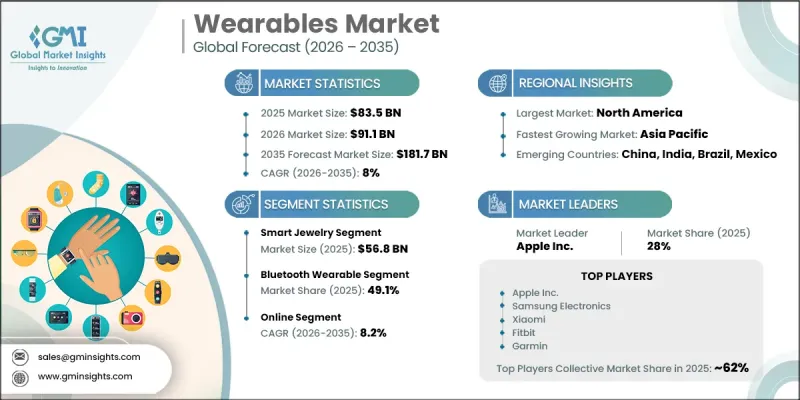
The wearable devices market is gaining momentum as demand for health and fitness monitoring solutions continues to rise alongside rapid technological progress in sensor integration and AI-driven capabilities. Consumers are increasingly adopting wearable technology that delivers real-time insights, seamless connectivity, and enhanced user convenience. The growing adoption of digital payment technologies is also contributing to market expansion, as modern wearable devices enable fast and secure transaction capabilities without reliance on traditional payment methods. Continuous innovation is transforming wearable products into highly efficient, intelligent tools that align with evolving consumer expectations. The integration of advanced features such as extended battery performance, improved connectivity range, and enhanced data privacy is further strengthening product appeal. The convergence of lifestyle enhancement, health monitoring, and digital functionality is driving widespread adoption, positioning the wearable industry for sustained growth across multiple consumer segments.
| Market Scope | |
|---|---|
| Start Year | 2025 |
| Forecast Year | 2026-2035 |
| Start Value | $83.5 Billion |
| Forecast Value | $181.7 Billion |
| CAGR | 8% |
The wearable devices market is being propelled by increasing demand for compact, multifunctional solutions that integrate effortlessly into daily life. Consumers are prioritizing devices that combine multiple functionalities within a single, efficient form factor, enabling seamless interaction with digital ecosystems. Advances in AI-based systems and sensor technologies are enabling manufacturers to develop next-generation wearables with improved operational capabilities, longer battery life, and enhanced performance. These developments are creating new opportunities for innovation and differentiation across the industry.
The Bluetooth wearable segment held a 49.1% share and is expected to grow at a CAGR of 19.2% from 2026 to 2035. This segment continues to gain traction due to its flexibility, connectivity, and compatibility with a wide range of devices. Wearables designed for health and wellness applications are witnessing accelerated adoption, supported by continuous improvements in performance and usability. The segment is expected to maintain strong growth momentum as demand for connected fitness solutions continues to increase.
The online distribution channel is projected to grow at a CAGR of 8.2% from 2026 to 2035. The rapid expansion of e-commerce platforms is enhancing accessibility and convenience for consumers, allowing them to explore a broad range of wearable products. Digital retail environments are evolving with advanced personalization features, including AI-powered recommendations and interactive technologies that enhance the shopping experience. These innovations are bridging the gap between digital and physical retail, supporting continued growth in online sales.
United States Wearables Market accounted for 77% share in 2025, generating USD 21.8 billion. Market growth in the country is driven by increasing consumer focus on health tracking, rising adoption of advanced wearable technologies, and growing awareness of personal wellness. Continuous innovation, combined with expanding applications of connected technologies, is further supporting demand. The strong presence of leading industry players and ongoing advancements in product capabilities are contributing significantly to regional market expansion.
Key companies operating in the Global Wearables Market include Samsung Electronics, Apple, Xiaomi, Garmin, Fitbit, Sony, Philips, Noise, Boat, Oura, Whoop, Withings, Ultrahuman, and Vuzix. Companies in the Wearables Market are adopting a range of strategic initiatives to strengthen their competitive positioning. Organizations are focusing on continuous product innovation by integrating advanced sensors, AI capabilities, and enhanced connectivity features into their devices. Strategic partnerships and collaborations are being pursued to expand technological expertise and accelerate product development. Companies are also investing in digital ecosystems and software platforms to deliver personalized user experiences and increase customer engagement. Expansion of online distribution channels and direct-to-consumer strategies is improving market reach and accessibility.
Table of Contents
Chapter 1 Methodology and Scope
- 1.1 Market scope and definition
- 1.2 Research design
- 1.2.1 Research approach
- 1.2.2 Data collection methods
- 1.3 Data mining sources
- 1.3.1 Global
- 1.3.2 Regional/Country
- 1.4 Base estimates and calculations
- 1.4.1 Base year calculation
- 1.4.2 Key trends for market estimation
- 1.5 Primary research and validation
- 1.5.1 Primary sources
- 1.6 Forecast model
- 1.7 Research assumptions and limitations
Chapter 2 Executive Summary
- 2.1 Industry 360° synopsis
- 2.2 Key market trends
- 2.2.1 Regional
- 2.2.2 Product Type
- 2.2.3 Technology
- 2.2.4 Price
- 2.2.5 End Use
- 2.2.6 Distribution Channel
Chapter 3 Industry Insights
- 3.1 Industry ecosystem analysis
- 3.1.1 Supplier landscape
- 3.1.2 Factor affecting the value chain
- 3.1.3 Profit margin analysis
- 3.1.4 Disruptions
- 3.1.5 Future outlook
- 3.1.6 Value addition at each stage
- 3.1.7 Distributors
- 3.2 Industry Impact forces
- 3.2.1 Growth drivers
- 3.2.1.1 Increased adoption of health monitoring devices
- 3.2.1.2 Technological advancements in wearable devices
- 3.2.2 Industry pitfalls & challenges
- 3.2.2.1 High cost of wearable devices
- 3.2.2.2 Data privacy and security concerns
- 3.2.3 Opportunities
- 3.2.3.1 Emerging markets in developing economies
- 3.2.3.2 Integration with IoT ecosystems
- 3.2.1 Growth drivers
- 3.3 Growth potential analysis
- 3.4 Technology and innovation landscape
- 3.4.1 Current technological trends
- 3.4.2 Emerging technologies
- 3.5 Price trends Pricing Analysis (Driven by Primary Research)
- 3.5.1 Historical Price Trend Analysis (Driven by Primary Research)
- 3.5.2 Pricing Strategy by Player Type (Premium / Value / Cost-plus) (Driven by Primary Research)
- 3.5.3 Price Positioning by Product Category
- 3.5.4 Regional Price Variations
- 3.6 Regulatory landscape
- 3.6.1 Standards and compliance requirements
- 3.6.2 Data Privacy & Protection Regulations (GDPR, HIPAA)
- 3.6.3 Medical Device Regulations (FDA, CE Mark)
- 3.6.4 Regional regulatory frameworks
- 3.6.5 Certification standards
- 3.7 Porter's analysis
- 3.8 PESTEL analysis
- 3.9 Trade statistics (HS code)
- 3.9.1 Major importing countries
- 3.9.2 Major exporting countries
- 3.10 Consumer behaviour analysis
- 3.10.1 Purchasing patterns
- 3.10.2 Preference analysis
- 3.10.3 Regional variations in consumer behaviour
- 3.10.4 Impact of e-commerce on buying decisions
- 3.11 Impact of AI & Generative AI on the Market
- 3.11.1 AI-Driven Disruption of Existing Business Models
- 3.11.2 GenAI Use Cases & Adoption Roadmap by Segment
- 3.11.3 AI-Powered Personalization & Insights Generation
- 3.11.4 Risks, Limitations & Regulatory Considerations
- 3.12 Infrastructure & Deployment Landscape (Driven by Primary Research)
- 3.12.1 Deployment Penetration by Region & Buyer Segment (Driven by Primary Research)
- 3.12.2 Scalability Constraints & Infrastructure Investment Trends (Driven by Primary Research)
Chapter 4 Competitive Landscape, 2025
- 4.1 Introduction
- 4.2 Company market share analysis
- 4.2.1 By region
- 4.2.1.1 North America
- 4.2.1.2 Europe
- 4.2.1.3 Asia Pacific
- 4.2.1.4 Middle East & Africa
- 4.2.1.5 Latin America
- 4.2.1 By region
- 4.3 Strategic outlook matrix
- 4.4 Company matrix analysis
- 4.5 Competitive analysis of major market players
- 4.6 Key developments
- 4.6.1 Mergers & acquisitions
- 4.6.2 Partnerships & collaborations
- 4.6.3 New Product Launches
- 4.6.4 Expansion Plans
Chapter 5 Market Estimates & Forecast, By Product Type, 2022 - 2035 ($Billion, Million Units)
- 5.1 Key trends
- 5.2 Smart jewelry
- 5.2.1 Smartwatch
- 5.2.2 Smart ring
- 5.2.3 Smart bracelet
- 5.2.4 Others (smart necklaces etc.)
- 5.3 Fitness apparel
- 5.3.1 Smart pants
- 5.3.2 Smart socks
- 5.3.3 Smart shirt
- 5.3.4 Smart shoes
- 5.3.5 Others (smart belt etc.)
- 5.4 Health monitoring devices
- 5.4.1 Wearable biosensors
- 5.4.2 Wearable defibrillators
- 5.4.3 Wearable ECG monitors
- 5.4.4 Others (continuous glucose monitors etc.)
- 5.5 Smart glasses
- 5.5.1 Augmented reality glasses
- 5.5.2 Virtual reality glasses
- 5.5.3 Others (mixed reality glasses etc.)
- 5.6 Others (smart hearables etc.)
Chapter 6 Market Estimates & Forecast, By Technology, 2022 - 2035 ($Billion, Million Units)
- 6.1 Key trends
- 6.2 GPS wearable
- 6.3 Bluetooth wearable
- 6.4 LTE wearable
- 6.5 Wi-Fi wearable
- 6.6 NFC
- 6.7 Others (LoRa wearable etc.)
Chapter 7 Market Estimates & Forecast, By Price, 2022 - 2035 ($Billion, Million Units)
- 7.1 Key trends
- 7.2 Low
- 7.3 Medium
- 7.4 High
Chapter 8 Market Estimates & Forecast, By End Use, 2022 - 2035 ($Billion, Million Units)
- 8.1 Key trends
- 8.2 Individual
- 8.3 Commercial
- 8.3.1 Offices
- 8.3.2 Military forces
- 8.3.3 Medical professionals
- 8.3.4 Sports and fitness
- 8.3.5 Others (retail etc.)
Chapter 9 Market Estimates & Forecast, By Distribution Channel, 2022 - 2035 ($Billion, Million Units)
- 9.1 Key trends
- 9.2 Online
- 9.2.1 E-commerce
- 9.2.2 Company websites
- 9.3 Offline
- 9.3.1 Supermarkets/hypermarket
- 9.3.2 Specialty retail stores
- 9.3.3 Others (independent retailer etc.)
Chapter 10 Market Estimates & Forecast, By Region, 2022-2035 ($Billion, Million Units)
- 10.1 Key trends
- 10.2 North America
- 10.2.1 U.S.
- 10.2.2 Canada
- 10.3 Europe
- 10.3.1 UK
- 10.3.2 Germany
- 10.3.3 France
- 10.3.4 Italy
- 10.3.5 Spain
- 10.4 Asia Pacific
- 10.4.1 China
- 10.4.2 India
- 10.4.3 Japan
- 10.4.4 South Korea
- 10.4.5 Australia
- 10.5 Latin America
- 10.5.1 Brazil
- 10.5.2 Mexico
- 10.5.3 Argentina
- 10.6 MEA
- 10.6.1 UAE
- 10.6.2 Saudi Arabia
- 10.6.3 South Africa
Chapter 11 Company Profiles
- 11.1 Amazfit
- 11.2 Apple
- 11.3 Boat
- 11.4 Fitbit
- 11.5 Garmin
- 11.6 Noise
- 11.7 Oura
- 11.8 Philips
- 11.9 Samsung Electronics
- 11.10 Sony
- 11.11 Ultrahuman
- 11.12 Vuzix
- 11.13 Whoop
- 11.14 Withings
- 11.15 Xiaomi
Chapter 12 Competitive Landscape, 2025
- 12.1 Introduction
- 12.2 Company market share analysis
- 12.2.1 By region
- 12.2.1.1 North America
- 12.2.1.2 Europe
- 12.2.1.3 Asia Pacific
- 12.2.1.4 Latin America
- 12.2.1.5 Middle East and Africa
- 12.2.1 By region
- 12.3 Company matrix analysis
- 12.4 Competitive analysis of major market players
- 12.5 Competitive positioning matrix
- 12.6 Key developments
- 12.6.1 Mergers & acquisitions
- 12.6.2 Partnerships & collaborations
- 12.6.3 New product launches
- 12.6.4 Expansion plans

