PUBLISHER: Global Market Insights Inc. | PRODUCT CODE: 2045667

PUBLISHER: Global Market Insights Inc. | PRODUCT CODE: 2045667
Asia Pacific Ice Maker Market Opportunity, Growth Drivers, Industry Trend Analysis, and Forecast 2026 - 2035
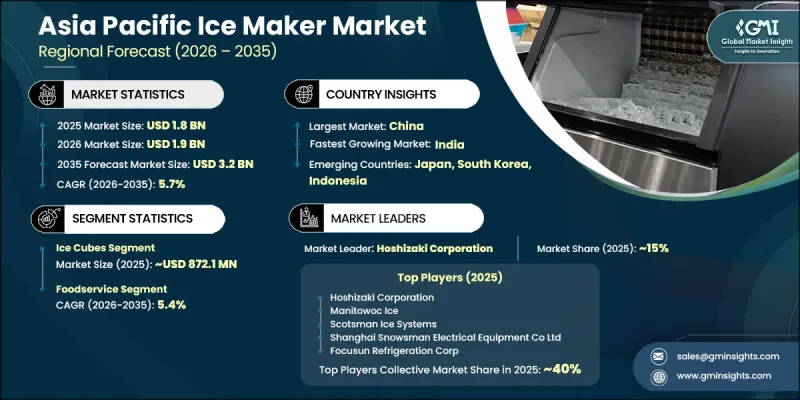
Asia Pacific Ice Maker Market was valued at USD 1.8 billion in 2025 and is estimated to grow at a CAGR of 5.7% to reach USD 3.2 billion by 2035.
Demand is driven by a shift toward high-end experiences, where both ice quality and machine aesthetics influence purchasing decisions. Growth across foodservice channels continues to accelerate as urbanization and lifestyle changes drive convenience-oriented consumption across key economies such as India, China, and Southeast Asia. At the same time, residential adoption is strengthening as households seek compact, efficient, and easy-to-use appliances. Rising electricity usage associated with these devices is also encouraging the uptake of energy-efficient technologies. In parallel, healthcare infrastructure upgrades are contributing to consistent product demand, particularly for equipment designed with strict hygiene compliance and operational reliability. Across the region, manufacturers are aligning product innovation with these evolving expectations, offering advanced, design-focused, and performance-driven solutions to capture a broader consumer base.
| Market Scope | |
|---|---|
| Start Year | 2025 |
| Forecast Year | 2026-2035 |
| Start Value | $1.8 Billion |
| Forecast Value | $3.2 Billion |
| CAGR | 5.7% |
The ice cubes segment generated USD 872.1 million in 2025 and is forecast to grow at a CAGR of 4.9% between 2026 and 2035. This category remains widely adopted for its balanced cooling efficiency, durability, and adaptability across multiple use cases. Variations in cube formats allow suppliers to address a wide range of application needs while maintaining consistency in performance. The segment benefits from mature production technologies and a competitive supplier landscape, which ensures accessibility and continuous product improvements.
The foodservice segment accounted for 40.7% share in 2025 and is expected to grow at a CAGR of 5.4% through 2035. Expansion in dining formats and beverage consumption patterns continues to sustain demand for high-output equipment. Growth in emerging urban centers and the proliferation of organized retail formats are further strengthening the need for reliable ice production systems across multiple service environments.
China Ice Maker Market captured USD 470.4 million in 2025 and is projected to grow at a CAGR of 6% from 2026 to 2035. Market concentration remains strong in high-demand regions, supported by climatic conditions and rising consumer adoption. Buyers prioritize features such as rapid ice production cycles, space-saving designs, and automated maintenance functions. While residential usage is expanding steadily, commercial applications continue to contribute a significant share, driven by the ongoing development of foodservice infrastructure.
The competitive landscape of the Asia Pacific Ice Maker Industry includes global participants such as Euhomy, GE Appliances, Hoshizaki Corporation, Ice-o-Matic, Manitowoc Ice, Newair, and Scotsman Ice Systems. Regional companies, including Gevi Ice Makers, Brema Ice Makers, Shanghai Snowsman Electrical Equipment Co Ltd, Panasonic, Focusun Refrigeration Corp, Ice-O-matic, and Maxx Ice, also maintain a strong presence. Emerging brands such as Follett Ice, ICESNOW Refrigeration Equipment, ICESTA (Shenzhen Brother Ice Systems), KOLD-DRAFT, Koller Refrigeration Equipment, Marvel Refrigeration, and Polar Ice are actively introducing new solutions to compete in the evolving market. Companies operating in the Asia Pacific ice maker market are strengthening their foothold through a mix of product innovation, regional expansion, and strategic partnerships. Many players are focusing on developing energy-efficient and compact machines to align with rising consumer demand and regulatory expectations. Firms are also investing in advanced features such as automated cleaning systems and enhanced durability to differentiate their offerings. Expanding distribution networks across emerging markets and forming alliances with foodservice operators are helping companies improve market penetration.
Table of Contents
Chapter 1 Methodology & Scope
- 1.1 Market scope and definition
- 1.2 Research design
- 1.2.1 Research approach
- 1.2.2 Data collection methods
- 1.3 Data mining sources
- 1.3.1 Global
- 1.3.2 Regional/Country
- 1.4 Base estimates and calculations
- 1.4.1 Base year calculation
- 1.4.2 Key trends for market estimation
- 1.5 Primary research and validation
- 1.5.1 Primary sources
- 1.6 Forecast model
- 1.7 Research assumptions and limitations
Chapter 2 Executive Summary
- 2.1 Industry 360° synopsis
- 2.2 Key market trends
- 2.2.1 Regional
- 2.2.2 Product Type
- 2.2.3 Ice Type
- 2.2.4 Application
- 2.2.5 Distribution channel
Chapter 3 Industry Insights
- 3.1 Industry ecosystem analysis
- 3.1.1 Supplier landscape
- 3.1.2 Profit margin analysis
- 3.1.3 Value addition at each stage
- 3.1.4 Factor affecting the value chain
- 3.2 Industry impact forces
- 3.2.1 Growth drivers
- 3.2.1.1 Rising demand from hospitality & foodservice sectors
- 3.2.1.2 Increasing healthcare infrastructure & cold chain requirements
- 3.2.1.3 Growth of Quick Service Restaurant (QSR) chains
- 3.2.1.4 Urbanization & rising disposable income in the emerging countries
- 3.2.2 Industry pitfalls & challenges
- 3.2.2.1 High initial capital investment & maintenance costs
- 3.2.2.2 Energy consumption & sustainability concerns
- 3.2.2.3 Regulatory compliance complexity across geographies
- 3.2.1 Growth drivers
- 3.3 Growth potential analysis
- 3.4 Future market trends
- 3.5 Technology and innovation landscape
- 3.5.1 Current technological trends
- 3.5.2 Emerging technologies
- 3.6 Price trends
- 3.6.1 By region
- 3.6.2 By product type
- 3.7 Regulatory landscape
- 3.7.1 Standards and compliance requirements
- 3.7.2 Regional regulatory frameworks
- 3.7.3 Certification standards
- 3.8 Porter's analysis
- 3.9 PESTEL analysis
- 3.10 Impact of AI & Generative AI on the market
- 3.10.1 AI-Driven disruption of existing business models
- 3.10.2 GenAI use cases & adoption roadmap by segment
- 3.10.3 Risks, limitations & regulatory considerations
- 3.11 Consumer behavior analysis
- 3.11.1 Purchasing patterns
- 3.11.2 Preference analysis
- 3.11.3 Regional variations in consumer behavior
Chapter 4 Competitive Landscape, 2025
- 4.1 Introduction
- 4.2 Company market share analysis
- 4.3 Company matrix analysis
- 4.4 Competitive analysis of major market players
- 4.5 Competitive positioning matrix
- 4.6 Key developments
- 4.6.1 Mergers & acquisitions
- 4.6.2 Partnerships & collaborations
- 4.6.3 New product launches
- 4.6.4 Expansion plans
Chapter 5 Market Estimates & Forecast, By Product Type, 2022 - 2035, (USD Billion) (Units)
- 5.1 Key trends
- 5.2 Modular ice maker
- 5.3 Undercounter ice maker
- 5.4 Countertop ice maker
- 5.5 Built-in ice maker
Chapter 6 Market Estimates & Forecast, By Ice Type, 2022 - 2035, (USD Billion) (Units)
- 6.1 Key trends
- 6.2 Ice cubes
- 6.3 Ice flakes
- 6.4 Ice nuggets
Chapter 7 Market Estimates & Forecast, By Application, 2022 - 2035, (USD Billion) (Units)
- 7.1 Key trends
- 7.2 Foodservice
- 7.2.1 Quick Service Restaurants (QSRs)
- 7.2.2 Full-service restaurants
- 7.2.3 Cafes & bars
- 7.3 Retail
- 7.4 Healthcare
- 7.5 Residential
- 7.6 Industrial
- 7.7 Others
Chapter 8 Market Estimates & Forecast, By Distribution Channel, 2022 - 2035, (USD Billion) (Units)
- 8.1 Key trends
- 8.2 Online
- 8.3 Offline
Chapter 9 Market Estimates & Forecast, By Region, 2022 - 2035, (USD Billion) (Units)
- 9.1 Key trends
- 9.2 Asia Pacific
- 9.2.1 China
- 9.2.2 India
- 9.2.3 Japan
- 9.2.4 South Korea
- 9.2.5 Australia
- 9.2.6 Indonesia
- 9.2.7 Malaysia
- 9.2.8 Singapore
Chapter 10 Company Profiles
- 10.1 Top Global Players
- 10.1.1 Euhomy
- 10.1.2 GE Appliances
- 10.1.3 Hoshizaki Corporation
- 10.1.4 Ice-o-Matic
- 10.1.5 Manitowoc Ice
- 10.1.6 Newair
- 10.1.7 Scotsman Ice Systems
- 10.2 Regional Players
- 10.2.1 Gevi Ice Makers
- 10.2.2 Brema Ice Makers
- 10.2.3 Shanghai Snowsman Electrical Equipment Co Ltd
- 10.2.4 Panasonic
- 10.2.5 Focusun Refrigeration Corp
- 10.2.6 Whynter LLC
- 10.2.7 Maxx Ice
- 10.3 Emerging Players & Innovators
- 10.3.1 Follett Ice
- 10.3.2 ICESNOW Refrigeration Equipment
- 10.3.3 ICESTA (Shenzhen Brother Ice Systems)
- 10.3.4 KOLD-DRAFT
- 10.3.5 Koller Refrigeration Equipment
- 10.3.6 Marvel Refrigeration
- 10.3.7 Polar Ice

