PUBLISHER: Global Market Insights Inc. | PRODUCT CODE: 2071165

PUBLISHER: Global Market Insights Inc. | PRODUCT CODE: 2071165
Portable Packaging Machines Market Opportunity, Growth Drivers, Industry Trend Analysis, and Forecast 2026 - 2035
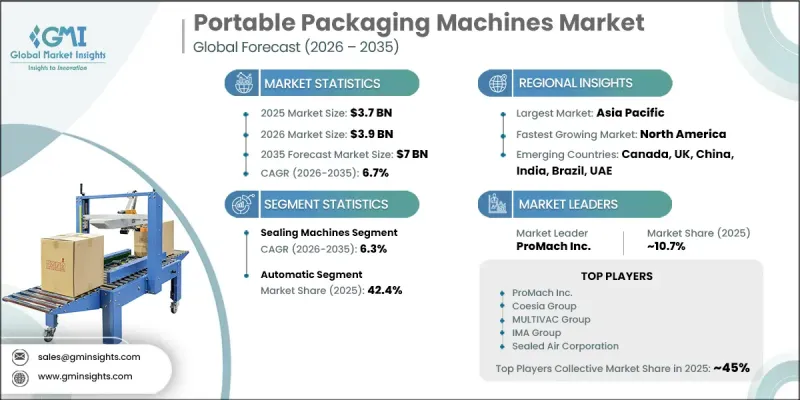
The Global Portable Packaging Machines Market was valued at USD 3.7 billion in 2025 and is estimated to grow at a CAGR of 6.7% to reach USD 7 billion in 2035.
Growth is supported by the rapid evolution of distributed logistics networks, increasing reliance on modular production setups, and the growing preference among small and medium-scale manufacturers for capital-efficient equipment that can be repositioned without requiring fixed infrastructure changes. The market is also benefiting from the shift toward agile manufacturing models, where packaging operations must adapt quickly to fluctuating demand patterns. Portable packaging systems are increasingly being adopted across decentralized fulfillment environments due to their operational mobility, reduced installation complexity, and adaptability across production settings. The transition from static, centralized packaging lines to flexible, demand-responsive configurations is reshaping equipment purchasing behavior across industries. Rising automation levels and efficiency requirements are further strengthening demand for compact, high-performance packaging systems capable of operating in dynamic production environments, reinforcing the long-term growth trajectory of the portable packaging machines market.
| Market Scope | |
|---|---|
| Start Year | 2025 |
| Forecast Year | 2026-2035 |
| Start Value | $3.7 Billion |
| Forecast Value | $7 Billion |
| CAGR | 6.7% |
The sealing machines segment generated USD 807.9 million in 2025 and is expected to grow at a CAGR of 6.3% through 2035. This category includes a wide range of equipment such as impulse sealers, vacuum sealing systems, heat sealing machines, and band sealing solutions. The strong position of this segment is supported by the essential role sealing plays across nearly all packaging operations. Its widespread applicability across diverse industries ensures consistent demand, making it one of the most fundamental and stable segments within the portable packaging machines landscape.
Automatic portable packaging machines accounted for 42.4% share in 2025 and are projected to grow at a CAGR of 7.1% through 2035. The strong performance of this segment is largely attributed to the increasing adoption of automation to improve productivity and reduce operational dependence on manual labor. Businesses are increasingly prioritizing systems that deliver higher throughput, improved consistency, and lower long-term operating costs, even if they require higher initial investment. This shift is accelerating the adoption of fully automated portable packaging solutions across industrial applications.
North America Portable Packaging Machines Market held a 27.2% share in 2025, reaching USD 996 million and is expected to grow at a CAGR of 7% through 2035. Expansion in e-commerce operations, ongoing investment in logistics infrastructure, and increasing emphasis on packaging compliance standards are key factors supporting market development. The growing share of online retail within total commerce activity is further strengthening demand for portable packaging equipment across fulfillment and distribution networks.
Major companies operating in the global portable packaging machines market include MULTIVAC Group, Syntegon Technology GmbH, Matrix Packaging Machinery, IMA Group, Volpak, Reepack, ULMA Packaging, SEALPAC International BV, Hualian Machinery Group Co., Ltd., Foshan Soonk Packaging Machine Co., Ltd., Minipack-Torre SpA, Wenzhou JOIE Machinery Co., Ltd., Accu-Seal Corporation, Kinex Cappers LLC, KHS Group, ProMach Inc., Coesia Group, and Sealed Air Corporation. Companies operating in the portable packaging machines market are focusing on several strategic initiatives to strengthen their market position and enhance competitiveness. A key approach involves increasing investment in automation technologies to improve machine efficiency, speed, and operational precision. Manufacturers are also prioritizing modular and lightweight designs that enhance portability and simplify deployment across diverse production environments. Expansion of product portfolios through technological upgrades and integration of smart control systems is another major strategy. Companies are strengthening global distribution networks and forming partnerships with logistics and manufacturing firms to expand market reach.
Table of Contents
Chapter 1 Methodology & Scope
- 1.1 Market scope and definition
- 1.2 Research design
- 1.2.1 Research approach
- 1.2.2 Data collection methods
- 1.3 Data mining sources
- 1.3.1 Global
- 1.3.2 Regional/Country
- 1.4 Base estimates and calculations
- 1.4.1 Base year calculation
- 1.4.2 Key trends for market estimation
- 1.5 Primary research and validation
- 1.5.1 Primary sources
- 1.6 Forecast model
- 1.7 Research assumptions and limitations
Chapter 2 Executive Summary
- 2.1 Industry 360° synopsis
- 2.2 Key market trends
- 2.2.1 Regional
- 2.2.2 Machine type
- 2.2.3 Mode of operation
- 2.2.4 Power source
- 2.2.5 End-use industry
- 2.2.6 Distribution channel
Chapter 3 Industry Insights
- 3.1 Industry ecosystem analysis
- 3.1.1 Supplier landscape
- 3.1.2 Profit margin
- 3.1.3 Value addition at each stage
- 3.1.4 Factor affecting the value chain
- 3.2 Industry impact forces
- 3.2.1 Growth drivers
- 3.2.1.1 Rising e-commerce activity & last-mile packaging demand
- 3.2.1.2 Growing SME adoption of flexible, low-capex packaging solutions
- 3.2.1.3 Surge in on-site & mobile packaging requirements across industries
- 3.2.1.4 Increasing regulatory mandates for tamper-evident & compliant packaging
- 3.2.2 Industry pitfalls & challenges
- 3.2.2.1 Standardization gaps across cross-border regulatory frameworks
- 3.2.2.2 Counterfeiting & low-cost substitutes from unorganized manufacturers
- 3.2.2.3 Managing maintenance downtime for field-deployed portable units
- 3.2.2.4 Pressure to meet sustainability & circular economy mandates
- 3.2.3 Opportunities
- 3.2.3.1 Expansion of portable packaging into emerging markets & rural distribution
- 3.2.3.2 Growing demand for cordless & battery-powered portable units in field operations
- 3.2.3.3 Integration of smart sensors & predictive maintenance capabilities
- 3.2.3.4 Rising adoption in pharmaceutical cold chain & medical device packaging
- 3.2.1 Growth drivers
- 3.3 Growth potential analysis
- 3.4 Future market trends
- 3.5 Technology and innovation landscape
- 3.5.1 Current technological trends
- 3.5.2 Emerging technologies
- 3.6 Regulatory landscape
- 3.6.1 Standards and compliance requirements
- 3.6.2 Regional regulatory frameworks
- 3.6.3 Certification standards
- 3.7 Trade data analysis (HS Code 8422)
- 3.7.1 Import/export volume & value trends
- 3.7.2 Key trade corridors & tariff impact
- 3.8 Pricing analysis
- 3.8.1 Historical price trend analysis (driven by primary research)
- 3.8.2 Pricing strategy by player type (premium / value / mass market)
- 3.9 Impact of AI & generative AI on the market
- 3.9.1 AI-driven disruption of existing business models
- 3.9.2 GenAI use cases & adoption roadmap by segment
- 3.9.3 Risks, limitations & regulatory considerations
- 3.10 Porter's analysis
- 3.11 PESTEL analysis
Chapter 4 Competitive Landscape, 2025
- 4.1 Introduction
- 4.2 Company market share analysis
- 4.2.1 By Region
- 4.2.1.1 North America
- 4.2.1.2 Europe
- 4.2.1.3 Asia Pacific
- 4.2.1.4 Latin America
- 4.2.1.5 Middle East & Africa
- 4.2.1 By Region
- 4.3 Company matrix analysis
- 4.4 Competitive analysis of major market players
- 4.5 Competitive positioning matrix
- 4.6 Key developments
- 4.6.1 Mergers & acquisitions
- 4.6.2 Partnerships & collaborations
- 4.6.3 New product launches
- 4.6.4 Expansion plans
Chapter 5 Market Estimates & Forecast, By Machine Type, 2022 - 2035, (USD Million) (Thousand Units)
- 5.1 Key trends
- 5.2 Sealing machines
- 5.3 Wrapping & strapping machines
- 5.4 Bagging machines
- 5.5 Capping machines
- 5.6 Labeling machines
- 5.7 Form-fill-seal (FFS) machines
Chapter 6 Market Estimates & Forecast, By Mode of Operation, 2022 - 2035, (USD Million) (Thousand Units)
- 6.1 Key trends
- 6.2 Automatic
- 6.3 Semi-automatic
- 6.4 Manual
Chapter 7 Market Estimates & Forecast, By Power Source, 2022 - 2035, (USD Million) (Thousand Units)
- 7.1 Key trends
- 7.2 Electric
- 7.3 Battery-powered
- 7.4 Pneumatic
- 7.5 Manual
Chapter 8 Market Estimates & Forecast, By End-Use Industry, 2022 - 2035, (USD Million) (Thousand Units)
- 8.1 Key trends
- 8.2 Food & beverage
- 8.3 Pharmaceutical & medical
- 8.4 E-commerce & retail
- 8.5 Cosmetics & personal care
- 8.6 Industrial & chemical
- 8.7 Electronics
Chapter 9 Market Estimates & Forecast, By Distribution Channel, 2022 - 2035, (USD Million) (Thousand Units)
- 9.1 Key trends
- 9.2 Direct sales
- 9.3 Indirect sales
Chapter 10 Market Estimates & Forecast, By Region, 2022 - 2035, (USD Million) (Thousand Units)
- 10.1 Key trends
- 10.2 North America
- 10.2.1 U.S.
- 10.2.2 Canada
- 10.3 Europe
- 10.3.1 Germany
- 10.3.2 UK
- 10.3.3 France
- 10.3.4 Italy
- 10.3.5 Spain
- 10.4 Asia Pacific
- 10.4.1 China
- 10.4.2 India
- 10.4.3 Japan
- 10.4.4 South Korea
- 10.4.5 Australia
- 10.4.6 Indonesia
- 10.4.7 Malaysia
- 10.5 Latin America
- 10.5.1 Brazil
- 10.5.2 Mexico
- 10.5.3 Argentina
- 10.6 MEA
- 10.6.1 Saudi Arabia
- 10.6.2 UAE
- 10.6.3 South Africa
Chapter 11 Company Profiles
- 11.1 MULTIVAC Group
- 11.2 Syntegon Technology GmbH
- 11.3 Matrix Packaging Machinery
- 11.4 IMA Group
- 11.5 Volpak
- 11.6 Reepack
- 11.7 ULMA Packaging
- 11.8 SEALPAC International BV
- 11.9 Hualian Machinery Group Co., Ltd.
- 11.10 Foshan Soonk Packaging Machine Co., Ltd.
- 11.11 Minipack-Torre SpA
- 11.12 Wenzhou JOIE Machinery Co., Ltd.
- 11.13 Accu-Seal Corporation
- 11.14 Kinex Cappers LLC
- 11.15 KHS Group

