PUBLISHER: Global Market Insights Inc. | PRODUCT CODE: 2045668

PUBLISHER: Global Market Insights Inc. | PRODUCT CODE: 2045668
Aerospace and Defense Market Opportunity, Growth Drivers, Industry Trend Analysis, and Forecast 2026 - 2035
The Global Aerospace & Defense Market was valued at USD 2.7 billion in 2025 and is estimated to grow at a CAGR of 6.1% to reach USD 4.9 billion by 2035.
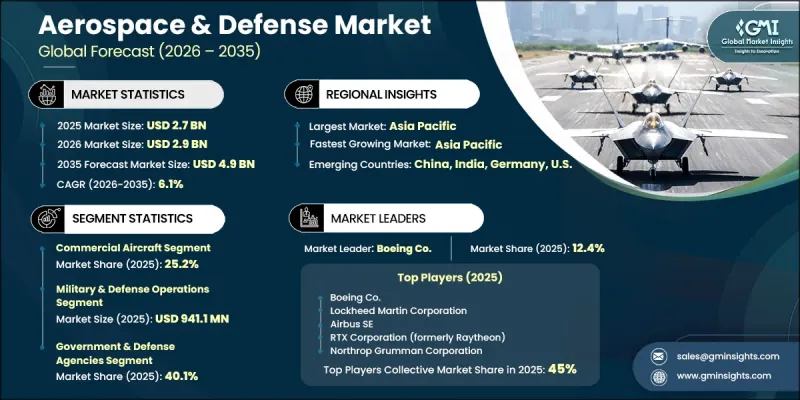
Growth across the aerospace & defense industry is being supported by rising investments in advanced military modernization programs, increasing geopolitical uncertainty, and the expansion of sophisticated air, land, and naval defense systems across major economies. Growing commercial aviation activity, rapid advancements in satellite technologies, and increasing deployment of autonomous and unmanned systems are further contributing to market expansion worldwide. These developments are accelerating demand for next-generation aerospace platforms, mission-focused technologies, and high-performance defense systems. The industry is also witnessing stronger integration of digital technologies to improve operational efficiency, system reliability, and platform performance. In addition, increasing demand for technologically advanced aerospace solutions across both commercial and defense sectors is encouraging long-term investments in innovation, research, and production capabilities. The combination of modernization initiatives, evolving security requirements, and continuous technological advancement continues to strengthen the long-term outlook of the global aerospace & defense market.
| Market Scope | |
|---|---|
| Start Year | 2025 |
| Forecast Year | 2026-2035 |
| Start Value | $2.7 Billion |
| Forecast Value | $4.9 Billion |
| CAGR | 6.1% |
The aerospace & defense market continues to benefit from growing government emphasis on enhancing military readiness through the deployment of advanced aviation systems, surveillance technologies, and space-based defense capabilities. Around 2021, digital engineering and model-based design technologies began gaining significant traction as aerospace and defense manufacturers shifted toward more integrated and accelerated product development processes. These advanced development approaches help reduce redesign expenses, improve operational efficiency, and shorten platform upgrade timelines across both commercial and military programs. In parallel, manufacturers are increasing investments in lightweight materials, advanced propulsion technologies, and energy-efficient aircraft systems as sustainability becomes a critical focus area within future fleet planning strategies. Rising environmental expectations and increasing pressure for more sustainable aviation technologies are expected to continue influencing product development and operational strategies through 2035.
The commercial aircraft segment accounted for 25.2% share in 2025. Strong growth in global air passenger traffic, increasing aircraft replacement programs, and rising demand for fuel-efficient aviation platforms are supporting expansion of this segment. Continuous requirements for aircraft maintenance, fleet modernization, upgrades, and new deliveries are also contributing to sustained manufacturing activity across the commercial aviation sector. These factors collectively position commercial aircraft as the leading platform category within the global aerospace & defense industry.
The military & defense operations segment reached USD 941.1 million in 2025. Ongoing investments in mission-critical systems, advanced combat platforms, defense communication technologies, and surveillance capabilities continue to support growth across this segment. The broad deployment of defense systems across air, land, maritime, and space-based operations ensures stable demand for modernization initiatives and operational readiness programs. Increasing focus on strengthening defense infrastructure and enhancing strategic capabilities continues to reinforce the segment's leading market position.
North America Aerospace & Defense Market accounted for 37.6% share in 2025. Market growth across the region is primarily driven by sustained spending on military modernization programs, strong procurement activity for advanced aircraft systems, and continued upgrades to defense communication, surveillance, and missile defense technologies. Expanding focus on strengthening aerospace and defense capabilities across air, land, and space domains is contributing to higher defense expenditures throughout the region. In addition, increasing support from both government agencies and private sector organizations for domestic production of aerospace systems, space technologies, and defense platforms is accelerating regional market expansion. Long-term capability development programs and growing investments in advanced aerospace manufacturing are further strengthening North America's position within the global aerospace & defense industry.
Major companies operating in the Global Aerospace & Defense Market include Lockheed Martin Corporation, The Boeing Company, Raytheon Technologies Corporation (RTX), Airbus SE, Northrop Grumman Corporation, General Dynamics Corporation, BAE Systems plc, Safran S.A., Leonardo S.p.A, Mitsubishi Heavy Industries, Israel Aerospace Industries, Embraer S.A., SpaceX, Anduril Industries, Joby Aviation, Archer Aviation, Relativity Space, and Shield AI. Companies operating in the aerospace & defense market are implementing multiple strategic initiatives to strengthen technological capabilities, improve competitive positioning, and expand global market presence. Leading manufacturers are increasing investments in advanced research and development focused on autonomous systems, artificial intelligence, next-generation aircraft platforms, and advanced defense technologies. Strategic collaborations with government agencies, defense organizations, and technology providers are helping companies secure long-term contracts and accelerate innovation. Businesses are also focusing on digital engineering, automation, and smart manufacturing technologies to improve operational efficiency and reduce production timelines.
Table of Contents
Chapter 1 Methodology and Scope
- 1.1 Market scope and definition
- 1.2 Research design
- 1.2.1 Research approach
- 1.2.2 Data collection methods
- 1.3 Data mining sources
- 1.3.1 Global
- 1.3.2 Regional/Country
- 1.4 Base estimates and calculations
- 1.4.1 Base year calculation
- 1.4.2 Key trends for market estimation
- 1.5 Primary research and validation
- 1.5.1 Primary sources
- 1.6 Forecast model
- 1.7 Research assumptions and limitations
Chapter 2 Executive Summary
- 2.1 Industry 360° synopsis, 2022 - 2035
- 2.2 Key market trends
- 2.2.1 Platform type trends
- 2.2.2 Application trends
- 2.2.3 End-User trends
- 2.2.4 Regional trends
- 2.3 TAM Analysis, 2026-2035
- 2.4 CXO perspectives: Strategic imperatives
Chapter 3 Industry Insights
- 3.1 Industry ecosystem analysis
- 3.1.1 Supplier Landscape
- 3.1.2 Profit Margin
- 3.1.3 Cost structure
- 3.1.4 Value addition at each stage
- 3.1.5 Factor affecting the value chain
- 3.1.6 Disruptions
- 3.2 Industry impact forces
- 3.2.1 Growth drivers
- 3.2.1.1 Rising defense modernization programs
- 3.2.1.2 Increasing geopolitical tensions and border security needs
- 3.2.1.3 Growth of commercial aviation and fleet expansion
- 3.2.1.4 Advancements in space exploration and satellite deployment
- 3.2.1.5 Adoption of autonomous and unmanned systems
- 3.2.2 Industry pitfalls and challenges
- 3.2.2.1 High program development and procurement costs
- 3.2.2.2 Supply chain vulnerabilities in critical defense components
- 3.2.3 Market opportunities
- 3.2.3.1 Expansion of maintenance, repair, and overhaul (MRO) capabilities
- 3.2.3.2 Integration of commercial technologies into defense systems
- 3.2.1 Growth drivers
- 3.3 Growth potential analysis
- 3.4 Regulatory landscape
- 3.4.1 North America
- 3.4.2 Europe
- 3.4.3 Asia Pacific
- 3.4.4 Latin America
- 3.4.5 Middle East & Africa
- 3.5 Porter's analysis
- 3.6 PESTEL analysis
- 3.7 Technology and Innovation landscape
- 3.7.1 Current technological trends
- 3.7.2 Emerging technologies
- 3.8 Price trends
- 3.8.1 By region
- 3.8.2 By product
- 3.9 Pricing Strategies
- 3.10 Emerging Business Models
- 3.11 Compliance Requirements
- 3.12 Patent and IP analysis
Chapter 4 Competitive Landscape, 2025
- 4.1 Introduction
- 4.2 Company market share analysis
- 4.2.1 By region
- 4.2.1.1 North America
- 4.2.1.2 Europe
- 4.2.1.3 Asia Pacific
- 4.2.1.4 Latin America
- 4.2.1.5 Middle East & Africa
- 4.2.2 Market concentration analysis
- 4.2.1 By region
- 4.3 Competitive benchmarking of key players
- 4.3.1 Financial performance comparison
- 4.3.1.1 Revenue
- 4.3.1.2 Profit margin
- 4.3.1.3 R&D
- 4.3.2 Product portfolio comparison
- 4.3.2.1 Product range breadth
- 4.3.2.2 Technology
- 4.3.2.3 Innovation
- 4.3.3 Geographic presence comparison
- 4.3.3.1 Global footprint analysis
- 4.3.3.2 Service network coverage
- 4.3.3.3 Market penetration by region
- 4.3.4 Competitive positioning matrix
- 4.3.4.1 Leaders
- 4.3.4.2 Challengers
- 4.3.4.3 Followers
- 4.3.4.4 Niche players
- 4.3.5 Strategic outlook matrix
- 4.3.1 Financial performance comparison
- 4.4 Key developments
- 4.4.1 Mergers and acquisitions
- 4.4.2 Partnerships and collaborations
- 4.4.3 Technological advancements
- 4.4.4 Expansion and investment strategies
- 4.4.5 Digital transformation initiatives
- 4.5 Emerging/ startup competitors landscape
Chapter 5 Market Estimates and Forecast, By Platform Type, 2022 - 2035 (USD Million)
- 5.1 Key trends
- 5.2 Commercial aircraft
- 5.2.1 Narrow-body aircraft
- 5.2.2 Wide-body aircraft
- 5.2.3 Regional aircraft
- 5.2.4 Business jets
- 5.2.5 Commercial helicopters
- 5.2.6 Commercial unmanned aerial vehicles (UAVs)
- 5.3 Military aircraft
- 5.3.1 Fighter aircraft
- 5.3.2 Bomber aircraft
- 5.3.3 Military transport aircraft
- 5.3.4 Military helicopters
- 5.3.5 Patrol & reconnaissance aircraft
- 5.3.6 Military unmanned aerial vehicles (UAVs)
- 5.4 Space systems
- 5.4.1 Satellites
- 5.4.2 Launch vehicles & spacecraft
- 5.4.3 Ground systems & infrastructure
- 5.5 Ground defense systems
- 5.6 Naval systems
- 5.7 Missiles & munitions
- 5.8 Aerospace components & parts
- 5.9 Others
Chapter 6 Market Estimates and Forecast, By Application, 2022 - 2035 (USD Million)
- 6.1 Key trends
- 6.2 Commercial aviation
- 6.3 Military & defense operations
- 6.4 Space exploration & satellites
- 6.5 Homeland security & border protection
- 6.6 Maintenance, repair & overhaul (MRO)
- 6.7 Others
Chapter 7 Market Estimates and Forecast, By End-User, 2022 - 2035 (USD Million)
- 7.1 Key trends
- 7.2 Commercial airlines & aviation operators
- 7.3 Government & defense agencies
- 7.4 Space agencies
- 7.5 Original equipment manufacturers (OEMs)
- 7.6 Maintenance & service providers
- 7.7 Others
Chapter 8 Market Estimates and Forecast, By Region, 2022 - 2035 (USD Million)
- 8.1 Key trends
- 8.2 North America
- 8.2.1 U.S.
- 8.2.2 Canada
- 8.3 Europe
- 8.3.1 Germany
- 8.3.2 UK
- 8.3.3 France
- 8.3.4 Spain
- 8.3.5 Italy
- 8.3.6 Russia
- 8.4 Asia Pacific
- 8.4.1 China
- 8.4.2 India
- 8.4.3 Japan
- 8.4.4 Australia
- 8.4.5 South Korea
- 8.5 Latin America
- 8.5.1 Brazil
- 8.5.2 Mexico
- 8.5.3 Argentina
- 8.6 Middle East and Africa
- 8.6.1 South Africa
- 8.6.2 Saudi Arabia
- 8.6.3 UAE
Chapter 9 Company Profiles
- 9.1 Global Key Players
- 9.1.1 Boeing Co.
- 9.1.2 Lockheed Martin Corporation
- 9.1.3 Airbus SE
- 9.1.4 RTX Corporation (formerly Raytheon)
- 9.1.5 Northrop Grumman Corporation
- 9.2 Regional key players
- 9.2.1 North America
- 9.2.1.1 General Dynamics Corporation
- 9.2.1.2 SpaceX
- 9.2.1.3 Anduril Industries
- 9.2.1.4 Joby Aviation
- 9.2.1.5 Archer Aviation
- 9.2.1.6 Relativity Space
- 9.2.1.7 Shield AI
- 9.2.2 Asia Pacific
- 9.2.2.1 Mitsubishi Heavy Industries
- 9.2.2.2 Israel Aerospace Industries
- 9.2.2.3 Embraer S.A.
- 9.2.3 Europe
- 9.2.3.1 BAE Systems plc
- 9.2.3.2 Safran S.A.
- 9.2.3.3 Leonardo S.p.A.
- 9.2.1 North America

