PUBLISHER: Mordor Intelligence | PRODUCT CODE: 2100619

PUBLISHER: Mordor Intelligence | PRODUCT CODE: 2100619
Europe Aerospace and Defense - Market Share Analysis, Industry Trends & Statistics, Growth Forecasts (2026 - 2031)
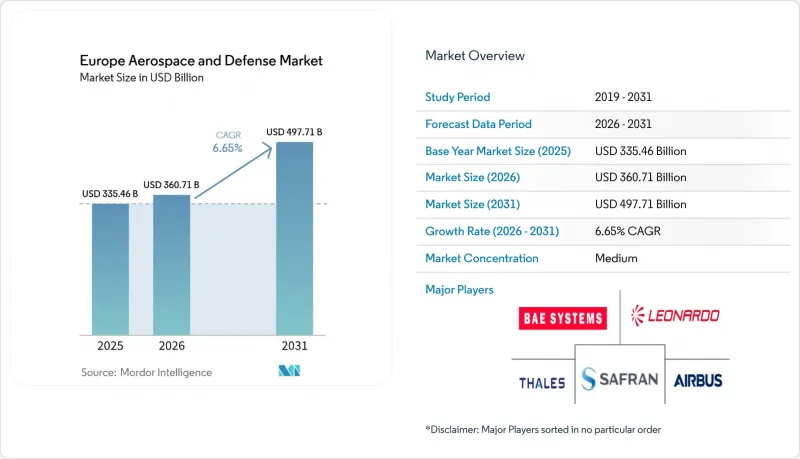
According to Mordor Intelligence, the Europe aerospace and defense market size is expected to grow from USD 335.46 billion in 2025 to USD 360.71 billion in 2026 and is forecasted to reach USD 497.71 billion by 2031 at a 4.90% CAGR over 2026-2031.
This report is Segmented by Industry (Commercial Aviation, Defense, and Space), Type (Platform, Systems, and MRO), Component (Structures and Materials, Propulsion and Power Systems, Mission Payload, Sensors, and More), Point of Sale (Original Equipment Manufacturer and Retrofit/Upgrade), and Geography (United Kingdom, France, and More). The Market Forecasts are Provided in Terms of Value (USD).
Europe Aerospace and Defense Market Trends and Insights
Increased EU Defense Fund and Strategic Compass Budget Allocations
The European Defence Fund (EDF) disbursed EUR 1.5 billion (USD 1.75 billion) in 2025, representing a 15% year-on-year increase, which financed 61 cross-border projects covering next-generation tanks, hypersonic interceptors, and secure satellite communications. The Strategic Compass initiative, approved in 2022, calls for a 5,000-troop Rapid Deployment Capacity by 2025, requiring interoperable Command and Control (C2) networks that legacy national architectures cannot deliver. Multinational teaming has therefore accelerated; KNDS, a Franco-German joint venture, secured funds to prototype the Main Ground Combat System, satisfying funding rules that privilege collaborative bids. Dual-use prioritization is also driving the development of AI-enabled target recognition and autonomous logistics, thereby narrowing Europe's historical gap with US primes. The Europe aerospace and defense market benefits directly as advanced capability programs transition from concept to funded development, securing multi-year pipeline visibility.
Climate-Neutral Aviation and SAF Mandates Driving Aerospace R&D Investments
ReFuelEU Aviation requires a 6% SAF blend by 2030, escalating to 70% by 2050, and imposes financial penalties on suppliers that fail to comply with this requirement. Airbus has earmarked research on hydrogen propulsion through 2035 and is retrofitting its Toulouse final-assembly lines to handle cryogenic tanks. Safran is validating its open-rotor RISE engine, which promises 20% lower fuel burn and full SAF compatibility, with ground tests expected to be completed in 2025. A joint Shell-TotalEnergies power-to-liquid plant slated for Rotterdam will produce 200,000 tons of e-kerosene annually by 2028, ensuring feedstock availability. These mandates shift R&D risk profiles, pulling alternative-propellant programs into the mainstream and creating long-run upside for the Europe aerospace and defense market as civil and military fleets converge on low-carbon technologies.
Supply Chain Vulnerabilities in Titanium and Rare-Earth Materials
Russia supplied 30% of European aerospace-grade titanium before sanctions took hold, and stockpiles are forecast to run dry by mid-2026. Substitution contracts with Japanese mills closed some gaps, but prices climbed 40% between 2024 and 2025, eroding margins on fixed-price airframe deals. Parallel exposure exists in rare-earth magnets, where China controls 85% of global refining capacity and tightened export quotas in 2025. A Thales-Safran recycling venture aims to recover 15% of annual neodymium demand by 2028, yet no domestic extraction projects have broken ground. The Europe aerospace and defense market, therefore, carries raw material cost volatility that could dilute program profitability and stretch delivery schedules.
Other drivers and restraints analyzed in the detailed report include:
- Ukraine Conflict Accelerating Demand for Munitions and Land-Based Defense Systems
- Expansion of Europe's Commercial Small-Launch Ecosystem
- Persistent Skills Shortages in Avionics and Propulsion Engineering
For complete list of drivers and restraints, kindly check the Table Of Contents.
Segment Analysis
Defense accounted for 68.75% of 2025 revenue as governments replenished inventories and elevated readiness. Space captures a smaller baseline but is advancing at an 8.19% CAGR on the strength of IRIS2 and commercial Earth-observation constellations. The dual-use nature of surveillance satellites attracts both civil and military budgets, further enlarging the Europe aerospace and defense market. Commercial aviation is recovering from pandemic-era troughs; Airbus delivered 793 jets in 2025, yet a backlog of over 8,600 aircraft highlights ongoing supply chain bottlenecks.
Space momentum is reinforced by the proliferation of mini-launchers and growing demand for low-Earth-orbit broadband, adding durable upside for sensor payloads, ground-segment software, and frequency-allocation services. Defense growth, though strong, may moderate after initial restocking peaks unless export pipelines offset plateauing domestic spend post-2031. Commercial aviation will hinge on the availability and certification timelines of SAF, which could either compress or stretch the trajectory of the Europe aerospace and defense market size.
Platforms delivered 62.37% of turnover in 2025, driven by fighter aircraft, upgraded frigates, and satellite buses. Systems, however, are projected to expand at a 7.22% CAGR as militaries retrofit digital backbones onto legacy fleets. MBDA's missile order from Poland, Germany, and Italy typifies the shift toward networked effectors. Platform demand remains healthy for unmanned aerial vehicles; Airbus's Zephyr achieved a 64-day stratospheric flight, showcasing long-endurance surveillance at a fractional cost.
Growth in systems reflects the adoption of open architecture, allowing for incremental capability insertions without requiring wholesale fleet replacement. Over the forecast horizon, budget holders favor software-defined radios, AESA radars, and cyber-warfare modules that integrate swiftly and elevate operational readiness, further tilting the share toward systems within the Europe aerospace and defense market.
Complete Report Scope:
- By Industry
- Commercial Aviation
- Defense
- Space
- By Type
- Platform
- Commercial Aviation
- General Aviation
- Military Land Vehicles
- Military Aircraft
- Military Naval Vessels
- Unmanned Systems
- Satellites
- Systems
- Weapons and Munitions
- Sensors
- C4ISR and Tactical Communications
- Electronic and Cyber Warfare Systems
- Air and Missile Defense
- Soldier Systems
- Military Infrastructure
- Training and Simulation
- MRO
- Military MRO
- Commercial aviation MRO
- General Aviation MRO
- Platform
- By Component
- Structures and Materials
- Propulsion and Power Systems
- Mission Payload
- Sensors
- Electronics
- Communications
- Cyber Warfare
- Software and Digital Systems
- Services and Sustainment
- By Point of Sale
- Original Equipment Manufacturer (OEM)
- Retrofit/Upgrade
- By Geography
- United Kingdom
- France
- Germany
- Italy
- Spain
- Russia
- Rest of Europe
List of Companies Covered in this Report:
- Airbus SE
- BAE Systems plc
- Leonardo S.p.A.
- Thales Group
- Safran SA
- Rolls-Royce Holdings plc
- Dassault Aviation
- Saab AB
- Rheinmetall AG
- MBDA
- KNDS N.V.
- Hensoldt AG
- Indra Sistemas S.A.
- Fincantieri S.p.A.
- Navantia S.A.
- MTU Aero Engines AG
- ArianeGroup SAS
- OHB SE
- Patria Oyj
- Diehl Stiftung & Co. KG
- Volocopter Technologies GmbH
- QinetiQ Group
Additional Benefits:
- The market estimate (ME) sheet in Excel format
- 3 months of analyst support
TABLE OF CONTENTS
1 INTRODUCTION
- 1.1 Study Assumptions and Market Definition
- 1.2 Scope of the Study
2 RESEARCH METHODOLOGY
3 EXECUTIVE SUMMARY
4 MARKET LANDSCAPE
- 4.1 Market Overview
- 4.2 Market Drivers
- 4.2.1 Increased EU defense fund and strategic compass budget allocations
- 4.2.2 Climate-neutral aviation and SAF mandates driving aerospace R&D investments
- 4.2.3 Ukraine conflict accelerating demand for munitions and land-based defense systems
- 4.2.4 Expansion of Europe's commercial small-launch and mini-launcher ecosystem
- 4.2.5 Adoption of digital engineering and MBSE to reduce program life-cycle costs
- 4.2.6 Urban air mobility corridor pilot programs advancing next-generation air transport
- 4.3 Market Restraints
- 4.3.1 Supply chain vulnerabilities in titanium and rare earth materials
- 4.3.2 Persistent skills shortages in avionics and propulsion engineering
- 4.3.3 Stringent noise and emissions regulations extending civil certification timelines
- 4.3.4 Fragmented export-control frameworks constraining multinational programs
- 4.4 Value Chain Analysis
- 4.5 Regulatory Landscape
- 4.6 Technological Outlook
- 4.7 Porter's Five Forces Analysis
- 4.7.1 Bargaining Power of Suppliers
- 4.7.2 Bargaining Power of Buyers
- 4.7.3 Threat of New Entrants
- 4.7.4 Threat of Substitutes
- 4.7.5 Competitive Rivalry
5 MARKET SIZE AND GROWTH FORECASTS (VALUE)
- 5.1 By Industry
- 5.1.1 Commercial Aviation
- 5.1.2 Defense
- 5.1.3 Space
- 5.2 By Type
- 5.2.1 Platform
- 5.2.1.1 Commercial Aviation
- 5.2.1.2 General Aviation
- 5.2.1.3 Military Land Vehicles
- 5.2.1.4 Military Aircraft
- 5.2.1.5 Military Naval Vessels
- 5.2.1.6 Unmanned Systems
- 5.2.1.7 Satellites
- 5.2.2 Systems
- 5.2.2.1 Weapons and Munitions
- 5.2.2.2 Sensors
- 5.2.2.3 C4ISR and Tactical Communications
- 5.2.2.4 Electronic and Cyber Warfare Systems
- 5.2.2.5 Air and Missile Defense
- 5.2.2.6 Soldier Systems
- 5.2.2.7 Military Infrastructure
- 5.2.2.8 Training and Simulation
- 5.2.3 MRO
- 5.2.3.1 Military MRO
- 5.2.3.2 Commercial aviation MRO
- 5.2.3.3 General Aviation MRO
- 5.2.1 Platform
- 5.3 By Component
- 5.3.1 Structures and Materials
- 5.3.2 Propulsion and Power Systems
- 5.3.3 Mission Payload
- 5.3.4 Sensors
- 5.3.5 Electronics
- 5.3.6 Communications
- 5.3.7 Cyber Warfare
- 5.3.8 Software and Digital Systems
- 5.3.9 Services and Sustainment
- 5.4 By Point of Sale
- 5.4.1 Original Equipment Manufacturer (OEM)
- 5.4.2 Retrofit/Upgrade
- 5.5 By Geography
- 5.5.1 United Kingdom
- 5.5.2 France
- 5.5.3 Germany
- 5.5.4 Italy
- 5.5.5 Spain
- 5.5.6 Russia
- 5.5.7 Rest of Europe
6 COMPETITIVE LANDSCAPE
- 6.1 Market Concentration
- 6.2 Strategic Moves
- 6.3 Market Share Analysis
- 6.4 Company Profiles (includes Global level Overview, Market level overview, Core Segments, Financials as available, Strategic Information, Market Rank/Share for key companies, Products and Services, and Recent Developments)
- 6.4.1 Airbus SE
- 6.4.2 BAE Systems plc
- 6.4.3 Leonardo S.p.A.
- 6.4.4 Thales Group
- 6.4.5 Safran SA
- 6.4.6 Rolls-Royce Holdings plc
- 6.4.7 Dassault Aviation
- 6.4.8 Saab AB
- 6.4.9 Rheinmetall AG
- 6.4.10 MBDA
- 6.4.11 KNDS N.V.
- 6.4.12 Hensoldt AG
- 6.4.13 Indra Sistemas S.A.
- 6.4.14 Fincantieri S.p.A.
- 6.4.15 Navantia S.A.
- 6.4.16 MTU Aero Engines AG
- 6.4.17 ArianeGroup SAS
- 6.4.18 OHB SE
- 6.4.19 Patria Oyj
- 6.4.20 Diehl Stiftung & Co. KG
- 6.4.21 Volocopter Technologies GmbH
- 6.4.22 QinetiQ Group
7 MARKET OPPORTUNITIES AND FUTURE OUTLOOK
- 7.1 White-space and Unmet-Need Assessment

