PUBLISHER: Global Market Insights Inc. | PRODUCT CODE: 2045675

PUBLISHER: Global Market Insights Inc. | PRODUCT CODE: 2045675
Asia-Pacific Wooden Furniture Market Opportunity, Growth Drivers, Industry Trend Analysis, and Forecast 2026 - 2035
Asia-Pacific Wooden Furniture Market was valued at USD 166 billion in 2025 and is estimated to grow at a CAGR of 5.7% to reach USD 287.4 billion by 2035.
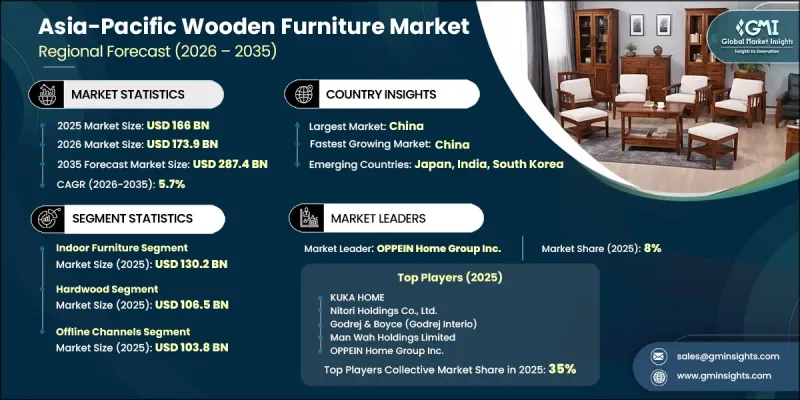
The industry is witnessing notable expansion in both production scale and product refinement, supported by growing consumer purchasing power and an increasing preference for environmentally responsible materials. Demand for premium wooden furnishings continues to climb as consumers prioritize durability, craftsmanship, and natural aesthetics. Manufacturers are responding by enhancing production techniques, adopting responsible sourcing practices, and introducing refined design approaches. Rising disposable income levels across emerging and developed economies in the region are significantly contributing to the demand for higher-end furniture offerings. Digital transformation is also playing a key role, as online retail channels enable wider product accessibility and improve customer engagement through advanced visualization tools. At the same time, government initiatives aimed at strengthening domestic manufacturing ecosystems are reinforcing industry development. The convergence of evolving consumer expectations, design innovation, and sustainability trends is shaping a competitive, rapidly advancing market landscape across Asia-Pacific.
| Market Scope | |
|---|---|
| Start Year | 2025 |
| Forecast Year | 2026-2035 |
| Start Value | $166 Billion |
| Forecast Value | $287.4 Billion |
| CAGR | 5.7% |
The indoor wooden furniture segment held a 78.4% share in 2025 with USD 130.2 billion. This segment continues to lead due to consistent demand from both residential and commercial environments, where functionality, comfort, and design play critical roles. Consumers increasingly prefer furniture that blends practicality with visual appeal, leading to the rise of modern styles that emphasize efficiency and adaptability. Continuous advancements in design and usability have further strengthened the position of indoor furniture within the broader market.
The hardwood materials segment accounted for 64.2% share in 2025, with a value of USD 106.5 billion. This dominance is attributed to the material's strength, longevity, and refined appearance, which align well with premium product positioning. High-quality wooden furniture made from durable materials is widely perceived as a long-term investment, driving strong demand across various consumer segments. The emphasis on quality craftsmanship and superior raw materials continues to influence purchasing decisions and pricing structures.
China Wooden Furniture Market held a 33.6% share in 2025, generating USD 55.7 billion, with an anticipated CAGR of 6.5% through 2035. The country's leadership is driven by its extensive manufacturing capabilities, strong domestic consumption, and expanding middle-income population. Increasing consumer awareness and preference for high-quality furniture are further accelerating market growth. The evolving expectations of buyers are encouraging manufacturers to focus on design innovation and product differentiation.
Key companies operating in the Asia-Pacific Wooden Furniture Market include Man Wah Holdings Limited, Durian Industries Limited, Godrej & Boyce (Godrej Interio), Guangdong Lesso Home, Harvey Norman Holdings Limited, Index Living Mall Public Co., Ltd., Karimoku Furniture Inc., Kokuyo Co., Ltd., KUKA HOME, Maruni Wood Industry Inc., Nitori Holdings Co., Ltd., Okamura Corporation, OPPEIN Home Group Inc., Pepperfry, and Suofeiya Home Collection Co., Ltd. Companies across the Asia-Pacific Wooden Furniture Industry are focusing on multiple strategic initiatives to strengthen their market presence. Businesses are prioritizing product innovation by integrating modern design elements with traditional craftsmanship to appeal to evolving consumer preferences. Investment in sustainable sourcing and environmentally responsible manufacturing processes is becoming a central strategy to align with regulatory standards and consumer expectations. Digital expansion is another key focus, with companies enhancing their e-commerce capabilities and adopting immersive technologies to improve customer experience. Strategic partnerships, regional expansion, and localized production are being leveraged to optimize supply chains and reduce operational costs.
Table of Contents
Chapter 1 Methodology and Scope
- 1.1 Market scope and definition
- 1.2 Research design
- 1.2.1 Research approach
- 1.2.2 Data collection methods
- 1.3 Data mining sources
- 1.3.1 Global
- 1.3.2 Regional/Country
- 1.4 Base estimates and calculations
- 1.4.1 Base year calculation
- 1.4.2 Key trends for market estimation
- 1.5 Primary research and validation
- 1.5.1 Primary sources
- 1.6 Forecast model
- 1.7 Research assumptions and limitations
Chapter 2 Executive Summary
- 2.1 Industry 360° synopsis
- 2.2 Key market trends
- 2.2.1 Product Type
- 2.2.2 Wood Type
- 2.2.3 Price
- 2.2.4 Application
- 2.2.5 Distribution Channel
Chapter 3 Industry Insights
- 3.1 Industry ecosystem analysis
- 3.1.1 Supplier landscape
- 3.1.2 Profit margin
- 3.1.3 Value addition at each stage
- 3.1.4 Factor affecting the value chain
- 3.2 Industry impact forces
- 3.2.1 Growth drivers
- 3.2.1.1 Growing affluence and urbanization in emerging markets
- 3.2.1.2 Rising appreciation for sustainable materials and eco-friendly furniture
- 3.2.1.3 Innovation in furniture design and manufacturing technology
- 3.2.2 Industry pitfalls & challenges
- 3.2.2.1 Competition from alternative materials and ready-to-assemble furniture
- 3.2.2.2 Rising raw material costs and supply chain complexities
- 3.2.3 Opportunities
- 3.2.3.1 Expansion of online retail and direct-to-consumer channels
- 3.2.3.2 Integration of smart features and multifunctional designs
- 3.2.1 Growth drivers
- 3.3 Growth potential analysis
- 3.4 Future market trends
- 3.5 Technology and innovation landscape
- 3.5.1 Current technological trends
- 3.5.2 Emerging technologies
- 3.6 Price trends
- 3.6.1 By Country
- 3.6.2 By Product
- 3.7 Regulatory landscape
- 3.7.1 Standards and compliance requirements
- 3.7.2 Regional regulatory frameworks
- 3.7.3 Certification standards
- 3.8 Trade Data Analysis (Driven by Primary Research)
- 3.8.1 Import/Export Volume & Value Trends (2022-2025) (Driven by Primary Research)
- 3.8.2 Key Trade Corridors & Tariff Impact (Driven by Primary Research)
- 3.9 Porter's analysis
- 3.10 PESTEL analysis
- 3.11 Impact of AI & Generative AI on the Market
- 3.11.1 AI-Driven Disruption of Traditional Retail Models
- 3.11.2 GenAI Use Cases (Virtual Try-on, Personalization, Authentication)
- 3.12 Distribution Infrastructure & Channel Penetration Landscape (Driven by Primary Research)
- 3.12.1 Channel Coverage by Region & Format (Mono-brand vs. Multi-brand) (Driven by Primary Research)
- 3.12.2 E-commerce Infrastructure Gaps & Omnichannel Integration (Driven by Primary Research)
Chapter 4 Competitive Landscape, 2025
- 4.1 Introduction
- 4.2 Company market share analysis
- 4.3 Company matrix analysis
- 4.4 Competitive analysis of major market players
- 4.5 Competitive positioning matrix
- 4.6 Key developments
- 4.6.1 Mergers & acquisitions
- 4.6.2 Partnerships & collaborations
- 4.6.3 New product launches
- 4.6.4 Expansion plans
Chapter 5 Wooden Furniture Market Estimates & Forecast, By Product Type , 2022-2035 (USD Billion) (Thousand Units)
- 5.1 Key trends
- 5.2 Indoor Furniture
- 5.3 Outdoor Furniture
Chapter 6 Wooden Furniture Market Estimates & Forecast, By Wood Type, 2022-2035 (USD Billion) (Thousand Units)
- 6.1 Key trends
- 6.2 Hardwood
- 6.3 Softwood
Chapter 7 Wooden Furniture Market Estimates & Forecast, By Price 2022-2035 (USD Billion) (Thousand Units)
- 7.1 Key trends
- 7.2 Low
- 7.3 Medium
- 7.4 High
Chapter 8 Wooden Furniture Market Estimates & Forecast, By Application 2022-2035 (USD Billion) (Thousand Units)
- 8.1 Key trends
- 8.2 Residential
- 8.2.1 Upholstered furniture
- 8.2.2 Non-upholstered furniture Kitchen
- 8.2.3 Bedroom
- 8.2.4 Kitchen cabinet
- 8.2.5 Dining room
- 8.2.6 Others
- 8.3 Commercial
- 8.3.1 Business/office
- 8.3.2 Educational
- 8.3.3 Healthcare
- 8.3.4 Hospitality
- 8.3.5 Others
Chapter 9 Wooden Furniture Market Estimates & Forecast, By Distribution Channel, 2022-2035 (USD Billion) (Thousand Units)
- 9.1 Key trends
- 9.2 Online
- 9.2.1 E-Commerce Sites
- 9.2.2 Company Websites
- 9.3 Offline
- 9.3.1 Specialty Stores
- 9.3.2 Mega Retail Stores
- 9.3.3 Others (Home Decor etc.)
Chapter 10 Market Estimates and Forecast, By Region, 2022 - 2035 (USD Billion) (Thousand Units)
- 10.1 Key trends
- 10.2 China
- 10.3 Japan
- 10.4 India
- 10.5 South Korea
- 10.6 Indonesia
Chapter 11 Company Profiles
- 11.1 Top Global Player
- 11.1.1 Nitori Holdings Co., Ltd.
- 11.1.2 Okamura Corporation
- 11.1.3 Kokuyo Co., Ltd.
- 11.1.4 Man Wah Holdings Limited
- 11.1.5 OPPEIN Home Group Inc.
- 11.1.6 Harvey Norman Holdings Limited
- 11.2 Regional Player
- 11.2.1 Godrej & Boyce (Godrej Interio)
- 11.2.2 Suofeiya Home Collection Co., Ltd.
- 11.2.3 KUKA HOME
- 11.2.4 Guangdong Lesso Home
- 11.2.5 Karimoku Furniture Inc.
- 11.2.6 Maruni Wood Industry Inc.
- 11.3 Emerging Players
- 11.3.1 Durian Industries Limited
- 11.3.2 Index Living Mall Public Co., Ltd.
- 11.3.3 Pepperfry

