PUBLISHER: Global Market Insights Inc. | PRODUCT CODE: 2045815

PUBLISHER: Global Market Insights Inc. | PRODUCT CODE: 2045815
Wooden Furniture Market Opportunity, Growth Drivers, Industry Trend Analysis, and Forecast 2026 - 2035
The Global Wooden Furniture Market was valued at USD 417.5 billion in 2025 and is estimated to grow at a CAGR of 4.9% to reach USD 668.5 billion by 2035.
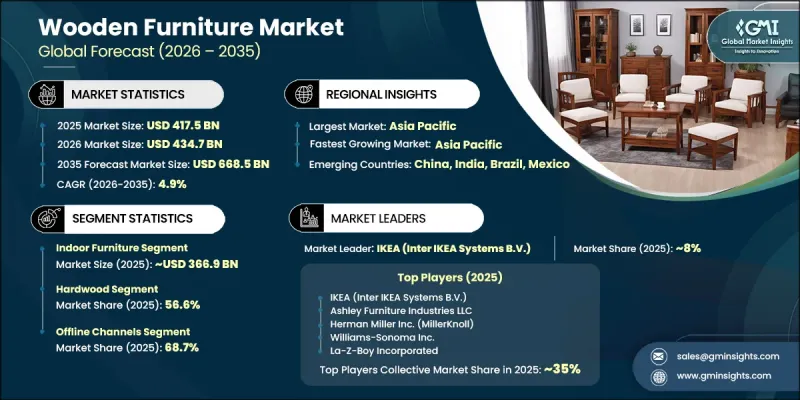
The market is experiencing expansion driven by rapid urbanization, rising disposable incomes, and continuous growth in residential and commercial construction activities worldwide. Increasing real estate development is significantly boosting demand for both new and replacement furniture. Consumers are showing a stronger preference for products that combine durability, sustainability, and visual appeal, positioning wooden furniture as a preferred choice across global markets. The natural aesthetics, long lifespan, and eco-friendly nature of wood-based products are further strengthening adoption trends. Rising awareness of sustainable sourcing practices is also encouraging demand for responsibly manufactured furniture. In residential settings, wooden furniture enhances interior warmth and comfort in living spaces and bedrooms, while in commercial environments such as offices and retail spaces, it supports functional design and creates a more welcoming atmosphere. Expanding hospitality infrastructure, including hotels and restaurants, is further supporting demand for premium wooden furniture solutions that enhance interior design quality and customer experience.
| Market Scope | |
|---|---|
| Start Year | 2025 |
| Forecast Year | 2026-2035 |
| Start Value | $417.5 Billion |
| Forecast Value | $668.5 Billion |
| CAGR | 4.9% |
The indoor furniture segment generated USD 366.9 billion in 2025 and is expected to grow at a CAGR of 4.8% through 2035. This segment continues to dominate the market due to its extensive use across residential and commercial applications. Indoor wooden furniture includes products such as bedroom furnishings, living room setups, dining arrangements, office interiors, storage units, and cabinets. Growing residential construction activity and rising home renovation projects are key contributors to sustained demand. Commercial spaces such as corporate offices, hospitality establishments, and retail outlets continue to rely on indoor wooden furniture for both functionality and design appeal. The adaptability of wood allows manufacturers to produce diverse styles, ranging from classic designs to modern aesthetics, further supporting consistent market demand.
The hardwood segment held a 56.6% share in 2025 and is projected to grow at a CAGR of 5.4% between 2026 and 2035. Hardwood remains the most preferred material category due to its superior strength, durability, and premium appearance. Common hardwood varieties are widely used in the production of high-quality furniture due to their resistance to wear and long service life. These materials are especially suitable for frequently used furniture items such as tables and seating solutions. Distinct natural grain patterns and rich tones enhance the visual appeal of hardwood furniture, making it highly desirable in both residential and commercial interiors.
U.S. Wooden Furniture Market was valued at USD 91.4 billion in 2025 and is forecast to grow at a CAGR of 4.9% through 2035. Market growth is supported by strong housing activity, rising renovation spending, and steady expansion in commercial real estate development. Demand is further driven by new residential construction and existing home sales. The growing adoption of remote and hybrid working models has increased demand for home office furniture, including wooden desks and storage solutions. Consumer inclination toward premium, durable, and sustainable products continues to support market expansion. Additionally, the growth of e-commerce platforms is improving product accessibility and enabling furniture brands to reach wider consumer bases across the country.
Major players operating in the Global Wooden Furniture Industry include IKEA (Inter IKEA Systems B.V.), Ashley Furniture Industries LLC, Godrej & Boyce (Godrej Interio), Ethan Allen Interiors Inc., La-Z-Boy Incorporated, Bassett Furniture Industries Inc., Herman Miller Inc. (MillerKnoll), Hooker Furniture Corporation, Flexsteel Industries Inc., Williams-Sonoma Inc., Haworth Inc., Natuzzi S.p.A., Kimball International Inc., Nobilia-Werke GmbH, and Nowy Styl Group. Companies in the wooden furniture market are increasingly focusing on sustainable sourcing of raw materials and certified wood procurement to strengthen brand credibility. Many manufacturers are expanding product portfolios with modular and multifunctional furniture designs to meet evolving consumer space optimization needs. Digital transformation through e-commerce expansion and direct-to-consumer platforms is improving market reach and sales efficiency. Strategic collaborations with real estate developers and hospitality chains are supporting large-scale project-based demand. Firms are also investing in advanced woodworking technologies and automation to enhance production efficiency and design precision.
Table of Contents
Chapter 1 Methodology and Scope
- 1.1 Market scope and definition
- 1.2 Research design
- 1.2.1 Research approach
- 1.2.2 Data collection methods
- 1.3 Data mining sources
- 1.3.1 Global
- 1.3.2 Regional/Country
- 1.4 Base estimates and calculations
- 1.4.1 Base year calculation
- 1.4.2 Key trends for market estimation
- 1.5 Primary research and validation
- 1.5.1 Primary sources
- 1.6 Forecast model
- 1.7 Research assumptions and limitations
Chapter 2 Executive Summary
- 2.1 Industry 360° synopsis
- 2.2 Key market trends
- 2.2.1 Regional
- 2.2.2 Product Type
- 2.2.3 Wood Type
- 2.2.4 Price
- 2.2.5 Application
- 2.2.6 Distribution Channel
Chapter 3 Industry Insights
- 3.1 Industry ecosystem analysis
- 3.1.1 Supplier landscape
- 3.1.2 Profit margin
- 3.1.3 Value addition at each stage
- 3.1.4 Factor affecting the value chain
- 3.2 Industry impact forces
- 3.2.1 Growth drivers
- 3.2.1.1 Growing urbanization and rising disposable incomes
- 3.2.1.2 Expansion of real estate and hospitality industries
- 3.2.1.3 Rising preference for sustainable and eco-friendly products
- 3.2.2 Industry pitfalls & challenges
- 3.2.2.1 Fluctuating raw material costs and supply chain disruptions
- 3.2.2.2 Competition from alternative materials and synthetic furniture
- 3.2.3 Opportunities
- 3.2.3.1 Growing e-commerce and online furniture retail
- 3.2.3.2 Increasing demand for customized and artisanal furniture
- 3.2.1 Growth drivers
- 3.3 Growth potential analysis
- 3.4 Future market trends
- 3.5 Technology and innovation landscape
- 3.5.1 Current technological trends
- 3.5.2 Emerging technologies
- 3.6 Price trends
- 3.6.1 Historical Price Trend Analysis (Driven by Primary Research)
- 3.6.2 Pricing Strategy by Player Type (Premium/Value/Cost-plus) (Driven by Primary Research)
- 3.7 Regulatory landscape
- 3.7.1 Standards and compliance requirements
- 3.7.2 Regional regulatory frameworks
- 3.7.3 Certification standards
- 3.8 Porter's analysis
- 3.9 PESTEL analysis
- 3.10 Trade Data Analysis (Driven by Primary Research)
- 3.10.1 Import/Export Volume & Value Trends (Driven by Primary Research)
- 3.10.2 Key Trade Corridors & Tariff Impact (Driven by Primary Research)
- 3.10.3 Regional Trade Balances & Self-Sufficiency Levels
- 3.11 Impact of AI & Generative AI on the Market
- 3.11.1 AI-Driven Disruption of Existing Business Models
- 3.11.2 GenAI Use Cases & Adoption Roadmap by Segment
- 3.11.3 Risks, Limitations & Regulatory Considerations
- 3.12 Capacity & Production Landscape (Driven by Primary Research)
- 3.12.1 Installed Capacity by Region & Key Producer (Driven by Primary Research)
- 3.12.2 Capacity Utilization Rates & Expansion Pipelines (Driven by Primary Research)
Chapter 4 Competitive Landscape, 2025
- 4.1 Introduction
- 4.2 Company market share analysis
- 4.2.1 By region
- 4.2.1.1 North America
- 4.2.1.2 Europe
- 4.2.1.3 Asia Pacific
- 4.2.1.4 Latin America
- 4.2.1.5 Middle East and Africa
- 4.2.1 By region
- 4.3 Company matrix analysis
- 4.4 Competitive analysis of major market players
- 4.5 Competitive positioning matrix
- 4.6 Key developments
- 4.6.1 Mergers & acquisitions
- 4.6.2 Partnerships & collaborations
- 4.6.3 New product launches
- 4.6.4 Expansion plans
Chapter 5 Wooden Furniture Market Estimates & Forecast, By Product Type , 2022-2035 (USD Billion) (Thousand Units)
- 5.1 Key trends
- 5.2 Indoor Furniture
- 5.3 Outdoor Furniture
Chapter 6 Wooden Furniture Market Estimates & Forecast, By Wood Type, 2022-2035 (USD Billion) (Thousand Units)
- 6.1 Key trends
- 6.2 Hardwood
- 6.3 Softwood
Chapter 7 Wooden Furniture Market Estimates & Forecast, By Price 2022-2035 (USD Billion) (Thousand Units)
- 7.1 Key trends
- 7.2 Low
- 7.3 Medium
- 7.4 High
Chapter 8 Wooden Furniture Market Estimates & Forecast, By Application 2022-2035 (USD Billion) (Thousand Units)
- 8.1 Key trends
- 8.2 Residential
- 8.2.1 Upholstered furniture
- 8.2.2 Non-upholstered furniture Kitchen
- 8.2.3 Bedroom
- 8.2.4 Kitchen cabinet
- 8.2.5 Dining room
- 8.2.6 Others
- 8.3 Commercial
- 8.3.1 Business/office
- 8.3.2 Educational
- 8.3.3 Healthcare
- 8.3.4 Hospitality
- 8.3.5 Others
Chapter 9 Wooden Furniture Market Estimates & Forecast, By Distribution Channel, 2022-2035 (USD Billion) (Thousand Units)
- 9.1 Key trends
- 9.2 Online
- 9.2.1 E-Commerce Sites
- 9.2.2 Company Websites
- 9.3 Offline
- 9.3.1 Specialty Stores
- 9.3.2 Mega Retail Stores
- 9.3.3 Others (Home Decor etc.)
Chapter 10 Market Estimates and Forecast, By Region, 2022 - 2035 (USD Billion) (Thousand Units)
- 10.1 Key trends
- 10.2 North America
- 10.2.1 U.S.
- 10.2.2 Canada
- 10.3 Europe
- 10.3.1 Germany
- 10.3.2 UK
- 10.3.3 France
- 10.3.4 Italy
- 10.3.5 Spain
- 10.4 Asia Pacific
- 10.4.1 China
- 10.4.2 Japan
- 10.4.3 India
- 10.4.4 Australia
- 10.4.5 South Korea
- 10.5 Latin America
- 10.5.1 Brazil
- 10.5.2 Mexico
- 10.5.3 Argentina
- 10.6 Middle East and Africa
- 10.6.1 South Africa
- 10.6.2 Saudi Arabia
- 10.6.3 UAE
Chapter 11 Company Profiles
- 11.1 Top Global Player
- 11.1.1 IKEA (Inter IKEA Systems B.V.)
- 11.1.2 Ashley Furniture Industries LLC
- 11.1.3 Herman Miller Inc. (MillerKnoll)
- 11.1.4 Williams-Sonoma Inc.
- 11.1.5 Ethan Allen Interiors Inc.
- 11.1.6 Natuzzi S.p.A.
- 11.1.7 Haworth Inc.
- 11.2 Regional Player
- 11.2.1 La-Z-Boy Incorporated
- 11.2.2 Godrej & Boyce (Godrej Interio)
- 11.2.3 Nowy Styl Group
- 11.2.4 Bassett Furniture Industries Inc.
- 11.2.5 Hooker Furniture Corporation
- 11.3 Emerging Players
- 11.3.1 Flexsteel Industries Inc.
- 11.3.2 Kimball International Inc.
- 11.3.3 Nobilia-Werke GmbH

