
PUBLISHER: Global Market Insights Inc. | PRODUCT CODE: 2045677

PUBLISHER: Global Market Insights Inc. | PRODUCT CODE: 2045677
Europe Cosmetics and Personal Care Products Market Opportunity, Growth Drivers, Industry Trend Analysis, and Forecast 2026 - 2035
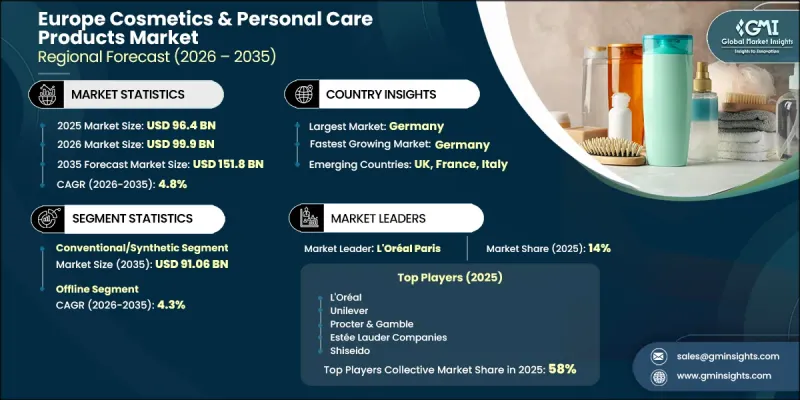
Europe Cosmetics & Personal Care Products Market was valued at USD 96.4 billion in 2025 and is estimated to grow at a CAGR of 4.8% to reach USD 151.8 billion by 2035.
Rising consumer preference for clean-label beauty and personal care products is significantly influencing the growth trajectory of the Europe cosmetics & personal care products industry. Consumers across the region are increasingly prioritizing formulations that emphasize ingredient transparency, product safety, sustainability, and dermatological effectiveness. Demand for products designed to support skin protection, anti-aging benefits, and advanced beauty enhancement continues to rise as consumers seek high-performance solutions with minimal environmental impact. The growing popularity of premium beauty routines and the increasing adoption of digitally influenced purchasing behavior are further strengthening market demand. In addition, beauty brands are expanding product portfolios with formulations focused on natural ingredients, sustainable sourcing, and environmentally responsible packaging solutions. Technological advancements in cosmetic formulations, combined with increasing investments in biotechnology-based ingredients, are also contributing to innovation throughout the market. Manufacturers are introducing products featuring advanced active compounds and skin-friendly formulations to improve efficacy and consumer satisfaction. Growing focus on refillable packaging, low-water formulations, and sustainable beauty concepts continues to reshape the competitive landscape across the European cosmetics and personal care products market.
| Market Scope | |
|---|---|
| Start Year | 2025 |
| Forecast Year | 2026-2035 |
| Start Value | $96.4 Billion |
| Forecast Value | $151.8 Billion |
| CAGR | 4.8% |
The Europe cosmetics & personal care products market is experiencing steady innovation driven by increasing demand for premium formulations and scientifically developed beauty solutions. Consumers are becoming more selective regarding product ingredients and are increasingly seeking formulations designed to provide improved skin and hair care performance. Advanced ingredient technologies, including biotechnology-derived compounds and naturally sourced actives, are gaining strong traction among manufacturers focused on product differentiation. The market is also benefiting from rising investment in sustainable product development and environmentally responsible packaging innovations. Continuous expansion of premium product lines and increasing consumer interest in personalized beauty solutions are expected to further support industry growth across the region.
The conventional and synthetic segment generated USD 59.2 billion in 2025 and is anticipated to reach USD 91.06 billion by 2035, growing at a CAGR of 4.5%. The segment continues to maintain a significant market presence due to the widespread availability and established consumer familiarity associated with these products. At the same time, growing awareness regarding ingredient safety, environmental concerns, and long-term wellness is encouraging consumers to increasingly evaluate product compositions before purchase. This shift in purchasing behavior is accelerating demand for products developed with naturally derived ingredients and cleaner formulations. Sustainable packaging solutions, ethical product positioning, and environmentally conscious manufacturing practices are also contributing to changing consumer preferences across the Europe cosmetics & personal care products industry.
The offline distribution channel accounted for 58.5% share in 2025 and is projected to grow at a CAGR of 4.3% from 2025 to 2035. Physical retail channels continue to dominate the market because consumers prefer direct interaction with beauty and personal care products before making purchasing decisions. The ability to evaluate textures, fragrances, product quality, and overall performance in-store remains an important factor influencing consumer behavior. In addition, offline retail locations provide personalized assistance, professional recommendations, and immediate product availability, which enhance the overall shopping experience. Department stores, beauty specialty retailers, supermarkets, and pharmacies continue to play a major role in strengthening product visibility and customer engagement across the region.
Europe Cosmetics & Personal Care Products Market is forecast to increase from USD 96.4 billion in 2025 to USD 151.8 billion by 2035, expanding at a CAGR of 4.8%. Strong regulatory frameworks, strict quality standards, and increasing consumer emphasis on safe and ethically manufactured products continue to support market development throughout Europe. Consumers across the region show strong preference for products with transparent labeling, sustainable packaging, and high-quality formulations. Demand for scientifically developed ingredients with enhanced efficacy and low sensitivity profiles is also rising steadily, particularly among aging consumer groups seeking advanced skincare and wellness solutions. The region's well-established expertise in pharmaceutical and chemical innovation continues to support the development of high-performance cosmetic and personal care products.
Major companies operating in the Europe Cosmetics & Personal Care Products Market include Amorepacific Corporation, Avon Products, Inc., Beiersdorf AG, Coty Inc., Estee Lauder Companies Inc., Fenty Beauty, Henkel AG & Co. KGaA, Kao Corporation, Kenvue Inc., L'Oreal S.A., LVMH, Procter & Gamble Co., Revlon, Inc., Shiseido Company, Limited, and Unilever PLC. Companies operating in the Europe cosmetics & personal care products market are implementing multiple strategic initiatives to strengthen their market position and improve long-term competitiveness. Manufacturers are increasing investments in research and development to introduce advanced skincare, haircare, and wellness formulations with improved efficacy and cleaner ingredient profiles. Businesses are also focusing on sustainable packaging innovations, refillable product systems, and environmentally responsible sourcing practices to align with evolving consumer expectations. Strategic collaborations with retailers, digital influencers, and dermatology-focused brands are helping companies improve customer engagement and strengthen brand loyalty. In addition, market participants are expanding premium product portfolios and enhancing omnichannel distribution strategies to increase product accessibility across online and offline channels.
Table of Contents
Chapter 1 Research Methodology
- 1.1 Research approach
- 1.2 Quality Commitments
- 1.2.1 GMI AI policy & data integrity commitment
- 1.2.1.1 Source consistency protocol
- 1.2.1 GMI AI policy & data integrity commitment
- 1.3 Research Trail & Confidence Scoring
- 1.3.1 Research Trail Components
- 1.3.2 Scoring Components
- 1.4 Data Collection
- 1.4.1 Partial list of primary sources
- 1.5 Data mining sources
- 1.5.1 Paid sources
- 1.5.1.1 Sources, by countries
- 1.5.1 Paid sources
- 1.6 Base estimates and calculations
- 1.6.1 Base year calculation for any one approach
- 1.7 Forecast model
- 1.7.1 Quantified market impact analysis
- 1.7.1.1 Mathematical impact of growth parameters on forecast
- 1.7.1 Quantified market impact analysis
- 1.8 Research transparency addendum
- 1.8.1 Source attribution framework
- 1.8.2 Quality assurance metrics
- 1.8.3 Our commitment to trust
Chapter 2 Executive Summary
- 2.1 Industry 360° snapshot
- 2.2 Company market share analysis
- 2.3 Product
- 2.4 Ingredient Type
- 2.5 Consumer group
- 2.6 Price
- 2.7 Distribution Channel
Chapter 3 Industry Insights
- 3.1 Industry ecosystem analysis
- 3.1.1 Supplier landscape
- 3.1.2 Profit margin
- 3.1.3 Value addition at each stage
- 3.1.4 Factor affecting the value chain
- 3.2 Industry impact forces
- 3.2.1 Market growth driver
- 3.2.1.1 Rising adoption of natural and organic beauty products
- 3.2.1.2 Digital transformation & personalized beauty
- 3.2.1.3 Dermatology & professional beauty influence
- 3.2.2 Market challenges
- 3.2.2.1 Regulatory complexity & compliance costs
- 3.2.2.2 Ingredient sourcing & sustainability pressure
- 3.2.3 Opportunities
- 3.2.3.1 The "Wellness Beauty" Convergence
- 3.2.3.2 Emerging market expansion
- 3.2.1 Market growth driver
- 3.3 Growth potential analysis
- 3.4 Future market trends
- 3.5 Technology and innovation landscape
- 3.5.1 Current technological trends
- 3.5.2 Emerging technologies
- 3.6 Regulatory landscape
- 3.6.1 Regional regulatory frameworks
- 3.6.2 Certification standards
- 3.7 Trade data analysis (HS Code -3304)
- 3.7.1 Import/export volume & value trends
- 3.7.2 Key trade corridors & partner countries
- 3.7.3 Tariff impact on export competitiveness
- 3.7.4 Trade balance analysis (2022-2025)
- 3.8 Porter’s analysis
- 3.9 PESTEL analysis
- 3.10 Impact of AI & generative ai on the market
- 3.10.1 AI-driven disruption of existing business models
- 3.10.2 GenAI use cases & adoption roadmap by segment
- 3.10.3 Risks, limitations & regulatory considerations
- 3.11 Pricing Analysis (Driven by Primary Research)
- 3.11.1 Historical Price Trend Analysis (2022-2025)
- 3.11.2 Pricing Strategy by Player Type
- 3.11.3 Price Sensitivity Analysis by Segment
- 3.12 Consumer behaviour analysis
- 3.12.1 Purchasing patterns
- 3.12.2 Preference analysis
- 3.12.3 Regional variations in consumer behaviour
- 3.12.4 Impact of e-commerce on buying decisions
Chapter 4 Competitive Landscape, 2025
- 4.1 Introduction
- 4.2 Company market share analysis
- 4.3 Company matrix analysis
- 4.4 Competitive analysis of major market players
- 4.5 Competitive positioning matrix
- 4.6 Key developments
- 4.6.1 Mergers & acquisitions
- 4.6.2 Partnerships & collaborations
- 4.6.3 New product launches
- 4.6.4 Expansion plans
Chapter 5 Market Estimates and Forecast, By Product, 2022 - 2035 (USD Billion) (Million Units)
- 5.1 Key trends
- 5.2 Personal care
- 5.2.1 Skincare
- 5.2.2 Body Care
- 5.2.3 Sun Care
- 5.2.4 Haircare
- 5.2.5 Bath & Shower
- 5.2.6 Oral Care
- 5.2.7 Men's Grooming
- 5.2.8 Fragrances & Perfumes
- 5.2.9 Feminine Hygiene
- 5.3 Makeup & Color Cosmetics
- 5.3.1 Facial Cosmetics
- 5.3.2 Eye Cosmetics
- 5.3.3 Lip Cosmetics
- 5.3.4 Nail Cosmetics
- 5.4 Services
- 5.4.1 Spa & Wellness Services
- 5.4.2 Hair Salons
- 5.4.3 Nail Salons
- 5.4.4 Beauty Clinics & Aesthetic Treatments
- 5.4.5 Makeup Services
Chapter 6 Market Estimates and Forecast, By Ingredient Type, 2022 - 2035 (USD Billion) (Million Units)
- 6.1 Key trends
- 6.2 Natural & Organic
- 6.3 Conventional/Synthetic
Chapter 7 Market Estimates and Forecast, By Consumer group, 2022 - 2035 (USD Billion) (Million Units)
- 7.1 Key trends
- 7.2 Female
- 7.3 Male
- 7.4 Kids
Chapter 8 Market Estimates and Forecast, By Price, 2022 - 2035 (USD Billion) (Million Units)
- 8.1 Key trends
- 8.2 Low
- 8.3 Medium
- 8.4 High
Chapter 9 Market Estimates and Forecast, By Distribution Channel, 2022 - 2035 (USD Billion) (Million Units)
- 9.1 Key trends
- 9.2 Online
- 9.2.1 E-commerce
- 9.2.2 Company website
- 9.3 Offline
- 9.3.1 Specialty Stores
- 9.3.2 Pharmacies
- 9.3.3 Salons
- 9.4 Others (departmental stores, etc.)
Chapter 10 Market Estimates & Forecast, By Country, 2022 - 2035, (USD Billion) (Million Units)
- 10.1 Key trends
- 10.2 Europe
- 10.2.1 Germany
- 10.2.2 UK
- 10.2.3 France
- 10.2.4 Italy
- 10.2.5 Spain
Chapter 11 Company Profiles
- 11.1 Top Global Players
- 11.1.1 L'Oreal
- 11.1.2 Unilever
- 11.1.3 Procter & Gamble
- 11.1.4 Estee Lauder Companies
- 11.1.5 Shiseido
- 11.2 Regional Champions
- 11.2.1 Beiersdorf
- 11.2.2 Kao Corporation
- 11.2.3 Amorepacific
- 11.2.4 Henkel
- 11.2.5 LVMH (Beauty Division)
- 11.3 Emerging & Specialized Players
- 11.3.1 Kenvue Inc.
- 11.3.2 Fenty Beauty
- 11.3.3 Revlon
- 11.3.4 Avon
- 11.3.5 Coty Inc.

