PUBLISHER: Global Market Insights Inc. | PRODUCT CODE: 2045680

PUBLISHER: Global Market Insights Inc. | PRODUCT CODE: 2045680
Asia-Pacific Wooden Toy Market Opportunity, Growth Drivers, Industry Trend Analysis, and Forecast 2026 - 2035
Asia-Pacific Wooden Toy Market was valued at USD 9.5 billion in 2025 and is estimated to grow at a CAGR of 6.5% to reach USD 18.3 billion by 2035.
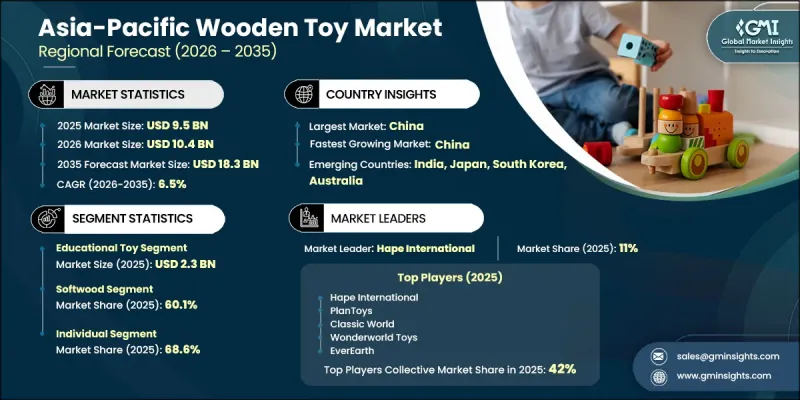
Growth across the Asia-Pacific wooden toy industry is fueled by rising consumer awareness regarding child development, increasing household spending power, and a stronger preference for safe and eco-friendly play products. Parents across the region are increasingly choosing toys that support learning, creativity, and long-term developmental benefits while also meeting sustainability expectations. Growing demand for environmentally responsible products manufactured from non-toxic materials continues to create new opportunities for manufacturers operating in the Asia Pacific wooden toy market. The market is also benefiting from the integration of educational value with traditional play concepts, encouraging companies to introduce innovative and skill-focused toy designs that align with evolving parenting preferences. Expanding middle-class populations and rising disposable incomes across key regional economies are further supporting market demand for premium-quality wooden toys. In addition, the rapid growth of online retail platforms has significantly improved product accessibility for consumers while enabling both established and emerging brands to strengthen their presence across the Asia-Pacific wooden toy industry. Features such as digital product visualization, customization capabilities, and interactive online shopping experiences continue to improve customer engagement and purchasing confidence.
| Market Scope | |
|---|---|
| Start Year | 2025 |
| Forecast Year | 2026-2035 |
| Start Value | $9.5 Billion |
| Forecast Value | $18.3 Billion |
| CAGR | 6.5% |
The educational toy segment held a 24.2% share, generating USD 2.3 billion in 2025. The segment continues to lead the market as parents increasingly prioritize products that contribute to learning and cognitive development during childhood. Educational wooden toys are widely preferred because they support problem-solving abilities, creativity, motor skill enhancement, and interactive learning experiences across multiple age groups. Consumers are increasingly seeking toys that combine entertainment with developmental value, driving strong demand for educational wooden products. Modern educational wooden toys are also evolving with advanced design concepts focused on improving sensory engagement, logical thinking, and early learning capabilities, further strengthening the segment's market position.
The softwood segment held a 60.1% share, generating USD 4.34 billion in 2025. Softwood continues to dominate the market due to its affordability, lightweight characteristics, and flexibility in manufacturing various toy designs. Manufacturers prefer softwood materials because they are easier to shape, finish, and customize while maintaining cost efficiency and product quality. Consumers also favor softwood toys for their durability, safety standards, and visually appealing finishes. Advancements in wood treatment technologies and safety enhancement processes are further increasing the popularity of softwood-based toys across the regional market while helping manufacturers maintain competitive pricing structures.
China Wooden Toy Market held a 43.4% share in 2025, generating USD 4.1 billion. The country is anticipated to expand at a CAGR of 7.1% through 2035. China's leadership position is supported by its extensive manufacturing capabilities, strong domestic consumption, and rapidly expanding middle-income population investing in premium children's products. The market is benefiting from increasing consumer awareness regarding educational development and the growing preference for high-quality wooden toys designed to support learning and creativity. Rising urbanization levels and increasing spending on child-focused products continue to create strong demand for wooden toys across major metropolitan areas. In addition, improving living standards and a greater emphasis on safe and sustainable toys are encouraging consumers to shift toward premium wooden toy products within the Chinese market.
Key companies operating in the Asia-Pacific Wooden Toy Market include Aden & Ren, Ariro Toys, Child Friend (CFW), Classic World, DAWON MONTESSORI, EverEarth, GENI, Hape International, Kukkia, Masterkidz, MOKULOCK, Once a Tree, PlanToys, PlayMe Toys, Qtoys, SD Woodentoy, Sunta Toys, Tano Co., Ltd, Tree Toys, Voila Toys, and Wonderworld Toys. Companies operating in the Asia-Pacific wooden toy industry are implementing a variety of strategic initiatives to strengthen their market foothold and improve long-term competitiveness. Leading manufacturers are investing heavily in sustainable sourcing practices, eco-friendly production technologies, and non-toxic materials to align with changing consumer expectations regarding safety and environmental responsibility. Businesses are also focusing on product innovation by developing educational and skill-based toys designed to support child development and interactive learning. Expansion of online sales channels and partnerships with e-commerce platforms are helping brands improve market visibility and customer reach across regional markets. In addition, companies are enhancing product customization capabilities, strengthening brand positioning through digital marketing campaigns, and expanding distribution networks to capture growing demand for premium wooden toys throughout the Asia-Pacific region.
Table of Contents
Chapter 1 Methodology and Scope
- 1.1 Market scope and definition
- 1.2 Research design
- 1.2.1 Research approach
- 1.2.2 Data collection methods
- 1.3 Data mining sources
- 1.3.1 Global
- 1.3.2 Regional/Country
- 1.4 Base estimates and calculations
- 1.4.1 Base year calculation
- 1.4.2 Key trends for market estimation
- 1.5 Primary research and validation
- 1.5.1 Primary sources
- 1.6 Forecast model
- 1.7 Research assumptions and limitations
Chapter 2 Executive Summary
- 2.1 Industry 360° synopsis, 2022 - 2035
- 2.2 Key market trends
- 2.2.1 Regional trends
- 2.2.2 Product type trends
- 2.2.3 Price trends
- 2.2.4 Age group trends
- 2.2.5 Wood type trends
- 2.2.6 End use trends
- 2.2.7 Distribution channel trends
Chapter 3 Industry Insights
- 3.1 Industry ecosystem analysis
- 3.1.1 Factor affecting the value chain
- 3.1.2 Profit margin analysis
- 3.1.3 Disruptions
- 3.1.4 Future outlook
- 3.1.5 Manufacturers
- 3.1.6 Distributors
- 3.2 Supplier landscape
- 3.3 Key news & initiatives
- 3.4 Regulatory landscape
- 3.4.1 EU Toy Safety Directive (2009/48/EC) & EN 71 Standards
- 3.4.2 U.S. CPSIA & ASTM F963 Compliance Requirements
- 3.4.3 ISO 8124 International Standards
- 3.4.4 Chemical Restrictions (REACH, Prop 65)
- 3.5 Impact forces
- 3.5.1 Growth drivers
- 3.5.1.1 Growing awareness about child development and educational play
- 3.5.1.2 Rising demand for eco-friendly and sustainable toy materials
- 3.5.1.3 Innovation in educational concepts and design
- 3.5.2 Industry pitfalls & challenges
- 3.5.2.1 Competition from plastic toys and digital entertainment
- 3.5.2.2 Rising raw material costs and supply chain complexities
- 3.5.3 Opportunities
- 3.5.3.1 Expansion of online retail and direct-to-consumer channels
- 3.5.3.2 Integration of traditional play with modern educational concepts
- 3.5.1 Growth drivers
- 3.6 Pricing analysis, 2025 (driven by primary research)
- 3.6.1 Historical price trend analysis (2022-2025)
- 3.6.2 Pricing strategy by player type (premium/value/cost-plus)
- 3.6.3 Regional price variation analysis
- 3.6.4 Impact of raw material costs on pricing
- 3.7 Consumer buying behavior analysis
- 3.7.1 Demographic trends
- 3.7.2 Factors affecting buying decisions
- 3.7.3 Consumer product adoption
- 3.7.4 Preferred distribution channel
- 3.8 Growth potential analysis
- 3.9 Porter’s analysis
- 3.10 PESTEL analysis
- 3.11 Trade data analysis (driven by paid database)
- 3.11.1 Import/export volume & value trends
- 3.11.2 Key trade corridors & tariff impact
- 3.11.3 Export destination analysis
- 3.11.4 Import source analysis for raw materials
- 3.12 Impact of AI & generative AI on the market
- 3.12.1 AI-driven disruption of existing business models
- 3.12.2 GenAI use cases & adoption roadmap by segment
- 3.12.3 Risks, limitations & regulatory considerations
- 3.13 Distribution infrastructure & channel penetration landscape (driven by primary research)
- 3.13.1 Channel coverage by region & format (modern vs. Traditional trade)
- 3.13.2 Last-mile infrastructure gaps & emerging channel shifts
Chapter 4 Competitive Landscape, 2025
- 4.1 Introduction
- 4.2 Company market share analysis
- 4.3 Competitive positioning matrix
- 4.4 Strategic outlook matrix
Chapter 5 Market Estimates & Forecast, By Product Type, 2022-2035 (USD Billion) (Million Units)
- 5.1 Key Trends
- 5.2 Educational toy
- 5.3 Construction toy
- 5.4 Musical toy
- 5.5 Game toy
- 5.6 Doll & miniature
- 5.7 Automotive toy
- 5.8 Pretended play toy
Chapter 6 Market Estimates & Forecast, By Price, 2022-2035 (USD Billion) (Million Units)
- 6.1 Key Trends
- 6.2 Low
- 6.3 Medium
- 6.4 High
Chapter 7 Market Estimates & Forecast, By Age Group, 2022-2035 (USD Billion) (Million Units)
- 7.1 Key Trends
- 7.2 Below 1 Yrs.
- 7.3 Age 1- 3
- 7.4 Age 3- 5
- 7.5 Age 5- 12
- 7.6 Age 12+
Chapter 8 Market Estimates & Forecast, By Wood Type, 2022 - 2035, (USD Billion) (Million Units)
- 8.1 Key Trends
- 8.2 Softwood
- 8.3 Hardwood
Chapter 9 Market Estimates & Forecast, By End Use, 2022 - 2035, (USD Billion) (Million Units)
- 9.1 Key trends
- 9.2 Individual
- 9.3 Commercial
Chapter 10 Market Estimates & Forecast, By Distribution Channel, 2022 - 2035, (USD Billion) (Million Units)
- 10.1 Key trends
- 10.2 Online
- 10.2.1 E-commerce website
- 10.2.2 Company owned website
- 10.3 Offline
- 10.3.1 Hypermarket/supermarket
- 10.3.2 Departmental stores
- 10.3.3 Specialized stores
- 10.3.4 Other retail stores
Chapter 11 Market Estimates & Forecast, By Country, 2022 - 2035, (USD Billion) (Million Units)
- 11.1 Key trends
- 11.2 China
- 11.3 India
- 11.4 Japan
- 11.5 South Korea
- 11.6 Australia
- 11.7 Indonesia
Chapter 12 (Business Overview, Financial Data, Product Landscape, Strategic Outlook, SWOT Analysis)
- 12.1 Aden & Ren
- 12.2 Ariro Toys
- 12.3 Child Friend (CFW)
- 12.4 Classic World
- 12.5 DAWON MONTESSORI
- 12.6 EverEarth
- 12.7 GENI
- 12.8 Hape International
- 12.9 Kukkia
- 12.10 Masterkidz
- 12.11 MOKULOCK
- 12.12 Once a Tree
- 12.13 PlanToys
- 12.14 PlayMe Toys
- 12.15 Qtoys
- 12.16 SD Woodentoy
- 12.17 Sunta Toys
- 12.18 Tano Co., Ltd
- 12.19 Tree Toys
- 12.20 Voila Toys
- 12.21 Wonderworld Toys

