PUBLISHER: Global Market Insights Inc. | PRODUCT CODE: 2045816

PUBLISHER: Global Market Insights Inc. | PRODUCT CODE: 2045816
Wooden Toy Market Opportunity, Growth Drivers, Industry Trend Analysis, and Forecast 2026 - 2035
The Global Wooden Toy Market was valued at USD 31.2 billion in 2025 and is estimated to grow at a CAGR of 6% to reach USD 57.1 billion by 2035.
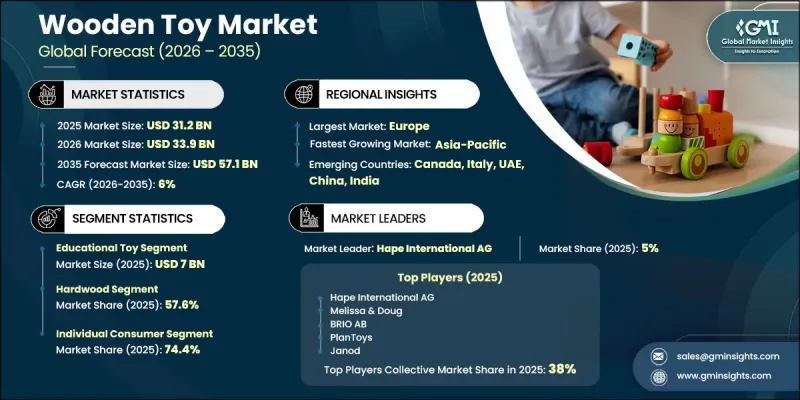
Rising awareness regarding the developmental benefits of traditional toys is significantly contributing to market growth worldwide. Parents are increasingly choosing wooden toys because of their durability, safety, and ability to encourage interactive and imaginative play without reliance on digital screens or electronic features. Growing environmental awareness among consumers is also driving demand for eco-friendly toys manufactured using renewable and sustainable raw materials. Wooden toys are widely recognized for their long product lifespan, making them attractive investments for families seeking durable alternatives to plastic-based products. Increasing focus on child development, creativity, and hands-on learning experiences is further supporting adoption across residential and educational settings. Educational institutions and childcare centers are increasingly utilizing wooden toys to support cognitive growth, motor skill development, and problem-solving abilities. In addition, rising emphasis on international safety certifications and non-toxic manufacturing practices is strengthening consumer confidence in premium-quality wooden toys. Expanding demand for sustainable, safe, and development-focused play products continues to create strong growth opportunities for the global wooden toy industry.
| Market Scope | |
|---|---|
| Start Year | 2025 |
| Forecast Year | 2026-2035 |
| Start Value | $31.2 Billion |
| Forecast Value | $57.1 Billion |
| CAGR | 6% |
The educational toys segment generated USD 7 billion in 2025, making it the leading category within the wooden toy market. Educational wooden toys continue to gain strong consumer preference due to their ability to support early childhood learning and developmental activities. Products designed for cognitive learning, coordination improvement, and problem-solving exercises are increasingly adopted by parents and educational institutions seeking engaging learning solutions for children. These toys support the development of essential skills related to creativity, spatial awareness, hand-eye coordination, and logical thinking while encouraging interactive play experiences. The durability and versatility of educational wooden toys allow repeated long-term use across multiple age groups and learning environments. Their growing integration into home learning activities and early childhood education programs continues to strengthen demand across global markets.
The hardwood segment accounted for 57.6% share in 2025 owing to its superior strength, durability, and premium finish quality. Hardwood materials are widely preferred in toy manufacturing because they offer enhanced resistance to damage caused by repeated handling and extended usage. Wooden toys manufactured using high-quality hardwood materials provide improved safety, structural stability, and reduced risk of surface deterioration over time. Manufacturers also favor hardwood because it supports precise detailing, smooth finishing, and long-lasting product quality. The growing preference for premium and heirloom-quality toys among consumers is further increasing demand for hardwood-based wooden toys. In addition, the use of non-toxic coatings, natural oils, and child-safe finishing materials continues to improve product appeal while maintaining compliance with strict safety standards for children's products.
U.S. Wooden Toy Market held a 75.3% share, generating USD 6.51 billion in 2025. Strong consumer awareness regarding sustainable products, child development benefits, and environmentally responsible purchasing behavior continues to support market growth across the country. Rising disposable income levels among middle- and upper-income households are encouraging higher spending on premium educational toys and eco-friendly play products. Retailers and e-commerce platforms are significantly expanding their wooden toy portfolios to meet increasing consumer demand for safe and sustainable alternatives. The U.S. market also benefits from stringent product safety regulations that strengthen consumer confidence in wooden toy quality and reliability. In addition, increasing demand for artisan-crafted and specialty toys through boutique stores and online retail channels is creating new opportunities for premium wooden toy manufacturers across the country.
Major companies operating in the Global Wooden Toy Market include Wonderworld Toys, Wooden Story, Melissa & Doug, Hape International AG, Le Toy Van, Tender Leaf Toys, KidKraft, PlanToys, Grimm's Spiel und Holz Design, BRIO AB, Janod, Voila Toys, Sevi, TickiT, The Manhattan Toy Company, EverEarth, Vilac, and Tidlo. Companies operating in the wooden toy market are focusing heavily on sustainable manufacturing practices, premium product development, and educational innovation to strengthen their competitive position. Manufacturers are increasingly utilizing certified sustainable wood, non-toxic coatings, and eco-friendly packaging materials to appeal to environmentally conscious consumers. Businesses are also expanding educational product portfolios that support creativity, problem-solving, and developmental learning activities for children across different age groups. Strategic collaborations with educational institutions, specialty retailers, and online marketplaces are helping brands improve product visibility and market reach.
Table of Contents
Chapter 1 Research Methodology
- 1.1 Research approach
- 1.2 Quality Commitments
- 1.2.1 GMI AI policy & data integrity commitment
- 1.2.1.1 Source consistency protocol
- 1.2.1 GMI AI policy & data integrity commitment
- 1.3 Research Trail & Confidence Scoring
- 1.3.1 Research Trail Components
- 1.3.2 Scoring Components
- 1.4 Data Collection
- 1.4.1 Partial list of primary sources
- 1.5 Data mining sources
- 1.5.1 Paid sources
- 1.5.1.1 Sources, by region
- 1.5.1 Paid sources
- 1.6 Base estimates and calculations
- 1.6.1 Base year calculation for any one approach
- 1.7 Forecast model
- 1.7.1 Quantified market impact analysis
- 1.7.1.1 Mathematical impact of growth parameters on forecast
- 1.7.1 Quantified market impact analysis
- 1.8 Research transparency addendum
- 1.8.1 Source attribution framework
- 1.8.2 Quality assurance metrics
- 1.8.3 Our commitment to trust
Chapter 2 Executive Summary
- 2.1 Industry 360° synopsis, 2022 - 2035
- 2.2 Key market trends
- 2.2.1 Regional trends
- 2.2.2 Product type trends
- 2.2.3 Price trends
- 2.2.4 Age group trends
- 2.2.5 Wood type trends
- 2.2.6 End use trends
- 2.2.7 Distribution channel trends
Chapter 3 Industry Insights
- 3.1 Industry ecosystem analysis
- 3.1.1 Factor affecting the value chain
- 3.1.2 Profit margin analysis
- 3.1.3 Disruptions
- 3.1.4 Future outlook
- 3.1.5 Manufacturers
- 3.1.6 Distributors
- 3.2 Supplier landscape
- 3.3 Key news & initiatives
- 3.4 Regulatory landscape
- 3.4.1 EU Toy Safety Directive (2009/48/EC) & EN 71 Standards
- 3.4.2 U.S. CPSIA & ASTM F963 Compliance Requirements
- 3.4.3 ISO 8124 International Standards
- 3.4.4 Chemical Restrictions (REACH, Prop 65)
- 3.5 Impact forces
- 3.5.1 Growth drivers
- 3.5.1.1 Growing Environmental consciousness
- 3.5.1.2 Educational benefits recognition
- 3.5.1.3 Premium quality preference
- 3.5.2 Industry pitfalls & challenges
- 3.5.2.1 Higher price points
- 3.5.2.2 Competition from electronic toys
- 3.5.3 Opportunities
- 3.5.3.1 Customization and personalization
- 3.5.3.2 Educational institution partnerships
- 3.5.1 Growth drivers
- 3.6 Pricing analysis, 2025 (driven by primary research)
- 3.6.1 Historical price trend analysis (2022-2025)
- 3.6.2 Pricing strategy by player type (premium/value/cost-plus)
- 3.6.3 Regional price variation analysis
- 3.6.4 Impact of raw material costs on pricing
- 3.7 Consumer buying behavior analysis
- 3.7.1 Demographic trends
- 3.7.2 Factors affecting buying decisions
- 3.7.3 Consumer product adoption
- 3.7.4 Preferred distribution channel
- 3.8 Growth potential analysis
- 3.9 Porter's analysis
- 3.10 PESTEL analysis
- 3.11 Trade data analysis (driven by paid data base)
- 3.11.1 Import/export volume & value trends
- 3.11.2 Key trade corridors & tariff impact
- 3.11.3 Export destination analysis
- 3.11.4 Import source analysis for raw materials
- 3.12 Impact of AI & generative AI on the market
- 3.12.1 AI-driven disruption of existing business models
- 3.12.2 GenAI use cases & adoption roadmap by segment
- 3.12.3 Risks, limitations & regulatory considerations
- 3.13 Distribution infrastructure & channel penetration landscape (driven by primary research)
- 3.13.1 Channel coverage by region & format (modern vs. Traditional trade)
- 3.13.2 Last-mile infrastructure gaps & emerging channel shifts
Chapter 4 Competitive Landscape, 2025
- 4.1 Introduction
- 4.2 Company market share analysis
- 4.3 Competitive positioning matrix
- 4.4 Strategic outlook matrix
Chapter 5 Market Estimates & Forecast, By Product Type, 2022-2035 (USD Billion) (Million Units)
- 5.1 Key Trends
- 5.2 Educational toy
- 5.3 Construction toy
- 5.4 Musical toy
- 5.5 Game toy
- 5.6 Doll & miniature
- 5.7 Automotive toy
- 5.8 Pretended play toy
Chapter 6 Market Estimates & Forecast, By Price, 2022-2035 (USD Billion) (Million Units)
- 6.1 Key Trends
- 6.2 Low
- 6.3 Medium
- 6.4 High
Chapter 7 Market Estimates & Forecast, By Age Group, 2022-2035 (USD Billion) (Million Units)
- 7.1 Key Trends
- 7.2 Below 1 Yrs.
- 7.3 Age 1- 3
- 7.4 Age 3- 5
- 7.5 Age 5- 12
- 7.6 Age 12+
Chapter 8 Market Estimates & Forecast, By Wood Type, 2022 - 2035, (USD Billion) (Million Units)
- 8.1 Key Trends
- 8.2 Softwood
- 8.3 Hardwood
Chapter 9 Market Estimates & Forecast, By End Use, 2022 - 2035, (USD Billion) (Million Units)
- 9.1 Key trends
- 9.2 Individual
- 9.3 Commercial
Chapter 10 Market Estimates & Forecast, By Distribution Channel, 2022 - 2035, (USD Billion) (Million Units)
- 10.1 Key trends
- 10.2 Online
- 10.2.1 E-commerce website
- 10.2.2 Company owned website
- 10.3 Offline
- 10.3.1 Hypermarket/supermarket
- 10.3.2 Departmental stores
- 10.3.3 Specialized stores
- 10.3.4 Other retail stores
Chapter 11 Market Estimates & Forecast, By Region, 2022 - 2035, (USD Billion) (Million Units)
- 11.1 Key trends
- 11.2 North America
- 11.2.1 U.S.
- 11.2.2 Canada
- 11.3 Europe
- 11.3.1 Germany
- 11.3.2 U.K.
- 11.3.3 France
- 11.3.4 Italy
- 11.3.5 Spain
- 11.4 Asia Pacific
- 11.4.1 China
- 11.4.2 India
- 11.4.3 Japan
- 11.4.4 South Korea
- 11.4.5 Australia
- 11.5 Latin America
- 11.5.1 Brazil
- 11.5.2 Mexico
- 11.5.3 Argentina
- 11.6 MEA
- 11.6.1 UAE
- 11.6.2 Saudi Arabia
- 11.6.3 South Africa
Chapter 12 Company Profiles (Business Overview, Financial Data, Product Landscape, Strategic Outlook, SWOT Analysis)
- 12.1 Global players
- 12.1.1 Hape International AG
- 12.1.2 Melissa & Doug
- 12.1.3 BRIO AB
- 12.1.4 PlanToys
- 12.1.5 Janod
- 12.1.6 KidKraft
- 12.1.7 EverEarth
- 12.1.8 The Manhattan Toy Company
- 12.2 Regional players
- 12.2.1 Le Toy Van
- 12.2.2 Sevi
- 12.2.3 TickiT
- 12.2.4 Tidlo
- 12.2.5 Vilac
- 12.2.6 Voila Toys
- 12.2.7 Wonderworld Toys
- 12.2.8 Wooden Story
- 12.3 Emerging players
- 12.3.1 Grimm's Spiel und Holz Design
- 12.3.2 Tender Leaf Toys
- 12.3.3 Goki Toys

