
PUBLISHER: Global Market Insights Inc. | PRODUCT CODE: 2045683

PUBLISHER: Global Market Insights Inc. | PRODUCT CODE: 2045683
Asia Pacific Centrifugal Blower Market Opportunity, Growth Drivers, Industry Trend Analysis, and Forecast 2026 - 2035
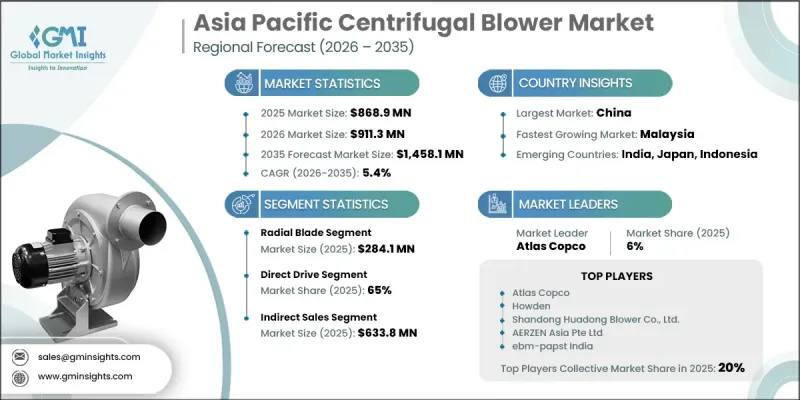
Asia Pacific Centrifugal Blower Market was valued at USD 868.9 million in 2025 and is estimated to grow at a CAGR of 5.4% to reach USD 1,458.1 million by 2035.
Rapid urban expansion across the Asia Pacific is reshaping commercial and industrial infrastructure development throughout the region. Rising investments in transportation systems, healthcare facilities, commercial complexes, airports, and residential projects are creating strong demand for efficient air movement and ventilation systems. Centrifugal blowers are increasingly being adopted because they deliver consistent airflow performance in applications that require high static pressure handling and efficient operation within complicated ventilation networks. Growing urban populations and accelerating industrialization are also increasing pressure on water treatment infrastructure, resulting in significant investments in wastewater treatment facilities and utility modernization projects. End users are prioritizing long-term operational efficiency, reliability, and equipment durability over upfront procurement costs. This shift in purchasing preference continues to support the adoption of advanced centrifugal blower systems across industrial and infrastructure applications throughout the Asia Pacific region.
| Market Scope | |
|---|---|
| Start Year | 2025 |
| Forecast Year | 2026-2035 |
| Start Value | $868.9 Million |
| Forecast Value | $1,458.1 Million |
| CAGR | 5.4% |
In 2025, the radial blade segment accounted for USD 284.1 million. Radial-blade centrifugal blowers feature impellers with straight blades extending outward from the rotor center, enabling effective airflow management in demanding operating environments. These systems are widely preferred in industrial operations because they maintain stable performance even when handling contaminated air streams containing dust and suspended particles. Their rugged construction and resistance to material accumulation make them suitable for heavy-duty industrial usage where long-term operational consistency is critical. Industrial operators continue to favor radial blade designs for their durability, lower maintenance requirements, and ability to operate efficiently under challenging conditions.
The direct drive segment held a 65% share in 2025. Direct-drive centrifugal blowers are engineered with the impeller mounted directly on the motor shaft, eliminating the need for additional transmission components. This configuration improves energy transfer efficiency by minimizing mechanical losses during operation. The simplified design also reduces maintenance requirements and contributes to greater operational reliability. End users increasingly prefer direct drive systems because they offer improved equipment lifespan, reduced downtime, and enhanced performance consistency in continuous-use applications. The growing emphasis on energy-efficient industrial systems and reduced operating costs is further supporting demand for direct drive centrifugal blowers across the region.
China Centrifugal Blower Market held a 31.9% share, generating USD 277.2 million in 2025, owing to rapid industrial expansion and extensive infrastructure development activities. Strong manufacturing output and ongoing investments in industrial production facilities continue to create substantial demand for centrifugal blower systems. Large-scale urban infrastructure projects and expanding commercial construction activities are also contributing to market growth across the country. Continuous development of transportation facilities, public infrastructure, and industrial operations has strengthened the need for dependable ventilation and air handling systems, positioning China as the leading revenue contributor within the Asia Pacific centrifugal blower industry.
Key companies operating in the Asia Pacific Centrifugal Blower Market include global manufacturers such as Atlas Copco, Kaeser Kompressoren, Elektror Airsystems, The New York Blower Company, Howden, ebm-papst India, and AERZEN Asia Pte Ltd. Regional participants include Chuan-Fan Electric Co., Ltd., Shandong Huadong Blower Co., Ltd., CLEANTEK, Alfotech Fans, EVG Engicon Airtech Pvt. Ltd., Trimech India, and Blowtech Engineers Pvt. Ltd. Companies operating in the Asia Pacific centrifugal blower market are actively implementing multiple growth strategies to strengthen their market position and expand regional presence. Manufacturers are focusing on product innovation by introducing energy-efficient and low-maintenance blower systems designed for industrial and infrastructure applications. Several companies are increasing investments in research and development activities to improve airflow performance, operational durability, and energy optimization. Strategic partnerships with regional distributors and industrial contractors are also helping companies expand customer reach across emerging markets. In addition, market participants are strengthening manufacturing capabilities and supply chain networks to ensure faster product delivery and improved customer support.
Table of Contents
Chapter 1 Methodology and Scope
- 1.1 Market scope and definition
- 1.2 Research design
- 1.2.1 Research approach
- 1.2.2 Data collection methods
- 1.3 Data mining sources
- 1.3.1 Country
- 1.4 Base estimates and calculations
- 1.4.1 Base year calculation
- 1.4.2 Key trends for market estimation
- 1.5 Primary research and validation
- 1.5.1 Primary sources
- 1.6 Forecast model
- 1.7 Research assumptions and limitations
Chapter 2 Executive Summary
- 2.1 Industry 360° synopsis
- 2.2 Key market trends
- 2.2.1 Country
- 2.2.2 Type
- 2.2.3 Drive mechanism
- 2.2.4 Pressure
- 2.2.5 Application
- 2.2.6 Distribution channel
Chapter 3 Industry Insights
- 3.1 Industry ecosystem analysis
- 3.1.1 Supplier landscape
- 3.1.2 Profit margin
- 3.1.3 Value addition at each stage
- 3.1.4 Factor affecting the value chain
- 3.2 Industry impact forces
- 3.2.1 Growth drivers
- 3.2.1.1 Urbanization and infrastructure build-out
- 3.2.1.2 Expansion of water, wastewater & environmental systems
- 3.2.1.3 Shift toward automation and process reliability
- 3.2.2 Industry pitfalls & challenges
- 3.2.2.1 Strong price sensitivity
- 3.2.2.2 Noise, footprint, and maintenance concerns
- 3.2.3 Opportunities
- 3.2.3.1 Smart & energy-optimized blower systems
- 3.2.3.2 Aftermarket, services, and lifecycle solutions
- 3.2.1 Growth drivers
- 3.3 Growth potential analysis
- 3.4 Technology and innovation landscape
- 3.4.1 Current technological trends
- 3.4.2 Emerging technologies
- 3.5 Price trends
- 3.5.1 By country
- 3.5.2 By type
- 3.6 Regulatory framework
- 3.6.1 Standards & certifications
- 3.6.1.1 Iso standards (ISO 1940 for balancing, ISO 5801 for testing)
- 3.6.1.2 Regional standards (AMCA, ASHRAE, JIS, GB standards)
- 3.6.1.3 Energy efficiency standards (asia pacific)
- 3.6.2 Environmental regulations
- 3.6.2.1 Emissions control requirements
- 3.6.2.2 Noise pollution standards
- 3.6.2.3 Material restrictions (ROHS, REACH)
- 3.6.3 Import/export regulations
- 3.6.3.1 Tariff structures in Asia Pacific
- 3.6.3.2 Trade agreements impact (RCEP, CPTPP)
- 3.6.3.3 Country-specific import requirements
- 3.6.1 Standards & certifications
- 3.7 Pricing analysis (driven by primary research)
- 3.7.1 Historical price trend analysis (2022-2025)
- 3.7.2 Pricing strategy by player type (premium/value/cost-plus)
- 3.7.3 Price variation by type & pressure range
- 3.7.4 Regional price differential analysis
- 3.7.5 Impact of raw material costs on pricing
- 3.7.6 Price elasticity of demand assessment
- 3.8 Trade data analysis (driven by paid database) (HS Code 841459)
- 3.8.1 Import/export volume & value trends (2022-2025)
- 3.8.2 Key trade corridors & tariff impact (China-Sea, Japan-Australia, etc.)
- 3.8.3 Intra-apac trade flows
- 3.8.4 Major importing countries
- 3.8.5 Major exporting countries
- 3.9 Impact of AI & generative AI on the market
- 3.9.1 AI-driven disruption of existing business models
- 3.9.2 GenAI use cases & adoption roadmap by segment
- 3.9.2.1 Predictive maintenance algorithms
- 3.9.2.2 Design optimization & computational fluid dynamics
- 3.9.2.3 Supply chain forecasting & inventory management
- 3.9.3 Risks, limitations & regulatory considerations
- 3.9.4 Asia pacific AI adoption maturity
- 3.10 Capacity & production landscape (driven by primary research)
- 3.10.1 Installed capacity by region & key producer (asia pacific focus)
- 3.10.2 Capacity utilization rates & expansion pipelines
- 3.10.3 Asia pacific manufacturing footprint analysis
Chapter 4 Competitive Landscape, 2025
- 4.1 Introduction
- 4.2 Company market share analysis
- 4.2.1 By country
- 4.2.1.1 China
- 4.2.1.2 India
- 4.2.1.3 Japan
- 4.2.1.4 South Korea
- 4.2.1.5 Australia
- 4.2.1.6 Malaysia
- 4.2.1.7 Indonesia
- 4.2.1 By country
- 4.3 Company matrix analysis
- 4.4 Competitive analysis of major market players
- 4.5 Competitive positioning matrix
- 4.6 Key developments
- 4.6.1 Mergers & acquisitions
- 4.6.2 Partnerships & collaborations
- 4.6.3 New product launches
- 4.6.4 Expansion plans
Chapter 5 Market Estimates and Forecast, By Type, 2022 - 2035 (USD Million) (Thousand Units)
- 5.1 Key trends
- 5.2 Radial blade
- 5.3 Forward-curved
- 5.4 Backwards curved
- 5.5 Mixed flow
- 5.6 Axial flow
- 5.7 Multi-stage
- 5.8 Others
Chapter 6 Market Estimates and Forecast, By Drive Mechanism, 2022 - 2035 (USD Million) (Thousand Units)
- 6.1 Key trends
- 6.2 Direct drive
- 6.3 Belt drive
Chapter 7 Market Estimates and Forecast, By Pressure, 2022 - 2035 (USD Million) (Thousand Units)
- 7.1 Key trends
- 7.2 High
- 7.3 Medium
- 7.4 Low
Chapter 8 Market Estimates and Forecast, By Application, 2022 - 2035 (USD Million) (Thousand Units)
- 8.1 Key trends
- 8.2 HVAC
- 8.3 Industrial processes
- 8.4 Power generation
- 8.5 Pharmaceutical
- 8.6 Food processing
- 8.7 Mining
- 8.8 Agriculture
- 8.9 Others
Chapter 9 Market Estimates and Forecast, By Distribution Channel, 2022 - 2035 (USD Million) (Thousand Units)
- 9.1 Key trends
- 9.2 Direct sales
- 9.3 Indirect sales
Chapter 10 Market Estimates and Forecast, By Country, 2022 - 2035 (USD Million) (Thousand Units)
- 10.1 Key trends
- 10.2 China
- 10.3 India
- 10.4 Japan
- 10.5 South Korea
- 10.6 Australia
- 10.7 Malaysia
- 10.8 Indonesia
Chapter 11 Company Profiles
- 11.1 Global players
- 11.1.1 Atlas Copco
- 11.1.2 Kaeser kompressoren
- 11.1.3 Elektror Airsystems
- 11.1.4 The New York Blower Company
- 11.1.5 Howden
- 11.1.6 ebm-papst India
- 11.1.7 AERZEN Asia Pte Ltd
- 11.2 Regional players
- 11.2.1 Chuan-Fan Electric Co., Ltd.
- 11.2.2 Shandong Huadong Blower Co., Ltd.
- 11.2.3 CLEANTEK
- 11.2.4 Alfotech Fans
- 11.2.5 EVG Engicon Airtech Pvt. Ltd.
- 11.2.6 Trimech India
- 11.2.7 Blowtech Engineers Pvt. Ltd.
- 11.3 Emerging players
- 11.3.1 Aerotech Equipments
- 11.3.2 Airmake Cooling Systems
- 11.3.3 Vishwakarma Air Systems
- 11.3.4 Hisashi Industries
- 11.3.5 Airtech Blower Industries
- 11.3.6 Vayu Vents Pvt. Ltd.
- 11.3.7 Long Chang Electric Industrial Co., LTD.

