PUBLISHER: Global Market Insights Inc. | PRODUCT CODE: 2045716

PUBLISHER: Global Market Insights Inc. | PRODUCT CODE: 2045716
Motorcycle and Scooter Market Opportunity, Growth Drivers, Industry Trend Analysis, and Forecast 2026 - 2035
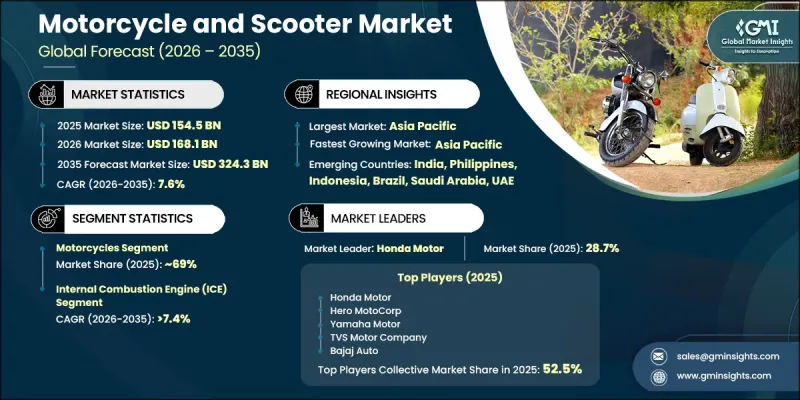
The Global Motorcycle and Scooter Market was valued at USD 154.5 billion in 2025 and is estimated to grow at a CAGR of 7.6% to reach USD 324.3 billion by 2035.
The industry is experiencing rapid transformation due to accelerating urbanization, rising fuel costs, and growing demand for economical mobility solutions worldwide. Consumer preference is steadily shifting toward connected, fuel-efficient, and electric-powered two-wheelers designed for both personal and commercial transportation needs. Manufacturers are increasingly integrating advanced digital displays, smartphone connectivity features, telematics systems, navigation technologies, rider assistance functions, and intelligent battery management systems to enhance safety, efficiency, and user experience across premium as well as mass-market vehicle categories. Expanding traffic congestion and limitations in public transportation infrastructure across emerging economies are also increasing reliance on motorcycles and scooters as practical mobility alternatives. In addition, rising penetration of e-commerce delivery networks, ride-sharing platforms, and last-mile transportation services is driving strong demand for commercial two-wheelers globally. Government support for electric mobility adoption through subsidies, infrastructure investments, and emission reduction policies is further accelerating growth opportunities for the motorcycle and scooter industry, particularly across Asia Pacific and European markets.
| Market Scope | |
|---|---|
| Start Year | 2025 |
| Forecast Year | 2026-2035 |
| Start Value | $154.5 Billion |
| Forecast Value | $324.3 Billion |
| CAGR | 7.6% |
The motorcycles segment accounted for 69% share in 2025 and is projected to grow at a CAGR of 6% through 2035. The segment continues to dominate the industry due to strong consumer demand for fuel-efficient, affordable, and versatile transportation solutions. Motorcycles remain widely preferred for daily commuting because they offer lower acquisition costs, reduced operating expenses, and improved mobility within congested urban environments. Rapid population growth, expanding urbanization, and limited public transportation accessibility across developing regions are further contributing to sustained motorcycle adoption. The growing preference for practical and economical transportation options continues to strengthen the long-term outlook for the motorcycles segment worldwide.
The internal combustion engine segment held a 80.7% share in 2025 and is anticipated to grow at a CAGR of 7.4% from 2026 to 2035. Internal combustion engine-powered motorcycles and scooters continue to lead the market due to their widespread affordability, established fuel infrastructure, and strong consumer familiarity across both developed and emerging economies. Consumers continue to favor ICE-powered two-wheelers because of their extended driving range, lower upfront costs, and easier refueling accessibility. The segment also benefits from highly developed manufacturing ecosystems, extensive dealership networks, readily available spare parts, and mature servicing infrastructure, which simplify vehicle ownership and maintenance for consumers. These factors continue to support the dominant position of internal combustion engine vehicles within the global motorcycle and scooter industry.
India Motorcycle and Scooter Market held a 64.2% share and generated USD 73.4 billion in 2025. The India motorcycle and scooter market continues to expand steadily due to the country's large consumer base, growing demand for affordable mobility, and increasing transportation needs across urban and rural regions. Two-wheelers remain among the most cost-effective and practical transportation solutions for Indian consumers because of their fuel efficiency, lower maintenance requirements, and ease of navigation through dense traffic conditions. Rising middle-income population levels, expanding workforce participation, and growing demand for personal mobility are further supporting market growth throughout the country. In addition, increasing activity across e-commerce logistics, commercial delivery services, and shared mobility platforms is driving higher adoption of motorcycles and scooters for commercial transportation applications across India.
Major companies operating in the Global Motorcycle and Scooter Market include Honda Motor, Hero MotoCorp, Yamaha Motor, TVS Motor Company, Bajaj Auto, Suzuki Motor, Royal Enfield (Eicher), KTM AG, Ducati Motor Holding, and Triumph Motorcycles. Companies operating in the Motorcycle And Scooter Market are adopting several strategic initiatives to strengthen their market position and expand global presence. Leading manufacturers are investing heavily in electric mobility technologies, connected vehicle platforms, and advanced safety systems to align with evolving consumer preferences and regulatory requirements. Product innovation focused on fuel efficiency, smart connectivity features, lightweight vehicle architecture, and enhanced battery technologies remains a major priority across the industry. Companies are also expanding production capabilities and strengthening dealership and after-sales service networks to improve customer reach and operational efficiency. Strategic partnerships with battery manufacturers, charging infrastructure providers, and technology firms are helping companies accelerate electric vehicle development and commercialization. In addition, businesses are increasing investments in digital retail platforms, financing solutions, and emerging market expansion strategies to strengthen customer engagement and reinforce their competitive foothold within the global motorcycle and scooter market.
Table of Contents
Chapter 1 Methodology
- 1.1 Research approach
- 1.2 Quality Commitments
- 1.2.1 GMI AI policy & data integrity commitment
- 1.2.1.1 Source consistency protocol
- 1.2.1 GMI AI policy & data integrity commitment
- 1.3 Research Trail & Confidence Scoring
- 1.3.1 Research Trail Components
- 1.3.2 Scoring Components
- 1.4 Data Collection
- 1.4.1 Partial list of primary sources
- 1.5 Data mining sources
- 1.5.1 Paid sources
- 1.5.1.1 Sources, by region
- 1.5.1 Paid sources
- 1.6 Base estimates and calculations
- 1.6.1 Base year calculation
- 1.7 Forecast Model
- 1.7.1 Quantified market impact analysis
- 1.7.1.1 Mathematical impact of growth parameters on forecast
- 1.7.1 Quantified market impact analysis
- 1.8 Research transparency addendum
- 1.8.1 Source attribution framework
- 1.8.2 Quality assurance metrics
- 1.8.3 Our commitment to trust
Chapter 2 Executive Summary
- 2.1 Industry 360° synopsis, 2022 - 2035
- 2.2 Key market trends
- 2.2.1 Regional
- 2.2.2 Product
- 2.2.3 Propulsion
- 2.2.4 Engine Displacement
- 2.2.5 Distribution Channel
- 2.2.6 End Use
- 2.3 TAM Analysis, 2026-2035
- 2.4 CXO perspectives: Strategic imperatives
Chapter 3 Industry Insights
- 3.1 Industry ecosystem analysis
- 3.1.1 Supplier landscape
- 3.1.2 Profit margin analysis
- 3.1.3 Cost structure
- 3.1.4 Value addition at each stage
- 3.1.5 Factor affecting the value chain
- 3.1.6 Disruptions
- 3.2 Industry impact forces
- 3.2.1 Growth drivers
- 3.2.1.1 Rising urbanization and traffic congestion.
- 3.2.1.2 Expansion of e-commerce and last-mile delivery.
- 3.2.1.3 Increasing fuel prices.
- 3.2.1.4 Rapid adoption of electric two-wheelers.
- 3.2.1.5 Growing middle-class population in Asia
- 3.2.2 Industry pitfalls and challenges
- 3.2.2.1 Safety concerns and rising accident rates.
- 3.2.2.2 Inadequate charging infrastructure..
- 3.2.3 Market opportunities
- 3.2.3.1 Electrification and EV penetration.
- 3.2.3.2 Connected and smart mobility solutions.
- 3.2.3.3 Subscription and leasing models.
- 3.2.3.4 Market expansion in Africa and Southeast Asia.
- 3.2.1 Growth drivers
- 3.3 Growth potential analysis
- 3.4 Technology and Innovation landscape
- 3.4.1 Current technological trends
- 3.4.2 Emerging technologies
- 3.5 Pricing Analysis (Driven by Primary Research)
- 3.5.1 Historical Price Trend Analysis
- 3.5.2 Pricing Strategy by Player Type (Premium / Value / Cost-plus)
- 3.6 Regulatory guideline
- 3.6.1 North America
- 3.6.1.1 U.S.: National Highway Traffic Safety Administration (NHTSA) FMVSS Regulations
- 3.6.1.2 Canada: Canada Motor Vehicle Safety Standards (CMVSS)
- 3.6.2 Europe
- 3.6.2.1 Germany: Euro 5 / Euro 5+ Emission Standards
- 3.6.2.2 UK: UK Vehicle Certification Agency (VCA) Type Approval Regulations
- 3.6.2.3 France: EU Type Approval Framework (Regulation EU 168/2013)
- 3.6.2.4 Italy: EU Regulation 168/2013 Vehicle Type Approval
- 3.6.3 Asia Pacific
- 3.6.3.1 China: China VI Emission Standards (GB Standards)
- 3.6.3.2 India: Bharat Stage VI (BS-VI) Emission Norms
- 3.6.3.3 Japan: Japanese Automotive Type Approval System
- 3.6.3.4 Australia: Australian Design Rules (ADR)
- 3.6.4 Latin America
- 3.6.4.1 Brazil: PROCONVE L7 / L8 Emission Standards
- 3.6.4.2 Mexico: NOM-042-SEMARNAT Emission Standards
- 3.6.4.3 Argentina: Emission Standard Euro Equivalency Regulations
- 3.6.5 MEA
- 3.6.5.1 UAE: Emirates Authority for Standardization and Metrology (ESMA) Vehicle Regulations
- 3.6.5.2 Saudi Arabia: Saudi Standards, Metrology and Quality Organization (SASO) Regulations
- 3.6.5.3 South Africa: South African Bureau of Standards (SABS) Vehicle Regulations
- 3.6.1 North America
- 3.7 PESTEL analysis
- 3.8 Patent Landscape (Driven by Primary Research)
- 3.9 Trade Data Analysis (Based on Paid Database)
- 3.9.1 Import/Export Volume & Value Trends
- 3.9.2 Key Trade Corridors & Tariff Impact
- 3.10 Impact of AI & Generative AI on the Market (Driven by Primary Research)
- 3.10.1 AI-Driven Disruption of Existing Business Models
- 3.10.2 GenAI Use Cases & Adoption Roadmap by Segment
- 3.10.3 Risks, Limitations & Regulatory Considerations
- 3.11 Capacity & Production Landscape (Driven by Primary Research)
- 3.11.1 Production Capacity by Region & Key Producer
- 3.11.2 Capacity Utilization Rates & Expansion Pipelines
- 3.12 Sustainability and environmental aspects
- 3.12.1 Sustainable practices
- 3.12.2 Waste reduction strategies
- 3.12.3 Energy efficiency in production
- 3.12.4 Eco-friendly initiatives
- 3.12.5 Carbon footprint considerations
- 3.13 Forecast assumptions & scenario analysis (Driven by Primary Research)
- 3.13.1 Base Case - Key Macro & Industry Variables Driving CAGR
- 3.13.2 Optimistic Scenarios - Favourable macro and industry tailwinds
- 3.13.3 Pessimistic Scenario - Macroeconomic slowdown or industry headwinds
Chapter 4 Competitive Landscape, 2025
- 4.1 Introduction
- 4.2 Company market share analysis
- 4.2.1 North America
- 4.2.2 Europe
- 4.2.3 Asia Pacific
- 4.2.4 Latin America
- 4.2.5 MEA
- 4.3 Competitive analysis of major market players
- 4.4 Competitive positioning matrix
- 4.5 Key developments
- 4.5.1 Mergers & acquisitions
- 4.5.2 Partnerships & collaborations
- 4.5.3 New Product Launches
- 4.5.4 Expansion Plans and funding
- 4.6 Company Tier Benchmarking
- 4.6.1 Tier Classification Criteria & Qualifying Thresholds
- 4.6.2 Tier Positioning Matrix by Revenue, Geography & Innovation
Chapter 5 Market Estimates & Forecast, By Product, 2022 - 2035 ($Bn, Units)
- 5.1 Key trends
- 5.2 Motorcycles
- 5.2.1 Cruiser motorcycles
- 5.2.2 Sport motorcycles
- 5.2.3 Touring motorcycles
- 5.2.4 Standard/naked motorcycles
- 5.2.5 Adventure/dual-sport motorcycles
- 5.2.6 Off-road/dirt motorcycles
- 5.3 Scooters
- 5.3.1 Traditional gasoline scooters
- 5.3.2 Electric scooters
- 5.3.3 Maxi scooters
- 5.3.4 Moped-style scooters
Chapter 6 Market Estimates & Forecast, By Propulsion, 2022 - 2035 ($Bn, Units)
- 6.1 Key trends
- 6.2 Internal combustion engine (ICE)
- 6.3 Electric vehicles (EVs)
Chapter 7 Market Estimates & Forecast, By Engine Displacement, 2022 - 2035 ($Bn, Units)
- 7.1 Key trends
- 7.2 Under 250cc
- 7.3 250cc-500cc
- 7.4 500cc-1000cc
- 7.5 Above 1000cc
Chapter 8 Market Estimates & Forecast, By Distribution Channel, 2022 - 2035 ($Bn, Units)
- 8.1 Key trends
- 8.2 Offline
- 8.3 Online
Chapter 9 Market Estimates & Forecast, By Distribution Channel, 2022 - 2035 ($Bn, Units)
- 9.1 Key trends
- 9.2 Personal
- 9.3 Commercial
Chapter 10 Market Estimates & Forecast, By Region, 2022 - 2035 ($Bn, Units)
- 10.1 Key trends
- 10.2 North America
- 10.2.1 US
- 10.2.2 Canada
- 10.3 Europe
- 10.3.1 Germany
- 10.3.2 UK
- 10.3.3 France
- 10.3.4 Italy
- 10.3.5 Spain
- 10.3.6 Russia
- 10.3.7 Netherlands
- 10.3.8 Belgium
- 10.4 Asia Pacific
- 10.4.1 China
- 10.4.2 India
- 10.4.3 Japan
- 10.4.4 Australia
- 10.4.5 South Korea
- 10.4.6 Philippines
- 10.4.7 Indonesia
- 10.5 Latin America
- 10.5.1 Brazil
- 10.5.2 Mexico
- 10.5.3 Argentina
- 10.6 MEA
- 10.6.1 South Africa
- 10.6.2 Saudi Arabia
- 10.6.3 UAE
Chapter 11 Company Profiles
- 11.1 Global Players
- 11.1.1 Honda Motor
- 11.1.2 Yamaha Motor
- 11.1.3 Harley-Davidson
- 11.1.4 BMW Motorrad
- 11.1.5 Suzuki Motor
- 11.1.6 Kawasaki Heavy Industries
- 11.1.7 KTM
- 11.1.8 Ducati Motor
- 11.1.9 Triumph Motorcycles
- 11.1.10 Piaggio
- 11.2 Regional Players
- 11.2.1 Hero MotoCorp
- 11.2.2 Bajaj Auto
- 11.2.3 TVS Motor Company
- 11.2.4 Royal Enfield (Eicher)
- 11.2.5 Kymco
- 11.2.6 SYM Motors
- 11.2.7 CFMoto
- 11.2.8 Zongshen Industrial
- 11.2.9 Indian Motorcycle
- 11.2.10 MV Agusta
- 11.3 Emerging Players
- 11.3.1 Yadea
- 11.3.2 Niu Technologies
- 11.3.3 Zero Motorcycles
- 11.3.4 Ather Energy
- 11.3.5 Gogoro
- 11.3.6 LiveWire

