PUBLISHER: Global Market Insights Inc. | PRODUCT CODE: 2045734

PUBLISHER: Global Market Insights Inc. | PRODUCT CODE: 2045734
Detergent Chemicals Market Opportunity, Growth Drivers, Industry Trend Analysis, and Forecast 2026 - 2035
The Global Detergent Chemicals Market was valued at USD 61.7 billion in 2025 and is estimated to grow at a CAGR of 4.7% to reach USD 97.5 billion by 2035.
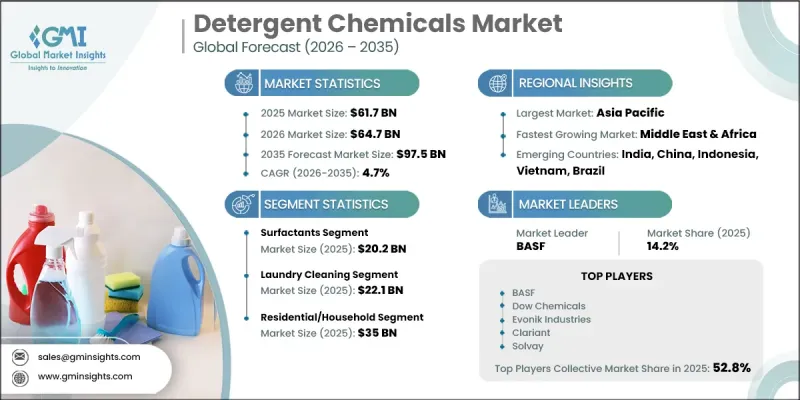
The market plays a critical role within the global chemical industry by supplying essential ingredients used in cleaning formulations. Detergent chemicals are composed of multiple functional components that interact with dirt, oils, and residues to deliver effective cleaning performance. These ingredients are processed and blended into a wide range of cleaning products designed for various applications across residential, commercial, and industrial sectors. The market continues to evolve as manufacturers focus on improving product performance while aligning with shifting consumer expectations related to convenience and sustainability. Increasing awareness around hygiene and cleanliness, particularly in densely populated regions, is further supporting demand. Rising disposable income and changing living standards are encouraging higher consumption of cleaning solutions. The detergent chemicals market is therefore witnessing steady expansion driven by innovation, growing demand for efficient formulations, and the need to address both performance and environmental considerations.
| Market Scope | |
|---|---|
| Start Year | 2025 |
| Forecast Year | 2026-2035 |
| Start Value | $61.7 Billion |
| Forecast Value | $97.5 Billion |
| CAGR | 4.7% |
The surfactants segment generated USD 20.2 billion in 2025. The detergent chemicals market is advancing across multiple product categories as manufacturers seek high-performance ingredients. Surfactants continue to lead due to their essential role in breaking down and removing contaminants. Enzymes are experiencing rapid growth as they enhance cleaning efficiency by targeting various types of residues under lower temperature conditions. Builders maintain consistent demand as they improve overall formulation performance by supporting water treatment and preventing residue buildup. Bleaching agents are also gaining traction as demand for enhanced cleaning effectiveness continues to rise.
The residential or household segment accounted for USD 35 billion in 2025. Demand from this segment is increasing as urbanization progresses and awareness of hygiene continues to strengthen. Household consumption remains a key driver of the detergent chemicals market due to consistent usage of cleaning products in daily routines. Growth is further supported by increasing disposable income levels and the widespread adoption of household appliances, which contribute to higher product utilization rates.
North America Detergent Chemicals Market is projected to grow from USD 16.7 billion in 2025 to USD 25.7 billion by 2035. The region is experiencing increased demand for high-quality and environmentally responsible formulations that meet evolving performance standards. Consumer preferences are shifting toward sustainable solutions, encouraging the adoption of alternative ingredient sources and cleaner formulations. Market growth is also supported by advancements in specialized chemical formulations and ongoing regulatory developments that promote environmentally compliant products.
Key players in the Global Detergent Chemicals Market include BASF, Dow Chemicals, Clariant, Evonik Industries, Solvay, Croda International, Huntsman International, Nouryon, Sasol, Lubrizol, Kao Corporation, and Mahaveer Surfactants. Companies in the detergent chemicals market are strengthening their competitive position by investing in advanced formulation technologies and sustainable ingredient development. Many are focusing on creating environmentally friendly and high-performance products to align with evolving regulatory standards and consumer expectations. Strategic collaborations and partnerships are being used to enhance innovation capabilities and expand market reach. Businesses are also increasing their research and development efforts to improve efficiency and reduce environmental impact. Expanding production capacities and entering emerging markets are key growth strategies.
Table of Contents
Chapter 1 Methodology & Scope
- 1.1 Market scope and definition
- 1.2 Research design
- 1.2.1 Research approach
- 1.2.2 Data collection methods
- 1.3 Data mining sources
- 1.3.1 Global
- 1.3.2 Regional/Country
- 1.4 Base estimates and calculations
- 1.4.1 Base year calculation
- 1.4.2 Key trends for market estimation
- 1.5 Primary research and validation
- 1.5.1 Primary sources
- 1.6 Forecast model
- 1.7 Research assumptions and limitations
Chapter 2 Executive Summary
- 2.1 Industry 360° synopsis
- 2.2 Key market trends
- 2.2.1 Product
- 2.2.2 Application
- 2.2.3 End-Use Sector
- 2.2.4 Regional
- 2.3 TAM Analysis, 2026-2035
- 2.4 CXO perspectives: Strategic imperatives
Chapter 3 Industry Insights
- 3.1 Industry ecosystem analysis
- 3.1.1 Supplier landscape
- 3.1.2 Profit margin
- 3.1.3 Value addition at each stage
- 3.1.4 Factor affecting the value chain
- 3.1.5 Disruptions
- 3.2 Industry impact forces
- 3.2.1 Growth drivers
- 3.2.2 Industry pitfalls and challenges
- 3.2.3 Market opportunities
- 3.3 Growth potential analysis
- 3.4 Regulatory landscape
- 3.4.1 North America
- 3.4.2 Europe
- 3.4.3 Asia Pacific
- 3.4.4 Latin America
- 3.4.5 Middle East & Africa
- 3.5 Porter's analysis
- 3.6 PESTEL analysis
- 3.7 Price trends
- 3.7.1 By region
- 3.7.2 By product
- 3.8 Future market trends
- 3.9 Technology and Innovation landscape
- 3.9.1 Current technological trends
- 3.9.2 Emerging technologies
- 3.10 Patent Landscape
- 3.11 Trade statistics (HS code)
- 3.11.1 Major importing countries
- 3.11.2 Major exporting countries
- 3.12 Sustainability and environmental aspects
- 3.12.1 Sustainable practices
- 3.12.2 Waste reduction strategies
- 3.12.3 Energy efficiency in production
- 3.12.4 Eco-friendly initiatives
- 3.13 Carbon footprint consideration
Chapter 4 Competitive Landscape, 2025
- 4.1 Introduction
- 4.2 Company market share analysis
- 4.2.1 By region
- 4.2.1.1 North America
- 4.2.1.2 Europe
- 4.2.1.3 Asia Pacific
- 4.2.1.4 LATAM
- 4.2.1.5 MEA
- 4.2.1 By region
- 4.3 Competitive analysis of major market players
- 4.4 Competitive positioning matrix
- 4.5 Key developments
- 4.5.1 Mergers & acquisitions
- 4.5.2 Partnerships & collaborations
- 4.5.3 New Product Launches
- 4.5.4 Expansion Plans
Chapter 5 Market Estimates and Forecast, By Product, 2022-2035 (USD Billion) (Kilo Tons)
- 5.1 Key trends
- 5.2 Surfactants
- 5.3 Enzymes
- 5.4 Fragrances
- 5.5 Builders
- 5.6 Bleaching Agents
- 5.7 Chelating Agents
- 5.8 Optical Brighteners
- 5.9 Others
Chapter 6 Market Estimates and Forecast, By Application, 2022-2035 (USD Billion) (Kilo Tons)
- 6.1 Key trends
- 6.2 Laundry Cleaning
- 6.3 Dishwashing
- 6.4 Soaps & Shampoos
- 6.5 Household Cleaning
- 6.6 Industrial & Institutional Cleaning
- 6.7 Others
Chapter 7 Market Estimates and Forecast, By End-Use Industry, 2022-2035 (USD Million) (Kilo Tons)
- 7.1 Key trends
- 7.2 Residential/Household
- 7.3 Commercial & Institutional
- 7.4 Industrial
Chapter 8 Market Estimates and Forecast, By Region, 2022-2035 (USD Million) (Kilo Tons)
- 8.1 Key trends
- 8.2 North America
- 8.2.1 U.S.
- 8.2.2 Canada
- 8.3 Europe
- 8.3.1 Germany
- 8.3.2 UK
- 8.3.3 France
- 8.3.4 Spain
- 8.3.5 Italy
- 8.3.6 Rest of Europe
- 8.4 Asia Pacific
- 8.4.1 China
- 8.4.2 India
- 8.4.3 Japan
- 8.4.4 Australia
- 8.4.5 South Korea
- 8.4.6 Rest of Asia Pacific
- 8.5 Latin America
- 8.5.1 Brazil
- 8.5.2 Mexico
- 8.5.3 Argentina
- 8.5.4 Rest of Latin America
- 8.6 Middle East and Africa
- 8.6.1 Saudi Arabia
- 8.6.2 South Africa
- 8.6.3 UAE
- 8.6.4 Rest of Middle East and Africa
Chapter 9 Company Profiles
- 9.1 Clariant
- 9.2 Croda International
- 9.3 Dow Chemicals
- 9.4 Evonik Industries
- 9.5 Huntsman International
- 9.6 Kao Corporation
- 9.7 Lubrizol
- 9.8 Mahaveer Surfactants
- 9.9 Solvay
- 9.10 BASF
- 9.11 Nouryon
- 9.12 Sasol

