PUBLISHER: Global Market Insights Inc. | PRODUCT CODE: 2045736

PUBLISHER: Global Market Insights Inc. | PRODUCT CODE: 2045736
Solar Energy Storage Market Opportunity, Growth Drivers, Industry Trend Analysis, and Forecast 2026 - 2035
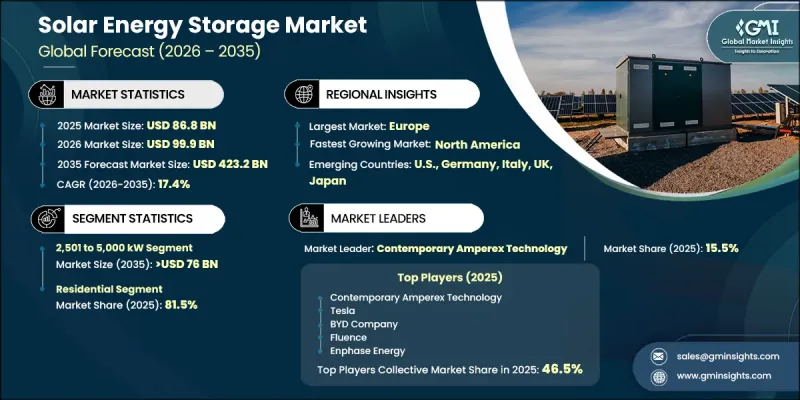
The Global Solar Energy Storage Market was valued at USD 86.8 billion in 2025 and is estimated to grow at a CAGR of 17.4% to reach USD 423.2 billion by 2035.
The market is experiencing growth momentum driven by rising environmental awareness and increasingly strict emission reduction regulations across major economies. Growing emphasis on clean energy transition is accelerating the adoption of integrated solar-plus-storage solutions. Continuous technological improvements are enhancing system efficiency, reducing overall costs, and improving long-term reliability, which is further supporting market penetration. Increasing global energy demand, combined with the need for stable and uninterrupted power supply, is reinforcing the role of storage systems in modern energy infrastructure. These systems store excess solar power generated during peak sunlight hours and supply it during periods of low or no generation, ensuring continuous energy availability. Expanding renewable energy installations, along with supportive policy frameworks and sustainability initiatives, is strengthening adoption across residential, commercial, and utility-scale applications. Rising investments in grid modernization and distributed energy systems are also contributing to sustained long-term market growth.
| Market Scope | |
|---|---|
| Start Year | 2025 |
| Forecast Year | 2026-2035 |
| Start Value | $86.8 Billion |
| Forecast Value | $423.2 Billion |
| CAGR | 17.4% |
The 2,501 to 5,000 kW solar energy storage segment is projected to reach USD 76 billion by 2035. Growth in this segment is supported by expanding clean energy initiatives, renewable integration targets, and supportive financial mechanisms such as clean energy programs, green financing instruments, and renewable energy certificates. Increasing deployment of battery energy storage systems is further enhancing market expansion, supported by declining battery costs and the growing trend of integrating storage with photovoltaic installations, including retrofit applications in distributed energy networks.
The residential solar energy storage segment accounted for 81.5% share in 2025. This dominance is driven by rising adoption across households due to improved affordability, enhanced energy independence, and flexible deployment capabilities. Advances in manufacturing scale, improved supply chain efficiency, and technological innovation are reducing system costs and accelerating adoption. Growing electrification trends, along with rising power demand in suburban, urban, and remote regions, are further strengthening residential deployment. Additionally, parallel growth in electric vehicle adoption is supporting distributed energy usage patterns and reinforcing the expansion of residential storage systems alongside broader infrastructure upgrades.
U.S. Solar Energy Storage Market was valued at USD 23 billion in 2025. Market growth in the country is influenced by regulatory frameworks focused on accelerating renewable energy deployment and improving grid resilience. Policy mechanisms such as clean energy mandates, green financing programs, renewable certificates, and state-level energy transition initiatives are encouraging widespread adoption of solar storage systems. However, the market is currently experiencing moderate expansion due to financial and investment constraints despite strong long-term growth potential supported by ongoing energy transition efforts.
Major players operating in the Global Solar Energy Storage Industry include Tesla, BYD Company, LG Electronics, Siemens Energy, Schneider Electric, Enphase Energy, Contemporary Amperex Technology, ABB, Samsung, Fluence, NextEra Energy, Huawei, Saft, Honeywell International, EnerSys, Toshiba Corporation, Aquion Energy, BAE Batteries, Adara Power, Leclanche SA, ESS, FIAMM Energy Technology, Primus Power, Maxwell Technologies, Sol Systems, Innova Renewables, V-Land International, and BMW Group. Companies in the solar energy storage market are increasingly focusing on improving battery efficiency and reducing lifecycle costs through continuous innovation in energy storage technologies. Strategic partnerships with solar developers and utility providers are expanding integrated renewable solutions. Manufacturers are investing heavily in large-scale production facilities to achieve economies of scale and improve cost competitiveness. Expansion of grid-connected storage projects is enhancing system reliability and market reach. Firms are also prioritizing digital energy management systems and smart monitoring platforms to optimize performance. Geographic diversification into high-growth renewable markets is further strengthening global presence.
Table of Contents
Chapter 1 Methodology & Scope
- 1.1 Research approach
- 1.2 Quality commitments
- 1.2.1 GMI AI policy & data integrity commitment
- 1.2.1.1 Source consistency protocol
- 1.2.1 GMI AI policy & data integrity commitment
- 1.3 Research trail & confidence scoring
- 1.3.1 Research trail components
- 1.3.2 Scoring components
- 1.4 Data collection
- 1.4.1 Partial list of primary sources
- 1.5 Data mining sources
- 1.5.1 Paid sources
- 1.5.1.1 Sources, by region
- 1.5.1 Paid sources
- 1.6 Base estimates and calculations
- 1.6.1 Base year calculation for any one approach
- 1.7 Market estimates & forecasts parameters
- 1.8 Forecast model
- 1.8.1 Quantified market impact analysis
- 1.8.1.1 Mathematical impact of growth parameters on forecast
- 1.8.1 Quantified market impact analysis
- 1.9 Research transparency addendum
- 1.9.1 Source attribution framework
- 1.9.2 Quality assurance metrics
- 1.9.3 Our commitment to trust
- 1.10 Market definitions
Chapter 2 Executive Summary
- 2.1 Industry synopsis, 2022 - 2035
- 2.1.1 Business trends
- 2.1.2 Composition trends
- 2.1.3 Capacity trends
- 2.1.4 Installation trends
- 2.1.5 Application trends
- 2.1.6 Regional trends
Chapter 3 Industry Insights
- 3.1 Industry ecosystem analysis
- 3.1.1 Raw material availability & sourcing analysis
- 3.1.2 Manufacturing capacity assessment
- 3.1.3 Supply chain resilience & risk factors
- 3.1.4 Distribution network analysis
- 3.2 Industry impact forces
- 3.2.1 Growth drivers
- 3.2.2 Industry pitfalls & challenges
- 3.3 Regulatory landscape
- 3.4 Growth potential analysis
- 3.5 Porter's analysis
- 3.5.1 Bargaining power of suppliers
- 3.5.2 Bargaining power of buyers
- 3.5.3 Threat of new entrants
- 3.5.4 Threat of substitutes
- 3.6 PESTEL analysis
- 3.6.1 Political factors
- 3.6.2 Economic factors
- 3.6.3 Social factors
- 3.6.4 Technological factors
- 3.6.5 Legal factors
- 3.6.6 Environmental factors
- 3.7 Cost structure analysis of solar energy storage systems
- 3.8 Emerging opportunities & trends
- 3.9 Digitalization & IoT integration
- 3.10 Growth in untapped markets & applications
- 3.11 Investment analysis & future prospects
- 3.12 Price trend analysis (USD/MW) (Driven by Primary Research)
- 3.12.1 By region (Driven by Primary Research)
- 3.12.2 By capacity (Driven by Primary Research)
- 3.13 Capacity & production landscape (Driven by Primary Research)
- 3.13.1 Capacity by region & key producer (Driven by Primary Research)
- 3.13.2 Capacity utilization rates & expansion pipelines (Driven by Primary Research)
- 3.14 Impact of AI & Generative AI on the market (Driven by Primary Research)
- 3.14.1 AI-Driven production optimization (Driven by Primary Research)
- 3.14.2 Predictive maintenance & fault detection (Driven by Primary Research)
Chapter 4 Competitive Landscape, 2026
- 4.1 Introduction
- 4.2 Company market share analysis, by region, 2025
- 4.2.1 North America
- 4.2.2 Europe
- 4.2.3 Asia Pacific
- 4.2.4 Middle East & Africa
- 4.2.5 Latin America
- 4.3 Competitive analysis of major market players
- 4.4 Competitive positioning matrix
- 4.5 Key developments
- 4.5.1 Mergers & acquisitions
- 4.5.2 Partnerships & collaborations
- 4.5.3 New product launches
- 4.5.4 Expansion plans & funding
- 4.6 Company tier benchmarking
- 4.6.1 Tier classification criteria & qualifying thresholds
- 4.6.2 Tier positioning matrix by revenue, geography & innovation
Chapter 5 Market Size and Forecast, By Composition, 2022 - 2035 (USD Million & MW)
- 5.1 Key trends
- 5.2 Lead acid
- 5.3 Lithium-ion
Chapter 6 Market Size and Forecast, By Capacity, 2022 - 2035 (USD Million & MW)
- 6.1 Key trends
- 6.2 ≤ 50 kW
- 6.3 51 to 250 kW
- 6.4 251 to 500 kW
- 6.5 501 to 1,000 kW
- 6.6 1,001 to 2,500 kW
- 6.7 2,501 to 5,000 kW
- 6.8 5,001 to 10,000 kW
- 6.9 > 10,000 kW
Chapter 7 Market Size and Forecast, By Installation, 2022 - 2035 (USD Million & MW)
- 7.1 Key trends
- 7.2 On-grid
- 7.3 Off-grid
Chapter 8 Market Size and Forecast, By Application, 2022 - 2035 (USD Million & MW)
- 8.1 Key trends
- 8.2 Residential
- 8.3 Commercial & industrial
- 8.4 Utility
Chapter 9 Market Size and Forecast, By Region, 2022 - 2035 (USD Million & MW)
- 9.1 Key trends
- 9.2 North America
- 9.2.1 U.S.
- 9.2.2 Canada
- 9.3 Europe
- 9.3.1 Germany
- 9.3.2 France
- 9.3.3 Italy
- 9.3.4 Spain
- 9.3.5 UK
- 9.3.6 Switzerland
- 9.3.7 Austria
- 9.4 Asia Pacific
- 9.4.1 China
- 9.4.2 Japan
- 9.4.3 India
- 9.4.4 Australia
- 9.4.5 South Korea
- 9.5 Middle East & Africa
- 9.5.1 Saudi Arabia
- 9.5.2 UAE
- 9.5.3 South Africa
- 9.6 Latin America
- 9.6.1 Brazil
- 9.6.2 Argentina
Chapter 10 Company Profiles
- 10.1 ABB
- 10.2 Adara Power
- 10.3 Aquion Energy
- 10.4 BAE Batteries
- 10.5 BMW Group
- 10.6 BYD Company
- 10.7 Contemporary Amperex Technology
- 10.8 ENERSYS
- 10.9 Enphase Energy
- 10.10 ESS
- 10.11 FIAMM Energy Technology
- 10.12 Fluence
- 10.13 Honeywell International
- 10.14 Huawei
- 10.15 Innova Renewables
- 10.16 Leclanche SA
- 10.17 LG Electronics
- 10.18 Maxwell Technologies
- 10.19 NextEra Energy
- 10.20 Primus Power
- 10.21 Saft
- 10.22 SAMSUNG
- 10.23 Schneider Electric
- 10.24 Siemens Energy
- 10.25 Sol Systems
- 10.26 Tesla
- 10.27 Toshiba Corporation
- 10.28 V-land International

