PUBLISHER: Global Market Insights Inc. | PRODUCT CODE: 2045764

PUBLISHER: Global Market Insights Inc. | PRODUCT CODE: 2045764
Game Consoles Market Opportunity, Growth Drivers, Industry Trend Analysis, and Forecast 2026 - 2035
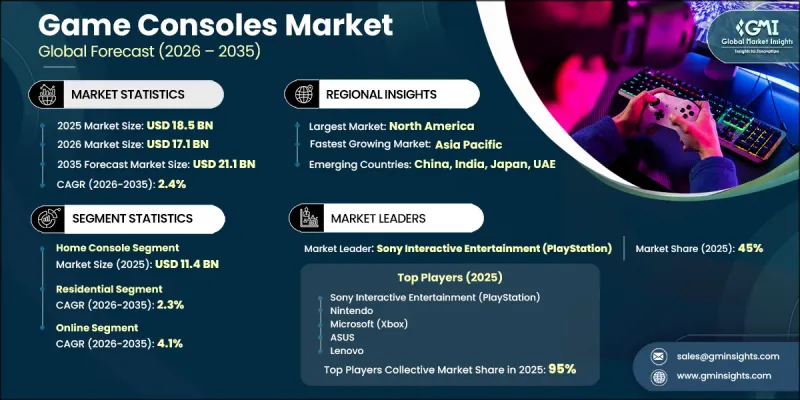
The Global Game Consoles Market was valued at USD 18.5 billion in 2025 and is estimated to grow at a CAGR of 2.4% to reach USD 21.1 billion by 2035.
Growth in the game consoles industry is driven by increasing demand for immersive entertainment experiences and the rising popularity of online multiplayer gaming ecosystems. The shift toward subscription-based gaming services is also reshaping consumer engagement patterns and supporting long-term market expansion. Technological advancements in console hardware, including improved graphics performance, faster processing capabilities, and compatibility with immersive technologies such as virtual reality and augmented reality, are further strengthening product appeal. These innovations are broadening the consumer base to include both casual users and competitive gaming enthusiasts. Rising disposable incomes, particularly in emerging economies, are also contributing to higher adoption of gaming consoles as consumers allocate more spending toward entertainment and digital leisure. Additionally, integration of gaming consoles with smart home ecosystems and connected entertainment devices is enhancing their role as central entertainment hubs. Expanding e-sports participation, increasing internet penetration, and the growing influence of digital gaming communities are further reinforcing steady demand across global markets.
| Market Scope | |
|---|---|
| Start Year | 2025 |
| Forecast Year | 2026-2035 |
| Start Value | $18.5 Billion |
| Forecast Value | $21.1 Billion |
| CAGR | 2.4% |
The game consoles industry is also experiencing consistent growth due to the evolution of digital distribution models and cloud-based gaming ecosystems. Consumers are increasingly shifting toward connected gaming environments that provide seamless access to large game libraries and online interaction features. Continuous innovation in gaming content, hardware performance, and subscription-driven services is supporting sustained engagement and repeat usage across global user bases.
In 2025, the home console segment generated USD 11.4 billion and is projected to grow at a CAGR of 2.6% through 2035. Demand for home consoles continues to rise due to improvements in gaming technology and increasing consumer expectations for high-quality gaming experiences. Enhanced capabilities such as ultra-high-definition resolution support, virtual reality compatibility, and advanced processing performance have strengthened the position of home consoles as the preferred gaming platform. In addition, the rising popularity of exclusive game titles and online multiplayer functionalities is further driving sustained adoption of home-based gaming systems.
The online distribution segment is expected to grow at a CAGR of 4.1% from 2026 to 2035. Expansion of digital commerce platforms and increasing consumer preference for convenient purchasing methods are key factors driving growth in this segment. Online channels offer consumers a wide variety of gaming consoles, competitive pricing, and convenient home delivery services, making them an attractive purchasing option. In addition, promotional discounts, bundled offers, and seasonal deals available through digital retail platforms are further encouraging online sales growth within the game consoles market.
United States Game Consoles Market accounted for 89% share in 2025, generating USD 5.4 billion. Market expansion in the country is driven by strong demand for immersive gaming experiences and the rapid development of advanced gaming technologies. High disposable income levels, coupled with a well-established digital infrastructure, continue to support widespread adoption of next-generation gaming consoles. The increasing popularity of competitive gaming and e-sports is also contributing to sustained market growth. The presence of leading global gaming companies and continuous innovation in console hardware, including enhanced graphics capabilities, improved processing power, and virtual reality integration, further strengthens market development in the United States.
Major companies operating in the Global Game Consoles Market include Microsoft, Sony Interactive Entertainment, Nintendo, Valve Corporation, ASUS, Lenovo, MSI, SNK Corporation, Anbernic, Ayn Technology, Evercade, Hyperkin, Miyoo, OneXPlayer, Arduboy, Datafrog, Panic Inc., Polymega, Retro-Bit Gaming, Supretro, and Thumby. Companies operating in the game consoles market are adopting a range of strategic initiatives to strengthen market presence and enhance competitiveness. Manufacturers are heavily investing in hardware innovation, focusing on improved graphics performance, faster processing units, and integration of immersive technologies such as virtual reality and augmented reality. Subscription-based gaming ecosystems and digital content platforms are expanded to increase recurring revenue streams and improve user retention. Firms are also strengthening exclusive game development partnerships to differentiate their platforms and build strong brand loyalty. Expansion of cloud gaming services and cross-platform compatibility is further enhancing accessibility and user engagement. In addition, companies are leveraging strategic collaborations with e-sports organizations and gaming communities to boost brand visibility.
Table of Contents
Chapter 1 Methodology and scope
- 1.1 Research approach
- 1.2 Quality Commitments
- 1.2.1 GMI AI policy & data integrity commitment
- 1.2.1.1 Source consistency protocol
- 1.2.1 GMI AI policy & data integrity commitment
- 1.3 Research Trail & Confidence Scoring
- 1.3.1 Research Trail Components
- 1.3.2 Scoring Components
- 1.4 Data Collection
- 1.4.1 Partial list of primary sources
- 1.5 Data mining sources
- 1.5.1 Paid sources
- 1.5.1.1 Sources, by region
- 1.5.1 Paid sources
- 1.6 Base estimates and calculations
- 1.6.1 Base year calculation for any one approach
- 1.7 Forecast model
- 1.7.1 Quantified market impact analysis
- 1.7.1.1 Mathematical impact of growth parameters on forecast
- 1.7.1 Quantified market impact analysis
- 1.8 Research transparency addendum
- 1.8.1 Source attribution framework
- 1.8.2 Quality assurance metrics
- 1.8.3 Our commitment to trust
Chapter 2 Executive summary
- 2.1 Industry 360° synopsis
- 2.2 Key market trends
- 2.2.1 Regional
- 2.2.2 Console type
- 2.2.3 Application
- 2.2.4 Price range
- 2.2.5 End users
- 2.2.6 Distribution channel
Chapter 3 Industry insights
- 3.1 Industry ecosystem analysis
- 3.1.1 Supplier landscape
- 3.1.2 Profit margin
- 3.1.3 Value addition at each stage
- 3.1.4 Factor affecting the value chain
- 3.1.5 Disruptions
- 3.2 Industry impact forces
- 3.2.1 Growth drivers
- 3.2.2 Industry pitfalls & challenges
- 3.2.3 Opportunities
- 3.3 Growth potential analysis
- 3.4 Future market trends
- 3.5 Technology and innovation landscape
- 3.5.1 Graphics processing & ray tracing technology
- 3.5.2 Cloud gaming integration
- 3.5.3 Virtual reality & augmented reality capabilities
- 3.5.4 Backward compatibility & cross-platform play
- 3.5.5 Solid-State Drive (SSD) technology evolution
- 3.6 Pricing Analysis
- 3.6.1 Historical price trend analysis
- 3.6.2 Pricing strategy by player type
- 3.7 Regulatory framework
- 3.7.1 Regional Content Rating Systems (ESRB, PEGI, CERO)
- 3.7.2 Data Privacy & Child Protection Regulations
- 3.7.3 Import/Export Tariffs & Trade Policies
- 3.7.4 Digital Rights Management & Licensing
- 3.8 Trade Data Analysis (HS Code: 95045000)
- 3.8.1 Import/export volume & value trends
- 3.8.2 Key trade corridors & tariff impact
- 3.9 Impact of AI & generative ai on the market
- 3.9.1 AI-driven disruption of traditional business models
- 3.9.2 GenAI use cases & adoption roadmap by customer segment
- 3.9.3 Risks, limitations & regulatory considerations
- 3.9.4 AI-enabled smart home ecosystem integration
- 3.10 Porter's five forces analysis
- 3.11 PESTEL analysis
- 3.12 Consumer behavior analysis
- 3.12.1 Purchasing patterns
- 3.12.2 Preference analysis
- 3.12.3 Regional variations in consumer behavior
- 3.12.4 Impact of e-commerce on buying decisions
Chapter 4 Competitive landscape, 2025
- 4.1 Introduction
- 4.2 Company market share analysis
- 4.2.1 North America
- 4.2.2 Europe
- 4.2.3 Asia Pacific
- 4.2.4 Latin America
- 4.2.5 MEA
- 4.3 Company matrix analysis
- 4.4 Competitive analysis of major market players
- 4.5 Competitive positioning matrix
- 4.6 Key developments
- 4.6.1 Mergers & acquisitions
- 4.6.2 Partnerships & collaborations
- 4.6.3 New product launches
- 4.6.4 Expansion plans
Chapter 5 Market Estimates & Forecast, By Console Type, 2022 - 2035 ($Billion, Thousand Units)
- 5.1 Key trends
- 5.2 Home console
- 5.3 Handheld console
- 5.4 Hybrid console
- 5.5 Dedicated console
Chapter 6 Market Estimates & Forecast, By Application, 2022 - 2035 ($Billion, Thousand Units)
- 6.1 Key trends
- 6.2 Online gaming
- 6.3 Offline gaming
Chapter 7 Market Estimates & Forecast, By Price Range, 2022 - 2035 ($Billion, Thousand Units)
- 7.1 Key trends
- 7.2 Low (below USD 200)
- 7.3 Medium (USD 200 - USD 499)
- 7.4 High (USD 500 & above)
Chapter 8 Market Estimates & Forecast, By End Users, 2022 - 2035 ($Billion, Thousand Units)
- 8.1 Key trends
- 8.2 Residential
- 8.3 Commercial
- 8.3.1 Gaming cafes
- 8.3.2 Esports arenas
- 8.3.3 Hospitality & entertainment
Chapter 9 Market Estimates & Forecast, By Distribution Channel, 2022 - 2035 ($Billion, Thousand Units)
- 9.1 Key trends
- 9.2 Online
- 9.2.1 E-commerce
- 9.2.2 Company websites
- 9.3 Offline
- 9.3.1 Supermarkets/hypermarket
- 9.3.2 Specialty retail stores
- 9.3.3 Others (independent retailer etc.)
Chapter 10 Market Estimates & Forecast, By Region, 2022 - 2035 ($Billion, Thousand Units)
- 10.1 Key trends
- 10.2 North America
- 10.2.1 U.S.
- 10.2.2 Canada
- 10.3 Europe
- 10.3.1 Germany
- 10.3.2 UK
- 10.3.3 France
- 10.3.4 Spain
- 10.3.5 Italy
- 10.3.6 Netherlands
- 10.4 Asia Pacific
- 10.4.1 China
- 10.4.2 Japan
- 10.4.3 India
- 10.4.4 Australia
- 10.4.5 South Korea
- 10.5 Latin America
- 10.5.1 Brazil
- 10.5.2 Mexico
- 10.5.3 Argentina
- 10.6 MEA
- 10.6.1 South Africa
- 10.6.2 Saudi Arabia
- 10.6.3 UAE
Chapter 11 Company Profiles
- 11.1 Global Key Players
- 11.1.1 ASUS
- 11.1.2 Lenovo
- 11.1.3 Microsoft (Xbox)
- 11.1.4 MSI
- 11.1.5 Nintendo
- 11.1.6 Sony Interactive Entertainment (PlayStation)
- 11.1.7 Valve Corporation
- 11.2 Regional Players
- 11.2.1 Anbernic
- 11.2.2 Ayn Technology
- 11.2.3 Evercade (Blaze)
- 11.2.4 Hyperkin
- 11.2.5 Miyoo
- 11.2.6 OneXPlayer
- 11.2.7 SNK Corporation
- 11.3 Emerging/Niche Specialists
- 11.3.1 Arduboy
- 11.3.2 Datafrog
- 11.3.3 Panic Inc.
- 11.3.4 Polymega
- 11.3.5 Retro-Bit Gaming
- 11.3.6 Supretro
- 11.3.7 Thumby

