PUBLISHER: Global Market Insights Inc. | PRODUCT CODE: 2045774

PUBLISHER: Global Market Insights Inc. | PRODUCT CODE: 2045774
North America Residential Air to Water Heat Pump Market Opportunity, Growth Drivers, Industry Trend Analysis, and Forecast 2026 - 2035
North America Residential Air to Water Heat Pump Market was valued at USD 1.1 billion in 2025 and is estimated to grow at a CAGR of 16.2% to reach USD 5.2 billion by 2035.
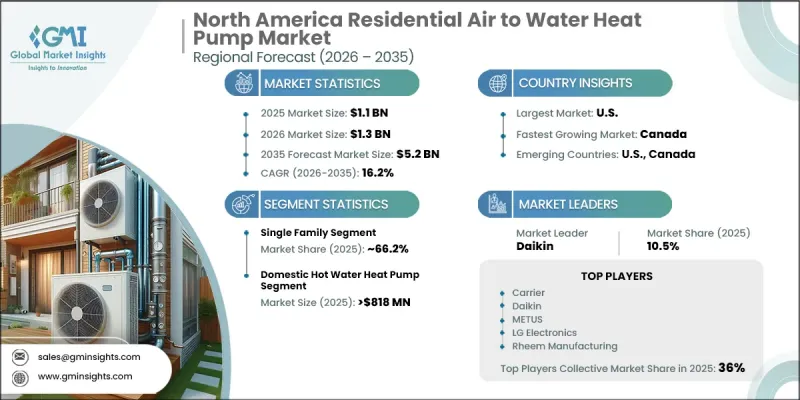
The market growth is driven by rising demand for efficient residential water heating systems, increasing focus on reducing greenhouse gas emissions, and stronger adoption of low-carbon heating technologies. Supportive regulatory frameworks, including energy efficiency mandates and government incentives promoting heat pump adoption, are further accelerating market penetration. Ongoing product innovation aimed at improving operational efficiency and performance across varying climatic conditions is also strengthening industry development. Manufacturers are increasingly introducing advanced heating systems designed to deliver reliable domestic hot water in colder regions, further supporting product demand. In addition, residential infrastructure expansion, population growth, and rising consumer preference for energy-efficient and environmentally friendly heating solutions are contributing to sustained market growth. Financial incentives such as tax benefits and clean energy programs are further encouraging widespread adoption of air to water heat pump systems across residential applications in North America.
| Market Scope | |
|---|---|
| Start Year | 2025 |
| Forecast Year | 2026-2035 |
| Start Value | $1.1 Billion |
| Forecast Value | $5.2 Billion |
| CAGR | 16.2% |
The single-family segment accounted for 66.2% share in 2025 and is projected to grow at a CAGR of 16.5% through 2035. Growth in this segment is being supported by rising urbanization and increasing residential construction activity, which is driving higher installation of air to water heat pump systems. Government-led initiatives, financial support programs, and strict energy efficiency regulations are further promoting the adoption of clean heating technologies. Additionally, growing consumer preference for cost-effective and energy-efficient heating solutions, along with ongoing retrofitting activities in residential buildings, is strengthening segment expansion. Rising disposable income levels and increasing awareness of sustainable home heating systems are also contributing to the positive outlook of this segment.
The domestic hot water heat pump segment was valued at USD 818 million in 2025. Increasing demand for energy-efficient water heating solutions in residential environments is driving segment growth. Rising hot water consumption across households, combined with the shift toward sustainable heating technologies, is further accelerating adoption. The growing trend of residential renovation and retrofitting projects, along with stricter energy efficiency standards, is supporting increased deployment of advanced hot water heat pump systems. Expanding construction activity and supportive regulatory frameworks promoting low-emission heating solutions are also contributing to long-term segment growth.
U.S. Residential Air To Water Heat Pump Market was valued at USD 1.1 billion in 2025 and is projected to grow at a CAGR of 16.1% from 2026 to 2035. Market expansion in the country is driven by rising demand for efficient heating and cooling systems, along with increasing need for reliable hot water solutions across residential applications. Changing climatic conditions are further encouraging adoption of advanced heating technologies capable of delivering consistent performance. Strong policy support for energy-efficient systems, combined with increasing consumer preference for clean energy technologies, is positively influencing market development. Continued emphasis on reducing carbon emissions and improving residential energy efficiency is further strengthening the growth outlook of the U.S. market.
Major companies operating in the North America Residential Air to Water Heat Pump Market include Carrier, Daikin Comfort Technologies, Mitsubishi Electric Trane HVAC, LG Electronics, Midea, Rheem Manufacturing, Stiebel Eltron, Johnson Controls-Hitachi Air Conditioning, Viessmann, Navien, GREE Canada, Blue Star, American Standard, Nordic Heat Pumps, SpacePak, U.S. Boiler Company, Arctic Heat Pumps, Apollo Heat Pumps Systems, Chiltrix, and AERMEC. Companies operating in the North America residential air to water heat pump market are adopting several strategic initiatives to strengthen their market position and expand adoption across residential applications. Leading manufacturers are heavily investing in research and development to enhance system efficiency, improve performance across extreme temperature conditions, and reduce overall energy consumption. Product innovation is focused on developing compact, high-efficiency units suitable for modern residential infrastructure and retrofitting projects. Companies are also expanding production capabilities and strengthening distribution networks to improve product availability across key regional markets. Strategic collaborations with contractors, builders, and energy service providers are supporting wider installation and adoption of heat pump systems.
Table of Contents
Chapter 1 Methodology & Scope
- 1.1 Research design
- 1.2 Quality commitment
- 1.2.1 GMI AI policy & data integrity commitment
- 1.2.1.1 Source consistency protocol
- 1.2.1 GMI AI policy & data integrity commitment
- 1.3 Research trail & confidence scoring
- 1.3.1 Research trail components
- 1.3.2 Scoring components
- 1.4 Data collection
- 1.4.1 Partial list of primary sources
- 1.5 Data mining sources
- 1.5.1 Paid sources
- 1.5.1.1 Sources, by country
- 1.5.1 Paid sources
- 1.6 Base estimates and calculations
- 1.6.1 Base year calculation for any one approach
- 1.7 Market estimates & forecasts parameters
- 1.8 Forecast model
- 1.8.1 Quantified market impact analysis
- 1.8.1.1 Mathematical impact of growth parameters on forecast
- 1.8.1 Quantified market impact analysis
- 1.9 Research transparency addendum
- 1.9.1 Source attribution framework
- 1.9.2 Quality assurance metrics
- 1.9.3 Our commitment to trust
- 1.10 Market definitions
Chapter 2 Executive Summary
- 2.1 Industry synopsis, 2022 - 2035
- 2.2 Business trends
- 2.3 Application trends
- 2.4 Product trends
- 2.5 Country trends
Chapter 3 Industry Insights
- 3.1 Industry ecosystem analysis
- 3.1.1 Raw material availability & sourcing analysis
- 3.1.2 Key factors affecting the value chain
- 3.1.3 Disruptions
- 3.2 Industry impact forces
- 3.2.1 Growth drivers
- 3.2.2 Industry pitfalls & challenges
- 3.3 Growth potential analysis
- 3.4 Regulatory landscape
- 3.5 Porter's analysis
- 3.5.1 Bargaining power of suppliers
- 3.5.2 Bargaining power of buyers
- 3.5.3 Threat of new entrants
- 3.5.4 Threat of substitutes
- 3.6 PESTEL analysis
- 3.6.1 Political factors
- 3.6.2 Economic factors
- 3.6.3 Social factors
- 3.6.4 Technological factors
- 3.6.5 Legal factors
- 3.6.6 Environmental factors
- 3.7 Cost structure analysis of air to water heat pump
- 3.8 Price trend analysis, 2022-2035 (USD/Unit) (Driven by Primary Research)
- 3.8.1 By product (Driven by Primary Research)
- 3.8.2 By country (Driven by Primary Research)
- 3.9 Emerging opportunities & trends
- 3.9.1 Digital transformation with IoT technologies
- 3.9.2 Emerging market penetration
- 3.10 Investment analysis & future outlook
- 3.11 Impact of AI & Generative AI on the market (Solution Core)
- 3.11.1 AI-Driven production optimization (Solution Core)
- 3.11.2 Predictive maintenance & fault detection (Solution Core)
- 3.12 Trade data analysis (Driven by Primary Research)
- 3.12.1 Import/export volume & value trends (Driven by Primary Research)
- 3.12.2 Key trade corridors & tariff impact (Driven by Primary Research)
Chapter 4 Competitive Landscape, 2026
- 4.1 Introduction
- 4.2 Company market share analysis, by country, 2025
- 4.2.1 U.S.
- 4.2.2 Canada
- 4.3 Competitive positioning matrix
- 4.4 Key developments
- 4.4.1 Mergers & acquisitions
- 4.4.2 Partnerships & collaborations
- 4.4.3 New product launches
- 4.4.4 Expansion plans and funding
Chapter 5 Market Size and Forecast, By Application, 2022 - 2035 (USD Million, '000 Units)
- 5.1 Key trends
- 5.2 Single family
- 5.3 Multi family
Chapter 6 Market Size and Forecast, By Product, 2022 - 2035 (USD Million, '000 Units)
- 6.1 Key trends
- 6.2 Domestic hot water heat pump
- 6.3 Room heat pump
Chapter 7 Market Size and Forecast, By Country, 2022 - 2035 (USD Million, '000 Units)
- 7.1 Key trends
- 7.2 U.S.
- 7.3 Canada
Chapter 8 Company Profiles
- 8.1 AERMEC
- 8.2 American Standard
- 8.3 Apollo Heat Pumps Systems
- 8.4 Arctic Heat Pumps
- 8.5 Blue Star
- 8.6 Carrier
- 8.7 Chiltrix
- 8.8 Daikin Comfort Technologies
- 8.9 GREE Canada
- 8.10 Johnson Controls-Hitachi Air Conditioning
- 8.11 LG Electronics
- 8.12 Midea
- 8.13 Mitsubishi Electric Trane HVAC
- 8.14 Navien
- 8.15 Nordic Heat Pumps
- 8.16 Rheem Manufacturing
- 8.17 SpacePak
- 8.18 Stiebel Eltron
- 8.19 U.S. Boiler Company
- 8.20 Viessmann

