PUBLISHER: Global Market Insights Inc. | PRODUCT CODE: 2045801

PUBLISHER: Global Market Insights Inc. | PRODUCT CODE: 2045801
Timber Laminating Adhesives Market Opportunity, Growth Drivers, Industry Trend Analysis, and Forecast 2026 - 2035
The Global Timber Laminating Adhesives Market was valued at USD 1.08 billion in 2025 and is estimated to grow at a CAGR of 6.2% to reach USD 1.96 billion by 2035.
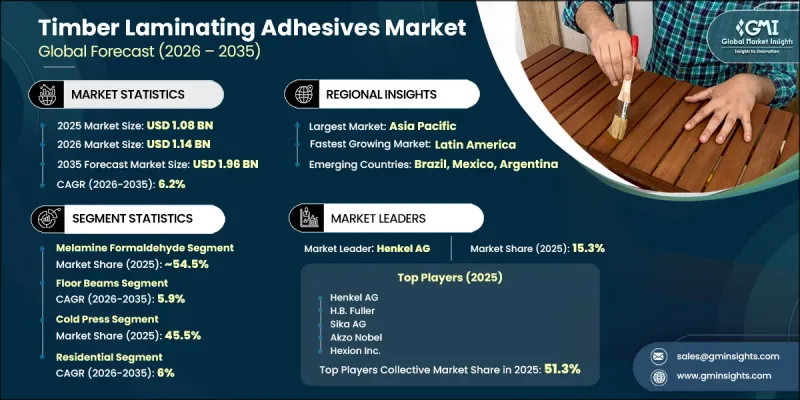
The timber laminating adhesives industry plays a crucial role in enabling the production of engineered wood products by delivering strong, durable, and adaptable bonding solutions required for high-performance construction. These adhesives support the development of structurally sound and visually appealing wood-based materials, allowing manufacturers to create complex and large-scale designs with precision. Their performance advantages include high bonding strength, resistance to environmental variations, and compatibility with a wide range of wood materials, making them suitable for diverse construction needs. Increasing demand for sustainable building materials is further accelerating market growth, as environmentally responsible solutions gain traction across the construction sector. The ease of application and efficiency of these adhesives contribute to faster production cycles and reduced labor costs. Their lightweight characteristics also support material optimization, helping lower overall environmental impact. The market continues to expand as modern construction increasingly relies on engineered wood and sustainable building practices, reinforcing the importance of advanced adhesive technologies.
| Market Scope | |
|---|---|
| Start Year | 2025 |
| Forecast Year | 2026-2035 |
| Start Value | $1.08 Billion |
| Forecast Value | $1.96 Billion |
| CAGR | 6.2% |
The melamine formaldehyde adhesives segment held a 54.5% share in 2025 and is expected to grow at a CAGR of 6% through 2035. This segment maintains its dominance due to its excellent durability, strong bonding capabilities, and resistance to heat, making it highly suitable for demanding applications. Continuous improvements in formulation are further enhancing product performance and reliability.
The floor beams segment held a 31.5% share in 2025 and is projected to grow at a CAGR of 5.9% between 2026 and 2035. This application remains a key contributor to market demand as it requires adhesives that ensure long-term structural strength and stability. The need for high-performance bonding solutions in load-bearing components continues to drive adoption within this segment.
North America Timber Laminating Adhesives Market held a 27.7% share in 2025. Expansion is supported by increasing preference for sustainable construction materials and ongoing development across residential and commercial sectors. Technological advancements are enabling the production of low-emission adhesive solutions, aligning with regulatory requirements and environmental standards. Growing awareness of eco-friendly materials is further contributing to market expansion in the region.
Key companies operating in the Global Timber Laminating Adhesives Market include Henkel AG & Co. KGaA, H.B. Fuller Company, 3M Company, Akzo Nobel N.V., Sika AG, Ashland Global Holdings, Dynea AS, Hexion Inc., Jowat SE, Kiilto Oy, and Evertree. Companies in the timber laminating adhesives market are implementing a range of strategies to strengthen their competitive position. Organizations are investing in research and development to enhance adhesive performance, durability, and environmental compliance. A strong focus on sustainable product innovation is driving the development of low-emission and eco-friendly adhesive solutions. Strategic partnerships and collaborations are being pursued to expand technological capabilities and improve market reach. Companies are also optimizing manufacturing processes to increase efficiency and reduce costs. Geographic expansion into high-growth regions is enabling broader customer access, while continuous product differentiation helps address evolving construction requirements.
Table of Contents
Chapter 1 Methodology & Scope
- 1.1 Market scope and definition
- 1.2 Research design
- 1.2.1 Research approach
- 1.2.2 Data collection methods
- 1.3 Data mining sources
- 1.3.1 Global
- 1.3.2 Regional/Country
- 1.4 Base estimates and calculations
- 1.4.1 Base year calculation
- 1.4.2 Key trends for market estimation
- 1.5 Primary research and validation
- 1.5.1 Primary sources
- 1.6 Forecast model
- 1.7 Research assumptions and limitations
Chapter 2 Executive Summary
- 2.1 Industry 360° synopsis
- 2.2 Key market trends
- 2.2.1 Regional
- 2.2.2 Resin type
- 2.2.3 Application
- 2.2.4 Technology
- 2.2.5 End user
- 2.3 TAM Analysis, 2026-2035
- 2.4 CXO perspectives: Strategic imperatives
- 2.4.1 Executive decision points
Chapter 3 Industry Insights
- 3.1 Industry ecosystem analysis
- 3.1.1 Supplier landscape
- 3.1.2 Profit margin
- 3.1.3 Value addition at each stage
- 3.1.4 Factor affecting the value chain
- 3.1.5 Disruptions
- 3.2 Industry impact forces
- 3.2.1 Growth drivers
- 3.2.2 Industry pitfalls and challenges
- 3.2.3 Market opportunities
- 3.3 Growth potential analysis
- 3.4 Regulatory landscape
- 3.4.1 North America
- 3.4.2 Europe
- 3.4.3 Asia Pacific
- 3.4.4 Latin America
- 3.4.5 Middle East & Africa
- 3.5 Porter's analysis
- 3.6 PESTEL analysis
- 3.7 Price trends
- 3.7.1 By region
- 3.7.2 By type
- 3.8 Future market trends
- 3.9 Technology and Innovation landscape
- 3.9.1 Current technological trends
- 3.9.2 Emerging technologies
- 3.10 Patent Landscape
- 3.11 Trade statistics (HS code)
- 3.11.1 Major importing countries
- 3.11.2 Major exporting countries
- 3.12 Sustainability and environmental aspects
- 3.12.1 Sustainable practices
- 3.12.2 Waste reduction strategies
- 3.12.3 Energy efficiency in production
- 3.12.4 Eco-friendly initiatives
- 3.13 Carbon footprint consideration
Chapter 4 Competitive Landscape, 2025
- 4.1 Introduction
- 4.2 Company market share analysis
- 4.2.1 By region
- 4.2.1.1 North America
- 4.2.1.2 Europe
- 4.2.1.3 Asia Pacific
- 4.2.1.4 LATAM
- 4.2.1.5 MEA
- 4.2.1 By region
- 4.3 Company matrix analysis
- 4.4 Competitive analysis of major market players
- 4.5 Competitive positioning matrix
- 4.6 Key developments
- 4.6.1 Mergers & acquisitions
- 4.6.2 Partnerships & collaborations
- 4.6.3 New Product Launches
- 4.6.4 Expansion Plans
Chapter 5 Market Estimates and Forecast, By Resin Type, 2022-2035 (USD Million) (Kilo Tons)
- 5.1 Key trends
- 5.2 Melamine formaldehyde
- 5.3 Phenol resorcinol formaldehyde adhesives
- 5.4 Polyurethane
- 5.5 Emulsion polymer isocyanate adhesives
- 5.6 Others
Chapter 6 Market Estimates and Forecast, By Application, 2022-2035 (USD Million) (Kilo Tons)
- 6.1 Key trends
- 6.2 Floor beams
- 6.3 Roof beams
- 6.4 Window and door headers
- 6.5 Trusses and supporting columns
- 6.6 Others
Chapter 7 Market Estimates and Forecast, By Technology, 2022-2035 (USD Million) (Kilo Tons)
- 7.1 Key trends
- 7.2 Cold press
- 7.3 Hot press
- 7.4 UV cure
Chapter 8 Market Estimates and Forecast, By End User, 2022-2035 (USD Million) (Kilo Tons)
- 8.1 Key trends
- 8.2 Residential
- 8.3 Commercial
- 8.4 Industrial
- 8.5 Institutional
- 8.6 Others
Chapter 9 Market Estimates and Forecast, By Region, 2022-2035 (USD Million) (Kilo Tons)
- 9.1 Key trends
- 9.2 North America
- 9.2.1 U.S.
- 9.2.2 Canada
- 9.3 Europe
- 9.3.1 Germany
- 9.3.2 UK
- 9.3.3 France
- 9.3.4 Spain
- 9.3.5 Italy
- 9.3.6 Rest of Europe
- 9.4 Asia Pacific
- 9.4.1 China
- 9.4.2 India
- 9.4.3 Japan
- 9.4.4 Australia
- 9.4.5 South Korea
- 9.4.6 Rest of Asia Pacific
- 9.5 Latin America
- 9.5.1 Brazil
- 9.5.2 Mexico
- 9.5.3 Argentina
- 9.5.4 Rest of Latin America
- 9.6 Middle East and Africa
- 9.6.1 Saudi Arabia
- 9.6.2 South Africa
- 9.6.3 UAE
- 9.6.4 Rest of Middle East and Africa
Chapter 10 Company Profiles
- 10.1 3M Company
- 10.2 Akzo Nobel N.V.
- 10.3 Ashland Global Holdings
- 10.4 Dynea AS
- 10.5 Evertree
- 10.6 H.B. Fuller Company
- 10.7 Henkel AG & Co. KGaA
- 10.8 Hexion Inc.
- 10.9 Jowat SE
- 10.10 Kiilto Oy
- 10.11 Sika AG

