PUBLISHER: Global Market Insights Inc. | PRODUCT CODE: 2045802

PUBLISHER: Global Market Insights Inc. | PRODUCT CODE: 2045802
Europe Heat Exchanger Market Opportunity, Growth Drivers, Industry Trend Analysis, and Forecast 2026 - 2035
Europe Heat Exchanger Market was valued at USD 6.6 billion in 2025 and is estimated to grow at a CAGR of 7.8% to reach USD 14 billion by 2035.
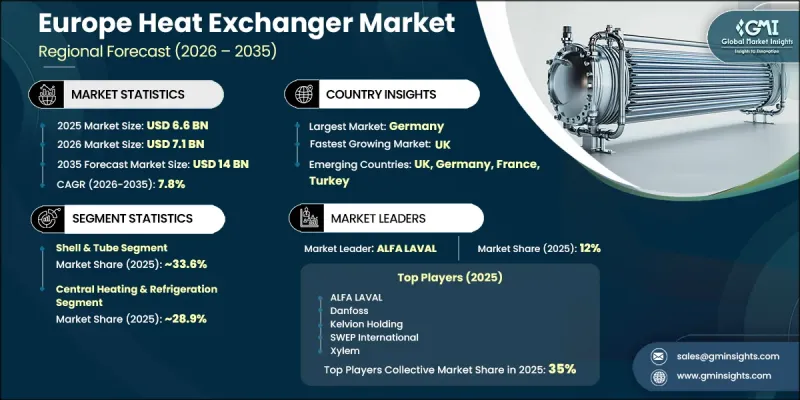
The market is expanding due to increasing demand for efficient heating and cooling solutions across building infrastructure and industrial applications. Growing investments in large-scale industrial activities are further strengthening demand for advanced thermal management systems. At the same time, the shift toward energy-efficient climate control technologies is encouraging the adoption of high-performance equipment. Continuous industrial expansion and the need for reliable operational systems are supporting the overall market trajectory. Manufacturers are focusing on improving product performance through ongoing technological innovation, which is enhancing system efficiency and durability. Additionally, the push toward achieving regional decarbonization targets is increasing the need for energy-efficient and compact solutions. The integration of scalable technologies that meet environmental standards is further contributing to market growth. These combined factors are shaping the Europe heat exchanger market as industries prioritize sustainability, efficiency, and advanced system capabilities.
| Market Scope | |
|---|---|
| Start Year | 2025 |
| Forecast Year | 2026-2035 |
| Start Value | $6.6 Billion |
| Forecast Value | $14 Billion |
| CAGR | 7.8% |
The shell and tube heat exchanger segment accounted for 33.6% share in 2025 and is expected to grow at a CAGR of 7.7% through 2035. Demand for these systems continues to rise across multiple industrial applications due to their efficiency and reliability. Increasing emphasis on optimizing energy consumption and ongoing investments in industrial development are further supporting growth. Expanding manufacturing activities and the need for specialized processing systems are also influencing the adoption of these heat exchangers.
The central heating and refrigeration segment held 28.9% share in 2025 and was valued at USD 1.9 billion. The segment is gaining momentum as industries adopt advanced heat exchanger technologies that align with evolving environmental requirements. The transition toward systems that support environmentally responsible refrigerants is positively shaping demand. Regulatory frameworks related to heating and cooling efficiency, combined with the growing integration of digital solutions for improved climate control, are driving adoption across commercial and industrial sectors.
Germany Heat Exchanger Market accounted for 22.7% share in 2025 and generated over USD 1.5 billion. The country continues to play a leading role due to its strong industrial foundation and commitment to sustainability goals. Government initiatives promoting efficient manufacturing practices and the adoption of advanced industrial technologies are strengthening market growth. Increased focus on automation and digital transformation within industrial operations is further enhancing demand for modern heat exchanger systems.
Key companies operating in the Europe Heat Exchanger Market include ALFA LAVAL, Danfoss, Kelvion Holding, SPX FLOW, Xylem, Mersen Group, SWEP International, API Heat Transfer, Pentair, HRS Heat Exchangers, FUNKE Warmeaustauscher, Nexson, Ecotherm Austria, APEX Heat Transfer, Bronswerk, Thermex, AMI Exchangers, IWS Monje Heat Exchangers, FTC Deutschland, TransTech Energy, and Anthermo. Companies in the Europe Heat Exchanger Market are focusing on innovation to enhance product efficiency and meet evolving energy standards. Many are investing in research and development to create advanced systems that deliver improved thermal performance while reducing environmental impact. Strategic partnerships and collaborations are being pursued to expand technological capabilities and strengthen distribution networks. Businesses are also increasing their presence in high-growth industrial sectors to capture new opportunities. Digitalization and the integration of smart technologies are enabling better monitoring and operational efficiency.
Table of Contents
Chapter 1 Methodology & Scope
- 1.1 Research approach
- 1.2 Quality commitments
- 1.2.1 GMI AI policy & data integrity commitment
- 1.2.1.1 Source consistency protocol
- 1.2.1 GMI AI policy & data integrity commitment
- 1.3 Research trail & confidence scoring
- 1.3.1 Research trail components
- 1.3.2 Scoring components
- 1.4 Data collection
- 1.4.1 Partial list of primary sources
- 1.5 Data mining sources
- 1.5.1 Paid sources
- 1.5.1.1 Sources, by country
- 1.5.1 Paid sources
- 1.6 Base estimates and calculations
- 1.6.1 Base year calculation for any one approach
- 1.7 Market estimates & forecasts parameters
- 1.8 Forecast model
- 1.8.1 Quantified market impact analysis
- 1.8.1.1 Mathematical impact of growth parameters on forecast
- 1.8.1 Quantified market impact analysis
- 1.9 Research transparency addendum
- 1.9.1 Source attribution framework
- 1.9.2 Quality assurance metrics
- 1.9.3 Our commitment to trust
- 1.10 Market definitions
Chapter 2 Executive Summary
- 2.1 Industry synopsis, 2022 - 2035
- 2.2 Business trends
- 2.3 Technology trends
- 2.4 Application trends
- 2.5 Country trends
Chapter 3 Industry Insights
- 3.1 Industry ecosystem analysis
- 3.1.1 Raw material availability & sourcing analysis
- 3.1.2 Key factors affecting the value chain
- 3.1.3 Disruptions
- 3.2 Regulatory landscape
- 3.3 Industry impact forces
- 3.3.1 Growth drivers
- 3.3.2 Industry pitfalls & challenges
- 3.4 Growth potential analysis
- 3.5 Porter's analysis
- 3.5.1 Bargaining power of suppliers
- 3.5.2 Bargaining power of buyers
- 3.5.3 Threat of new entrants
- 3.5.4 Threat of substitutes
- 3.6 PESTEL analysis
- 3.6.1 Political factors
- 3.6.2 Economic factors
- 3.6.3 Social factors
- 3.6.4 Technological factors
- 3.6.5 Legal factors
- 3.6.6 Environmental factors
- 3.7 Cost structure analysis of heat exchanger
- 3.8 Emerging opportunities & trends
- 3.8.1 Digital transformation with IoT technologies
- 3.8.2 Emerging market penetration
- 3.9 Investment analysis & future outlook
- 3.10 Trade data analysis (Driven by Primary Research)
- 3.10.1 Import/export value trends (Driven by Primary Research)
- 3.10.2 Key trade corridors & tariff impact (Driven by Primary Research)
- 3.11 Capacity & production landscape (Driven by Primary Research)
- 3.11.1 Capacity by region & key producer (Driven by Primary Research)
- 3.11.2 Capacity utilization rates & expansion pipelines (Driven by Primary Research)
- 3.12 Impact of AI & Generative AI on the market (Solution Core)
- 3.12.1 AI-Driven production optimization (Solution Core)
- 3.12.2 Predictive maintenance & fault detection (Solution Core)
Chapter 4 Competitive Landscape, 2025
- 4.1 Introduction
- 4.2 Company market share analysis, by country, 2025
- 4.2.1 Germany
- 4.2.2 UK
- 4.2.3 France
- 4.2.4 Russia
- 4.2.5 Italy
- 4.2.6 Spain
- 4.2.7 Poland
- 4.2.8 Turkiye
- 4.3 Competitive positioning matrix
- 4.4 Key developments
- 4.4.1 Mergers & acquisitions
- 4.4.2 Partnerships & collaborations
- 4.4.3 New product launches
- 4.4.4 Expansion plans & funding
Chapter 5 Market Size and Forecast, By Technology, 2022 - 2035 (USD Million)
- 5.1 Key trends
- 5.2 Shell & tube
- 5.3 Plate
- 5.4 Air cooled
- 5.5 Others
Chapter 6 Market Size and Forecast, By Application, 2022 - 2035 (USD Million)
- 6.1 Key trends
- 6.2 Oil & gas
- 6.3 Chemical
- 6.4 Power generation & metallurgy
- 6.5 Marine
- 6.6 Mechanical industry
- 6.7 Central heating & refrigeration
- 6.8 Food processing
- 6.9 Others
Chapter 7 Market Size and Forecast, By Country, 2022 - 2035 (USD Million)
- 7.1 Key trends
- 7.2 Germany
- 7.3 UK
- 7.4 France
- 7.5 Russia
- 7.6 Italy
- 7.7 Spain
- 7.8 Poland
- 7.9 Turkey
Chapter 8 Company Profiles
- 8.1 ALFA LAVAL
- 8.2 AMI Exchangers
- 8.3 Anthermo
- 8.4 APEX Heat Transfer
- 8.5 API Heat Transfer
- 8.6 Bronswerk
- 8.7 Danfoss
- 8.8 Ecotherm Austria
- 8.9 FTC Deutschland
- 8.10 FUNKE Warmeaustauscher
- 8.11 HRS Heat Exchangers
- 8.12 IWS-Monje Heat Exchangers
- 8.13 Kelvion Holding
- 8.14 Mersen Group
- 8.15 Nexson
- 8.16 Pentair
- 8.17 SPX FLOW
- 8.18 SWEP International
- 8.19 Thermex
- 8.20 TransTech Energy
- 8.21 Xylem

