PUBLISHER: Global Market Insights Inc. | PRODUCT CODE: 2045818

PUBLISHER: Global Market Insights Inc. | PRODUCT CODE: 2045818
Asia Pacific Heat Exchanger Market Opportunity, Growth Drivers, Industry Trend Analysis, and Forecast 2026 - 2035
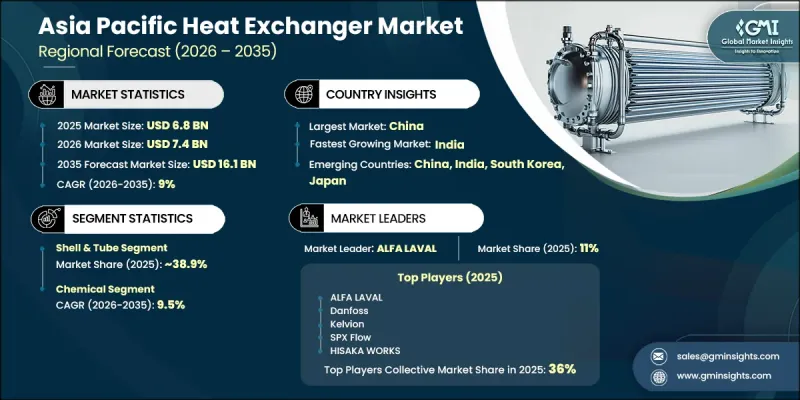
Asia Pacific Heat Exchanger Market was valued at USD 6.8 billion in 2025 and is estimated to grow at a CAGR of 9% to reach USD 16.1 billion by 2035.
Market expansion is supported by rising investments in heavy industrial operations, alongside increasing energy consumption across heating and cooling systems used in commercial and residential buildings. Growth in crude imports, the establishment of new petrochemical and chemical production facilities, and ongoing discoveries of both conventional and unconventional hydrocarbon reserves are further strengthening industry demand. The market outlook is also being shaped by rising requirements for efficient heating and cooling systems and the growing emphasis on recovering and reusing waste heat from industrial operations. In addition, stricter carbon emission reduction mandates, tightening energy efficiency regulations, and increasing adoption of advanced thermal management technologies are supporting sustained product demand. Expanding energy requirements across power generation, oil and gas, and petrochemical sectors continue to influence overall market dynamics across the region.
| Market Scope | |
|---|---|
| Start Year | 2025 |
| Forecast Year | 2026-2035 |
| Start Value | $6.8 Billion |
| Forecast Value | $16.1 Billion |
| CAGR | 9% |
Shell and tube heat exchanger systems accounted for a 38.9% share in 2025 and is projected to grow at a CAGR of 8.8% from 2026 to 2035. Increasing investments in industrial production facilities, along with the expansion of specialty chemical manufacturing, are driving higher deployment of this technology type. Growing demand for energy-efficient thermal solutions across industries such as oil and gas, as well as food and beverage processing, is further supporting segment growth and shaping broader industry trends.
The chemical application segment was valued at USD 2.2 billion in 2025 and is expected to grow at a CAGR of 9.5% through 2035. Rising chemical production demand, coupled with increasing emphasis on energy optimization, has significantly boosted the adoption of advanced heat exchange technologies in the chemical sector. Strict safety standards, regulatory compliance requirements, and the integration of digital monitoring systems, predictive maintenance solutions, and real-time control technologies in modern chemical processing plants are further improving operational efficiency and strengthening market growth.
China Heat Exchanger Market held a 42.9% share, generating USD 2.9 billion in 2025. Strong expansion in chemicals, petrochemicals, energy, and manufacturing industries, supported by government initiatives promoting energy efficiency and industrial modernization, is reinforcing market growth in the country. Rapid growth in manufacturing infrastructure, coupled with increasing investments in energy-intensive production facilities, continues to shape the regional outlook. Furthermore, ongoing technological advancements aimed at improving operational efficiency, expansion of production capacities, and rising environmental compliance requirements to reduce emissions are collectively driving sustained industry development.
Major manufacturers operating in the Asia Pacific Heat Exchanger Market include ACCESSEN, ALFA LAVAL, API Heat Transfer, Danfoss, Funke Heat Exchanger Systems, HRS Process Systems, HISAKA WORKS, Holtec International, Kelvion, KNM Group, Mersen, Nexson Group, SPX FLOW, SWEP International, Thermax, Thermofin, United Heat Transfer, Xylem, Hangzhou Shenshi Energy Conservation Technology, HFM, KAMUI Vietnam, and Yangzhou Panstar Heat Exchanger Equipment. Key strategies adopted by companies in the Asia Pacific heat exchanger market focus on enhancing thermal efficiency through continuous product innovation and advanced material engineering. Manufacturers are investing in digitalization, including smart monitoring systems, predictive maintenance, and real-time performance optimization to improve operational reliability. Expansion of production facilities and strengthening of regional supply chains are helping companies meet rising industrial demand more effectively. Strategic collaborations with end-use industries such as chemicals, oil and gas, and power generation are enabling customized solution development.
Table of Contents
Chapter 1 Methodology & Scope
- 1.1 Research design
- 1.2 Quality commitment
- 1.2.1 GMI AI policy & data integrity commitment
- 1.2.1.1 Source consistency protocol
- 1.2.1 GMI AI policy & data integrity commitment
- 1.3 Research trail & confidence scoring
- 1.3.1 Research trail components
- 1.3.2 Scoring components
- 1.4 Data collection
- 1.4.1 Partial list of primary sources
- 1.5 Data mining sources
- 1.5.1 Paid sources
- 1.5.1.1 Sources, by country
- 1.5.1 Paid sources
- 1.6 Base estimates and calculations
- 1.6.1 Base year calculation for any one approach
- 1.7 Market estimates & forecasts parameters
- 1.8 Forecast model
- 1.8.1 Quantified market impact analysis
- 1.8.1.1 Mathematical impact of growth parameters on forecast
- 1.8.1 Quantified market impact analysis
- 1.9 Research transparency addendum
- 1.9.1 Source attribution framework
- 1.9.2 Quality assurance metrics
- 1.9.3 Our commitment to trust
- 1.10 Market definitions
Chapter 2 Executive Summary
- 2.1 Industry synopsis, 2022 - 2035
- 2.2 Business trends
- 2.3 Technology trends
- 2.4 Application trends
- 2.5 Country trends
Chapter 3 Industry Insights
- 3.1 Industry ecosystem analysis
- 3.1.1 Raw material availability & sourcing analysis
- 3.1.2 Key factors affecting the value chain
- 3.1.3 Disruptions
- 3.2 Industry impact forces
- 3.2.1 Growth drivers
- 3.2.2 Industry pitfalls & challenges
- 3.3 Growth potential analysis
- 3.4 Regulatory landscape
- 3.5 Porter's analysis
- 3.5.1 Bargaining power of suppliers
- 3.5.2 Bargaining power of buyers
- 3.5.3 Threat of new entrants
- 3.5.4 Threat of substitutes
- 3.6 PESTEL analysis
- 3.6.1 Political factors
- 3.6.2 Economic factors
- 3.6.3 Social factors
- 3.6.4 Technological factors
- 3.6.5 Legal factors
- 3.6.6 Environmental factors
- 3.7 Cost structure analysis of heat exchanger
- 3.8 Emerging opportunities & trends
- 3.8.1 Digital transformation with IoT technologies
- 3.8.2 Emerging market penetration
- 3.9 Investment analysis & future outlook
- 3.10 Impact of AI & Generative AI on the market (Solution Core)
- 3.10.1 AI-Driven production optimization (Solution Core)
- 3.10.2 Predictive maintenance & fault detection (Solution Core)
- 3.11 Trade data analysis (Driven by Primary Research)
- 3.11.1 Import/export volume & value trends (Driven by Primary Research)
- 3.11.2 Key trade corridors & tariff impact (Driven by Primary Research)
Chapter 4 Competitive Landscape, 2026
- 4.1 Introduction
- 4.2 Company market share analysis, by country, 2025
- 4.2.1 China
- 4.2.2 Japan
- 4.2.3 South Korea
- 4.2.4 India
- 4.2.5 Indonesia
- 4.2.6 Malaysia
- 4.2.7 Thailand
- 4.2.8 Vietnam
- 4.2.9 Philippines
- 4.2.10 Australia
- 4.3 Competitive positioning matrix
- 4.4 Key developments
- 4.4.1 Mergers & acquisitions
- 4.4.2 Partnerships & collaborations
- 4.4.3 New product launches
- 4.4.4 Expansion plans and funding
Chapter 5 Market Size and Forecast, By Technology, 2022 - 2035 (USD Million)
- 5.1 Key trends
- 5.2 Shell & tube
- 5.3 Plate
- 5.4 Air cooled
- 5.5 Others
Chapter 6 Market Size and Forecast, By Application, 2022 - 2035 (USD Million)
- 6.1 Key trends
- 6.2 Oil & gas
- 6.3 Chemical
- 6.4 Power generation & metallurgy
- 6.5 Marine
- 6.6 Mechanical industry
- 6.7 Central heating & refrigeration
- 6.8 Food processing
- 6.9 Others
Chapter 7 Market Size and Forecast, By Country, 2022 - 2035 (USD Million)
- 7.1 Key trends
- 7.2 China
- 7.3 Japan
- 7.4 South Korea
- 7.5 India
- 7.6 Indonesia
- 7.7 Malaysia
- 7.8 Thailand
- 7.9 Vietnam
- 7.10 Philippines
- 7.11 Australia
Chapter 8 Company Profiles
- 8.1 ACCESSEN
- 8.2 ALFA LAVAL
- 8.3 API Heat Transfer
- 8.4 Danfoss
- 8.5 Funke Heat Exchanger Systems
- 8.6 Hangzhou Shenshi Energy Conservation Technology
- 8.7 HFM
- 8.8 HISAKA WORKS
- 8.9 Holtec International
- 8.10 HRS Process Systems
- 8.11 KAMUI Vietnam
- 8.12 Kelvion
- 8.13 KNM Group
- 8.14 Mersen
- 8.15 Nexson Group
- 8.16 SPX FLOW
- 8.17 SWEP International
- 8.18 Thermax
- 8.19 Thermofin
- 8.20 United Heat Transfer
- 8.21 Xylem
- 8.22 Yangzhou Panstar Heat Exchanger Equipment

