
PUBLISHER: Global Market Insights Inc. | PRODUCT CODE: 2045809

PUBLISHER: Global Market Insights Inc. | PRODUCT CODE: 2045809
Asia Pacific Electric Vehicle Charging Station Market Opportunity, Growth Drivers, Industry Trend Analysis, and Forecast 2026 - 2035
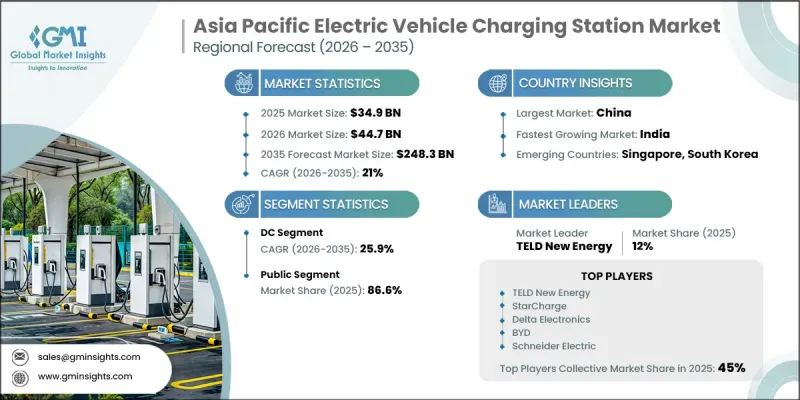
Asia Pacific Electric Vehicle Charging Station Market was valued at USD 34.9 billion in 2025 and is estimated to grow at a CAGR of 21% to reach USD 248.3 billion by 2035.
The market is witnessing strong momentum due to the accelerating adoption of electric vehicles across the region, backed by supportive government policies aimed at lowering carbon emissions and expanding clean energy usage. Rising environmental consciousness, combined with strict emission control norms, has significantly increased the deployment of EV charging infrastructure. Authorities across multiple countries are offering subsidies, tax incentives, and financial support to encourage both manufacturers and consumers to transition toward electric mobility. Continuous innovation in charging technologies, including ultra-fast charging systems and wireless solutions, is improving convenience and boosting market uptake. The integration of smart charging networks with renewable energy sources is further strengthening infrastructure expansion. Rapid urbanization, high population density, and limited residential charging access are pushing demand for public charging networks, particularly in commercial and high-traffic zones. Improvements in fast-charging systems are also reducing charging time and easing range anxiety, making EV adoption more practical and widespread across Asia Pacific.
| Market Scope | |
|---|---|
| Start Year | 2025 |
| Forecast Year | 2026-2035 |
| Start Value | $34.9 Billion |
| Forecast Value | $248.3 Billion |
| CAGR | 21% |
The AC EV charging station segment is projected to grow at a CAGR of 15.2% through 2035. AC charging systems are widely adopted across private and public applications due to their cost efficiency and ability to provide reliable charging within practical timeframes. The increasing integration of renewable energy sources, including wind and solar, into AC charging infrastructure is further improving energy efficiency and supporting sustainable charging ecosystem development.
The public EV charging station segment accounted for an 86.6% share in 2025. Expansion in this segment is being fueled by growing EV adoption rates and substantial investments from both public and private stakeholders in charging infrastructure. The expansion of charging availability across high-traffic commercial destinations, including fuel stations, retail outlets, and public parking areas, is improving accessibility and user convenience, thereby supporting broader EV adoption across the region.
China Electric Vehicle Charging Station Market was valued at USD 33.8 billion in 2025 and is expected to grow at a CAGR of 20.5% through 2035. Market expansion is strongly supported by proactive government initiatives promoting electric mobility and rapid infrastructure development. Increasing energy costs and the shift toward energy-efficient transportation solutions are further driving adoption. Additionally, continuous technological advancements and the launch of new EV models by leading automakers are accelerating infrastructure deployment and strengthening overall market growth across the country.
Major players operating in the Asia Pacific Electric Vehicle Charging Station Industry include Schneider Electric, ChargePoint, Delta Electronics, StarCharge, TELD New Energy, Eaton, XCharge, Blink Charging, BYD, Chaevi, Efacec, EV Top, Exicom, Joongang Control, Leviton, NIO, Signet EV, Tata Motors, Tritium, and VinFast. Asia Pacific EV Charging Station Market is witnessing competitive expansion as companies focus on scaling infrastructure networks across high-growth urban corridors. One major strategy includes forming partnerships with utilities, automotive manufacturers, and energy providers to develop integrated charging ecosystems. Firms are investing heavily in ultra-fast and smart charging technologies to improve efficiency and reduce charging time. Expansion into public-private collaboration models is enabling faster deployment of charging stations in commercial and residential hubs. Companies are also prioritizing renewable energy integration to support sustainable operations.
Table of Contents
Chapter 1 Methodology & Scope
- 1.1 Research approach
- 1.2 Quality commitments
- 1.2.1 GMI AI policy & data integrity commitment
- 1.2.1.1 Source consistency protocol
- 1.2.1 GMI AI policy & data integrity commitment
- 1.3 Research trail & confidence scoring
- 1.3.1 Research trail components
- 1.3.2 Scoring components
- 1.4 Data collection
- 1.4.1 Partial list of primary sources
- 1.5 Data mining sources
- 1.5.1 Paid sources
- 1.5.1.1 Sources, by country
- 1.5.1 Paid sources
- 1.6 Base estimates and calculations
- 1.6.1 Base year calculation for any one approach
- 1.7 Market estimates & forecasts parameters
- 1.8 Forecast model
- 1.8.1 Quantified market impact analysis
- 1.8.1.1 Mathematical impact of growth parameters on forecast
- 1.8.1 Quantified market impact analysis
- 1.9 Research transparency addendum
- 1.9.1 Source attribution framework
- 1.9.2 Quality assurance metrics
- 1.9.3 Our commitment to trust
- 1.10 Market definitions
Chapter 2 Executive Summary
- 2.1 Industry synopsis, 2022 - 2035
- 2.1.1 Business trends
- 2.1.2 Current trends
- 2.1.3 Charging site trends
- 2.1.4 Country trends
Chapter 3 Industry Insights
- 3.1 Industry ecosystem analysis
- 3.1.1 Raw material availability & sourcing analysis
- 3.1.2 Supply chain resilience & risk factors
- 3.1.3 Distribution network analysis
- 3.2 Regulatory landscape
- 3.3 Industry impact forces
- 3.3.1 Growth drivers
- 3.3.2 Industry pitfalls & challenges
- 3.4 Growth potential analysis
- 3.5 Porter's Analysis
- 3.5.1 Bargaining power of suppliers
- 3.5.2 Bargaining power of buyers
- 3.5.3 Threat of new entrants
- 3.5.4 Threat of substitutes
- 3.6 PESTEL Analysis
- 3.6.1 Political factors
- 3.6.2 Economic factors
- 3.6.3 Social factors
- 3.6.4 Technological factors
- 3.6.5 Environmental factors
- 3.6.6 Legal factors
- 3.7 Emerging opportunities & trends
- 3.8 Digitalization & IoT integration
- 3.9 Investment analysis & future prospects
- 3.10 EV sales, 2022 - 2025
- 3.10.1 By propulsion
- 3.10.2 By country
- 3.11 Price trend analysis
- 3.11.1 By current, (USD/Unit)
- 3.12 Impact of AI & Generative AI on the market (Solution Core)
- 3.12.1 AI-driven production optimization
- 3.12.2 Predictive maintenance & fault detection
Chapter 4 Competitive Landscape, 2026
- 4.1 Introduction
- 4.2 Company market share analysis, 2025
- 4.2.1 By country
- 4.2.1.1 China
- 4.2.1.2 India
- 4.2.1.3 Japan
- 4.2.1.4 South Korea
- 4.2.1.5 Singapore
- 4.2.2 Market concentration analysis
- 4.2.1 By country
- 4.3 Competitive analysis of major market players
- 4.4 Competitive positioning matrix
- 4.5 key developments
- 4.5.1 Merger & acquisition
- 4.5.2 Partnership & collaboration
- 4.5.3 New product launched
- 4.5.4 Expansion plans & funding
- 4.6 Company tier benchmarking
- 4.6.1 Tier classification criteria & qualifying thresholds
- 4.6.2 Tier positioning matrix by revenue, geography & innovation
Chapter 5 Market Size and Forecast, By Current, 2022 - 2035 (Units, USD Million)
- 5.1 Key trends
- 5.2 AC
- 5.2.1 Level 1
- 5.2.2 Level 2
- 5.3 DC
- 5.3.1 DC Fast
- 5.3.2 Others
Chapter 6 Market Size and Forecast, By Charging Site, 2022 - 2035 (Units, USD Million)
- 6.1 Key trends
- 6.2 Public
- 6.3 Private
Chapter 7 Market Size and Forecast, By Country, 2022 - 2035 (Units, USD Million)
- 7.1 Key trends
- 7.2 China
- 7.3 India
- 7.4 Japan
- 7.5 South Korea
- 7.6 Singapore
Chapter 8 Company Profiles
- 8.1 Blink Charging
- 8.2 BYD
- 8.3 Chaevi
- 8.4 ChargePoint
- 8.5 Delta Electronics
- 8.6 Eaton
- 8.7 Efacec
- 8.8 EV Top
- 8.9 Exicom
- 8.10 Joongang Control
- 8.11 Leviton
- 8.12 NIO
- 8.13 Schneider Electric
- 8.14 Signet EV
- 8.15 StarCharge
- 8.16 Tata Motors
- 8.17 TELD New Energy
- 8.18 Tritium
- 8.19 Vinfast
- 8.20 XCharge

