PUBLISHER: Global Market Insights Inc. | PRODUCT CODE: 2045862

PUBLISHER: Global Market Insights Inc. | PRODUCT CODE: 2045862
Sulfur-Based Micronutrients Market Opportunity, Growth Drivers, Industry Trend Analysis, and Forecast 2026 - 2035
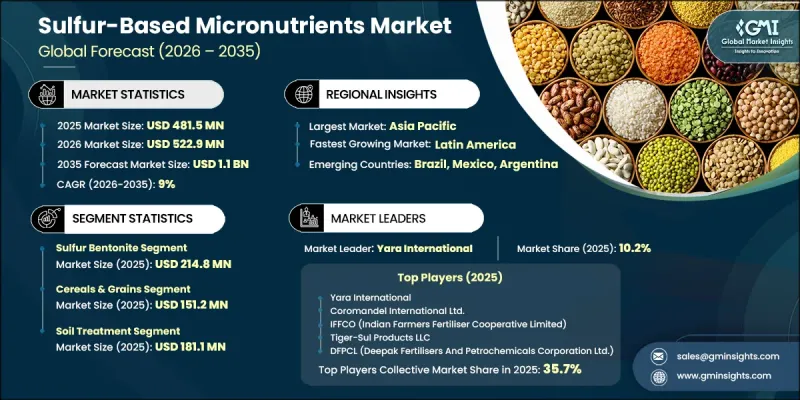
The Global Sulfur-Based Micronutrients Market was valued at USD 481.5 million in 2025 and is estimated to grow at a CAGR of 9% to reach USD 1.1 billion by 2035.
The market growth is driven by the increasing need for efficient crop nutrition solutions that address sulfur deficiencies and improve overall soil productivity. Sulfur-based micronutrients play a vital role in plant development by supporting protein formation and chlorophyll synthesis, making them essential for improving crop yield and quality. These nutrients are applied through soil treatment and foliar spray methods, enabling targeted correction of nutrient deficiencies across diverse crop types. Rising focus on sustainable agriculture, soil health management, and balanced fertilization practices is further strengthening market demand. In addition, modern farming systems are increasingly adopting precision nutrient management techniques to optimize fertilizer usage and reduce nutrient loss. Continuous agricultural intensification, declining soil fertility in several regions, and limited organic matter recycling are also contributing to sustained demand for sulfur-based micronutrient solutions. As global food production requirements increase, both developing and developed agricultural markets are increasingly relying on these inputs to maintain consistent productivity and improve crop performance under varying climatic and soil conditions.
| Market Scope | |
|---|---|
| Start Year | 2025 |
| Forecast Year | 2026-2035 |
| Start Value | $481.5 Million |
| Forecast Value | $1.1 Billion |
| CAGR | 9% |
The sulfur-based micronutrients industry is evolving as farmers increasingly prioritize soil testing, precision agriculture, and efficient nutrient application methods. Growing awareness of micronutrient deficiencies in soils is encouraging wider adoption of sulfur-enriched fertilizers across multiple crop categories. The market is also benefiting from a shift toward integrated nutrient management systems that combine multiple essential elements to enhance soil fertility and crop efficiency. Advancements in fertilizer formulation technologies are improving nutrient availability and uptake, further supporting agricultural productivity. Expanding agricultural research and increasing government support for soil health improvement programs are also reinforcing industry growth. In addition, rising demand for high-quality food production and sustainable farming practices is encouraging long-term use of micronutrient-based solutions in modern agriculture systems.
The sulfur bentonite segment accounted for USD 214.8 million in 2025. This segment is witnessing increasing adoption as agricultural producers shift toward multi-nutrient fertilizer systems designed to improve soil fertility and correct specific micronutrient deficiencies. Products combining sulfur bentonite with additional micronutrients are gaining traction due to their ability to provide controlled sulfur release and enhance overall nutrient efficiency. The growing preference for integrated nutrient solutions over single-nutrient applications is further supporting segment expansion. Farmers are increasingly using these advanced formulations to improve soil structure, enhance nutrient uptake, and achieve more stable crop yields across varying agricultural conditions.
The cereals and grains segment captured USD 151.2 million in 2025. Demand for sulfur-based micronutrients in this segment is rising due to the high nutrient requirements of cereal crops and their sensitivity to sulfur deficiency. These crops depend heavily on balanced nutrient availability to maintain productivity and support efficient growth cycles. Increasing adoption of modern farming practices and intensive cultivation methods is further driving the need for enhanced nutrient management in cereal production. Farmers are increasingly focusing on improving yield stability and grain quality, which is contributing to the growing application of sulfur-based micronutrient solutions in this crop category.
North America Sulfur-Based Micronutrients Market is expected to grow from USD 117.6 million in 2025 to USD 271.9 million by 2035. The region's growth is supported by widespread adoption of soil testing practices and advanced crop management systems that emphasize nutrient optimization. High-intensity farming practices and increasing awareness of sulfur deficiencies in soil are encouraging greater use of micronutrient-based fertilizers. The agricultural sector in the United States is particularly focused on maintaining balanced soil fertility through data-driven nutrient management approaches, which is strengthening market demand across cereal, oilseed, and commercial crop production systems.
Key companies operating in the Global Sulfur-Based Micronutrients Market include Yara International, Coromandel International Ltd., Aries Agro Limited, Deepak Fertilisers and Petrochemicals Corporation Ltd., IFFCO, Hindustan Bio Tec India Pvt. Ltd., Tiger-Sul Products LLC, Agroasia, Sohar Sulphur Fertilizers LLC, and Mirabelle Agro Manufacturing Pvt Ltd. Companies operating in the sulfur-based micronutrients market are adopting multiple strategic approaches to strengthen their competitive position and expand global presence. Leading players are investing in research and development to improve product formulations, enhance nutrient efficiency, and develop controlled-release technologies that improve crop absorption. Many companies are expanding their product portfolios to include multi-nutrient combinations that address multiple soil deficiencies simultaneously. Strategic partnerships with agricultural distributors, cooperatives, and government-backed farming programs are helping companies improve market penetration. In addition, firms are increasing their focus on region-specific product development tailored to local soil conditions and crop requirements. Expansion of manufacturing capacity and strengthening of supply chain networks are further supporting market reach. Companies are also investing in farmer education initiatives and precision agriculture solutions to promote efficient fertilizer use, which is helping to build long-term demand and strengthen market footholds in the global agricultural sector.
Table of Contents
Chapter 1 Methodology & Scope
- 1.1 Market scope and definition
- 1.2 Research design
- 1.2.1 Research approach
- 1.2.2 Data collection methods
- 1.3 Data mining sources
- 1.3.1 Global
- 1.3.2 Regional/Country
- 1.4 Base estimates and calculations
- 1.4.1 Base year calculation
- 1.4.2 Key trends for market estimation
- 1.5 Primary research and validation
- 1.5.1 Primary sources
- 1.6 Forecast model
- 1.7 Research assumptions and limitations
Chapter 2 Executive Summary
- 2.1 Industry 360° synopsis
- 2.2 Key market trends
- 2.2.1 Type
- 2.2.2 Crop Type
- 2.2.3 Application
- 2.2.4 Regional
- 2.3 TAM Analysis, 2026-2035
- 2.4 CXO perspectives: Strategic imperatives
- 2.5 Future outlook and strategic recommendations
Chapter 3 Industry Insights
- 3.1 Industry ecosystem analysis
- 3.1.1 Supplier landscape
- 3.1.2 Profit margin
- 3.1.3 Value addition at each stage
- 3.1.4 Factor affecting the value chain
- 3.1.5 Disruptions
- 3.2 Industry impact forces
- 3.2.1 Growth drivers
- 3.2.1.1 Rising sulfur deficiency in cultivated soils
- 3.2.1.2 Increased focus on balanced crop nutrition
- 3.2.1.3 Expansion of high nutrient-demand crops globally
- 3.2.2 Pitfalls/challenge
- 3.2.2.1 Variability in sulfur availability across soils
- 3.2.2.2 Improper application affecting nutrient utilization efficiency
- 3.2.3 Opportunities
- 3.2.3.1 Adoption of precision agriculture nutrient practices
- 3.2.3.2 Development of advanced sulfur formulations systems
- 3.2.1 Growth drivers
- 3.3 Growth potential analysis
- 3.4 Regulatory landscape
- 3.4.1 North America
- 3.4.2 Europe
- 3.4.3 Asia Pacific
- 3.4.4 Latin America
- 3.4.5 Middle East & Africa
- 3.5 Porter's analysis
- 3.6 PESTEL analysis
- 3.7 Price trends
- 3.7.1 By region
- 3.7.2 By type
- 3.8 Future market trends
- 3.9 Technology and innovation landscape
- 3.9.1 Current technological trends
- 3.9.2 Emerging technologies
- 3.10 Patent landscape
- 3.11 Trade statistics (HS code)
- 3.11.1 Major importing countries
- 3.11.2 Major exporting countries
- 3.12 Sustainability and environmental aspects
- 3.12.1 Sustainable practices
- 3.12.2 Waste reduction strategies
- 3.12.3 Energy efficiency in production
- 3.12.4 Eco-friendly initiatives
- 3.13 Carbon footprint consideration
Chapter 4 Competitive Landscape, 2025
- 4.1 Introduction
- 4.2 Company market share analysis
- 4.2.1 By region
- 4.2.1.1 North America
- 4.2.1.2 Europe
- 4.2.1.3 Asia Pacific
- 4.2.1.4 LATAM
- 4.2.1.5 MEA
- 4.2.1 By region
- 4.3 Company matrix analysis
- 4.4 Competitive analysis of major market players
- 4.5 Competitive positioning matrix
- 4.6 Key developments
- 4.6.1 Mergers & acquisitions
- 4.6.2 Partnerships & collaborations
- 4.6.3 New product launches
- 4.6.4 Expansion plans
Chapter 5 Market Estimates and Forecast, By Type, 2022-2035 (USD Million) (Kilo Tons)
- 5.1 Key trends
- 5.2 Sulfur-bentonite
- 5.3 Sulfur-bentonite-zinc
- 5.4 Sulfur-bentonite-molybdenum
- 5.5 Sulfur-bentonite-manganese
- 5.6 Sulfur-bentonite-iron
- 5.7 Other
Chapter 6 Market Estimates and Forecast, By Crop Type, 2022-2035 (USD Million) (Kilo Tons)
- 6.1 Key trends
- 6.2 Cereals & grains
- 6.3 Fruit & vegetables
- 6.4 Oilseeds & pulses
- 6.5 Commercial crops
- 6.6 Others
Chapter 7 Market Estimates and Forecast, By Application, 2022-2035 (USD Million) (Kilo Tons)
- 7.1 Key trends
- 7.2 Soil treatment
- 7.3 Foliar spray
- 7.4 Fertigation
- 7.5 Hydroponics
- 7.6 Others
Chapter 8 Market Estimates and Forecast, By Region, 2022-2035 (USD Million) (Kilo Tons)
- 8.1 Key trends
- 8.2 North America
- 8.2.1 U.S.
- 8.2.2 Canada
- 8.3 Europe
- 8.3.1 Germany
- 8.3.2 UK
- 8.3.3 France
- 8.3.4 Spain
- 8.3.5 Italy
- 8.3.6 Rest of Europe
- 8.4 Asia Pacific
- 8.4.1 China
- 8.4.2 India
- 8.4.3 Japan
- 8.4.4 Australia
- 8.4.5 South Korea
- 8.4.6 Rest of Asia Pacific
- 8.5 Latin America
- 8.5.1 Brazil
- 8.5.2 Mexico
- 8.5.3 Argentina
- 8.5.4 Rest of Latin America
- 8.6 Middle East and Africa
- 8.6.1 Saudi Arabia
- 8.6.2 South Africa
- 8.6.3 UAE
- 8.6.4 Rest of Middle East and Africa
Chapter 9 Company Profiles
- 9.1 Yara International
- 9.2 Coromandel International Ltd.
- 9.3 Aries Agro Limited
- 9.4 DFPCL (Deepak Fertilisers And Petrochemicals Corporation Ltd.)
- 9.5 IFFCO (Indian Farmers Fertiliser Cooperative Limited)
- 9.6 HBT India (Hindustan Bec Tec India Pvt. Ltd.)
- 9.7 Tessenderlo Kerley Inc.
- 9.8 Agroasia
- 9.9 Sohar Sulphur Fertilizers LLC
- 9.10 Mirabelle Agro Manufacturing Pvt Ltd

