
PUBLISHER: Global Market Insights Inc. | PRODUCT CODE: 2061295

PUBLISHER: Global Market Insights Inc. | PRODUCT CODE: 2061295
North America Slow Cooker Market Opportunity, Growth Drivers, Industry Trend Analysis, and Forecast 2026 - 2035
North America Slow Cooker Market was valued at USD 869 million in 2025 and is estimated to grow at a CAGR of 5.3% to reach USD 1.46 billion by 2035.
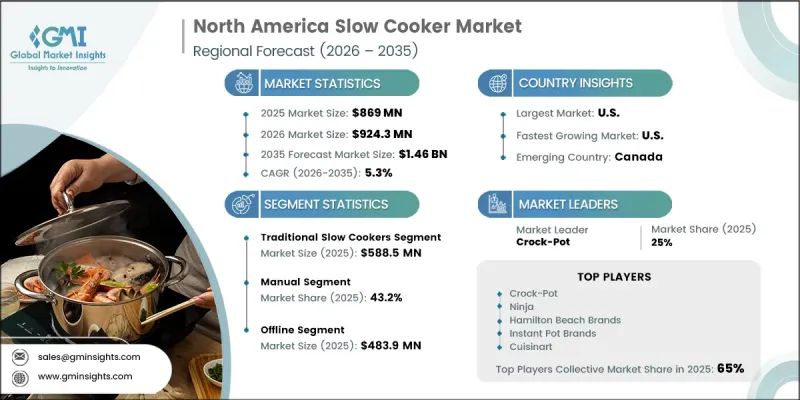
The market is expanding due to the increasing need for convenient cooking solutions that fit fast-paced household routines across the region. Consumers are increasingly seeking appliances that simplify meal preparation while reducing time spent in the kitchen, which has strengthened the adoption of slow cookers in everyday cooking practices. These appliances support advance preparation of ingredients and allow unattended cooking over extended hours, aligning well with modern convenience-driven lifestyles. Rising interest in home-cooked meals, combined with cost-conscious food planning habits, is further supporting product penetration. Additionally, slow cookers are widely valued for their ability to preserve taste, texture, and nutritional quality while enabling bulk cooking. The growing popularity of home meal planning and food storage practices has also reinforced their use among families and working individuals. Emotional value associated with ready-to-eat meals after long working hours is further enhancing consumer preference. Overall, the combination of convenience, affordability, and consistent cooking performance continues to drive market expansion across North America.
| Market Scope | |
|---|---|
| Start Year | 2025 |
| Forecast Year | 2026-2035 |
| Start Value | $869 Million |
| Forecast Value | $1.46 Billion |
| CAGR | 5.3% |
Traditional slow cookers generated USD 588.5 million in 2025. These appliances are widely preferred due to their straightforward design and simple operating mechanism. With basic heating options such as low, high, and warm settings, they provide a user-friendly cooking experience without requiring advanced technical knowledge. Their simplicity makes them especially suitable for consumers who prefer uncomplicated kitchen appliances, including older age groups and individuals who avoid digitally complex devices.
The manual segment accounted for 43.2% share in 2025. In North America, manual slow cookers represent the most basic product category, operating through simple knob or switch-based controls. Users can easily select temperature settings such as low, high, or warm, which eliminates the need for digital interfaces or programming. This ease of operation contributes significantly to their widespread acceptance, particularly among consumers who value reliability and straightforward functionality over advanced features.
United States Slow Cooker Market held an 87.8% share, generating USD 762.9 million in 2025. The country remains the most established and mature market for slow cookers in the region, supported by strong household penetration and long-standing consumer familiarity with the product category. Slow cookers are commonly used in American kitchens for preparing simple, time-efficient meals suited to busy lifestyles. Replacement demand is also contributing to market activity as consumers upgrade older appliances with newer models that offer improved efficiency, modern designs, and enhanced functionality.
Major companies operating in the North America Slow Cooker Industry include Crock-Pot, Hamilton Beach Brands, Ninja, Breville, Cuisinart, Instant Pot Brands, Black+Decker, National Presto (Presto), Aroma Housewares, West Bend, Bella, Elite Gourmet, Chefman, Magic Chef, All-Clad, GreenPan/GreenLife, VitaClay, Midea Group, Nostalgia Products LLC, COSORI, and De'Longhi. Companies in the North America slow cooker market are focusing on strengthening their market position through continuous product innovation and design enhancements that improve ease of use and cooking efficiency. Manufacturers are expanding their portfolios with smart-enabled and multifunctional appliances while maintaining demand for traditional and manual models to serve a wider consumer base. Strategic partnerships with retail and e-commerce platforms are being used to improve product accessibility and visibility across key distribution channels. Brands are also investing in marketing campaigns that highlight convenience, time-saving benefits, and cost-effectiveness of slow cooking. In addition, companies are emphasizing energy-efficient designs and improved safety features to attract environmentally conscious consumers.
Table of Contents
Chapter 1 Methodology and Scope
- 1.1 Market scope and definition
- 1.2 Research design
- 1.2.1 Research approach
- 1.2.2 Data collection methods
- 1.3 Data mining sources
- 1.3.1 Global
- 1.3.2 Regional/Country
- 1.4 Base estimates and calculations
- 1.4.1 Base year calculation
- 1.4.2 Key trends for market estimation
- 1.5 Primary research and validation
- 1.5.1 Primary sources
- 1.6 Forecast model
- 1.7 Research assumptions and limitations
Chapter 2 Executive Summary
- 2.1 Industry 360° synopsis
- 2.2 Key market trends
- 2.2.1 Country
- 2.2.2 Product type
- 2.2.3 Control type
- 2.2.4 Capacity
- 2.2.5 Price range
- 2.2.6 End user
- 2.2.7 Distribution channel
Chapter 3 Industry Insights
- 3.1 Industry ecosystem analysis
- 3.1.1 Supplier landscape
- 3.1.2 Profit margin
- 3.1.3 Value addition at each stage
- 3.1.4 Factor affecting the value chain
- 3.2 Industry impact forces
- 3.2.1 Growth drivers
- 3.2.1.1 Lifestyle shift toward convenience cooking
- 3.2.1.2 Product innovation
- 3.2.1.3 Influence of food culture & media
- 3.2.2 Industry pitfalls & challenges
- 3.2.2.1 Competition from substitute appliances
- 3.2.2.2 Price sensitivity
- 3.2.3 Opportunities
- 3.2.3.1 Smart & connected appliances
- 3.2.3.2 Sustainability & energy positioning
- 3.2.1 Growth drivers
- 3.3 Growth potential analysis
- 3.4 Regulatory framework
- 3.4.1 Energy efficiency standards & certifications
- 3.4.2 Product safety regulations (UL, CE, FDA)
- 3.4.3 Environmental compliance & RoHS directives
- 3.5 Pricing analysis
- 3.5.1 Historical price trend analysis (driven by primary research)
- 3.5.2 Pricing strategy by player type (premium / value / cost-plus)
- 3.5.3 Regional price variations
- 3.6 Trade data analysis (driven by paid data base) (8516.79)
- 3.6.1 Import/export volume & value trends
- 3.6.2 Key trade corridors & tariff impact
- 3.6.3 Regional trade flow patterns
- 3.7 Impact of AI & generative AI on the market
- 3.7.1 AI-driven disruption of existing business models
- 3.7.2 GenAI use cases & adoption roadmap by segment
- 3.7.3 Risks, limitations & regulatory considerations
- 3.8 Distribution infrastructure & channel penetration landscape (driven by primary research)
- 3.8.1 Channel coverage by region & format (modern vs. Traditional trade)
- 3.8.2 Last-mile infrastructure gaps & emerging channel shifts
Chapter 4 Competitive Landscape, 2025
- 4.1 Introduction
- 4.2 Company market share analysis
- 4.2.1 By country
- 4.2.1.1 U.S.
- 4.2.1.2 Canada
- 4.2.1 By country
- 4.3 Company matrix analysis
- 4.4 Competitive analysis of major market players
- 4.5 Competitive positioning matrix
- 4.6 Key developments
- 4.6.1 Mergers & acquisitions
- 4.6.2 Partnerships & collaborations
- 4.6.3 New product launches
- 4.6.4 Expansion plans
Chapter 5 Market Estimates and Forecast, By Product Type, 2022 - 2035 (USD Million) (Million Units)
- 5.1 Key trends
- 5.2 Traditional slow cookers
- 5.3 Searing slow cookers
Chapter 6 Market Estimates and Forecast, By Control Type, 2022 - 2035 (USD Million) (Million Units)
- 6.1 Key trends
- 6.2 Manual
- 6.3 Digital
- 6.4 Smart
Chapter 7 Market Estimates and Forecast, By Capacity, 2022 - 2035 (USD Million) (Million Units)
- 7.1 Key trends
- 7.2 Small (1-3 Quarts)
- 7.3 Medium (4-6 Quarts)
- 7.4 Large (7+ Quarts)
Chapter 8 Market Estimates and Forecast, By Price Range, 2022 - 2035 (USD Million) (Million Units)
- 8.1 Key trends
- 8.2 Budget/Economy (Under $50)
- 8.3 Mid-Range ($50-$150)
- 8.4 Premium/High-End (Above $150)
Chapter 9 Market Estimates and Forecast, By End User, 2022 - 2035 (USD Million) (Million Units)
- 9.1 Key trends
- 9.2 Residential/Household
- 9.3 Commercial
Chapter 10 Market Estimates and Forecast, By Distribution Channel, 2022 - 2035 (USD Million) (Million Units)
- 10.1 Key trends
- 10.2 Online
- 10.2.1 E-commerce
- 10.2.2 Company websites
- 10.3 Offline
- 10.3.1 Supermarkets
- 10.3.2 Specialty stores
- 10.3.3 Others (individual stores, etc.)
Chapter 11 Market Estimates and Forecast, By Country, 2022 - 2035 (USD Million) (Million Units)
- 11.1 Key trends
- 11.2 U.S.
- 11.3 Canada
Chapter 12 Company Profiles
- 12.1 Global players
- 12.1.1 Crock-Pot
- 12.1.2 Hamilton Beach Brands
- 12.1.3 Ninja
- 12.1.4 Breville
- 12.1.5 Cuisinart
- 12.1.6 Instant Pot Brands
- 12.1.7 Black+Decker
- 12.2 Regional players
- 12.2.1 National Presto (Presto)
- 12.2.2 Aroma Housewares
- 12.2.3 West Bend
- 12.2.4 Bella
- 12.2.5 Elite Gourmet
- 12.2.6 Chefman
- 12.2.7 Magic Chef
- 12.3 Emerging players
- 12.3.1 All-Clad
- 12.3.2 GreenPan/GreenLife
- 12.3.3 VitaClay
- 12.3.4 Midea Group
- 12.3.5 Nostalgia Products LLC
- 12.3.6 COSORI
- 12.3.7 De'Longhi

