
PUBLISHER: Global Market Insights Inc. | PRODUCT CODE: 2061481

PUBLISHER: Global Market Insights Inc. | PRODUCT CODE: 2061481
Slow Cooker Market Opportunity, Growth Drivers, Industry Trend Analysis, and Forecast 2026 - 2035
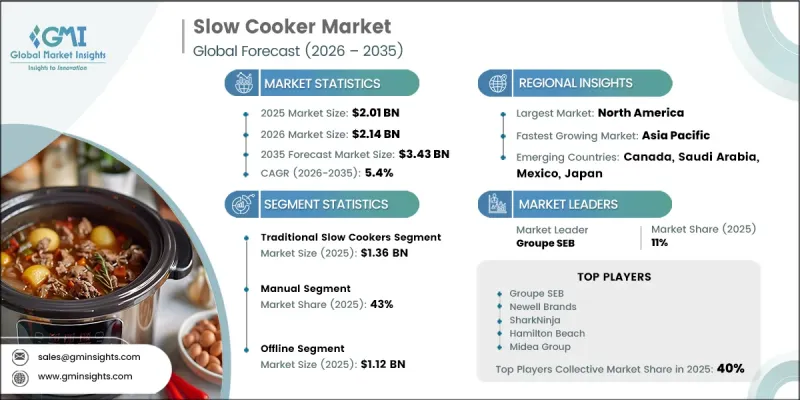
The Global Slow Cooker Market was valued at USD 2.01 billion in 2025 and is estimated to grow at a CAGR of 5.4% to reach USD 3.43 billion by 2035.
Rising consumer preference for convenience-oriented kitchen appliances is one of the major factors supporting market expansion, particularly among urban households with fast-paced lifestyles. Consumers increasingly favor appliances that simplify meal preparation and reduce the need for continuous supervision during cooking. Slow cookers have gained strong popularity because they allow users to prepare ingredients in advance and let the appliance complete the cooking process automatically over extended periods with minimal monitoring. This functionality strongly appeals to working professionals, dual-income households, and consumers seeking practical cooking solutions that save time and effort. In addition, evolving food preparation habits such as batch cooking and planned meal management are further contributing to market growth. Consumers are increasingly preparing meals in larger portions to reduce cooking frequency and better organize weekly meal schedules. These changing lifestyle and dietary patterns continue to strengthen the adoption of slow cookers across residential kitchens worldwide.
| Market Scope | |
|---|---|
| Start Year | 2025 |
| Forecast Year | 2026-2035 |
| Start Value | $2.01 Billion |
| Forecast Value | $3.43 Billion |
| CAGR | 5.4% |
Traditional slow cookers accounted for USD 1.36 billion in 2025. This segment remains the foundation of the slow cooker industry due to its affordability, reliability, and straightforward functionality. Traditional models are commonly equipped with basic heat settings such as low, high, and warm, allowing consumers to cook meals over long periods without requiring advanced digital controls or programming features. Their simplicity and ease of use continue to attract consumers who prefer uncomplicated kitchen appliances for everyday meal preparation.
The manual segment held a 43% share in 2025. Manual-control slow cookers continue to maintain strong market demand due to their classic design and user-friendly operation. These appliances generally feature rotary dials or simple switches that enable users to select preset temperature levels quickly and easily. Their uncomplicated functionality remains highly appealing among consumers who prefer traditional cooking methods and do not require advanced digital interfaces or programmable systems.
U.S. Slow Cooker Market held an 87.8% share, generating USD 0.76 billion in 2025. Market growth in the country is largely driven by replacement purchases, product upgrades, and increasing integration of modern technologies into conventional cooking appliances. Consumers in the U.S. continue to show strong interest in multifunctional and convenience-focused kitchen products, supporting rising demand for smart-enabled slow cookers and hybrid cooking appliances. Furthermore, growing interest in home cooking, healthier eating habits, and organized meal preparation practices continues to support steady product adoption across households.
Major players operating in the Global Slow Cooker Market include Hamilton Beach, Groupe SEB, Newell Brands, SharkNinja, KitchenAid, Breville Group, Midea Group, De'Longhi Group, Cuisinart, Sunbeam Products, Lakeland, Bajaj Electricals, NESCO, Galanz, West Bend, Bella, Gourmia, Elite Gourmet, Oster, Chefman, and Sub-Zero Group (Wolf Gourmet). Companies operating in the Slow Cooker Market are focusing on integrating smart technologies and multifunctional capabilities to enhance product appeal and improve user convenience. Manufacturers are introducing connected appliances with app-based controls, programmable cooking modes, and compatibility with smart home ecosystems. Product innovation centered on energy efficiency, compact designs, and versatile cooking functions is helping brands attract modern consumers with limited kitchen space and busy lifestyles. Companies are also expanding premium product portfolios featuring advanced safety systems, digital displays, and hybrid cooking technologies. Strategic partnerships with retail chains and e-commerce platforms are strengthening market visibility and distribution reach.
Table of Contents
Chapter 1 Methodology and Scope
- 1.1 Market scope and definition
- 1.2 Research design
- 1.2.1 Research approach
- 1.2.2 Data collection methods
- 1.3 Data mining sources
- 1.3.1 Global
- 1.3.2 Regional/Country
- 1.4 Base estimates and calculations
- 1.4.1 Base year calculation
- 1.4.2 Key trends for market estimation
- 1.5 Primary research and validation
- 1.5.1 Primary sources
- 1.6 Forecast model
- 1.7 Research assumptions and limitations
Chapter 2 Executive Summary
- 2.1 Industry 360° synopsis
- 2.2 Key market trends
- 2.2.1 Regional
- 2.2.2 Product type
- 2.2.3 Control type
- 2.2.4 Capacity
- 2.2.5 Price range
- 2.2.6 End user
- 2.2.7 Distribution channel
Chapter 3 Industry Insights
- 3.1 Industry ecosystem analysis
- 3.1.1 Supplier landscape
- 3.1.2 Profit margin
- 3.1.3 Value addition at each stage
- 3.1.4 Factor affecting the value chain
- 3.2 Industry impact forces
- 3.2.1 Growth drivers
- 3.2.1.1 Convenience & time-saving cooking
- 3.2.1.2 Rising popularity of smart kitchen appliances
- 3.2.1.3 Shift toward home cooking
- 3.2.2 Industry pitfalls & challenges
- 3.2.2.1 Long cooking time limitation
- 3.2.2.2 Energy consumption concerns
- 3.2.3 Opportunities
- 3.2.3.1 Integration with smart home ecosystems
- 3.2.3.2 Sustainability & energy-efficient models
- 3.2.1 Growth drivers
- 3.3 Growth potential analysis
- 3.4 Regulatory framework
- 3.4.1 Energy efficiency standards & certifications
- 3.4.2 Product safety regulations (UL, CE, FDA)
- 3.4.3 Environmental compliance & RoHS directives
- 3.5 Pricing analysis
- 3.5.1 Historical price trend analysis (driven by primary research)
- 3.5.2 Pricing strategy by player type (premium / value / cost-plus)
- 3.5.3 Regional price variations
- 3.6 Trade data analysis (driven by paid database) (8516.79)
- 3.6.1 Import/export volume & value trends
- 3.6.2 Key trade corridors & tariff impact
- 3.6.3 Regional trade flow patterns
- 3.7 Impact of AI & generative AI on the market
- 3.7.1 AI-driven disruption of existing business models
- 3.7.2 GenAI use cases & adoption roadmap by segment
- 3.7.3 Risks, limitations & regulatory considerations
- 3.8 Distribution infrastructure & channel penetration landscape (driven by primary research)
- 3.8.1 Channel coverage by region & format (modern vs. traditional trade)
- 3.8.2 Last-mile infrastructure gaps & emerging channel shifts
Chapter 4 Competitive Landscape, 2025
- 4.1 Introduction
- 4.2 Company market share analysis
- 4.2.1 By region
- 4.2.1.1 North America
- 4.2.1.2 Europe
- 4.2.1.3 Asia Pacific
- 4.2.1.4 Latin America
- 4.2.1.5 Middle East and Africa
- 4.2.1 By region
- 4.3 Company matrix analysis
- 4.4 Competitive analysis of major market players
- 4.5 Competitive positioning matrix
- 4.6 Key developments
- 4.6.1 Mergers & acquisitions
- 4.6.2 Partnerships & collaborations
- 4.6.3 New product launches
- 4.6.4 Expansion plans
Chapter 5 Market Estimates and Forecast, By Product Type, 2022 - 2035 (USD Billion)
- 5.1 Key trends
- 5.2 Traditional slow cookers
- 5.3 Searing slow cookers
Chapter 6 Market Estimates and Forecast, By Control Type, 2022 - 2035 (USD Billion)
- 6.1 Key trends
- 6.2 Manual
- 6.3 Digital
- 6.4 Smart
Chapter 7 Market Estimates and Forecast, By Capacity, 2022 - 2035 (USD Billion)
- 7.1 Key trends
- 7.2 Small (1-3 Quarts)
- 7.3 Medium (4-6 Quarts)
- 7.4 Large (7+ Quarts)
Chapter 8 Market Estimates and Forecast, By Price Range, 2022 - 2035 (USD Billion)
- 8.1 Key trends
- 8.2 Budget/Economy (Under $50)
- 8.3 Mid-Range ($50-$150)
- 8.4 Premium/High-End (Above $150)
Chapter 9 Market Estimates and Forecast, By End User, 2022 - 2035 (USD Billion)
- 9.1 Key trends
- 9.2 Residential/Household
- 9.3 Commercial
Chapter 10 Market Estimates and Forecast, By Distribution Channel, 2022 - 2035 (USD Billion)
- 10.1 Key trends
- 10.2 Online
- 10.2.1 E-commerce
- 10.2.2 Company websites
- 10.3 Offline
- 10.3.1 Supermarkets
- 10.3.2 Specialty stores
- 10.3.3 Others (individual stores, etc.)
Chapter 11 Market Estimates and Forecast, By Region, 2022 - 2035 (USD Billion)
- 11.1 Key trends
- 11.2 North America
- 11.2.1 U.S.
- 11.2.2 Canada
- 11.3 Europe
- 11.3.1 Germany
- 11.3.2 UK
- 11.3.3 France
- 11.3.4 Italy
- 11.3.5 Spain
- 11.4 Asia Pacific
- 11.4.1 China
- 11.4.2 Japan
- 11.4.3 India
- 11.4.4 Australia
- 11.4.5 South Korea
- 11.5 Latin America
- 11.5.1 Brazil
- 11.5.2 Mexico
- 11.5.3 Argentina
- 11.6 Middle East and Africa
- 11.6.1 South Africa
- 11.6.2 Saudi Arabia
- 11.6.3 UAE
Chapter 12 Company Profiles
- 12.1 Global players
- 12.1.1 Newell Brands
- 12.1.2 Hamilton Beach
- 12.1.3 Groupe SEB
- 12.1.4 KitchenAid
- 12.1.5 Breville Group
- 12.1.6 SharkNinja
- 12.1.7 Midea Group
- 12.2 Regional players
- 12.2.1 Bajaj Electricals
- 12.2.2 De'Longhi Group
- 12.2.3 Sunbeam Products
- 12.2.4 Cuisinart
- 12.2.5 Lakeland
- 12.2.6 Galanz
- 12.2.7 NESCO
- 12.3 Emerging players
- 12.3.1 Sub-Zero Group (Wolf Gourmet)
- 12.3.2 Chefman
- 12.3.3 Elite Gourmet
- 12.3.4 Gourmia
- 12.3.5 West Bend
- 12.3.6 Oster
- 12.3.7 Bella

