PUBLISHER: Global Market Insights Inc. | PRODUCT CODE: 2061312

PUBLISHER: Global Market Insights Inc. | PRODUCT CODE: 2061312
North America Swimwear Market Opportunity, Growth Drivers, Industry Trend Analysis, and Forecast 2026 - 2035
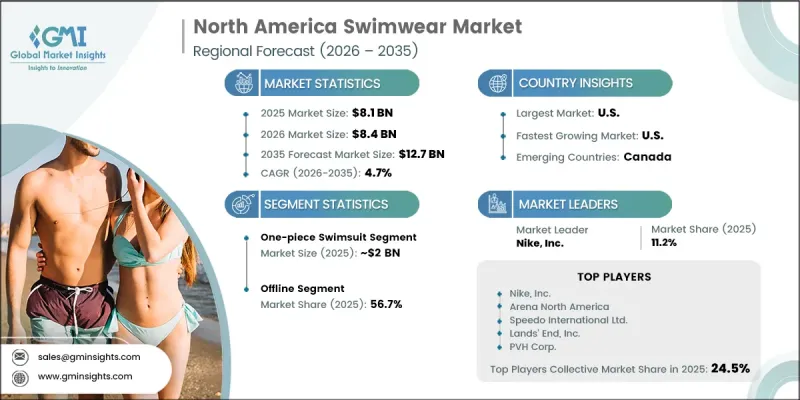
North America Swimwear Market was valued at USD 8.1 billion in 2025 and is estimated to grow at a CAGR of 4.7% to reach USD 12.7 billion by 2035.
The market has experienced steady growth in recent years, supported by increasing consumer expenditure on leisure travel, resort tourism, and lifestyle-oriented fashion products. Rising disposable incomes have encouraged consumers to invest more in premium beachwear and vacation apparel, contributing to higher seasonal and impulse purchases across the region. At the same time, growing participation in water-based recreational activities and wellness-focused lifestyles is strengthening demand for functional swimwear products. Consumers are increasingly engaging in fitness-oriented aquatic activities, creating year-round demand for durable and performance-driven swimwear. Technological advancements in textile manufacturing are also positively influencing market growth, with brands introducing features such as improved chlorine resistance, quick-drying fabrics, and enhanced UV protection. In addition, expanding digital marketing strategies and strong social media engagement are helping brands increase visibility, improve consumer interaction, and strengthen product awareness across diverse customer groups.
| Market Scope | |
|---|---|
| Start Year | 2025 |
| Forecast Year | 2026-2035 |
| Start Value | $8.1 Billion |
| Forecast Value | $12.7 Billion |
| CAGR | 4.7% |
The one-piece swimsuit segment generated USD 2 billion in 2025 and is expected to reach USD 3.2 billion by 2035. This category continues to lead the market due to its superior support, secure fit, and full-body coverage. Compared to other swimwear styles, one-piece swimsuits provide greater stability during water activities and recreational use, making them a preferred option for consumers seeking both comfort and functionality. The segment also benefits from growing demand for swimwear products that combine performance features with flattering silhouettes and enhanced body support.
The offline distribution channel accounted for 56.7% share in 2025. Physical retail stores continue to dominate because consumers prefer evaluating swimwear products in person before making a purchase decision. Factors such as fabric texture, elasticity, fit accuracy, and overall garment quality are important considerations that are easier to assess through in-store shopping experiences. Department stores, specialty outlets, and boutiques also provide immediate product availability, eliminating delivery wait times associated with online purchases. This convenience remains particularly important for consumers making urgent or seasonal travel-related purchases.
United States Swimwear Market held a 79.3% share in 2025. The country's leadership is supported by strong consumer spending on lifestyle apparel, growing interest in fitness and water sports activities, and a well-established leisure and beachwear culture. Continuous product innovation and the strong presence of globally recognized brands are further contributing to market expansion. Demand for premium, fashion-focused, and performance-oriented swimwear continues to increase as consumers seek versatile products suitable for both recreation and active use. Sustainability trends, including environmentally friendly fabrics and inclusive sizing options, are also gaining significant traction across the U.S. market.
Major companies operating in the North America Swimwear Market include Nike, Inc., Adidas AG, Speedo International Ltd., Arena North America, PVH Corp., Lands' End, Inc., Body Glove International, LLC, TYR Sport, Inc., Summersalt, Andie Swim, Miraclesuit, Swimsuits For All, JOLYN Clothing Company, ONIA, Marysia Swim, Gottex Swimwear, Aquilon Sportswear Inc., Affix Apparel Group, La Jolla Group, Lefty Production Co., and Crystal International Group Ltd. Companies operating in the North America swimwear market are adopting several strategies to strengthen their competitive position and expand consumer reach. Product innovation remains a key focus area, with brands introducing advanced fabrics that offer improved stretchability, UV protection, moisture management, and chlorine resistance. Companies are also expanding sustainable product lines by incorporating recycled materials and environmentally responsible manufacturing processes to align with changing consumer preferences. Digital marketing and social media engagement strategies are being widely utilized to increase brand visibility and attract younger audiences. In addition, businesses are strengthening omnichannel retail networks by integrating online platforms with physical stores to improve customer convenience and shopping flexibility.
Table of Contents
Chapter 1 Methodology & Scope
- 1.1 Research approach
- 1.2 Quality Commitments
- 1.2.1 GMI AI policy & data integrity commitment
- 1.2.1.1 Source consistency protocol
- 1.2.1 GMI AI policy & data integrity commitment
- 1.3 Research Trail & Confidence Scoring
- 1.3.1 Research Trail Components
- 1.3.2 Scoring Components
- 1.4 Data Collection
- 1.4.1 Partial list of primary sources
- 1.5 Data mining sources
- 1.5.1 Paid sources
- 1.5.1.1 Sources, by region
- 1.5.1 Paid sources
- 1.6 Base estimates and calculations
- 1.6.1 Base year calculation for any one approach
- 1.7 Forecast model
- 1.7.1 Quantified market impact analysis
- 1.7.1.1 Mathematical impact of growth parameters on forecast
- 1.7.1 Quantified market impact analysis
- 1.8 Research transparency addendum
- 1.8.1 Source attribution framework
- 1.8.2 Quality assurance metrics
- 1.9 Our commitment to trust
Chapter 2 Executive Summary
- 2.1 Industry 360° synopsis, 2022 - 2035
- 2.2 Key market trends
- 2.2.1 Country
- 2.2.2 Product Type
- 2.2.3 Material
- 2.2.4 Price
- 2.2.5 End use
- 2.2.6 Distribution Channel
Chapter 3 Industry Insights
- 3.1 Industry ecosystem analysis
- 3.1.1 Supplier landscape
- 3.1.2 Profit margin
- 3.1.3 Value addition at each stage
- 3.1.4 Factor affecting the value chain
- 3.2 Industry impact forces
- 3.2.1 Growth drivers
- 3.2.1.1 Heightened awareness of health and fitness
- 3.2.1.2 Surge in beach and resort tourism
- 3.2.1.3 Increasing disposable incomes and evolving lifestyles
- 3.2.2 Industry pitfalls & challenges
- 3.2.2.1 Intense competition & swift fashion cycles
- 3.2.2.2 Fluctuations in costs & supply chain
- 3.2.3 Opportunities
- 3.2.3.1 Emphasis on inclusive & customizable designs
- 3.2.3.2 Growth of e-commerce & digital evolution
- 3.2.1 Growth drivers
- 3.3 Growth potential analysis
- 3.4 Future market trends
- 3.5 Technology and innovation landscape
- 3.5.1 Current technological trends
- 3.5.2 Emerging technologies
- 3.6 Regulatory landscape
- 3.7 Trade data analysis (HS Code: 6112) (Driven by paid database)
- 3.7.1 Import/export volume & value trends
- 3.7.2 Key trade corridors & partner countries
- 3.7.3 Tariff impact on export competitiveness
- 3.7.4 Trade balance analysis (2022-2025)
- 3.8 Impact of AI & generative AI on the market
- 3.8.1 AI-driven disruption of existing business models
- 3.8.2 GenAI use cases & adoption roadmap by segment
- 3.8.3 Risks, limitations & regulatory considerations
- 3.9 Pricing Analysis (Driven by Primary Research)
- 3.9.1 Historical Price Trend Analysis (2022-2025)
- 3.9.2 Pricing Strategy by Player Type
- 3.9.3 Price Sensitivity Analysis by Application Segment
- 3.10 Distribution Infrastructure & Channel Penetration Landscape (Driven by Primary Research)
- 3.10.1 Channel Coverage by Region & Format (Modern vs. Traditional Trade) (Driven by Primary Research)
- 3.10.2 Last-Mile Infrastructure Gaps & Emerging Channel Shifts
- 3.11 Porter’s analysis
- 3.12 PESTEL analysis
- 3.13 Raw material analysis
- 3.14 Consumer behavior analysis
- 3.14.1 Purchasing patterns
- 3.14.2 Preference analysis
- 3.14.3 Regional variations in consumer behaviour
- 3.14.4 Impact of e-commerce on buying decisions
Chapter 4 Competitive Landscape, 2025
- 4.1 Introduction
- 4.2 Company market share analysis
- 4.2.1 By country
- 4.2.1.1 U.S.
- 4.2.1.2 Canada
- 4.2.1 By country
- 4.3 Company matrix analysis
- 4.4 Competitive analysis of major market players
- 4.5 Competitive positioning matrix
- 4.6 Key developments
- 4.6.1 Mergers & acquisitions
- 4.6.2 Partnerships & collaborations
- 4.6.3 New product launches
- 4.6.4 Expansion plans
Chapter 5 Market Estimates & Forecast, By Product Type, 2022-2035 (USD Billion) (Million Units)
- 5.1 Key Trends
- 5.2 One-piece swimsuit
- 5.2.1 Athletic/Performance One-Piece
- 5.2.2 Fashion/Leisure One-Piece
- 5.3 Two-piece swimsuit
- 5.3.1 Tankini
- 5.3.2 High-Waisted Two-Piece
- 5.3.3 Traditional Two-Piece
- 5.4 Swimming trunks
- 5.4.1 Brief Style
- 5.4.2 Square Cut
- 5.4.3 Mid-Length Trunks
- 5.5 Bikini
- 5.5.1 Triangle Bikini
- 5.5.2 Bandeau Bikini
- 5.5.3 Sports Bikini
- 5.6 Swim Shorts
- 5.6.1 Board Shorts
- 5.6.2 Hybrid Shorts
- 5.6.3 Others
- 5.7 Others
Chapter 6 Market Estimates & Forecast, By Material, 2022-2035 (USD Billion) (Million Units)
- 6.1 Key trends
- 6.2 Polyester/Nylon
- 6.3 Spandex
- 6.4 Neoprene
- 6.5 Cotton
- 6.6 Others
Chapter 7 Market Estimates & Forecast, By Price, 2022 - 2035, (USD Billion) (Million Units)
- 7.1 Key trends
- 7.2 Low
- 7.3 Medium
- 7.4 High
Chapter 8 Market Estimates & Forecast, By End Use, 2022-2035 (USD Billion) (Million units)
- 8.1 Key trends
- 8.2 Men
- 8.3 Women
- 8.4 Kids
Chapter 9 Market Estimates & Forecast, By Distribution Channel, 2022-2035 (USD Billion) (Million units)
- 9.1 Key trends
- 9.2 Online
- 9.2.1 E-Commerce
- 9.2.2 Company website
- 9.3 Offline
- 9.3.2 Other retail stores
Chapter 10 Market Estimates & Forecast, By Country, 2022-2035 (USD Billion) (Million units)
- 10.1 Key trends
- 10.2 U.S.
- 10.3 Canada
Chapter 11 Company Profiles
- 11.1 Global Companies
- 11.1.1 Adidas AG
- 11.1.2 Arena North America
- 11.1.3 Crystal International Group Ltd.
- 11.1.4 Lands' End, Inc.
- 11.1.5 Nike, Inc.
- 11.1.6 PVH Corp.
- 11.1.7 Speedo International Ltd.
- 11.2 Regional Companies
- 11.2.1 Aquilon Sportswear Inc.
- 11.2.2 Body Glove International, LLC
- 11.2.3 Gottex Swimwear
- 11.2.4 La Jolla Group
- 11.2.5 Miraclesuit
- 11.2.6 Swimsuits For All
- 11.2.7 TYR Sport, Inc.
- 11.3 Emerging Companies
- 11.3.1 Affix Apparel Group
- 11.3.2 Andie Swim
- 11.3.3 JOLYN Clothing Company
- 11.3.4 Lefty Production Co.
- 11.3.5 Marysia Swim
- 11.3.6 ONIA
- 11.3.7 Summersalt

