
PUBLISHER: Global Market Insights Inc. | PRODUCT CODE: 2061330

PUBLISHER: Global Market Insights Inc. | PRODUCT CODE: 2061330
UAV Propulsion Systems Market Opportunity, Growth Drivers, Industry Trend Analysis, and Forecast 2026 - 2035
The Global UAV Propulsion Systems Market was valued at USD 6.3 billion in 2025 and is estimated to grow at a CAGR of 11.2% to reach USD 18 billion by 2035.
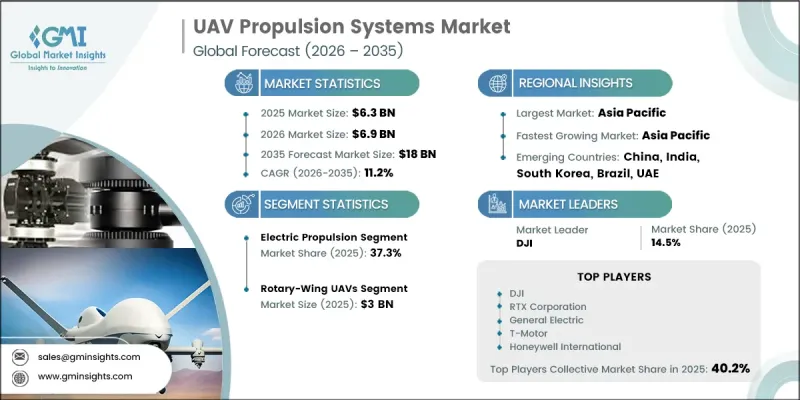
The growth of the global UAV propulsion systems industry is driven by the rising deployment of unmanned aerial platforms across defense and commercial operations, growing demand for high-efficiency propulsion technologies, and increasing investments in defense modernization initiatives. Expanding reliance on UAVs for advanced operational capabilities is encouraging the development of compact, lightweight, and fuel-efficient propulsion systems capable of supporting extended flight durations and enhanced mission performance. Technological innovations in propulsion architecture, energy management, and power optimization are also strengthening market expansion. Increasing integration of unmanned systems into industrial, logistics, monitoring, and security operations is creating consistent demand for advanced propulsion technologies that deliver reliability, operational efficiency, and improved endurance. At the same time, rapid advancements in UAV design and energy-efficient propulsion platforms are improving overall aircraft performance and supporting broader commercial adoption. Continuous investments in next-generation UAV technologies and autonomous systems are further contributing to the long-term growth potential of the UAV propulsion systems market.
| Market Scope | |
|---|---|
| Start Year | 2025 |
| Forecast Year | 2026-2035 |
| Start Value | $6.3 Billion |
| Forecast Value | $18 Billion |
| CAGR | 11.2% |
The UAV propulsion systems industry is witnessing strong momentum due to the increasing adoption of unmanned aerial systems across both military and commercial sectors. Rising utilization of UAVs for aerial monitoring, cargo transportation, industrial inspections, and agricultural applications is increasing the requirement for propulsion technologies capable of delivering longer operational endurance and efficient flight performance. Market expansion is also being supported by growing government spending on military UAV modernization programs focused on improving autonomous functionality and next-generation operational capabilities. During this period, the deployment of UAVs expanded significantly across industrial, surveillance, and logistics applications, while technological advancements and rising investments accelerated innovation throughout the market. Simultaneously, the introduction of advanced propulsion technologies and energy-efficient UAV configurations is improving operational capabilities and supporting wider adoption across multiple application areas.
The electric propulsion segment accounted for a 37.3% share in 2025. Strong market penetration of electric systems is attributed to their extensive use in small and medium-sized UAV platforms across commercial and defense operations. Electric propulsion technologies provide reduced operational noise, lower emissions, and improved energy efficiency, making them highly suitable for monitoring, transportation, and inspection-related applications. Their simplified mechanical structure, lower maintenance requirements, and compatibility with evolving battery technologies continue to strengthen large-scale deployment and market demand.
The hybrid configuration UAVs segment is anticipated to register a CAGR of 13.1% during 2035. Growth within this segment is primarily driven by increasing demand for UAV platforms capable of combining extended flight endurance with enhanced operational adaptability. Hybrid propulsion configurations are gaining significant traction in long-range operational missions because they support both vertical takeoff capability and efficient forward-flight performance. These operational advantages are accelerating commercialization and encouraging wider adoption across advanced UAV deployment scenarios.
North America UAV Propulsion Systems Market held a 36.7% share in 2025. Regional market growth is supported by substantial defense expenditures and the rapid integration of unmanned systems across military, surveillance, and homeland security operations. The region benefits from a mature UAV ecosystem and continuous incorporation of advanced propulsion technologies into next-generation aerospace and defense programs. These developments are increasing demand for high-performance propulsion systems capable of supporting long-endurance missions and critical operational requirements across multiple applications.
Major companies operating in the Global UAV Propulsion Systems Market include DJI, RTX Corporation, Honeywell International Inc., Rolls-Royce plc, General Electric Company, T-Motor, Maxon, BRP-Rotax GmbH & Co KG, Orbital UAV, Hirth Engines GmbH, Sky Power GmbH, General Atomics, Hobbywing Technology Co., Ltd., H3 Dynamics, Amprius Technologies, Yuneec, KDE Direct, and Rotron Power Ltd. Companies participating in the UAV propulsion systems industry are focusing on product innovation, strategic collaborations, and advanced propulsion technology development to strengthen their competitive position. Market players are investing heavily in lightweight propulsion architectures, energy-efficient systems, and hybrid-electric technologies to improve flight endurance and operational efficiency. Many manufacturers are also prioritizing research and development activities aimed at enhancing power density, reducing emissions, and supporting autonomous UAV operations. Partnerships with defense organizations, aerospace manufacturers, and technology providers are helping companies expand their technological capabilities and accelerate commercialization.
Table of Contents
Chapter 1 Methodology and Scope
- 1.1 Market scope and definition
- 1.2 Research design
- 1.2.1 Research approach
- 1.2.2 Data collection methods
- 1.3 Data mining sources
- 1.3.1 Global
- 1.3.2 Regional/Country
- 1.4 Base estimates and calculations
- 1.4.1 Base year calculation
- 1.4.2 Key trends for market estimation
- 1.5 Primary research and validation
- 1.5.1 Primary sources
- 1.6 Forecast model
- 1.7 Research assumptions and limitations
Chapter 2 Executive Summary
- 2.1 Industry 360° synopsis, 2022 - 2035
- 2.2 Key market trends
- 2.2.1 Propulsion type trends
- 2.2.2 Component trends
- 2.2.3 UAV type trends
- 2.2.4 Payload capacity trends
- 2.2.5 End-use application trends
- 2.2.6 Regional trends
- 2.3 TAM Analysis, 2026-2035
- 2.4 CXO perspectives: Strategic imperatives
Chapter 3 Industry Insights
- 3.1 Industry ecosystem analysis
- 3.1.1 Supplier Landscape
- 3.1.2 Profit Margin
- 3.1.3 Cost structure
- 3.1.4 Value addition at each stage
- 3.1.5 Factor affecting the value chain
- 3.1.6 Disruptions
- 3.2 Industry impact forces
- 3.2.1 Growth drivers
- 3.2.1.1 Rising global adoption of UAVs across defense and commercial applications
- 3.2.1.2 Rising demand for long-endurance and high-efficiency UAV operations
- 3.2.1.3 Increasing defense investments and military UAV modernization programs
- 3.2.1.4 Advancements in electric and hybrid propulsion technologies
- 3.2.1.5 Increasing demand for miniaturized and specialized UAV propulsion systems
- 3.2.2 Industry pitfalls and challenges
- 3.2.2.1 High development and integration costs of advanced propulsion systems
- 3.2.2.2 Limited battery capacity and energy density constraints
- 3.2.3 Market opportunities
- 3.2.3.1 Integration of propulsion systems in Urban Air Mobility (UAM) and drone delivery networks
- 3.2.3.2 Expansion of UAV-as-a-Service (UaaS) business models across industries
- 3.2.1 Growth drivers
- 3.3 Growth potential analysis
- 3.4 Regulatory landscape
- 3.4.1 North America
- 3.4.2 Europe
- 3.4.3 Asia Pacific
- 3.4.4 Latin America
- 3.4.5 Middle East & Africa
- 3.5 Porter’s analysis
- 3.6 PESTEL analysis
- 3.7 Technology and Innovation landscape
- 3.7.1 Current technological trends
- 3.7.2 Emerging technologies
- 3.8 Price trends
- 3.8.1 By region
- 3.8.2 By product
- 3.9 Pricing Strategies
- 3.10 Emerging Business Models
- 3.11 Compliance Requirements
- 3.12 Patent and IP analysis
Chapter 4 Competitive Landscape, 2025
- 4.1 Introduction
- 4.2 Company market share analysis
- 4.2.1 By region
- 4.2.1.1 North America
- 4.2.1.2 Europe
- 4.2.1.3 Asia Pacific
- 4.2.1.4 Latin America
- 4.2.1.5 Middle East & Africa
- 4.2.2 Market concentration analysis
- 4.2.1 By region
- 4.3 Competitive benchmarking of key players
- 4.3.1 Financial performance comparison
- 4.3.1.1 Revenue
- 4.3.1.2 Profit margin
- 4.3.1.3 R&D
- 4.3.2 Product portfolio comparison
- 4.3.2.1 Product range breadth
- 4.3.2.2 Technology
- 4.3.2.3 Innovation
- 4.3.3 Geographic presence comparison
- 4.3.3.1 Global footprint analysis
- 4.3.3.2 Service network coverage
- 4.3.3.3 Market penetration by region
- 4.3.4 Competitive positioning matrix
- 4.3.4.1 Leaders
- 4.3.4.2 Challengers
- 4.3.4.3 Followers
- 4.3.4.4 Niche players
- 4.3.5 Strategic outlook matrix
- 4.3.1 Financial performance comparison
- 4.4 Key developments
- 4.4.1 Mergers and acquisitions
- 4.4.2 Partnerships and collaborations
- 4.4.3 Technological advancements
- 4.4.4 Expansion and investment strategies
- 4.4.5 Digital transformation initiatives
- 4.5 Emerging/ startup competitors landscape
Chapter 5 Market Estimates and Forecast, By Propulsion Type, 2022 - 2035 (USD Million)
- 5.1 Key trends
- 5.2 Electric propulsion
- 5.2.1 Brushless DC motors
- 5.2.2 Electronic speed controllers
- 5.2.3 Others
- 5.3 Hybrid propulsion
- 5.3.1 Hybrid-electric architectures
- 5.3.2 Generator-motor systems
- 5.3.3 Others
- 5.4 Internal combustion engines
- 5.4.1 Gasoline engines
- 5.4.2 Heavy fuel engines
- 5.4.3 Piston engines
- 5.4.4 Others
- 5.5 Turbine & jet propulsion
- 5.5.1 Turbojet systems
- 5.5.2 Turbofan systems
- 5.5.3 Turboprop systems
- 5.5.4 Others
- 5.6 Fuel Cell propulsion
- 5.6.1 Hydrogen fuel cells
- 5.6.2 PEM (proton exchange membrane) fuel cells
- 5.6.3 Hybrid fuel cell-battery systems
Chapter 6 Market Estimates and Forecast, By Component, 2022 - 2035 (USD Million)
- 6.1 Key trends
- 6.2 Motors & engines
- 6.2.1 Brushless motors
- 6.2.2 Brushed motors
- 6.2.3 IC engines (piston, rotary, turbine)
- 6.3 Battery & energy storage systems
- 6.3.1 Lithium-ion batteries
- 6.3.2 Solid-state batteries
- 6.3.3 Fuel storage systems
- 6.3.4 Others
- 6.4 Propellers & rotor systems
- 6.4.1 Fixed-pitch propellers
- 6.4.2 Variable-pitch propellers
- 6.4.3 Rotor assemblies
- 6.4.4 Others
- 6.5 Accessories & supporting components
- 6.6 Others
Chapter 7 Market Estimates and Forecast, By UAV Type, 2022 - 2035 (USD Million)
- 7.1 Key trends
- 7.2 Fixed-wing UAVs
- 7.2.1 Short-range fixed-wing
- 7.2.2 Medium-range fixed-wing
- 7.2.3 Long-range fixed-wing
- 7.3 Rotary-wing UAVs
- 7.3.1 Quadcopters & multirotors
- 7.3.2 Helicopter configuration UAVs
- 7.3.3 Others
- 7.4 Hybrid configuration UAVs
- 7.4.1 VTOL fixed-wing systems
- 7.4.2 Tilt-rotor UAVs
- 7.4.3 Others
Chapter 8 Market Estimates and Forecast, By Payload Capacity, 2022 - 2035 (USD Million)
- 8.1 Key trends
- 8.2 Less than 2 kg
- 8.3 2-25 kg
- 8.4 25-150 kg
- 8.5 150-600 kg
- 8.6 More than 600 kg
Chapter 9 Market Estimates and Forecast, By End-use Application, 2022 - 2035 (USD Million)
- 9.1 Key trends
- 9.2 Military & defense
- 9.2.1 Combat UAVs & loitering munitions
- 9.2.2 Surveillance & reconnaissance (ISR)
- 9.2.3 Target drones & training systems
- 9.2.4 Others
- 9.3 Commercial
- 9.3.1 Agriculture & precision farming
- 9.3.2 Logistics & package delivery
- 9.3.3 Media & entertainment
- 9.3.4 Others
- 9.4 Civil government
- 9.4.1 Law enforcement & border patrol
- 9.4.2 Emergency response & disaster management
- 9.4.3 Others
Chapter 10 Market Estimates and Forecast, By Region, 2022 - 2035 (USD Million)
- 10.1 Key trends
- 10.2 North America
- 10.2.1 U.S.
- 10.2.2 Canada
- 10.3 Europe
- 10.3.1 Germany
- 10.3.2 UK
- 10.3.3 France
- 10.3.4 Spain
- 10.3.5 Italy
- 10.3.6 Russia
- 10.4 Asia Pacific
- 10.4.1 China
- 10.4.2 India
- 10.4.3 Japan
- 10.4.4 Australia
- 10.4.5 South Korea
- 10.5 Latin America
- 10.5.1 Brazil
- 10.5.2 Mexico
- 10.5.3 Argentina
- 10.6 Middle East and Africa
- 10.6.1 South Africa
- 10.6.2 Saudi Arabia
- 10.6.3 UAE
Chapter 11 Company Profiles
- 11.1 Global Key Players
- 11.1.1 DJI
- 11.1.2 RTX Corporation
- 11.1.3 General Electric
- 11.1.4 T-Motor
- 11.1.5 Honeywell International
- 11.2 Regional key players
- 11.2.1 North America
- 11.2.1.1 General Atomics
- 11.2.1.2 Amprius Technologies
- 11.2.1.3 KDE Direct
- 11.2.2 Asia Pacific
- 11.2.2.1 Hobbywing Technology Co., Ltd.
- 11.2.2.2 Yuneec
- 11.2.3 Europe
- 11.2.3.1 Rolls-Royce plc
- 11.2.3.2 Maxon
- 11.2.3.3 BRP-Rotax GmbH & Co KG
- 11.2.3.4 Hirth Engines GmbH
- 11.2.3.5 Sky Power GmbH
- 11.2.3.6 Rotron Power Ltd.
- 11.2.4 Middle East & Africa
- 11.2.4.1 H3 Dynamics
- 11.2.1 North America
- 11.3 Niche Players/Disruptors
- 11.3.1 Orbital UAV

