
PUBLISHER: Mordor Intelligence | PRODUCT CODE: 2061642

PUBLISHER: Mordor Intelligence | PRODUCT CODE: 2061642
UAV Propulsion Systems - Market Share Analysis, Industry Trends & Statistics, Growth Forecasts (2026 - 2031)
According to Mordor Intelligence, the uAV propulsion systems market size was valued at USD 10.85 billion in 2025 and estimated to grow from USD 11.92 billion in 2026 to reach USD 19.08 billion by 2031, at a CAGR of 9.87% during the forecast period (2026-2031).
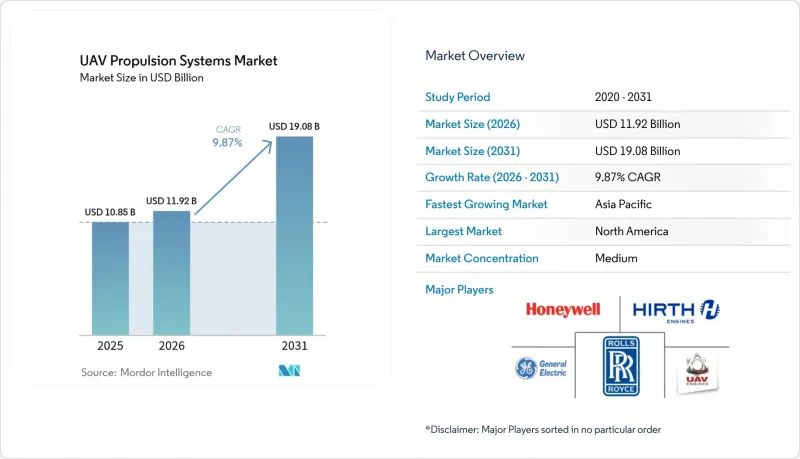
This report is Segmented by Engine Type (Conventional, Hybrid, Full-Electric), Fuel Type (Gasoline, Heavy Fuel, Hydrogen, and More), Endurance Class (Less Than 1 Hour, 1-3 Hours, and More), UAV Type (Micro UAV, Mini UAV, Tactical UAV, and More), and Geography (North America, Europe, and More). The Market Forecasts are Provided in Terms of Value (USD).
Global UAV Propulsion Systems Market Trends and Insights
Surge in E- and Hybrid-Electric Demand
Electric and hybrid-electric propulsion lowers acoustic and infrared signatures, simplifies maintenance at austere bases, and trims supply-chain weight by replacing bulk liquid fuel with modular battery packs. DARPA's XRQ-73 SHEPARD hybrid, powered by Northrop Grumman's 1,250-lb system, illustrates how series configurations deliver multi-hour loiter without compromising stealth. Honeywell's 1 MW turbogenerator scales these gains for heavy cargo drones, tripling earlier power levels and enabling distributed electric motors on larger wings. Defence ministries now budget for silent ingress drones that avoid acoustic detection at border standoff ranges. Procurement offices highlight simplified line-replaceable units that cut mean-time-to-repair, making electric-hybrid propulsion central to future tenders. In turn, the UAV propulsion system market sees incumbents partner with inverter, battery, and thermal-management specialists to balance power-to-weight targets with battlefield durability.
Military Swarm Drone Operations and Autonomous Combat Systems
Swarm concepts deploy dozens to hundreds of small, networked drones that saturate defenses, demand rapid thrust response, and accept higher attrition. US Army "launched effects" experiments showcase miniature engines and electric fans engineered for mass production and pre-flight self-diagnostics. Germany's EUR 100 billion (USD 117.7 billion) rearmament makes loitering munitions and autonomous wingmen core spending areas, creating large-volume opportunities for identical propulsion pods that clip into disposable airframes. Powerplants need common digital interfaces so AI mission controllers can manage throttle, health, and emergency shutdown across the swarm. Standardization accelerates depot assembly lines and lowers life-cycle cost, a key metric when each mission may consume dozens of vehicles. Swarm adoption, therefore, accelerates mini-motor innovation and stretches production capacity within the UAV propulsion system market.
Battery Energy-Density Plateau
Lithium-ion chemistries remain locked near 300 Wh/kg; tactical eVTOL sorties at 10-60 °C discharge trigger fast degradation and shorten battery life to under 100 combat cycles. Resulting 20-30 minute flight times force armies to stock spare packs or add hybrid boosters, raising the logistical burden. Thermal spikes require liquid-cooled enclosures that add weight and lower payload. Solid-state and lithium-sulfur prototypes show promise but need scale to meet NATO safety rules. Until then, battery limits cap pure-electric adoption, moderating the expansion pace in segments of the UAV propulsion system market.
Other drivers and restraints analyzed in the detailed report include:
- Defense Modernization Budgets for MALE/HALE UAVs
- Hydrogen Fuel-Cell Range-Extender Breakthroughs
- Rare-Earth Magnet Supply Constraints
For complete list of drivers and restraints, kindly check the Table Of Contents.
Segment Analysis
Conventional engines held 39.35% of the UAV propulsion system market 2025, signaling entrenched reliability for high-hot and sandy environments. Yet full-electric units expand at a 12.68% CAGR thanks to stealth, maintenance, and modular benefits that resonate with modern doctrines. Hybrid generators bridge payload gaps by handing cruise loads to heavy-fuel turbines while batteries power silent ingress. Print-to-fly micro-turbines democratize jet performance for expendable munitions, tightening competition between combustion and electric lines. Investors steer R&D toward common-core inverters and digital twins that cut unplanned downtime, reinforcing adoption curves across the UAV propulsion system market.
Platform integrators prefer engines delivered as sealed sub-systems with embedded health-monitoring that feed fleet-wide analytics. Electric motors achieve 98% efficiency at cruise, slashing infrared traces. Conversely, heavy-fuel two-strokes remain essential for Arctic and desert outposts where kilowatt-class generators power onboard heaters and de-icing kits. Procurement agencies thus request plug-and-play architecture that toggles between power modes, accelerating component reuse and lowering spares inventory exposure. This modular philosophy underpins forecast dominance of hybrid-ready designs in the UAV propulsion system market.
Gasoline held a 43.05% share of the UAV propulsion systems market size in 2025, supported by global availability and proven cold-start reliability. Hydrogen solutions register the highest 13.08% CAGR as power density gains and green-hydrogen infrastructure scale converge to unlock extended sorties at near-silent acoustic profiles. Heavy-fuel JP-8 variants maintain relevance for defense users who prioritize logistics commonality and shipboard safety. Battery-only configurations dominate sub-10 kg payload classes where missions last under one hour. Demonstrators such as China's liquid-hydrogen fixed-wing prototype prove that cryogenic fuel can support large UAVs, although storage and venting standards are still evolving.
Solar-assisted craft remains a narrow niche yet drives material research for ultrathin photovoltaics that could pair with hydrogen range extenders. Refueling times for compressed gas undercut battery recharge cycles, giving hydrogen an edge in availability for high sortie frequency models. Fuel selection influences cooling strategy, mission planning, and carbon accounting metrics, which now appear in European and Asian public tenders. Suppliers therefore engineer modular tanks and quick-disconnect valves that integrate with multiple airframe sizes, safeguarding residual value as technology choices shift through the UAV propulsion systems market.
Geography Analysis
North America sustained 33.40% share in 2025 because Pentagon programs, FAA test corridors, and Silicon Valley capital coalesce into robust demand and swift certification pipelines. DARPA and AFWERX grants de-risk early-stage engines, while US Navy shipboard tests evaluate hydrogen refueling at sea. Policy aligns state energy credits with base microgrid upgrades, incentivizing hybrid adoption.
Asia-Pacific posts the strongest 11.32% CAGR as China's trillion-yuan low-altitude economy charter encourages domestic propulsion lines and subsidizes fuel-cell trial fleets. India's Atmanirbhar initiative channels offset funds into heavy-fuel piston and hybrid labs to cut reliance on imported electronics. Japan pioneers gas-turbine electric hybrids for urban eVTOL, and South Korea includes hydrogen drones in its defence-export masterplan. Diverse regulatory codes create export-variant complexity yet drive parallel innovation, expanding overall opportunity within the UAV propulsion system market.
Europe grows steadily as EASA enforces noise and CO2 caps that tilt spending toward electric and hydrogen. France and Germany co-finance HyPoTraDe to validate cross-border hydrogen cargo corridors. The UK backs additive turbine centers that accelerate Type-Cert demonstrations for heavy-fuel engines destined for Loyal Wingman programs. Carbon pricing boosts ROI for zero-emission powerplants, and collective research networks ensure shared lessons, reinforcing continental momentum across the UAV propulsion system market.
- Honeywell International Inc.
- Rolls-Royce plc
- General Electric Company
- Sky Power GmbH
- UAV Engines Limited
- Hirth Engines GmbH (UMS SKELDAR)
- Orbital Corporation Ltd
- Intelligent Energy Limited
- H3 Dynamics Holdings Pte. Ltd.
- VerdeGo Aero, Inc.
- Rotron Power Ltd.
- Electra.Aero.
- PBS AEROSPACE
- DeltaHawk Engines, Inc.
Additional Benefits:
- The market estimate (ME) sheet in Excel format
- 3 months of analyst support
TABLE OF CONTENTS
1 INTRODUCTION
- 1.1 Study Assumptions and Market Definition
- 1.2 Scope of the Study
2 RESEARCH METHODOLOGY
3 EXECUTIVE SUMMARY
4 MARKET LANDSCAPE
- 4.1 Market Overview
- 4.2 Market Drivers
- 4.2.1 Surge in e- and hybrid-electric demand
- 4.2.2 Military swarm drone operations and autonomous combat systems
- 4.2.3 Defence modernisation budgets for MALE/HALE UAVs
- 4.2.4 Drone-as-a-service retrofit kits
- 4.2.5 Hydrogen fuel-cell range-extender breakthroughs
- 4.2.6 Additive-manufactured micro-turbine cost deflation
- 4.3 Market Restraints
- 4.3.1 Battery energy-density plateau
- 4.3.2 Rare-earth magnet supply constraints
- 4.3.3 Export-control (ITAR/MTCR) restrictions
- 4.3.4 Ultra-low thermal-/acoustic-signature thresholds for contested airspace
- 4.4 Value Chain Analysis
- 4.5 Regulatory Landscape
- 4.6 Technological Outlook
- 4.7 Porter's Five Forces Analysis
- 4.7.1 Bargaining Power of Suppliers
- 4.7.2 Bargaining Power of Buyers/Consumers
- 4.7.3 Threat of New Entrants
- 4.7.4 Threat of Substitute Products
- 4.7.5 Intensity of Competitive Rivalry
5 MARKET SIZE AND GROWTH FORECASTS (VALUE)
- 5.1 By Engine Type
- 5.1.1 Conventional
- 5.1.2 Hybrid
- 5.1.3 Full-Electric
- 5.2 By Fuel Type
- 5.2.1 Gasoline
- 5.2.2 Heavy Fuel
- 5.2.3 Hydrogen
- 5.2.4 Battery (Li-ion, Li-S)
- 5.2.5 Solar-Augmented
- 5.3 By Endurance Class
- 5.3.1 Less than 1 hour
- 5.3.2 1 - 3 hours
- 5.3.3 3 - 6 hours
- 5.3.4 Greater than 6 hours
- 5.4 By UAV Type
- 5.4.1 Micro UAV
- 5.4.2 Mini UAV
- 5.4.3 Tactical UAV
- 5.4.4 MALE UAV
- 5.4.5 HALE UAV
- 5.5 By Geography
- 5.5.1 North America
- 5.5.1.1 United States
- 5.5.1.2 Canada
- 5.5.1.3 Mexico
- 5.5.2 South America
- 5.5.2.1 Brazil
- 5.5.2.2 Rest of South America
- 5.5.3 Europe
- 5.5.3.1 United Kingdom
- 5.5.3.2 France
- 5.5.3.3 Germany
- 5.5.3.4 Russia
- 5.5.3.5 Rest of Europe
- 5.5.4 Asia-Pacific
- 5.5.4.1 China
- 5.5.4.2 India
- 5.5.4.3 Japan
- 5.5.4.4 South Korea
- 5.5.4.5 Rest of Asia-Pacific
- 5.5.5 Middle East and Africa
- 5.5.5.1 Middle East
- 5.5.5.1.1 United Arab Emirates
- 5.5.5.1.2 Saudi Arabia
- 5.5.5.1.3 Qatar
- 5.5.5.1.4 Rest of Middle East
- 5.5.5.2 Africa
- 5.5.5.2.1 South Africa
- 5.5.5.2.2 Rest of Africa
- 5.5.5.1 Middle East
- 5.5.1 North America
6 COMPETITIVE LANDSCAPE
- 6.1 Market Concentration
- 6.2 Strategic Moves
- 6.3 Market Share Analysis
- 6.4 Company Profiles (includes Global-level Overview, Market-level Overview, Core Segments, Financials, Strategic Info, Market Rank/Share, Products and Services, Recent Developments)
- 6.4.1 Honeywell International Inc.
- 6.4.2 Rolls-Royce plc
- 6.4.3 General Electric Company
- 6.4.4 Sky Power GmbH
- 6.4.5 UAV Engines Limited
- 6.4.6 Hirth Engines GmbH (UMS SKELDAR)
- 6.4.7 Orbital Corporation Ltd
- 6.4.8 Intelligent Energy Limited
- 6.4.9 H3 Dynamics Holdings Pte. Ltd.
- 6.4.10 VerdeGo Aero, Inc.
- 6.4.11 Rotron Power Ltd.
- 6.4.12 Electra.Aero.
- 6.4.13 PBS AEROSPACE
- 6.4.14 DeltaHawk Engines, Inc.
7 MARKET OPPORTUNITIES AND FUTURE OUTLOOK
- 7.1 White-space and Unmet-need Assessment

