PUBLISHER: Global Market Insights Inc. | PRODUCT CODE: 2061340

PUBLISHER: Global Market Insights Inc. | PRODUCT CODE: 2061340
Automotive Hypervisor and Mixed-Criticality OS Market Opportunity, Growth Drivers, Industry Trend Analysis, and Forecast 2026 - 2035
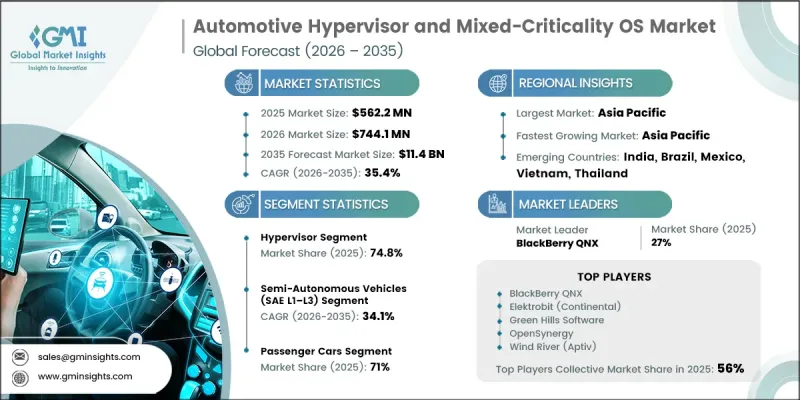
The Global Automotive Hypervisor and Mixed-Criticality OS Market was valued at USD 562.2 million in 2025 and is estimated to grow at a CAGR of 35.4% to reach USD 11.4 billion by 2035.
Market growth is driven by the automotive industry's transition toward centralized vehicle computing architectures, where numerous distributed electronic control units are being consolidated into a smaller number of domain and zonal controllers. This architectural shift is creating substantial demand for advanced automotive hypervisors and mixed-criticality operating systems capable of supporting multiple workloads on a single hardware platform while maintaining strict functional separation and system reliability. The increasing integration of advanced driver assistance technologies is further accelerating adoption, as automakers require secure execution environments for safety-critical and non-critical applications operating simultaneously. As vehicles become software-defined, manufacturers are prioritizing platforms that enable efficient resource utilization, enhanced computing performance, and compliance with automotive safety standards. Growing digitalization across vehicle systems, coupled with rising software complexity, is strengthening the need for virtualization technologies that support workload isolation, real-time responsiveness, and secure system operation. These factors continue to position the automotive hypervisor and mixed-criticality OS industry for substantial long-term expansion.
| Market Scope | |
|---|---|
| Start Year | 2025 |
| Forecast Year | 2026-2035 |
| Start Value | $562.2 Million |
| Forecast Value | $11.4 Billion |
| CAGR | 35.4% |
The rapid evolution of electric vehicle architectures is creating additional opportunities for the automotive hypervisor and mixed-criticality OS market. Vehicle functions related to battery management, propulsion control, and thermal regulation require dependable real-time operating environments capable of meeting stringent performance requirements. As automakers increasingly adopt centralized computing frameworks, demand is rising for solutions that can safely separate critical vehicle operations from other software functions while maintaining high levels of safety, reliability, and operational efficiency. This trend is reinforcing the role of mixed-criticality operating systems in next-generation vehicle platforms.
The hypervisor segment held a 74.8% share, and is anticipated to register a CAGR of 34.5% between 2026 and 2035. Segment growth is being supported by the industry's shift from conventional electronic control unit architectures toward centralized computing environments. Hypervisors enable multiple operating systems to run simultaneously on a single high-performance computing platform while ensuring workload separation and system integrity. The growing need to support diverse software environments within software-defined vehicles is increasing adoption across infotainment, driver assistance, and vehicle control applications. In addition, the integration of mixed-criticality operating systems across electric vehicle platforms is further contributing to demand for hypervisor-based solutions that support functional safety compliance and efficient resource management.
The semi-autonomous vehicles (SAE L1-L3) segment accounted for 68.7% share in 2025 and is expected to grow at a CAGR of 34.1% from 2026 to 2035. Demand within this segment is being driven by the increasing incorporation of advanced driver assistance capabilities across passenger vehicles. Automakers are focusing on delivering enhanced safety features and improved driving functionality through semi-autonomous technologies that support greater vehicle intelligence and driver convenience. The continued expansion of these systems is increasing the requirement for robust software platforms capable of managing multiple workloads while maintaining reliable performance and safety across vehicle operations.
U.S. Automotive Hypervisor and Mixed-Criticality OS Market generated USD 127.7 million in 2025 and is forecast to grow at a CAGR of 36.3% through 2035. The country remains a key hub for innovation in advanced vehicle automation technologies, creating strong demand for sophisticated software platforms that support centralized vehicle computing. Increasing investments in intelligent mobility solutions, software-defined vehicle development, and next-generation automotive technologies are accelerating adoption of hypervisors and mixed-criticality operating systems. In addition, supportive regulatory frameworks and ongoing technological advancements are contributing to the widespread implementation of virtualization technologies designed to ensure secure workload separation and high-performance vehicle operation.
Major companies operating in the Global Automotive Hypervisor and Mixed-Criticality OS Market include BlackBerry QNX, Elektrobit (Continental), Green Hills Software, Lynx Software Technologies, NVIDIA, NXP Semiconductors, OpenSynergy, Renesas Electronics, SYSGO, and Wind River (Aptiv). Leading participants in the automotive hypervisor and mixed-criticality OS market are implementing a range of strategies to strengthen their market position and expand business opportunities. Companies are investing significantly in research and development to improve virtualization capabilities, real-time performance, cybersecurity, and functional safety compliance. Strategic collaborations with automotive manufacturers, semiconductor providers, and software developers are helping accelerate technology integration across next-generation vehicle platforms. Product innovation remains a major focus area, with vendors developing scalable software solutions tailored for software-defined vehicles and centralized computing architectures. Many organizations are also expanding their global footprint through partnerships, acquisitions, and ecosystem development initiatives. In addition, companies are emphasizing compliance with evolving automotive safety standards while enhancing interoperability and platform flexibility to meet the growing demands of connected, autonomous, and electric vehicles.
Table of Contents
Chapter 1 Methodology
- 1.1 Research approach
- 1.2 Quality Commitments
- 1.2.1 GMI AI policy & data integrity commitment
- 1.2.1.1 Source consistency protocol
- 1.2.1 GMI AI policy & data integrity commitment
- 1.3 Research Trail & Confidence Scoring
- 1.3.1 Research Trail Components
- 1.3.2 Scoring Components
- 1.4 Data Collection
- 1.4.1 Partial list of primary sources
- 1.5 Data mining sources
- 1.5.1 Paid sources
- 1.5.1.1 Sources, by region
- 1.5.1 Paid sources
- 1.6 Base estimates and calculations
- 1.6.1 Base year calculation
- 1.7 Forecast model
- 1.7.1 Quantified market impact analysis
- 1.7.1.1 Mathematical impact of growth parameters on forecast
- 1.7.1 Quantified market impact analysis
- 1.8 Research transparency addendum
- 1.8.1 Source attribution framework
- 1.8.2 Quality assurance metrics
- 1.8.3 Our commitment to trust
Chapter 2 Executive Summary
- 2.1 Industry 360° synopsis
- 2.2 Key market trends
- 2.2.1 Regional
- 2.2.2 Software
- 2.2.3 Level of Autonomy
- 2.2.4 Application
- 2.2.5 Vehicle
- 2.2.6 Sales Channel
- 2.3 TAM analysis, 2026-2035
- 2.4 CXO perspectives: Strategic imperatives
Chapter 3 Industry Insights
- 3.1 Industry ecosystem analysis
- 3.1.1 Supplier landscape
- 3.1.2 Profit margin
- 3.1.3 Cost structure
- 3.1.4 Value addition at each stage
- 3.1.5 Factor affecting the value chain
- 3.1.6 Disruptions
- 3.2 Industry impact forces
- 3.2.1 Growth drivers
- 3.2.1.1 ECU Consolidation & SDV Transition
- 3.2.1.2 ADAS & Autonomous Complexity Growth
- 3.2.1.3 EV Powertrain Software Integration
- 3.2.1.4 Functional Safety & Cyber Compliance
- 3.2.2 Industry pitfalls and challenges
- 3.2.2.1 High ASIL Certification Cost
- 3.2.2.2 Virtualization Latency Constraints
- 3.2.3 Market opportunities
- 3.2.3.1 Zonal Architecture Expansion
- 3.2.3.2 L4-L5 Autonomous Vehicle Growth
- 3.2.3.3 Open-Source Hypervisor Adoption
- 3.2.3.4 EV Startup Ecosystem Expansion
- 3.2.1 Growth drivers
- 3.3 Growth potential analysis
- 3.4 Technology and innovation landscape
- 3.4.1 Current technological trends
- 3.4.2 Emerging technologies
- 3.5 Cost breakdown analysis
- 3.6 Regulatory landscape
- 3.6.1 North America
- 3.6.1.1 National Institute of Standards and Technology
- 3.6.1.2 Innovation, Science and Economic Development Canada
- 3.6.2 Europe
- 3.6.2.1 European Commission
- 3.6.2.2 European Telecommunications Standards Institute
- 3.6.3 Asia Pacific
- 3.6.3.1 Ministry of Industry and Information Technology
- 3.6.3.2 Ministry of Economy, Trade and Industry
- 3.6.4 Latin America
- 3.6.4.1 Ministry of Science, Technology and Innovation
- 3.6.4.2 National Institute of Statistics and Geography
- 3.6.5 Middle East & Africa
- 3.6.5.1 Saudi Data and Artificial Intelligence Authority
- 3.6.5.2 Department of Communications and Digital Technologies
- 3.6.1 North America
- 3.7 Pricing Analysis (Driven by Primary Research)
- 3.7.1 Historical Price Trend Analysis
- 3.7.2 Pricing Strategy by Player Type
- 3.8 Porter's analysis
- 3.9 PESTEL analysis
- 3.10 Patent analysis (Driven by Primary Research)
- 3.11 Impact of AI & Generative AI on the Market
- 3.11.1 AI-driven disruption of existing business models
- 3.11.2 Gen AI use cases & adoption roadmap by segment
- 3.11.3 Risks, limitations & regulatory considerations
- 3.12 Sustainability and environmental aspects
- 3.12.1 Sustainable practices
- 3.12.2 Waste reduction strategies
- 3.12.3 Energy efficiency in production
- 3.12.4 Eco-friendly initiatives
- 3.12.5 Carbon footprint considerations
- 3.13 Forecast assumptions & scenario analysis (Driven by primary research)
- 3.13.1 Base Case - key macro & industry variables driving CAGR
- 3.13.2 Optimistic Scenarios - Favorable macro and industry tailwinds
- 3.13.3 Pessimistic Scenario - Macroeconomic slowdown or industry headwinds
Chapter 4 Competitive Landscape, 2025
- 4.1 Introduction
- 4.2 Company market share analysis
- 4.2.1 North America
- 4.2.2 Europe
- 4.2.3 Asia Pacific
- 4.2.4 LATAM
- 4.2.5 MEA
- 4.3 Competitive analysis of major market players
- 4.4 Competitive positioning matrix
- 4.5 Key developments
- 4.5.1 Mergers & acquisitions
- 4.5.2 Partnerships & collaborations
- 4.5.3 New product launches
- 4.5.4 Expansion plans and funding
Chapter 5 Market Estimates and Forecast, By Software, 2022 - 2035 ($ Million)
- 5.1 Key trends
- 5.2 Hypervisor
- 5.2.1 Type 1 Hypervisor (Bare-Metal / Native)
- 5.2.2 Type 2 Hypervisor (Hosted)
- 5.3 Safety-Certified Mixed-Criticality OS Platforms (MC-OS)
- 5.3.1 AUTOSAR-Based MC Platforms
- 5.3.2 RTOS-Based MC Platforms
Chapter 6 Market Estimates and Forecast, By Level of Autonomy, 2022 - 2035 ($ Million)
- 6.1 Key trends
- 6.2 Semi-Autonomous Vehicles (SAE L1-L3)
- 6.3 Fully Autonomous Vehicles (SAE L4-L5)
Chapter 7 Market Estimates and Forecast, By Application, 2022 - 2035 ($ Million)
- 7.1 Key trends
- 7.2 Advanced driver assistance systems (ADAS) & autonomous driving
- 7.3 Infotainment & digital cockpit
- 7.4 Vehicle connectivity & telematics
- 7.5 Powertrain & energy management
- 7.6 Body electronics & comfort systems
- 7.7 Vehicle cybersecurity & secure gateway systems
Chapter 8 Market Estimates and Forecast, By Vehicle, 2022 - 2035 ($ Million)
- 8.1 Key trends
- 8.2 Passenger cars
- 8.2.1 Sedan
- 8.2.2 SUV
- 8.2.3 Hatchback
- 8.3 Commercial vehicles
- 8.3.1 LCV
- 8.3.2 MCV
- 8.3.3 HCV
Chapter 9 Market Estimates and Forecast, By Sales Channel, 2022 - 2035 ($ Million)
- 9.1 Key trends
- 9.2 OEM
- 9.3 Aftermarket
Chapter 10 Market Estimates & Forecast, By Region, 2022 - 2035 ($Mn)
- 10.1 Key trends
- 10.2 North America
- 10.2.1 U.S.
- 10.2.2 Canada
- 10.3 Europe
- 10.3.1 Germany
- 10.3.2 UK
- 10.3.3 France
- 10.3.4 Italy
- 10.3.5 Spain
- 10.3.6 Russia
- 10.3.7 Netherlands
- 10.3.8 Sweden
- 10.3.9 Poland
- 10.4 Asia Pacific
- 10.4.1 China
- 10.4.2 India
- 10.4.3 Japan
- 10.4.4 South Korea
- 10.4.5 Australia
- 10.4.6 Vietnam
- 10.4.7 Indonesia
- 10.4.8 Malaysia
- 10.4.9 Singapore
- 10.4.10 Thailand
- 10.5 Latin America
- 10.5.1 Brazil
- 10.5.2 Mexico
- 10.5.3 Argentina
- 10.5.4 Chile
- 10.6 MEA
- 10.6.1 South Africa
- 10.6.2 Saudi Arabia
- 10.6.3 UAE
Chapter 11 Company Profiles
- 11.1 Global players
- 11.1.1 BlackBerry QNX
- 11.1.2 Elektrobit (Continental)
- 11.1.3 Green Hills Software
- 11.1.4 Lynx Software Technologies
- 11.1.5 NVIDIA
- 11.1.6 NXP Semiconductors
- 11.1.7 OpenSynergy
- 11.1.8 Wind River (Aptiv)
- 11.2 Regional players
- 11.2.1 eSOL
- 11.2.2 NeuSoft Rui Chi
- 11.2.3 Perseus (CyberPerseus)
- 11.2.4 Renesas Electronics
- 11.2.5 SCSK
- 11.2.6 SYSGO
- 11.2.7 TTTech Auto
- 11.2.8 Vector Informatik
- 11.3 Emerging players
- 11.3.1 Apex.AI
- 11.3.2 easyCore
- 11.3.3 osdyne
- 11.3.4 Virtual Open Systems

