PUBLISHER: Mordor Intelligence | PRODUCT CODE: 2063373

PUBLISHER: Mordor Intelligence | PRODUCT CODE: 2063373
Automotive Hypervisor - Market Share Analysis, Industry Trends & Statistics, Growth Forecasts (2026 - 2031)
According to Mordor Intelligence, the automotive hypervisor market size is expected to increase from USD 0.47 billion in 2025 to USD 0.57 billion in 2026 and reach USD 1.51 billion by 2031, growing at a CAGR of 21.49% over 2026-2031.
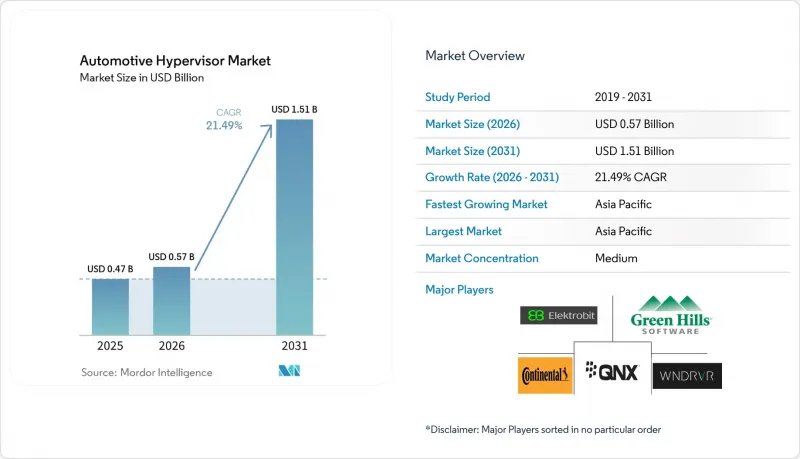
This report is Segmented by Type (Type 1 Bare-Metal Hypervisor, Type 2 Hosted Hypervisor), Vehicle Type (Passenger Cars, Light Commercial Vehicles, and More), Mode of Operation (Autonomous Vehicles, and More), Application (Advanced Driver Assistance Systems, and More), Demand Type (OEM, Replacement), and Geography (North America, and More). The Market Forecasts are Provided in Terms of Value (USD).
Global Automotive Hypervisor Market Trends and Insights
Proliferation of Domain-Controller E/E Architectures
The automotive industry's transition from distributed ECU architectures to centralized domain controllers fundamentally reshapes vehicle electrical/electronic (E/E) systems, with hypervisors as the critical enabler for consolidating 100+ individual ECUs onto fewer than 10 high-performance computing units. This architectural shift reduces vehicle weight by approximately 15-20 kilograms while cutting wiring harness complexity by up to 40%, directly impacting electric vehicle range and manufacturing costs. The consolidation is also creating significant opportunities in the automotive hypervisor market, as each domain controller requires advanced virtualization software to manage mixed-criticality workloads across ASIL-D safety functions and non-safety applications. OEMs are increasingly adopting hypervisor-based architectures to future-proof vehicle platforms against evolving software demands, with Tesla, BMW, and Volkswagen leading the move toward software-defined vehicles.
Mandatory Cybersecurity Compliance (ISO/SAE 21434, UNECE R155/R156)
Regulatory mandates for automotive cybersecurity are driving compliance-led growth in the automotive hypervisor market. UNECE R155 requires Cybersecurity Management Systems (CSMS) certification as a precondition for vehicle type approval in EU member countries, Japan, and South Korea since July 2024. The regulation's emphasis on organizational-level cybersecurity processes and regular threat analysis and risk assessment (TARA) activities drives OEMs to adopt hypervisor-based architectures that provide hardware-backed isolation between safety-critical and connectivity domains. ISO/SAE 21434 compliance requirements are particularly stringent for mixed-criticality systems, where hypervisors must demonstrate freedom from interference between different ASIL-rated applications running on shared hardware resources.
Legacy ECU Investment Lock-ins at Tier-1s
The automotive industry's heavy investment in legacy ECU architectures remains a major challenge for growth in the automotive hypervisor market, as Tier-1 suppliers face potential write-offs of billions of dollars in existing toolchains, manufacturing equipment, and engineering expertise optimized for distributed control systems. Many established suppliers have developed proprietary AUTOSAR Classic implementations and safety-certified software stacks requiring extensive re-engineering to operate within hypervisor environments, creating financial disincentives for rapid migration. The challenge is compounded by long automotive development cycles. ECU designs frozen in 2022-2023 will continue shipping in production vehicles through 2028-2030, limiting the addressable market for hypervisor solutions during the forecast period.
Other drivers and restraints analyzed in the detailed report include:
- Consolidation of Infotainment, ADAS and Powertrain on Single SoCs
- OEM Push Toward Software-Defined Vehicles (SDVs)
- Hypervisor Certification Costs for ASIL-D Compliance
For complete list of drivers and restraints, kindly check the Table Of Contents.
Segment Analysis
Type 1 bare-metal hypervisors hold 62.04% market share in 2025, reflecting their superior performance and direct hardware access capabilities, which are essential for safety-critical automotive applications. These hypervisors operate directly on vehicle hardware without an underlying operating system, providing deterministic real-time performance and minimal latency overhead crucial for ADAS and powertrain control systems. Type 2 hosted hypervisors, despite a smaller market share, are experiencing rapid growth at a 16.82% CAGR through 2031, driven by their flexibility in development environments and ease of integration with existing Linux-based infotainment platforms.
The performance advantages of bare-metal architectures become particularly pronounced in mixed-criticality scenarios, where ASIL-D safety functions must coexist with non-safety applications on shared hardware resources. Type 1 hypervisors, such as Green Hills' INTEGRITY Multivisor and Wind River's Helix Virtualization Platform, provide hardware-assisted virtualization features that enable strict temporal and spatial partitioning required for functional safety compliance. However, Type 2 solutions are gaining traction in specific use cases such as software development, testing, and non-safety infotainment applications where their simplified deployment model outweighs performance considerations. The market evolution suggests a bifurcated future, with Type 1 hypervisors dominating production vehicle deployments while Type 2 solutions capture development tool and aftermarket segments.
Passenger cars account for 58.28% of automotive hypervisor deployments in 2025, driven by the segment's high-volume production and the increasing integration of advanced infotainment and ADAS features that benefit from domain consolidation. The passenger car segment's dominance reflects OEMs' focus on differentiating consumer vehicles through software-defined features and over-the-air updates, which require robust virtualization platforms. Light Commercial Vehicles (LCVs) and Medium/Heavy Commercial Vehicles (HCVs) collectively account for the remaining market share, with commercial segments showing growing interest in hypervisor-enabled fleet management and telematics applications.
The LCV (Light Commercial Vehicle) segment is the fastest-growing category in the automotive hypervisor market, owing to the rapid digitalization of fleet operations and the adoption of connected, software-driven architectures. Rising demand for real-time telematics, driver assistance, and over-the-air updates in logistics and last-mile delivery fleets is accelerating the integration of hypervisors across LCV platforms. Automakers are consolidating multiple control domains-infotainment, ADAS, and powertrain-into virtualized ECUs to reduce hardware costs and enhance system efficiency. Furthermore, compliance with cybersecurity regulations and the shift toward electrified LCVs require secure and scalable virtualization frameworks. As a result, the LCV segment offers the highest deployment potential for automotive hypervisors during the forecast period.
Geography Analysis
Asia-Pacific led with 37.81% share in 2025 and is advancing at a 14.79% CAGR as Chinese OEMs race to localize silicon and adopt software-defined architectures. Roughly one-third of vehicles built in China for the 2025 model year will feature domain controllers, each of which embeds at least one hypervisor instance. Domestic chipmakers are now shipping early RISC-V automotive SoCs, prompting the development of localized virtualization stacks tuned for Chinese security algorithms.
North America follows, buoyed by widespread autonomous testing across 38 states and emerging NHTSA data-sharing mandates that require secure logging-an inherent hypervisor use case. U.S. supply-chain de-risking policies curtailing the use of Chinese telematics components are pushing OEMs toward domestic and allied software vendors.
Europe remains the reference market for rigorous functional safety. UNECE R156 update processes call for three-year re-certification cycles, generating recurring revenue for hypervisor suppliers offering compliance monitoring. Germany's 2024 Level 4 ordinance and France's 2025 black-box rules create unique opportunities for solutions that guarantee crash-proof data isolation.
- BlackBerry QNX
- Green Hills Software
- Wind River
- Continental AG
- Elektrobit
- Vector Informatik
- Renesas Electronics
- Siemens Digital Industries (Embedded Mentor)
- NXP Semiconductors
- LYNX Software Technologies
- Real-Time Systems (RTX)
- Bosch ETAS
- Aptiv
- Harman (Samsung)
- Denso
- Qualcomm
- KPIT Technologies
- TTTech Auto
- SYSGO
Additional Benefits:
- The market estimate (ME) sheet in Excel format
- 3 months of analyst support
TABLE OF CONTENTS
1 Introduction
- 1.1 Study Assumptions and Market Definition
- 1.2 Scope of the Study
2 Research Methodology
3 Executive Summary
4 Market Landscape
- 4.1 Market Overview
- 4.2 Market Drivers
- 4.2.1 Proliferation of Domain-Controller E/E Architectures
- 4.2.2 Mandatory Cybersecurity Compliance (ISO/SAE 21434, UNECE R155/R156)
- 4.2.3 Consolidation of Infotainment, ADAS, and Powertrain on Single SoCs
- 4.2.4 Rise of "Vehicle-as-a-Service" Subscription Models
- 4.2.5 Adoption of Zonal Architecture Enabling Mixed-Criticality Workloads
- 4.2.6 OEM Push Toward Software-Defined Vehicles (SDVs)
- 4.3 Market Restraints
- 4.3.1 Legacy ECU Investment Lock-Ins at Tier-1s
- 4.3.2 Hypervisor Certification Costs for ASIL-D Compliance
- 4.3.3 Real-Time Performance Overhead and Latency Jitter
- 4.3.4 Scarcity of Automotive-Grade Virtualization Skillsets
- 4.4 Value/Supply-Chain Analysis
- 4.5 Regulatory Landscape
- 4.6 Technological Outlook
- 4.7 Porter's Five Forces
- 4.7.1 Threat of New Entrants
- 4.7.2 Threat of Substitutes
- 4.7.3 Bargaining Power of Buyers
- 4.7.4 Bargaining Power of Suppliers
- 4.7.5 Competitive Rivalry
5 Market Size and Growth Forecasts (Value (USD))
- 5.1 By Type
- 5.1.1 Type 1 (Bare-Metal Hypervisor)
- 5.1.2 Type 2 (Hosted Hypervisor)
- 5.2 By Vehicle Type
- 5.2.1 Passenger Cars
- 5.2.2 Light Commercial Vehicles (LCVs)
- 5.2.3 Medium and Heavy Commercial Vehicles (HCVs)
- 5.3 By Mode of Operation
- 5.3.1 Autonomous Vehicles
- 5.3.2 Semi-Autonomous Vehicles
- 5.4 By Application
- 5.4.1 Advanced Driver Assistance Systems (ADAS)
- 5.4.2 Infotainment Systems
- 5.4.3 Connectivity and Telematics
- 5.4.4 Powertrain and Engine Control Systems
- 5.4.5 Others
- 5.5 By Demand Type
- 5.5.1 OEM
- 5.5.2 Replacement
- 5.6 By Region
- 5.6.1 North America
- 5.6.1.1 United States
- 5.6.1.2 Canada
- 5.6.1.3 Rest of North America
- 5.6.2 South America
- 5.6.2.1 Brazil
- 5.6.2.2 Argentina
- 5.6.2.3 Rest of South America
- 5.6.3 Europe
- 5.6.3.1 United Kingdom
- 5.6.3.2 Germany
- 5.6.3.3 Spain
- 5.6.3.4 Italy
- 5.6.3.5 France
- 5.6.3.6 Russia
- 5.6.3.7 Rest of Europe
- 5.6.4 Asia-Pacific
- 5.6.4.1 India
- 5.6.4.2 China
- 5.6.4.3 Japan
- 5.6.4.4 South Korea
- 5.6.4.5 Rest of Asia-Pacific
- 5.6.5 Middle East and Africa
- 5.6.5.1 United Arab Emirates
- 5.6.5.2 Saudi Arabia
- 5.6.5.3 Turkey
- 5.6.5.4 Egypt
- 5.6.5.5 South Africa
- 5.6.5.6 Rest of Middle East and Africa
- 5.6.1 North America
6 Competitive Landscape
- 6.1 Market Concentration
- 6.2 Strategic Moves
- 6.3 Market Share Analysis
- 6.4 Company Profiles (Includes Global Level Overview, Market Level Overview, Core Segments, Financials as Available, Strategic Information, Market Rank/Share for Key Companies, Products and Services, SWOT Analysis, and Recent Developments)
- 6.4.1 BlackBerry QNX
- 6.4.2 Green Hills Software
- 6.4.3 Wind River
- 6.4.4 Continental AG
- 6.4.5 Elektrobit
- 6.4.6 Vector Informatik
- 6.4.7 Renesas Electronics
- 6.4.8 Siemens Digital Industries (Embedded Mentor)
- 6.4.9 NXP Semiconductors
- 6.4.10 LYNX Software Technologies
- 6.4.11 Real-Time Systems (RTX)
- 6.4.12 Bosch ETAS
- 6.4.13 Aptiv
- 6.4.14 Harman (Samsung)
- 6.4.15 Denso
- 6.4.16 Qualcomm
- 6.4.17 KPIT Technologies
- 6.4.18 TTTech Auto
- 6.4.19 SYSGO
7 Market Opportunities and Future Outlook
- 7.1 White-space and Unmet-Need Assessment

