PUBLISHER: Global Market Insights Inc. | PRODUCT CODE: 2061366

PUBLISHER: Global Market Insights Inc. | PRODUCT CODE: 2061366
Outdoor Apparel Market Opportunity, Growth Drivers, Industry Trend Analysis, and Forecast 2026 - 2035
The Global Outdoor Apparel Market was valued at USD 26.7 billion in 2025 and is estimated to grow at a CAGR of 7.9% to reach USD 57.3 billion by 2035.
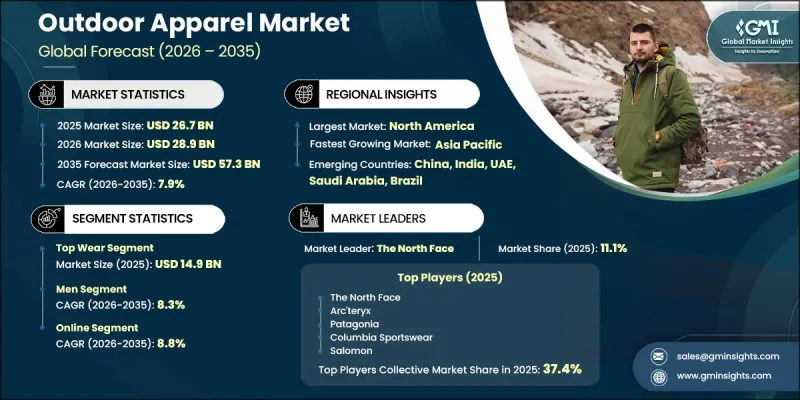
Market expansion is driven by rising consumer engagement in outdoor recreation activities and a growing emphasis on health, fitness, and overall well-being. Activities such as hiking, trekking, camping, and other adventure-based pursuits are becoming increasingly mainstream, which is strengthening demand for durable, high-performance outdoor clothing. Continuous advancements in fabric technologies are also playing a crucial role, with innovations in waterproofing, wind resistance, and breathability significantly enhancing product functionality and aligning with consumer expectations for performance-oriented apparel. In addition, urbanization and evolving lifestyle patterns are encouraging more individuals to participate in outdoor activities, further supporting market growth. Digital influence through social media platforms is also shaping consumer behavior, as exposure to outdoor lifestyles and adventure content is increasing interest in outdoor apparel. Rising disposable incomes, particularly in developing economies, are expanding access to premium outdoor clothing. Sustainability trends are further reshaping the industry, with increasing consumer preference for environmentally responsible products pushing manufacturers toward recycled materials and low-impact production methods, strengthening long-term differentiation strategies.
| Market Scope | |
|---|---|
| Start Year | 2025 |
| Forecast Year | 2026-2035 |
| Start Value | $26.7 Billion |
| Forecast Value | $57.3 Billion |
| CAGR | 7.9% |
The top wear segment generated USD 14.9 billion in 2025 and is projected to grow at a CAGR of 7.7% during 2026-2035. Growth in this segment is strongly supported by rising consumer demand for versatile and durable upper-body outdoor clothing designed to perform under diverse weather conditions. Increasing participation in outdoor activities such as hiking, trekking, and camping continues to drive demand for protective and functional top wear. Additionally, advancements in textile engineering, including moisture management and rapid-drying capabilities, have significantly improved comfort and performance, further supporting segment expansion.
The men's segment held a 50.5% share and is expected to grow at a CAGR of 8.3% from 2026 to 2035. The segment's growth is supported by rising disposable income levels and increasing participation of male consumers in outdoor recreational activities. Expanding interest in hiking, trekking, and camping continues to drive consistent demand for functional outdoor apparel among men. Additionally, growing attention to personal style and fashion-oriented outdoor clothing choices is further contributing to segment expansion.
United States Outdoor Apparel Market held an 83% share, generating USD 9.6 billion in 2025. Market demand in the country is influenced by varied climatic conditions that shape regional purchasing behavior for outdoor clothing. Strong sales are observed in regions with active outdoor cultures, where participation in hiking, skiing, and camping remains high. In addition, increasing consumer preference for environmentally sustainable and responsibly sourced apparel is becoming more prominent, reflecting rising awareness of ecological impact among American consumers.
Key companies operating in the Global Outdoor Apparel Industry include Patagonia, Columbia Sportswear, The North Face, Arc'teryx, Salomon, Black Diamond, Mammut, Mountain Hardwear, Outdoor Research, Rab, KUHL, Cotopaxi, Picture Organic Clothing, Westcomb, Bergans, Descente, Haglofs, Montbell, Norrona, Schoffel, and Vaude. Companies in the outdoor apparel market are increasingly focusing on product innovation centered on high-performance and weather-adaptive fabrics that enhance durability, comfort, and protection. A major strategy involves investing in advanced textile technologies such as moisture control, thermal regulation, and lightweight insulation to improve user experience. Brands are also expanding their sustainability initiatives by incorporating recycled fibers, reducing carbon emissions, and adopting circular production models to meet rising environmental expectations. Another key approach includes strengthening direct-to-consumer distribution channels and digital retail platforms to improve brand reach and customer engagement. Companies are further leveraging lifestyle branding and outdoor community marketing to build stronger emotional connections with consumers. Strategic collaborations with athletes, influencers, and outdoor organizations are also being used to enhance brand visibility.
Table of Contents
Chapter 1 Methodology and scope
- 1.1 Research approach
- 1.2 Quality Commitments
- 1.2.1 GMI AI policy & data integrity commitment
- 1.2.1.1 Source consistency protocol
- 1.2.1 GMI AI policy & data integrity commitment
- 1.3 Research Trail & Confidence Scoring
- 1.3.1 Research Trail Components
- 1.3.2 Scoring Components
- 1.4 Data Collection
- 1.4.1 Partial list of primary sources
- 1.5 Data mining sources
- 1.5.1 Paid sources
- 1.5.1.1 Sources, by region
- 1.5.1 Paid sources
- 1.6 Base estimates and calculations
- 1.6.1 Base year calculation for any one approach
- 1.7 Forecast model
- 1.7.1 Quantified market impact analysis
- 1.7.1.1 Mathematical impact of growth parameters on forecast
- 1.7.1 Quantified market impact analysis
- 1.8 Research transparency addendum
- 1.8.1 Source attribution framework
- 1.8.2 Quality assurance metrics
- 1.8.3 Our commitment to trust
Chapter 2 Executive summary
- 2.1 Industry 360° synopsis
- 2.2 Key market trends
- 2.2.1 Regional
- 2.2.2 Product type
- 2.2.3 Material
- 2.2.4 Consumer group
- 2.2.5 Price
- 2.2.6 Distribution channel
Chapter 3 Industry insights
- 3.1 Industry ecosystem analysis
- 3.1.1 Supplier landscape
- 3.1.2 Profit margin
- 3.1.3 Value addition at each stage
- 3.1.4 Factor affecting the value chain
- 3.1.5 Disruptions
- 3.2 Industry impact forces
- 3.2.1 Growth drivers
- 3.2.2 Industry pitfalls & challenges
- 3.2.3 Opportunities
- 3.3 Growth potential analysis
- 3.4 Price trends
- 3.4.1 Historical price trend analysis
- 3.4.2 Pricing strategy by player type
- 3.5 Regulatory framework
- 3.5.1 PFAS regulation: comprehensive geographic analysis
- 3.5.2 United States: federal and state-level PFAS framework
- 3.5.3 European Union: REACH regulation and PFAS universal restriction proposal
- 3.5.4 United Kingdom: post-Brexit chemical regulation (UK REACH)
- 3.5.5 Japan, South Korea, China: PFAS policy trajectories
- 3.5.6 DWR (durable water repellent) chemical regulation
- 3.5.7 EU Green Deal & extended producer responsibility (EPR) for textiles
- 3.5.8 Microplastic and fiber shedding regulation
- 3.6 Porter's five forces analysis
- 3.7 PESTEL analysis
- 3.8 Trade data analysis (based on paid database) (HS Code: 6109)
- 3.8.1 Import/export volume & value trends
- 3.8.2 Key trade corridors & tariff impact
- 3.9 Impact of AI & generative AI on the market
- 3.9.1 AI-driven disruption of traditional business models
- 3.9.2 GenAI use cases & adoption roadmap by customer segment
- 3.9.3 Risks, limitations & regulatory considerations
- 3.10 Future market trends
- 3.11 Technology and innovation landscape
- 3.11.1 Current technological trends
- 3.11.2 Emerging technologies
- 3.12 Consumer behavior analysis
- 3.12.1 Purchasing patterns
- 3.12.2 Preference analysis
- 3.12.3 Regional variations in consumer behavior
- 3.12.4 Impact of e-commerce on buying decisions
Chapter 4 Competitive landscape, 2025
- 4.1 Introduction
- 4.2 Company market share analysis
- 4.2.1 North America
- 4.2.2 Europe
- 4.2.3 Asia Pacific
- 4.2.4 Latin America
- 4.2.5 MEA
- 4.3 Company matrix analysis
- 4.4 Competitive analysis of major market players
- 4.5 Competitive positioning matrix
- 4.6 Key developments
- 4.6.1 Mergers & acquisitions
- 4.6.2 Partnerships & collaborations
- 4.6.3 New product launches
- 4.6.4 Expansion plans
Chapter 5 Market Estimates & Forecast, By Product Type, 2022 - 2035 ($Billion, Million Units)
- 5.1 Key trends
- 5.2 Top wear
- 5.2.1 T-shirts
- 5.2.2 Jackets
- 5.2.3 Vests
- 5.2.4 Others (neck gaiters, balaclavas etc.)
- 5.3 Bottom wear
- 5.3.1 Pants
- 5.3.2 Shorts
- 5.3.3 Trousers
- 5.3.4 Leggings
- 5.3.5 Others (ski bibs etc.)
- 5.4 Other accessories
Chapter 6 Market Estimates & Forecast, By Material, 2022 - 2035 ($Billion, Million Units)
- 6.1 Key trends
- 6.2 Synthetic fabrics
- 6.2.1 Polyester
- 6.2.2 Nylon
- 6.3 Natural fabrics
- 6.3.1 Cotton fabrics
- 6.3.2 Hemp
- 6.3.3 Bamboo
- 6.3.4 Wool
Chapter 7 Market Estimates & Forecast, By Consumer Group, 2022 - 2035 ($Billion, Million Units)
- 7.1 Key trends
- 7.2 Men
- 7.3 Women
- 7.4 Kids
Chapter 8 Market Estimates & Forecast, By Price, 2022 - 2035 ($Billion, Million Units)
- 8.1 Key trends
- 8.2 Low (below USD 200)
- 8.3 Medium (USD 200 - USD 500)
- 8.4 High (USD 500 and above)
Chapter 9 Market Estimates & Forecast, By Distribution Channel, 2022 - 2035 ($Billion, Million Units)
- 9.1 Key trends
- 9.2 Online
- 9.2.1 E-commerce
- 9.2.2 Company websites
- 9.3 Offline
- 9.3.1 Supermarkets/Hypermarkets
- 9.3.2 Specialty retail stores
- 9.3.3 Others (independent retailers, etc.)
Chapter 10 Market Estimates & Forecast, By Region, 2022 - 2035 ($Billion, Million Units)
- 10.1 Key trends
- 10.2 North America
- 10.2.1 U.S.
- 10.2.2 Canada
- 10.3 Europe
- 10.3.1 Germany
- 10.3.2 UK
- 10.3.3 France
- 10.3.4 Spain
- 10.3.5 Italy
- 10.3.6 Netherlands
- 10.4 Asia Pacific
- 10.4.1 China
- 10.4.2 Japan
- 10.4.3 India
- 10.4.4 Australia
- 10.4.5 South Korea
- 10.5 Latin America
- 10.5.1 Brazil
- 10.5.2 Mexico
- 10.5.3 Argentina
- 10.6 MEA
- 10.6.1 South Africa
- 10.6.2 Saudi Arabia
- 10.6.3 UAE
Chapter 11 Company Profiles
- 11.1 Global Key Players
- 11.1.1 Arc'teryx
- 11.1.2 Black Diamond
- 11.1.3 Columbia Sportswear
- 11.1.4 Mammut
- 11.1.5 Patagonia
- 11.1.6 Salomon
- 11.1.7 The North Face
- 11.2 Regional Players
- 11.2.1 Bergans
- 11.2.2 Descente
- 11.2.3 Haglofs
- 11.2.4 Montbell
- 11.2.5 Norrøna
- 11.2.6 Schoffel
- 11.2.7 Vaude
- 11.3 Emerging/Niche Specialists
- 11.3.1 Cotopaxi
- 11.3.2 Kuhl
- 11.3.3 Mountain Hardwear
- 11.3.4 Outdoor Research
- 11.3.5 Picture Organic Clothing
- 11.3.6 Rab
- 11.3.7 Westcomb

