PUBLISHER: Global Market Insights Inc. | PRODUCT CODE: 2061369

PUBLISHER: Global Market Insights Inc. | PRODUCT CODE: 2061369
Musical Instruments Market Opportunity, Growth Drivers, Industry Trend Analysis, and Forecast 2026 - 2035
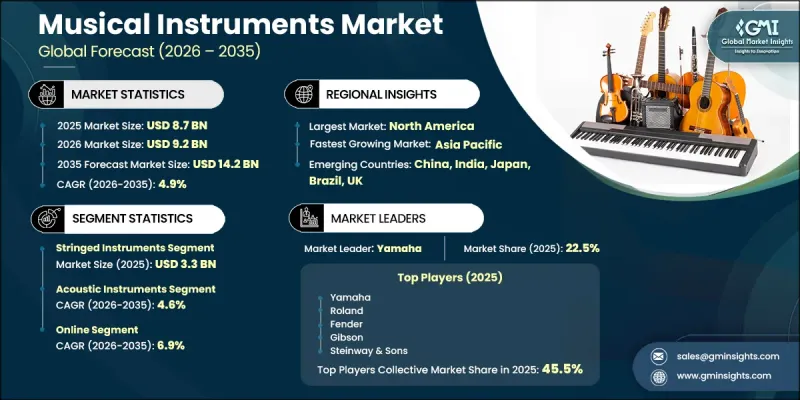
The Global Musical Instruments Market was valued at USD 8.7 billion in 2025 and is estimated to grow at a CAGR of 4.9% to reach USD 14.2 billion by 2035.
Rising disposable income levels and the growing popularity of music education programs are playing a major role in supporting market expansion worldwide. Consumers are increasingly spending on recreational and creative activities, including music learning and instrument purchases, as living standards continue to improve across developed and developing economies. Educational institutions and private music academies are also placing greater emphasis on music training as part of skill development and extracurricular learning, which is contributing to stronger adoption of musical instruments among students and hobbyists. In addition, the increasing popularity of live entertainment, music festivals, and performance events continues to generate demand for high-quality musical equipment. Digital platforms and social media channels are also influencing market growth by encouraging aspiring musicians to showcase their talent and engage with broader audiences. Technological innovation remains another key growth factor, with manufacturers introducing advanced electronic instruments, smart connectivity features, and enhanced sound technologies to improve user experience and product functionality across professional and amateur music segments.
| Market Scope | |
|---|---|
| Start Year | 2025 |
| Forecast Year | 2026-2035 |
| Start Value | $8.7 Billion |
| Forecast Value | $14.2 Billion |
| CAGR | 4.9% |
The stringed instruments segment generated USD 3.3 billion in 2025 and is expected to grow at a CAGR of 5.1% during 2026-2035. Strong consumer interest in guitars, violins, and related string-based instruments continues to support segment expansion. The growing popularity of live performances, online music tutorials, and music learning programs is encouraging more consumers to invest in string instruments. Technological advancements, improved product accessibility, and the availability of instruments across different price ranges are also contributing to increased adoption among beginners and professional musicians.
The online sales segment is expected to register a CAGR of 6.9% from 2026 to 2035. Online distribution channels are gaining significant traction due to the convenience and accessibility they offer consumers. E-commerce platforms provide a wide selection of products, detailed specifications, customer reviews, competitive pricing, and convenient delivery services, making online purchasing increasingly attractive to music enthusiasts and professional buyers alike.
United States Musical Instruments Market accounted for 87% share and generated USD 2.6 billion in 2025. Market growth in the country is being supported by increasing consumer participation in music-related leisure activities and a stronger interest in music education programs. The growing popularity of live performances and entertainment events is further driving demand for musical instruments across the region. In addition, rising investments in school-based music programs, community learning initiatives, and virtual music education platforms are contributing to sustained market expansion across the country.
Major companies operating in the Global Musical Instruments Market include Yamaha, Fender Musical Instruments, Gibson Brands, Roland, Steinway & Sons, Kawai Musical Instruments, Conn-Selmer, Taylor Guitars, Zildjian, PRS Guitars, Peavey Electronics, ESP Guitar, Buffet Crampon, Sabian Cymbals, Moog Music, Arturia, Teenage Engineering, Neural DSP Technologies, Strandberg Guitars, Reverend Guitars, and Victory Amplification. Companies operating in the Musical Instruments Market are adopting several strategies to strengthen their competitive position and expand their customer base. Product innovation remains a major focus area, with manufacturers introducing technologically advanced instruments featuring smart connectivity, digital integration, and enhanced sound capabilities. Businesses are also expanding product portfolios across entry-level, professional, and premium categories to address a broader range of consumer preferences. Companies are increasingly utilizing e-commerce platforms and direct-to-consumer sales models to improve market reach and customer engagement. Strategic partnerships with music schools, artists, influencers, and entertainment platforms are helping brands increase visibility and strengthen brand loyalty.
Table of Contents
Chapter 1 Methodology and scope
- 1.1 Research approach
- 1.2 Quality Commitments
- 1.2.1 GMI AI policy & data integrity commitment
- 1.2.1.1 Source consistency protocol
- 1.2.1 GMI AI policy & data integrity commitment
- 1.3 Research Trail & Confidence Scoring
- 1.3.1 Research Trail Components
- 1.3.2 Scoring Components
- 1.4 Data Collection
- 1.4.1 Partial list of primary sources
- 1.5 Data mining sources
- 1.5.1 Paid sources
- 1.5.1.1 Sources, by region
- 1.5.1 Paid sources
- 1.6 Base estimates and calculations
- 1.6.1 Base year calculation for any one approach
- 1.7 Forecast model
- 1.7.1 Quantified market impact analysis
- 1.7.1.1 Mathematical impact of growth parameters on forecast
- 1.7.1 Quantified market impact analysis
- 1.8 Research transparency addendum
- 1.8.1 Source attribution framework
- 1.8.2 Quality assurance metrics
- 1.8.3 Our commitment to trust
Chapter 2 Executive summary
- 2.1 Industry 360° synopsis
- 2.2 Key market trends
- 2.2.1 Regional
- 2.2.2 By product type
- 2.2.3 By technology type
- 2.2.4 By end users
- 2.2.5 By price range
- 2.2.6 By distribution channel
Chapter 3 Industry insights
- 3.1 Industry ecosystem analysis
- 3.1.1 Supplier landscape
- 3.1.2 Profit margin
- 3.1.3 Value addition at each stage
- 3.1.4 Factor affecting the value chain
- 3.1.5 Disruptions
- 3.2 Industry impact forces
- 3.2.1 Growth drivers
- 3.2.2 Industry pitfalls & challenges
- 3.2.3 Opportunities
- 3.3 Growth potential analysis
- 3.4 Porter's five forces analysis
- 3.5 PESTEL analysis
- 3.6 Future market trends
- 3.7 Technology and innovation landscape
- 3.7.1 Current technological trends
- 3.7.2 Emerging technologies
- 3.8 Price trends
- 3.8.1 Historical price trend analysis
- 3.8.2 Pricing strategy by player type
- 3.9 Regulatory framework
- 3.9.1 CITES Regulations for Endangered Wood Species
- 3.9.2 Environmental Compliance & Sustainability Standards
- 3.9.3 Product Safety & Quality Standards (ISO, CE, UL)
- 3.9.4 Import/Export Regulations & Tariffs
- 3.10 Trade Data Analysis (HS Code: 9207)
- 3.10.1 Import/Export Volume & Value Trends
- 3.10.2 Key Trade Corridors & Tariff Impact
- 3.10.3 Regional Trade Balance Analysis
- 3.11 Impact of AI & Generative AI on the market
- 3.11.1 AI-driven disruption of traditional business models
- 3.11.2 GenAI use cases & adoption roadmap by customer segment
- 3.11.3 Risks, limitations & regulatory considerations
- 3.11.4 AI-enabled smart home ecosystem integration
- 3.12 Consumer behavior analysis
- 3.12.1 Purchasing patterns
- 3.12.2 Preference analysis
- 3.12.3 Regional variations in consumer behavior
- 3.12.4 Impact of e-commerce on buying decisions
Chapter 4 Competitive landscape, 2025
- 4.1 Introduction
- 4.2 Company market share analysis
- 4.2.1 North America
- 4.2.2 Europe
- 4.2.3 Asia Pacific
- 4.2.4 Latin America
- 4.2.5 MEA
- 4.3 Company matrix analysis
- 4.4 Competitive analysis of major market players
- 4.5 Competitive positioning matrix
- 4.6 Key developments
- 4.6.1 Mergers & acquisitions
- 4.6.2 Partnerships & collaborations
- 4.6.3 New product launches
- 4.6.4 Expansion plans
Chapter 5 Market Estimates & Forecast, By Product Type, 2022 - 2035 ($Billion, Thousand Units)
- 5.1 Key trends
- 5.2 Stringed instruments
- 5.2.1 Bowed strings
- 5.2.2 Plucked strings
- 5.2.3 Plucked strings
- 5.3 Wind instruments (brass & woodwind)
- 5.3.1 Brass instruments
- 5.3.2 Woodwind
- 5.4 Percussion instruments
- 5.4.1 Pitched percussion
- 5.4.2 Unpitched percussion
- 5.5 Keyboard instruments
- 5.5.1 Acoustic pianos
- 5.5.2 Organs
- 5.5.3 Accordions
Chapter 6 Market Estimates & Forecast, By Technology Type, 2022 - 2035 ($Billion, Thousand Units)
- 6.1 Key trends
- 6.2 Acoustic instruments
- 6.3 Electric/amplified instruments
- 6.4 Electronic/digital instruments
- 6.5 Hybrid instruments
Chapter 7 Market Estimates & Forecast, By End Users, 2022 - 2035 ($Billion, Thousand Units)
- 7.1 Key trends
- 7.2 Professional musicians
- 7.3 Educational institutions
- 7.4 Hobbyists & recreational users
Chapter 8 Market Estimates & Forecast, By Price Range, 2022 - 2035 ($Billion, Thousand Units)
- 8.1 Key trends
- 8.2 Low (under USD 1,000)
- 8.3 Medium (USD 1,000 - USD 2,999)
- 8.4 High (USD 3,000 - USD 5,999)
- 8.5 Premium (USD 6,000 and above)
Chapter 9 Market Estimates & Forecast, By Distribution Channel, 2022 - 2035 ($Billion, Thousand Units)
- 9.1 Key trends
- 9.2 Online
- 9.2.1 E-commerce
- 9.2.2 Company websites
- 9.3 Offline
- 9.3.1 Supermarkets/hypermarket
- 9.3.2 Specialty retail stores
- 9.3.3 Others (independent retailer etc.)
Chapter 10 Market Estimates & Forecast, By Region, 2022 - 2035 ($Billion, Thousand Units)
- 10.1 Key trends
- 10.2 North America
- 10.2.1 U.S.
- 10.2.2 Canada
- 10.3 Europe
- 10.3.1 Germany
- 10.3.2 UK
- 10.3.3 France
- 10.3.4 Spain
- 10.3.5 Italy
- 10.3.6 Netherlands
- 10.4 Asia Pacific
- 10.4.1 China
- 10.4.2 Japan
- 10.4.3 India
- 10.4.4 Australia
- 10.4.5 South Korea
- 10.5 Latin America
- 10.5.1 Brazil
- 10.5.2 Mexico
- 10.5.3 Argentina
- 10.6 MEA
- 10.6.1 South Africa
- 10.6.2 Saudi Arabia
- 10.6.3 UAE
Chapter 11 Company Profiles
- 11.1 Global Key Players
- 11.1.1 Conn-Selmer
- 11.1.2 Fender Musical Instruments
- 11.1.3 Gibson Brands
- 11.1.4 Kawai Musical Instruments
- 11.1.5 Roland
- 11.1.6 Steinway & Sons
- 11.1.7 Yamaha
- 11.2 Regional Players
- 11.2.1 Buffet Crampon
- 11.2.2 ESP Guitar
- 11.2.3 Peavey Electronics
- 11.2.4 PRS Guitars
- 11.2.5 Sabian Cymbals
- 11.2.6 Taylor Guitars
- 11.2.7 Zildjian
- 11.3 Emerging/Niche Specialists
- 11.3.1 Arturia
- 11.3.2 Moog Music
- 11.3.3 Neural DSP Technologies
- 11.3.4 Reverend Guitars
- 11.3.5 Strandberg Guitars
- 11.3.6 Teenage Engineering
- 11.3.7 Victory Amplification

