PUBLISHER: Global Market Insights Inc. | PRODUCT CODE: 2061383

PUBLISHER: Global Market Insights Inc. | PRODUCT CODE: 2061383
Automotive Semiconductor Market Opportunity, Growth Drivers, Industry Trend Analysis, and Forecast 2026 - 2035
The Global Automotive Semiconductor Market was valued at USD 79.7 billion in 2025 and is estimated to grow at a CAGR of 8.6% to reach USD 180.2 billion by 2035.
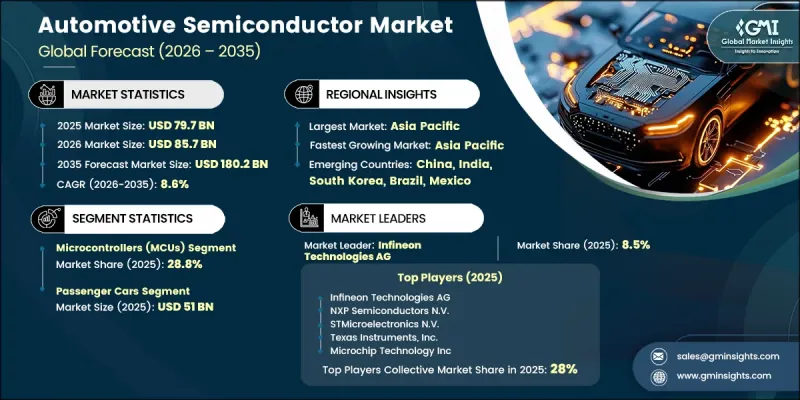
The market is witnessing strong expansion due to the accelerating shift toward electric vehicles, increasing integration of advanced driver assistance systems, and rising adoption of software-defined and connected vehicle architectures. Growing regulatory pressure related to safety and emissions is also increasing semiconductor content per vehicle. In addition, advancements in autonomous driving technologies are significantly boosting demand for high-performance electronic components. The transition toward electrified mobility is driving strong requirements for power and control semiconductors, while expanding vehicle intelligence is increasing reliance on sensors, processors, and memory solutions. As modern vehicles evolve into highly connected digital platforms, semiconductor integration is becoming a core enabler of automotive innovation. Continuous improvements in chip efficiency, computing performance, and system miniaturization are further strengthening adoption across vehicle categories. Rising consumer expectations for safety, connectivity, and enhanced driving experience are also contributing to sustained market growth across global automotive ecosystems.
| Market Scope | |
|---|---|
| Start Year | 2025 |
| Forecast Year | 2026-2035 |
| Start Value | $79.7 Billion |
| Forecast Value | $180.2 Billion |
| CAGR | 8.6% |
The sensors segment is projected to grow at a CAGR of 10.9% during 2035, supported by rising integration of advanced sensing technologies used for environmental awareness, safety enhancement, and vehicle performance optimization. Increasing deployment of radar, LiDAR, and camera-based systems is significantly driving sensor adoption in modern vehicles. Growing emphasis on real-time data processing and improved situational awareness is further accelerating demand for automotive sensing solutions across next-generation mobility platforms.
The passenger cars segment reached USD 51 billion in 2025. This dominance is driven by high production volumes and extensive use of semiconductor technologies across infotainment systems, safety functions, and body electronics. Increasing consumer preference for connected, intelligent, and feature-rich vehicles is further boosting semiconductor integration. The rising adoption of advanced electronic systems in passenger vehicles continues to reinforce this segment's leading position in the automotive semiconductor landscape.
North America Automotive Semiconductor Market accounted for 26.6% share in 2025. The region's growth is supported by strong demand for advanced vehicle electronics and high-performance computing systems in modern automobiles. Increasing adoption of premium and technologically advanced vehicles is driving the need for processors, sensors, and memory components. Strong research and development capabilities, along with the presence of leading technology and automotive players, are further supporting semiconductor innovation and deployment across the region.
Key companies operating in the Global Automotive Semiconductor Market include Infineon Technologies AG, NXP Semiconductors N.V., STMicroelectronics N.V., Texas Instruments, Inc., Renesas Electronics Corporation, Onsemi, Analog Devices, Inc., Microchip Technology Inc., Robert Bosch GmbH, Robert Bosch GmbH, Micron Technology, Rohm Co., Ltd., Toshiba, Allegro Microsystems, Advanced Micro Devices, Melexis N.V., Continental, TE Connectivity, Tower Semiconductor Ltd., and ZF Friedrichshafen AG. Companies in the automotive semiconductor market are focusing on strengthening their competitive position through continuous innovation in high-performance, energy-efficient chip architectures tailored for electric and autonomous vehicles. A key strategy includes expanding investment in research and development to enhance processing power, reduce energy consumption, and improve system integration across automotive platforms. Market players are also forming strategic collaborations with automakers and Tier-1 suppliers to co-develop advanced semiconductor solutions for next-generation mobility systems. In addition, companies are expanding production capacity and strengthening supply chain resilience to meet rising global demand. Geographic expansion into high-growth automotive markets is also a major focus area. sac
Table of Contents
Chapter 1 Methodology and Scope
- 1.1 Market scope and definition
- 1.2 Research design
- 1.2.1 Research approach
- 1.2.2 Data collection methods
- 1.3 Data mining sources
- 1.3.1 Global
- 1.3.2 Regional/Country
- 1.4 Base estimates and calculations
- 1.4.1 Base year calculation
- 1.4.2 Key trends for market estimation
- 1.5 Primary research and validation
- 1.5.1 Primary sources
- 1.6 Forecast model
- 1.7 Research assumptions and limitations
Chapter 2 Executive Summary
- 2.1 Industry 360° synopsis, 2022 - 2035
- 2.2 Key market trends
- 2.2.1 Component type trends
- 2.2.2 Vehicle type trends
- 2.2.3 Application trends
- 2.2.4 Sales Channel trends
- 2.2.5 Regional trends
- 2.3 TAM Analysis, 2026-2035
- 2.4 CXO perspectives: Strategic imperatives
Chapter 3 Industry Insights
- 3.1 Industry ecosystem analysis
- 3.1.1 Supplier Landscape
- 3.1.2 Profit Margin
- 3.1.3 Cost structure
- 3.1.4 Value addition at each stage
- 3.1.5 Factor affecting the value chain
- 3.1.6 Disruptions
- 3.2 Industry impact forces
- 3.2.1 Growth drivers
- 3.2.1.1 Rapid electrification of vehicles (EV adoption)
- 3.2.1.2 Rising integration of advanced driver assistance systems (ADAS)
- 3.2.1.3 Growing vehicle connectivity and software-defined vehicle architecture
- 3.2.1.4 Increasing government regulations on vehicle safety and emissions
- 3.2.1.5 Advancements in autonomous and semi-autonomous driving technologies
- 3.2.2 Industry pitfalls and challenges
- 3.2.2.1 High dependence on complex semiconductor supply chains
- 3.2.2.2 Stringent automotive-grade qualification and reliability requirements
- 3.2.3 Market opportunities
- 3.2.3.1 Emergence of automotive-specific semiconductor fabs and capacity expansion
- 3.2.3.2 Integration of AI at the edge for in-vehicle computing
- 3.2.1 Growth drivers
- 3.3 Growth potential analysis
- 3.4 Regulatory landscape
- 3.4.1 North America
- 3.4.2 Europe
- 3.4.3 Asia Pacific
- 3.4.4 Latin America
- 3.4.5 Middle East & Africa
- 3.5 Porter's analysis
- 3.6 PESTEL analysis
- 3.7 Technology and Innovation landscape
- 3.7.1 Current technological trends
- 3.7.2 Emerging technologies
- 3.8 Price trends
- 3.8.1 By region
- 3.8.2 By product
- 3.9 Pricing Strategies
- 3.10 Emerging Business Models
- 3.11 Compliance Requirements
- 3.12 Patent and IP analysis
Chapter 4 Competitive Landscape, 2025
- 4.1 Introduction
- 4.2 Company market share analysis
- 4.2.1 By region
- 4.2.1.1 North America
- 4.2.1.2 Europe
- 4.2.1.3 Asia Pacific
- 4.2.1.4 Latin America
- 4.2.1.5 Middle East & Africa
- 4.2.2 Market concentration analysis
- 4.2.1 By region
- 4.3 Competitive benchmarking of key players
- 4.3.1 Financial performance comparison
- 4.3.1.1 Revenue
- 4.3.1.2 Profit margin
- 4.3.1.3 R&D
- 4.3.2 Product portfolio comparison
- 4.3.2.1 Product range breadth
- 4.3.2.2 Technology
- 4.3.2.3 Innovation
- 4.3.3 Geographic presence comparison
- 4.3.3.1 Global footprint analysis
- 4.3.3.2 Service network coverage
- 4.3.3.3 Market penetration by region
- 4.3.4 Competitive positioning matrix
- 4.3.4.1 Leaders
- 4.3.4.2 Challengers
- 4.3.4.3 Followers
- 4.3.4.4 Niche players
- 4.3.5 Strategic outlook matrix
- 4.3.1 Financial performance comparison
- 4.4 Key developments
- 4.4.1 Mergers and acquisitions
- 4.4.2 Partnerships and collaborations
- 4.4.3 Technological advancements
- 4.4.4 Expansion and investment strategies
- 4.4.5 Digital transformation initiatives
- 4.5 Emerging/ startup competitors landscape
Chapter 5 Market Estimates and Forecast, By Component Type, 2022 - 2035 (USD Billion & Units)
- 5.1 Key trends
- 5.2 Microcontrollers (MCUs)
- 5.3 Sensors
- 5.4 Power semiconductors
- 5.5 Memory
- 5.6 Analog & mixed-signal ICs
- 5.7 Others
Chapter 6 Market Estimates and Forecast, By Vehicle Type, 2022 - 2035 (USD & Billion & Units)
- 6.1 Key trends
- 6.2 Passenger cars
- 6.3 Light commercial vehicles (LCVs)
- 6.4 Heavy commercial vehicles (HCVs)
Chapter 7 Market Estimates and Forecast, By Application, 2022 - 2035 (USD Billion & Units)
- 7.1 Key trends
- 7.2 Powertrain & electrification
- 7.2.1 Engine control units (ECU)
- 7.2.2 Battery management systems (BMS)
- 7.2.3 Onboard chargers
- 7.2.4 Others
- 7.3 Safety Systems
- 7.3.1 Advanced driver assistance systems (ADAS)
- 7.3.2 Anti-lock braking systems (ABS)
- 7.3.3 Electronic stability control (ESC)
- 7.3.4 Others
- 7.4 Body Electronics
- 7.4.1 Door, seat & window control
- 7.4.2 Lighting (LED, Adaptive headlamps)
- 7.4.3 HVAC systems
- 7.4.4 Others
- 7.5 Chassis & suspension
- 7.5.1 Electric power steering (EPS)
- 7.5.2 Suspension control units
- 7.5.3 Others
- 7.6 Infotainment & telematics
- 7.6.1 Audio processing & amplifiers
- 7.6.2 GPS & navigation systems
- 7.6.3 Others
- 7.7 Others
Chapter 8 Market Estimates and Forecast, By Sales Channel, 2022 - 2035 (USD Billion & Units)
- 8.1 Key trends
- 8.2 OEMs
- 8.3 Aftermarket
Chapter 9 Market Estimates and Forecast, By Region, 2022 - 2035 (USD Billion & Units)
- 9.1 Key trends
- 9.2 North America
- 9.2.1 U.S.
- 9.2.2 Canada
- 9.3 Europe
- 9.3.1 Germany
- 9.3.2 UK
- 9.3.3 France
- 9.3.4 Spain
- 9.3.5 Italy
- 9.3.6 Russia
- 9.4 Asia Pacific
- 9.4.1 China
- 9.4.2 India
- 9.4.3 Japan
- 9.4.4 Australia
- 9.4.5 South Korea
- 9.5 Latin America
- 9.5.1 Brazil
- 9.5.2 Mexico
- 9.5.3 Argentina
- 9.6 Middle East and Africa
- 9.6.1 South Africa
- 9.6.2 Saudi Arabia
- 9.6.3 UAE
Chapter 10 Company Profiles
- 10.1 Global Key Players
- 10.1.1 Infineon Technologies AG
- 10.1.2 NXP Semiconductors N.V.
- 10.1.3 STMicroelectronics N.V.
- 10.1.4 Texas Instruments, Inc.
- 10.1.5 Microchip Technology Inc
- 10.2 Regional key players
- 10.2.1 North America
- 10.2.1.1 Analog Devices, Inc.
- 10.2.1.2 Advanced Micro Devices
- 10.2.1.3 Allegro Microsystems
- 10.2.1.4 Onsemi
- 10.2.2 Asia Pacific
- 10.2.2.1 Renesas Electronics Corporation
- 10.2.2.2 Rohm Co., Ltd.
- 10.2.2.3 Toshiba
- 10.2.2.4 Tower Semiconductor Ltd.
- 10.2.3 Europe
- 10.2.3.1 Continental
- 10.2.3.2 Melexis N.V.
- 10.2.3.3 Robert Bosch GmbH
- 10.2.3.4 ZF Friedrichshafen AG
- 10.2.3.5 TE Connectivity
- 10.2.1 North America
- 10.3 Niche Players/Disruptors
- 10.3.1 Micron Technology

