PUBLISHER: Global Market Insights Inc. | PRODUCT CODE: 2061384

PUBLISHER: Global Market Insights Inc. | PRODUCT CODE: 2061384
Suncare Products Market Opportunity, Growth Drivers, Industry Trend Analysis, and Forecast 2026 - 2035
The Global Suncare Products Market was valued at USD 16.6 billion in 2025 and is estimated to grow at a CAGR of 6.1% to reach USD 29.8 billion by 2035.
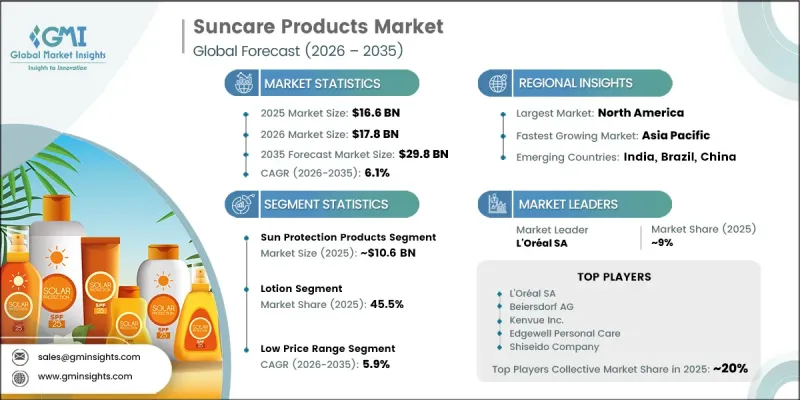
The market is experiencing steady growth as consumer awareness regarding the harmful effects of ultraviolet radiation and long-term skin damage continues to increase worldwide. Suncare products are increasingly becoming a daily skincare essential rather than a product used only during seasonal travel or outdoor activities. Growing concerns related to skin aging, pigmentation, and other sun-related skin conditions are encouraging consumers to incorporate sun protection products into their regular personal care routines. In addition, expanding interest in skincare and wellness trends is positively influencing market demand across multiple age groups. Rising participation in outdoor leisure activities and increased travel frequency are also supporting the adoption of advanced sun protection formulations. Consumers are increasingly seeking products that combine skincare benefits with effective UV protection, driving innovation in lightweight, hydrating, and multifunctional formulations. Furthermore, the growing popularity of active lifestyles and outdoor fitness activities is accelerating demand for high-performance products designed to offer long-lasting coverage, water resistance, and broad-spectrum protection across diverse environmental conditions.
| Market Scope | |
|---|---|
| Start Year | 2025 |
| Forecast Year | 2026-2035 |
| Start Value | $16.6 Billion |
| Forecast Value | $29.8 Billion |
| CAGR | 6.1% |
The sun protection products segment generated USD 10.6 billion in 2025 and is anticipated to grow at a CAGR of 6.3% between 2026 and 2035. This segment continues to maintain a dominant position within the suncare products market as awareness regarding the long-term effects of sun exposure continues to rise among consumers globally. Increasing emphasis on preventive skincare and daily UV protection is contributing to strong year-round demand for sunscreen and related protective products. In addition, ongoing educational initiatives and recommendations from skincare professionals are further strengthening consumer preference for sun protection solutions as part of regular skincare routines.
The lotion segment held 45.5% share in 2025, emerging as the leading product format within the suncare products industry. Lotion-based formulations remain highly preferred due to their ease of use, smooth application, and ability to provide even coverage across larger areas of the body. Consumers also favor lotions because of their moisturizing properties and comfortable skin feel, making them suitable for extended outdoor exposure and everyday use. Their versatility and convenience continue to support strong market demand across both individual and family-oriented consumer categories.
U.S. Suncare Products Market reached USD 4.7 billion in 2025, and is expected to grow at a CAGR of 5.7% from 2026 to 2035. The country continues to represent one of the most influential markets globally due to strong consumer understanding of sun protection benefits and rising demand for multifunctional skincare solutions containing SPF protection. Consumers in the U.S. are increasingly prioritizing lightweight textures, non-greasy formulations, and broad-spectrum coverage suitable for daily skincare use. Continuous product innovation, strong dermatologist influence, and the presence of established skincare brands are further supporting the country's leadership position within the regional market.
Major companies operating in the Suncare Products Market include L'Oreal, Beiersdorf AG, Johnson & Johnson Consumer Health, P&G, Shiseido Company, Unilever, Kao Corporation, Edgewell Personal Care, Estee Lauder Companies, Amorepacific Corporation, and Coty Inc., among global participants. Regional companies active in the industry include Pierre Fabre Group, ISDIN, Rohto Pharmaceutical, Lotus Herbals, Cancer Council, Grupo Boticario, and Genomma Lab Internacional. Emerging companies shaping the competitive landscape include Supergoop!, Sun Bum, Bondi Sands, and Coola LLC. Companies operating in the suncare products industry are implementing various strategic initiatives to strengthen their market position and expand consumer reach. Leading manufacturers are focusing on product innovation by introducing advanced formulations with multifunctional benefits, including hydration, anti-aging properties, and lightweight textures suitable for everyday use. Many companies are also investing in research and development to create mineral-based, reef-safe, and skin-sensitive formulations aligned with evolving consumer preferences. Strategic partnerships with skincare specialists, retailers, and digital platforms are helping brands improve visibility and market penetration. In addition, businesses are expanding their online sales channels and strengthening direct-to-consumer strategies to enhance customer engagement.
Table of Contents
Chapter 1 Methodology & Scope
- 1.1 Market scope & definitions
- 1.2 Research design
- 1.2.1 Research approach
- 1.2.2 Data collection methods
- 1.3 Base estimates and calculations
- 1.3.1 Base year calculation
- 1.3.2 Market estimates & forecasts parameters
- 1.4 Forecast Model
- 1.4.1 Key trends for market estimates
- 1.4.2 Quantified market impact analysis
- 1.4.2.1 Mathematical impact of growth parameters on forecast
- 1.4.3 Scenario analysis framework
- 1.5 Primary research and validation
- 1.5.1 Some of the primary sources (but not limited to)
- 1.6 Data mining sources
- 1.6.1 Paid Sources
- 1.7 Primary research and validation
- 1.7.1 Primary sources
- 1.8 Research Trail & confidence scoring
- 1.8.1 Research trail components
- 1.8.2 Scoring components
- 1.9 Research transparency addendum
- 1.9.1 Source attribution framework
- 1.9.2 Quality assurance metrics
- 1.9.3 Our commitment to trust
- 1.10 Market Definitions
Chapter 2 Executive Summary
- 2.1 Industry 360° synopsis
- 2.2 Key market trends
- 2.2.1 Region
- 2.2.2 Product type
- 2.2.3 Product formulation
- 2.2.4 Form
- 2.2.5 Price
- 2.2.6 Consumer group
- 2.2.7 Application
- 2.2.8 Distribution channel
Chapter 3 Industry Insights
- 3.1 Industry ecosystem analysis
- 3.1.1 Supplier landscape
- 3.1.2 Raw material suppliers
- 3.1.2.1 UV filter manufacturers
- 3.1.2.2 Emollient & moisturizer suppliers
- 3.1.2.3 Packaging material providers (tubes, bottles, pumps)
- 3.1.2.4 Fragrance & additive suppliers
- 3.1.3 Brand owners & product developers
- 3.1.4 Distribution & logistics layer
- 3.1.5 Retail & End-Channel partners
- 3.1.6 Value addition at each stage
- 3.1.7 Profit margin
- 3.1.8 Factor affecting the value chain
- 3.2 Industry impact forces
- 3.2.1 Growth drivers
- 3.2.1.1 Rising awareness of skin cancer & UV protection
- 3.2.1.2 Increasing outdoor recreational activities & tourism
- 3.2.1.3 Growing demand for multi-functional beauty products
- 3.2.2 Industry pitfalls & challenges
- 3.2.2.1 Stringent regulatory approval processes for new ingredients
- 3.2.2.2 Environmental concerns over chemical UV filters
- 3.2.3 Opportunities
- 3.2.3.1 Innovation in mineral & hybrid formulations
- 3.2.3.2 Blue light protection & anti-pollution product development
- 3.2.3.3 Sustainable & reef-safe sunscreen demand
- 3.2.1 Growth drivers
- 3.3 Growth potential analysis
- 3.4 Future market trends
- 3.5 Technology and innovation landscape
- 3.5.1 UV filter technology evolution
- 3.5.2 Formulation technology breakthroughs
- 3.5.3 Delivery system innovations
- 3.5.4 Multi-functional product development
- 3.5.5 Sustainability & clean beauty innovations
- 3.5.5.1 Reef-safe formulations
- 3.5.5.2 Biodegradable UV filters
- 3.5.5.3 Ocean-friendly packaging
- 3.5.5.4 Waterless formulations & concentrated formats
- 3.5.5.5 Vegan & cruelty-free certifications
- 3.5.6 Digital & smart suncare technologies
- 3.5.6.1 UV sensor wearables & skin patches
- 3.5.6.2 AI-powered skin analysis apps for SPF recommendations
- 3.5.7 Emerging technology frontiers
- 3.5.7.1 Ingestible sun protection (oral photoprotection)
- 3.5.7.2 Infrared (IR) radiation protection
- 3.5.7.3 DNA repair enzymes (photolyase integration)
- 3.5.7.4 Biomimetic melanin technology
- 3.6 Price trends
- 3.6.1 By product
- 3.6.2 Historical price trend analysis
- 3.6.3 Price pricing strategy by player type (premium / value / cost-plus)
- 3.6.4 Regional price variation analysis
- 3.7 Regulatory landscape
- 3.7.1 Global Regulatory Classification Systems
- 3.7.1.1 OTC Drug Classification (US, Canada, Australia)
- 3.7.1.2 Cosmetic Classification (EU, Most of Asia)
- 3.7.1.3 Quasi-Drug Classification (Japan, South Korea)
- 3.7.2 North America
- 3.7.2.1 US
- 3.7.2.1.1 Consumer Product Safety Commission (CPSC) 16 Code of Federal Regulations (CFR) part 1512
- 3.7.2.1.2 FDA OTC Monograph System (21 CFR 352)
- 3.7.2.1.3 GRASE (Generally Recognized as Safe & Effective) Status
- 3.7.2.1.4 New Ingredient Approval Pathway (SUNDIA Act Implications)
- 3.7.2.1.5 SPF Testing Requirements (FDA Final Rule 2011/2019)
- 3.7.2.1.6 Labeling & Claims Regulations (Broad Spectrum, Water Resistance)
- 3.7.2.1.7 State-Level Bans
- 3.7.2.2 Canada
- 3.7.2.2.1 International Organization for Standardization (ISO) 4210
- 3.7.2.2.2 NPN (Natural Product Number) Requirements
- 3.7.2.2.3 Pre-Market Authorization Process
- 3.7.2.2.4 SPF & UVA Testing Standards
- 3.7.2.1 US
- 3.7.3 Europe
- 3.7.3.1 EU Cosmetics Regulation (EC) No 1223/2009
- 3.7.3.2 Annex VI (Allowed UV Filters List)
- 3.7.3.3 Product Information File (PIF) Requirements
- 3.7.3.4 Germany: Deutsches Institut fur Normung (DIN) European Norm (EN) ISO 4210
- 3.7.3.5 UK
- 3.7.3.5.1 European Norm (EN) ISO 4210 / United Kingdom Conformity Assessed (UKCA)
- 3.7.3.5.2 UKCA Marking vs CE Marking Transition
- 3.7.3.5.3 UK Responsible Person Requirements
- 3.7.3.5.4 Divergence from EU Regulations
- 3.7.3.6 France: European Norm (EN) ISO 4210
- 3.7.4 Asia Pacific
- 3.7.4.1 China
- 3.7.4.1.1 Guobiao (GB) 3565
- 3.7.4.1.2 Import vs Domestic Product Registration Pathway
- 3.7.4.1.3 NMPA Registration Timeline (18-24 months)
- 3.7.4.1.4 Animal Testing Requirements & Exemptions
- 3.7.4.1.5 Hygienic License Requirements
- 3.7.4.1.6 New Ingredient Approval Process (IECIC List)
- 3.7.4.2 India: Indian Standard (IS) 10613
- 3.7.4.3 Japan
- 3.7.4.3.1 Japanese Industrial Standard (JIS) D 9110
- 3.7.4.3.2 Quasi-Drug Classification for Sunscreens
- 3.7.4.3.3 Approval Standards for Cosmetics/Quasi-Drugs
- 3.7.4.3.4 PA Rating System (Protection Grade of UVA)
- 3.7.4.3.5 Manufacturing & Import Licensing
- 3.7.4.4 South Korea
- 3.7.4.4.1 Functional Cosmetics Designation
- 3.7.4.4.2 Pre-Market vs Post-Market Notification
- 3.7.4.4.3 SPF & PA Testing Requirements
- 3.7.4.4.4 K-Beauty Export Certification
- 3.7.4.5 Australia
- 3.7.4.5.1 Therapeutic Goods (Sunscreens) Order 2022
- 3.7.4.5.2 ARTG (Australian Register of Therapeutic Goods) Listing
- 3.7.4.5.3 SPF & Broad Spectrum Testing (AS/NZS 2604)
- 3.7.4.5.4 Primary vs Secondary Sunscreen Classification
- 3.7.4.5.5 Mandatory Cancer Council Endorsement for Claims
- 3.7.4.1 China
- 3.7.5 Latin America
- 3.7.5.1 Brazil
- 3.7.5.1.1 Associacao Brasileira de Normas Tecnicas (ABNT) Norma Brasileira (NBR) ISO 4210
- 3.7.5.1.2 RDC 69/2016 (Sunscreen Product Technical Regulation)
- 3.7.5.1.3 Pre-Market Notification (Form 1) vs Registration
- 3.7.5.2 Mexico
- 3.7.5.2.1 International Organization for Standardization (ISO) 4210
- 3.7.5.2.2 Sanitary Registration Requirements
- 3.7.5.2.3 COFEPRIS Pre-Market Approval Timeline
- 3.7.5.2.4 Labeling Requirements (Spanish Language)
- 3.7.5.3 Argentina (ANMAT Regulation)
- 3.7.5.1 Brazil
- 3.7.6 Middle East & Africa
- 3.7.6.1 UAE
- 3.7.6.1.1 Cosmetic Product Registration Certificate
- 3.7.6.1.2 GCC Standardization Organization (GSO) Alignment
- 3.7.6.1.3 Halal Certification for Certain Ingredients
- 3.7.6.2 South Africa: South African National Standard (SANS) 311
- 3.7.6.3 Saudi Arabia: Saudi Standards, Metrology and Quality Organization (SASO) Gulf Standardization Organization (GSO) ISO 4210
- 3.7.6.1 UAE
- 3.7.1 Global Regulatory Classification Systems
- 3.8 Supply chain analysis
- 3.8.1 Raw material sourcing landscape
- 3.8.2 Manufacturing footprint
- 3.8.3 Logistics & distribution networks
- 3.8.4 Supply chain resilience & risk factors
- 3.8.5 Supply chain sustainability initiatives
- 3.9 Trade statistics (HS code- 33049990)
- 3.9.1 Major importing countries
- 3.9.2 Major exporting countries
- 3.9.3 Import/export volume & value trends
- 3.9.4 Key trade corridors & tariff impact
- 3.10 Impact of AI & Generative AI on the Market
- 3.10.1 AI-driven disruption of existing business models
- 3.10.2 GenAI use cases & adoption roadmap by segment
- 3.10.2.1 Content generation for marketing (product descriptions, social media)
- 3.10.2.2 Customer service chatbots & virtual assistants
- 3.10.2.3 R&D acceleration (molecule discovery, formulation testing)
- 3.10.2.4 Supply chain optimization
- 3.10.3 Risks, limitations & regulatory considerations
- 3.11 Distribution infrastructure & channel penetration landscape (driven by primary research)
- 3.11.1 Channel coverage by region & format (modern vs. Traditional trade)
- 3.11.2 Last-mile infrastructure gaps & emerging channel shifts
- 3.12 Porter's analysis
- 3.13 PESTEL analysis
- 3.14 Consumer buying behaviour analysis
- 3.14.1 Purchase Decision-Making Process
- 3.14.2 Demographic trends
- 3.14.3 Factors affecting buying decisions
- 3.14.4 Consumer product adoption
- 3.14.5 Preferred distribution channel
- 3.14.6 Brand preference
Chapter 4 Competitive Landscape, 2025
- 4.1 Introduction
- 4.2 Company market share analysis
- 4.2.1 By Region
- 4.2.1.1 North America
- 4.2.1.2 Europe
- 4.2.1.3 Asia Pacific
- 4.2.1.4 Latin America
- 4.2.1.5 Middle East & Africa
- 4.2.1 By Region
- 4.3 Company matrix analysis
- 4.4 Competitive analysis of major market players
- 4.5 Competitive positioning matrix
- 4.6 Key developments
- 4.6.1 Mergers & acquisitions
- 4.6.2 Partnerships & collaborations
- 4.6.3 New product launches
- 4.6.4 Expansion plans
Chapter 5 Market Estimates & Forecast, By Product Type, 2022 - 2035, (USD Billion) (Million Units)
- 5.1 Key trends
- 5.2 Sun protection products
- 5.2.1 Daily wear sunscreen (SPF 15-30)
- 5.2.2 High protection sunscreens (SPF 50+)
- 5.2.3 Tinted sunscreens & bb/cc creams with SPF
- 5.3 After sun products
- 5.3.1 Cooling gels & lotions
- 5.3.2 Repair & hydration treatments
- 5.3.3 Anti-aging after-sun care
- 5.4 Self-tanning products
- 5.4.1 Gradual tanners
- 5.4.2 Instant bronzers
- 5.4.3 Tanning mousses & sprays
- 5.5 Others
Chapter 6 Market Estimates & Forecast, By Product Formulation, 2022 - 2035, (USD Billion) (Million Units)
- 6.1 Key trends
- 6.2 Chemical sunscreens
- 6.3 Mineral sunscreens
- 6.4 Hybrid formulations
Chapter 7 Market Estimates & Forecast, By Form, 2022 - 2035, (USD Billion) (Million Units)
- 7.1 Key trends
- 7.2 Lotion
- 7.3 Spray
- 7.4 Gel
- 7.5 Stick
- 7.6 Others
Chapter 8 Market Estimates & Forecast, By Price, 2022 - 2035, (USD Billion) (Million Units)
- 8.1 Key trends
- 8.2 Low
- 8.3 Medium
- 8.4 High
Chapter 9 Market Estimates & Forecast, By Consumer Group, 2022 - 2035, (USD Billion) (Million Units)
- 9.1 Key trends
- 9.2 Men
- 9.3 Women
- 9.4 Kids
Chapter 10 Market Estimates & Forecast, By Application, 2022 - 2035, (USD Billion) (Million Units)
- 10.1 Key trends
- 10.2 Body
- 10.3 Face
- 10.4 Lip
Chapter 11 Market Estimates & Forecast, By Distribution Channel, 2022 - 2035, (USD Billion) (Million Units)
- 11.1 Key trends
- 11.2 Online
- 11.2.1 E-commerce websites
- 11.2.2 Company-owned websites
- 11.3 Offline
- 11.3.1 Hypermarkets & supermarkets
- 11.3.2 Specialty stores
- 11.3.3 Pharmacies & drugstores
- 11.3.4 Others
Chapter 12 Market Estimates & Forecast, By Region, 2022 - 2035, (USD Billion) (Million Units)
- 12.1 Key trends
- 12.2 North America
- 12.2.1 U.S.
- 12.2.2 Canada
- 12.3 Europe
- 12.3.1 Germany
- 12.3.2 UK
- 12.3.3 France
- 12.3.4 Italy
- 12.3.5 Spain
- 12.4 Asia Pacific
- 12.4.1 China
- 12.4.2 India
- 12.4.3 Japan
- 12.4.4 South Korea
- 12.4.5 Australia
- 12.5 Latin America
- 12.5.1 Brazil
- 12.5.2 Mexico
- 12.5.3 Argentina
- 12.6 MEA
- 12.6.1 Saudi Arabia
- 12.6.2 UAE
- 12.6.3 South Africa
Chapter 13 Company Profiles
- 13.1 Global Players
- 13.1.1 L'Oreal
- 13.1.2 Beiersdorf AG
- 13.1.3 Johnson & Johnson Consumer Health
- 13.1.4 P&G
- 13.1.5 Shiseido Company
- 13.1.6 Unilever
- 13.1.7 Kao Corporation
- 13.1.8 Edgewell Personal Care
- 13.1.9 Estee Lauder Companies
- 13.1.10 Amorepacific Corporation
- 13.1.11 Coty Inc.
- 13.2 Regional players
- 13.2.1 Pierre Fabre Group
- 13.2.2 ISDIN
- 13.2.3 Rohto Pharmaceutical
- 13.2.4 Lotus Herbals
- 13.2.5 Cancer Council
- 13.2.6 Grupo Boticario
- 13.2.7 Genomma Lab Internacional
- 13.3 Emerging Players
- 13.3.1 Supergoop!
- 13.3.2 Sun Bum
- 13.3.3 Bondi Sands
- 13.3.4 Coola LLC

