PUBLISHER: Global Market Insights Inc. | PRODUCT CODE: 2061391

PUBLISHER: Global Market Insights Inc. | PRODUCT CODE: 2061391
Hydrogen Storage Tanks and Transportation Market Opportunity, Growth Drivers, Industry Trend Analysis, and Forecast 2026 - 2035
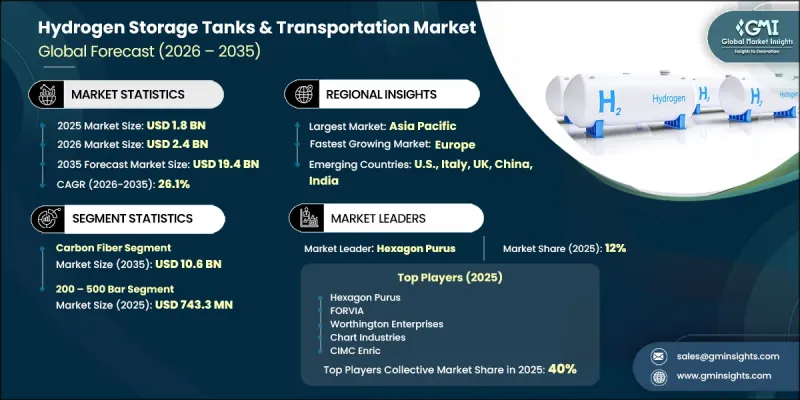
The Global Hydrogen Storage Tanks and Transportation Market was valued at USD 1.8 billion in 2025 and is estimated to grow at a CAGR of 26.1% to reach USD 19.4 billion by 2035.
The industry is gaining strong momentum due to accelerating global decarbonization efforts and the rising focus on hydrogen as a clean energy carrier. Governments across multiple regions are actively promoting hydrogen infrastructure development, including storage and transportation systems, to support fuel cell adoption and large-scale clean energy transition initiatives. Growing deployment of hydrogen-powered mobility solutions is further increasing the need for safe, efficient, and high-capacity storage systems. At the same time, advancements in composite materials, high-pressure engineering, and cryogenic technologies are improving storage efficiency, safety, and cost-effectiveness. Expanding investments in hydrogen corridors, pipelines, and refueling infrastructure are strengthening global supply chain connectivity. The market is also benefiting from increasing industrial use of hydrogen in energy-intensive sectors, alongside rising demand for modular and scalable transport systems that support distributed energy networks and remote applications.
| Market Scope | |
|---|---|
| Start Year | 2025 |
| Forecast Year | 2026-2035 |
| Start Value | $1.8 Billion |
| Forecast Value | $19.4 Billion |
| CAGR | 26.1% |
Hydrogen storage tanks and transportation systems refer to engineered solutions designed to safely store and transport hydrogen in compressed, liquefied, or solid-state forms depending on application requirements. These systems are built with specialized materials and structural designs to manage hydrogen's highly flammable nature while ensuring efficiency and safety during storage and movement. They play a crucial role in enabling hydrogen distribution for mobility, industrial usage, and energy applications, forming a backbone for emerging hydrogen economies worldwide.
The carbon fiber hydrogen storage tanks and transportation segment is expected to reach USD 10.6 billion by 2035. This segment is favored due to carbon fiber's high strength-to-weight ratio, strong corrosion resistance, and superior ability to withstand extreme pressure conditions compared to conventional metal alternatives. Its lightweight properties also improve transport efficiency and enable safer handling of high-pressure hydrogen. Increasing utilization of carbon fiber-based systems in hydrogen logistics is creating strong growth opportunities across the supply chain and supporting broader adoption in hydrogen distribution networks.
The 200-500 bar hydrogen storage tanks and transportation segment was valued at USD 743.3 million in 2025 and is projected to grow at 26.2% by 2035. Growth in this segment is driven by expanding hydrogen mobility applications, increasing decentralized distribution systems, and rising development of refueling infrastructure. The transition from traditional steel-based systems to advanced composite pressure vessels, including type III and type IV configurations, is accelerating adoption. High-pressure modular transport systems are also gaining traction across fuel-cell buses, trucks, rail systems, and industrial applications where pipeline access is limited, further supporting market expansion.
U.S. Hydrogen Storage Tanks and Transportation Market is anticipated to reach USD 2.2 billion by 2035. Market growth in the country is supported by strong federal initiatives promoting clean energy deployment and decarbonization across industrial sectors. Increasing investment in hydrogen mobility infrastructure and fuel cell adoption is driving demand for advanced storage systems. Rising use of composite high-pressure tanks across transportation, gas handling, and refueling networks is further strengthening market expansion. Hydrogen storage and transportation technologies are becoming central to the development of hydrogen hubs and large-scale industrial decarbonization efforts across the region.
Prominent players operating in the Global Hydrogen Storage Tanks And Transportation Industry include Hexagon Purus, Chart Industries, CIMC Enric, NPROXX, Luxfer Gas Cylinders, Worthington, Tenaris, Kawasaki Heavy Industries, Iljin Hysolus, INOXCVA, Faber Industrie, Steelhead Composites, Quantum Fuel Systems, Umoe Advanced Composites, Voith HySTech, BayoTech, OPmobility, FORVIA, Chesterfield Special Cylinders, Aciturri HyStorage, Weldship, and CATEC Gases. Companies in the hydrogen storage tanks and transportation market are focusing on advanced material innovation and structural engineering improvements to enhance safety and storage efficiency. A major strategy involves increasing investment in carbon fiber composite technologies to reduce weight while improving pressure resistance. Firms are also expanding production capacities to meet rising global hydrogen infrastructure demand. Strategic partnerships with energy companies, automotive manufacturers, and government programs are helping accelerate deployment across mobility and industrial applications. Many players are also investing in cryogenic and high-pressure storage innovations to improve performance across varied use cases. Expansion into hydrogen corridor and refueling infrastructure projects is further strengthening supply chain integration.
Table of Contents
Chapter 1 Methodology & Scope
- 1.1 Research design
- 1.2 Quality commitments
- 1.2.1 GMI AI policy & data integrity commitment
- 1.2.1.1 Source consistency protocol
- 1.2.1 GMI AI policy & data integrity commitment
- 1.3 Research trail & confidence scoring
- 1.3.1 Research trail components
- 1.3.2 Scoring components
- 1.4 Data collection
- 1.4.1 Partial list of primary sources
- 1.5 Data mining sources
- 1.5.1 Paid sources
- 1.5.1.1 Sources, by region
- 1.5.1 Paid sources
- 1.6 Base estimates and calculations
- 1.6.1 Base year calculation for any one approach
- 1.7 Market estimates and forecasts parameters
- 1.8 Forecast model
- 1.8.1 Quantified market impact analysis
- 1.8.1.1 Mathematical impact of growth parameters on forecast
- 1.8.1 Quantified market impact analysis
- 1.9 Research transparency addendum
- 1.9.1 Source attribution framework
- 1.9.2 Quality assurance metrics
- 1.9.3 Our commitment to trust
- 1.10 Market definitions
Chapter 2 Executive Summary
- 2.1 Industry synopsis, 2022 - 2035
- 2.2 Business trends
- 2.3 Material trends
- 2.4 Tank type trends
- 2.5 Pressure trends
- 2.6 Application trends
- 2.7 Regional trends
Chapter 3 Industry Insights
- 3.1 Industry ecosystem analysis
- 3.2 Regulatory landscape
- 3.3 Industry impact forces
- 3.3.1 Growth drivers
- 3.3.2 Industry pitfalls & challenges
- 3.4 Growth potential analysis
- 3.5 Porter's Analysis
- 3.5.1 Bargaining power of suppliers
- 3.5.2 Bargaining power of buyers
- 3.5.3 Threat of new entrants
- 3.5.4 Threat of substitutes
- 3.6 PESTEL Analysis
- 3.7 Cost structure analysis of hydrogen storage tank
- 3.8 Trade data analysis (Driven by Primary Research)
- 3.8.1 Import/export value trends (Driven by Primary Research)
- 3.8.2 Key trade corridors & tariff impact (Driven by Primary Research)
- 3.9 Impact of AI & Gen AI on the industry
- 3.9.1 AI driven product optimization
- 3.9.2 Predictive maintenance & fault detection
- 3.9.3 Risks, limitations & regulatory considerations
- 3.10 Investment analysis & future outlook
- 3.11 Digitalization & IoT integration
Chapter 4 Competitive Landscape, 2026
- 4.1 Introduction
- 4.2 Company market share analysis, 2025
- 4.2.1 North America
- 4.2.2 Europe
- 4.2.3 Asia Pacific
- 4.2.4 Middle East & Africa
- 4.2.5 Latin America
- 4.3 Competitive analysis of major market players
- 4.4 Competitive positioning matrix
- 4.5 Key developments
- 4.5.1 Mergers & acquisitions
- 4.5.2 Partnerships & collaborations
- 4.5.3 New product launches
- 4.5.4 Expansion plans & funding
- 4.6 Company tier benchmarking
- 4.6.1 Tier classification criteria & qualifying thresholds
- 4.6.2 Tier positioning matrix by revenue, geography & innovation
Chapter 5 Market Size and Forecast, By Material, 2022 - 2035 (USD Million)
- 5.1 Key trends
- 5.2 Metals
- 5.3 Glass fibers
- 5.4 Carbon fibers
Chapter 6 Market Size and Forecast, By Tank, 2022 - 2035 (USD Million)
- 6.1 Key trends
- 6.2 Type 1
- 6.3 Type 2
- 6.4 Type 3
- 6.5 Type 4
Chapter 7 Market Size and Forecast, By Pressure, 2022 - 2035 (USD Million)
- 7.1 Key trends
- 7.2 Below 200 bar
- 7.3 200 - 500 bar
- 7.4 Above 500 bar
Chapter 8 Market Size and Forecast, By Application, 2022 - 2035 (USD Million)
- 8.1 Key trends
- 8.2 Vehicles
- 8.3 Railways
- 8.4 Marine
- 8.5 Industrial
- 8.6 Others
Chapter 9 Market Size and Forecast, By Region, 2022 - 2035 (USD Million)
- 9.1 Key trends
- 9.2 North America
- 9.2.1 U.S.
- 9.2.2 Canada
- 9.2.3 Mexico
- 9.3 Europe
- 9.3.1 Germany
- 9.3.2 UK
- 9.3.3 France
- 9.3.4 Italy
- 9.3.5 Netherlands
- 9.3.6 Russia
- 9.4 Asia Pacific
- 9.4.1 China
- 9.4.2 India
- 9.4.3 Japan
- 9.4.4 South Korea
- 9.5 Rest of World
Chapter 10 Company Profiles
- 10.1 Aciturri HyStorage
- 10.2 BayoTech
- 10.3 CATEC Gases
- 10.4 CIMC Enric
- 10.5 Chart Industries
- 10.6 Chesterfield Special Cylinders
- 10.7 FORVIA
- 10.8 Faber Industrie
- 10.9 Hexagon Purus
- 10.10 Iljin Hysolus
- 10.11 INOXCVA
- 10.12 Kawasaki Heavy Industries
- 10.13 Luxfer Gas Cylinders
- 10.14 NPROXX
- 10.15 OPmobility SE
- 10.16 Quantum Fuel Systems
- 10.17 Steelhead Composites
- 10.18 Tenaris
- 10.19 Umoe Advanced Composites
- 10.20 Vitkovice Cylinders
- 10.21 Voith HySTech
- 10.22 Weldship Corporation
- 10.23 Worthington Enterprises

