PUBLISHER: Global Market Insights Inc. | PRODUCT CODE: 2061398

PUBLISHER: Global Market Insights Inc. | PRODUCT CODE: 2061398
AI in Oncology Market Opportunity, Growth Drivers, Industry Trend Analysis, and Forecast 2026 - 2035
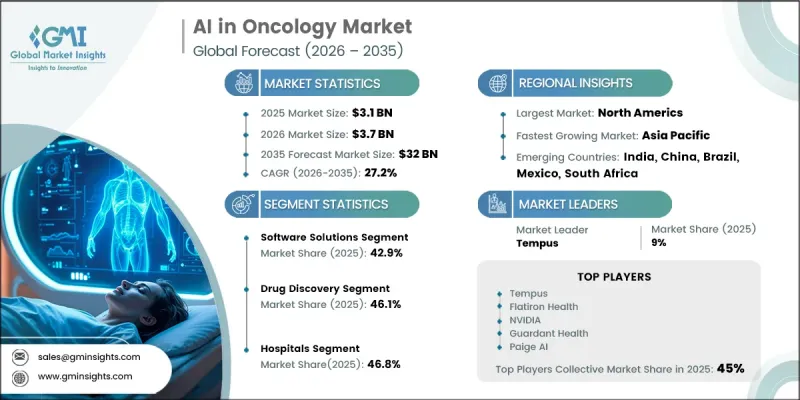
The Global AI In Oncology Market was valued at USD 3.1 billion in 2025 and is estimated to grow at a CAGR of 27.2% to reach USD 32 billion by 2035.
The market is experiencing rapid expansion due to the rising global burden of cancer, increasing demand for early-stage detection, and the accelerating shift toward precision medicine approaches. Artificial intelligence in oncology refers to the application of machine learning, data analytics, and advanced computational models to support cancer detection, diagnosis, treatment planning, and drug development processes. The growing complexity and volume of oncology cases, driven by aging populations, lifestyle-related risks, and environmental exposures, is placing significant pressure on traditional diagnostic and treatment systems. AI-enabled technologies help address these challenges by improving diagnostic accuracy, reducing turnaround times, and enhancing clinical decision-making. Increasing emphasis on early cancer detection is also contributing strongly to market expansion, as early intervention is directly linked to improved survival outcomes, lower treatment costs, and better patient management. In addition, expanding investments in digital healthcare infrastructure and rising adoption of data-driven oncology solutions across healthcare institutions are further accelerating market growth globally.
| Market Scope | |
|---|---|
| Start Year | 2025 |
| Forecast Year | 2026-2035 |
| Start Value | $3.1 Billion |
| Forecast Value | $32 Billion |
| CAGR | 27.2% |
The software solutions segment accounted for 42.9% share in 2025. This segment continues to dominate due to the increasing dependence on advanced analytics platforms and clinical decision-support systems in oncology workflows. These software solutions enable efficient processing of large volumes of clinical records, imaging datasets, and genomic information, supporting accurate diagnosis, treatment optimization, and outcome prediction. Their ability to integrate with existing healthcare IT ecosystems while offering scalability and interoperability is driving widespread adoption across hospitals, research organizations, and diagnostic laboratories. The increasing shift toward personalized medicine and evidence-based treatment planning is further reinforcing demand for AI-driven oncology software solutions.
The drug discovery segment held a 46.1% share in 2025. Growth in this segment is primarily driven by the rising need to accelerate cancer drug development and improve therapeutic innovation timelines. AI technologies are being widely utilized to streamline compound screening, identify therapeutic targets, and predict drug responses with higher precision. These capabilities significantly reduce the time and cost associated with traditional drug development processes while improving the probability of clinical success in oncology research.
U.S. AI in Oncology Market was valued at USD 1.2 billion in 2025. Market growth in the country is supported by the rising incidence of cancer and the increasing demand for advanced diagnostic and screening solutions. The adoption of AI-powered imaging tools and predictive analytics is accelerating across healthcare systems to improve early detection and treatment accuracy. Strong digital healthcare infrastructure, high technology penetration, and established clinical research capabilities are further supporting the integration of AI technologies into oncology care pathways.
Key companies operating in the AI in Oncology Market include Aidoc, Freenome, Flatiron Health, GE HealthCare, Guardant Health, Ibex Medical Analytics, Lunit, Merative, NVIDIA, Paige AI, PathAI, Qure.ai, Siemens Healthineers, SOPHiA GENETICS, and Tempus. Companies operating in the AI in oncology market are adopting a range of strategic initiatives to strengthen their market position and expand clinical adoption. Leading players are heavily investing in advanced machine learning models, multimodal data integration, and next-generation diagnostic algorithms to improve cancer detection accuracy and treatment personalization. Strategic collaborations with hospitals, research institutions, and pharmaceutical companies are enabling broader clinical validation and faster commercialization of AI-based oncology solutions. Organizations are also focusing on expanding cloud-based platforms and interoperable software systems to ensure seamless integration into existing healthcare infrastructures. In addition, companies are strengthening their presence through regulatory approvals, clinical trials, and real-world evidence generation to enhance trust and adoption among healthcare providers.
Table of Contents
Chapter 1 Research Methodology
- 1.1 Research approach
- 1.2 Quality commitments
- 1.2.1 GMI AI policy and data integrity commitment
- 1.2.1.1 Source consistency protocol
- 1.2.1 GMI AI policy and data integrity commitment
- 1.3 Research trail and confidence scoring
- 1.3.1 Research trail components
- 1.3.2 Scoring components
- 1.4 Data collection
- 1.4.1 Partial list of primary sources
- 1.5 Data mining sources
- 1.5.1 Paid sources
- 1.5.1.1 Sources, by region
- 1.5.1 Paid sources
- 1.6 Base estimates and calculations
- 1.6.1 Base year calculation for any one approach
- 1.7 Forecast model
- 1.7.1 Quantified market impact analysis
- 1.7.1.1 Mathematical impact of growth parameters on forecast
- 1.7.1 Quantified market impact analysis
- 1.8 Research transparency addendum
- 1.8.1 Source attribution framework
- 1.8.2 Quality assurance metrics
- 1.8.3 Our commitment to trust
Chapter 2 Executive Summary
- 2.1 Industry 3600 synopsis
- 2.2 Key market trends
- 2.2.1 Component trends
- 2.2.2 Cancer type trends
- 2.2.3 Application trends
- 2.2.4 End use trends
- 2.2.5 Regional trends
- 2.3 CXO perspectives: Strategic imperatives
Chapter 3 Industry Insights
- 3.1 Industry ecosystem analysis
- 3.2 Industry impact forces
- 3.2.1 Growth drivers
- 3.2.1.1 Rising demand for early detection and classification of cancer
- 3.2.1.2 Increasing prevalence of cancer
- 3.2.1.3 Growing adoption of precision medicine
- 3.2.1.4 Surging advancements in healthcare infrastructure
- 3.2.2 Industry pitfalls and challenges
- 3.2.2.1 High procurement and implementation cost
- 3.2.2.2 High impact of regulations
- 3.2.3 Market opportunities
- 3.2.3.1 Expansion into rare cancers and pediatric oncology
- 3.2.1 Growth drivers
- 3.3 Growth potential analysis
- 3.4 Regulatory landscape (Driven by primary research)
- 3.4.1 North America
- 3.4.2 Europe
- 3.4.3 Asia Pacific
- 3.4.4 Latin America
- 3.4.5 Middle East and Africa
- 3.5 Technology landscape (Driven by primary research)
- 3.5.1 Current technological trends
- 3.5.1.1 AI-powered medical imaging & diagnostics
- 3.5.1.2 Genomics & precision oncology analytics
- 3.5.2 Emerging technologies
- 3.5.2.1 Multimodal ai (integrated data platforms)
- 3.5.2.2 Real-world evidence & predictive oncology
- 3.5.1 Current technological trends
- 3.6 Future market trends (Driven by primary research)
- 3.7 Impact of AI and Generative AI on the market (Driven by primary research)
- 3.8 Pricing trend analysis (Driven by primary research)
- 3.9 Porter’s analysis
- 3.10 PESTEL analysis
Chapter 4 Competitive Landscape, 2025
- 4.1 Introduction
- 4.2 Company market share analysis
- 4.2.1 Global
- 4.2.2 North America
- 4.2.3 Europe
- 4.2.4 Asia Pacific
- 4.3 Company matrix analysis
- 4.4 Competitive analysis of major market players
- 4.5 Competitive positioning matrix
- 4.6 Key developments
- 4.6.1 Mergers and acquisitions
- 4.6.2 Partnerships and collaborations
- 4.6.3 New product launches
- 4.6.4 Expansion plans
Chapter 5 Market Estimates and Forecast, By Component, 2022 - 2035 ($ Mn)
- 5.1 Key trends
- 5.2 Software solutions
- 5.3 Hardware
- 5.4 Services
Chapter 6 Market Estimates and Forecast, By Cancer Type, 2022 - 2035 ($ Mn)
- 6.1 Key trends
- 6.2 Breast cancer
- 6.3 Lung cancer
- 6.4 Prostate cancer
- 6.5 Colorectal cancer
- 6.6 Brain tumor
- 6.7 Other cancer types
Chapter 7 Market Estimates and Forecast, By Application, 2022 - 2035 ($ Mn)
- 7.1 Key trends
- 7.2 Cancer detection and diagnosis
- 7.3 Treatment planning and optimization
- 7.4 Drug discovery
- 7.5 Drug development and clinical trials
Chapter 8 Market Estimates and Forecast, By End Use, 2022 - 2035 ($ Mn)
- 8.1 Key trends
- 8.2 Hospitals
- 8.3 Diagnostics centers
- 8.4 Specialty clinics
- 8.5 Other end users
Chapter 9 Market Estimates and Forecast, By Region, 2022 - 2035 ($ Mn)
- 9.1 Key trends
- 9.2 North America
- 9.2.1 U.S.
- 9.2.2 Canada
- 9.3 Europe
- 9.3.1 Germany
- 9.3.2 UK
- 9.3.3 France
- 9.3.4 Spain
- 9.3.5 Italy
- 9.3.6 Netherlands
- 9.4 Asia Pacific
- 9.4.1 China
- 9.4.2 Japan
- 9.4.3 India
- 9.4.4 Australia
- 9.4.5 South Korea
- 9.5 Latin America
- 9.5.1 Brazil
- 9.5.2 Mexico
- 9.5.3 Argentina
- 9.6 Middle East and Africa
- 9.6.1 South Africa
- 9.6.2 Saudi Arabia
- 9.6.3 UAE
Chapter 10 Company Profiles
- 10.1 Aidoc
- 10.2 Freenome
- 10.3 Flatiron Health
- 10.4 GE HealthCare
- 10.5 Guardant Health
- 10.6 Ibex Medical Analytics
- 10.7 Lunit
- 10.8 Merative
- 10.9 NVIDIA
- 10.10 Paige AI
- 10.11 PathAI
- 10.12 Qure.ai
- 10.13 Siemens Healthineers
- 10.14 SOPHiA GENETICS
- 10.15 Tempus

