PUBLISHER: Mordor Intelligence | PRODUCT CODE: 2072547

PUBLISHER: Mordor Intelligence | PRODUCT CODE: 2072547
AI In Oncology - Market Share Analysis, Industry Trends & Statistics, Growth Forecasts (2026 - 2031)
According to Mordor Intelligence, AI in oncology market size in 2026 is estimated at USD 2.66 billion, growing from 2025 value of USD 1.98 billion with 2031 projections showing USD 11.58 billion, growing at 34.20% CAGR over 2026-2031.
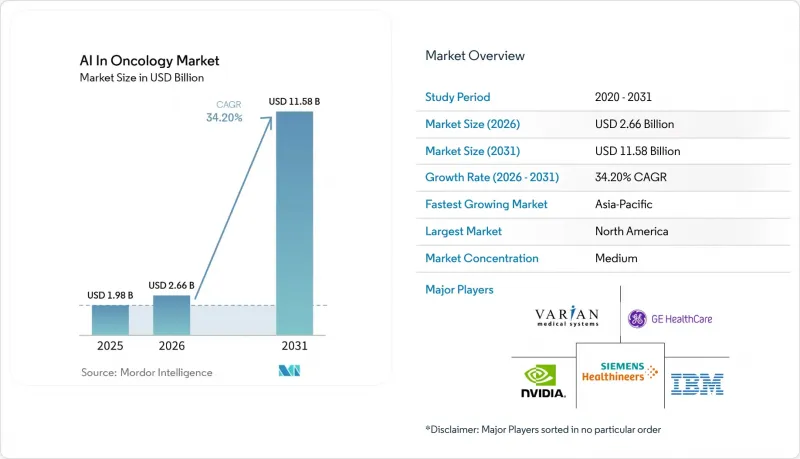
This report is Segmented by Component (Software Solutions, Hardware, and Services), Cancer Type (Breast Cancer, Lung Cancer, and More), Treatment Type (Radiotherapy, Chemotherapy, Immunotherapy, Other Treatment Types), Application (Cancer Detection, and More), and Geography (North America, Europe, Asia-Pacific, Middle East & Africa, South America). The Market Forecasts are Provided in Terms of Value (USD).
Global AI In Oncology Market Trends and Insights
Growing Cancer Burden Worldwide
New cancer diagnoses are projected to swell by more than 12 million cases annually by 2050, a trend most acute in lower-income countries that lack specialist capacity. Rising incidence magnifies the appeal of lightweight AI tools that operate on commodity laptops, enabling radiologists to triage images rapidly and spot tumours that conventionally slip through busy reading rooms. Global spend on oncology therapeutics and supportive care hit USD 223 billion in 2023 and is on course to top USD 409 billion by 2028, prompting payers to reward technologies that can shave costs through earlier detection. Early-stage AI systems such as National Taiwan University Hospital's PANCREASaver, which detects sub-2 cm pancreatic lesions with 86.4% accuracy, illustrate how algorithmic innovation can redirect care pathways toward prevention.
Expanding Precision Medicine Programs
AI has become the analytical engine of precision oncology, sifting through whole-genome sequencing, RNA expression, and digital pathology images to craft tailored regimens. The National Comprehensive Cancer Network's endorsement of the ArteraAI Prostate Test, backed by randomised trials and level 1B evidence, has legitimised algorithmic prognostics in mainstream guidelines. In Europe, the €28 million Thera4Care consortium is establishing pan-EU protocols that link imaging, genomics, and treatment planning across 29 institutions, demonstrating how concerted funding can speed translational adoption. These programmes heighten demand for interoperable software frameworks that insert AI outputs directly into tumour-board workflows, trimming iteration cycles between sequencing results and treatment initiation.
High Implementation Costs and ROI Uncertainty
Deploying enterprise-grade oncology AI often costs mid-sized cancer centres more than USD 1 million once specialised GPUs, data-integration bridges and staff training are tallied. Management teams struggle to balance these outlays against invisible savings from avoided late-stage treatments, especially because only 15 prospective studies between 2013-2023 have provided real-world outcome data for oncology AI. Hardware risk compounds the challenge: rapid algorithmic efficiency gains can make dedicated inference chips obsolete within two equipment cycles. Consequently, smaller providers favour pay-per-use cloud models but still face temporary workflow slowdowns during integration, lengthening their payback horizon.
Other drivers and restraints analyzed in the detailed report include:
- Integration of AI With Medical Imaging Modalities
- Accelerated Approvals of AI-Based Oncology Devices
- Stringent Data Privacy and Security Regulations
For complete list of drivers and restraints, kindly check the Table Of Contents.
Segment Analysis
Software Solutions accounted for a 63.78% AI in oncology market share in 2025, underscoring hospitals' preference for subscription-based algorithms that install on existing PACS viewers and radiation-planning consoles. The Services segment, projected to post a 36.10% CAGR to 2031, shows that many institutions are outsourcing data curation, algorithm tuning and post-deployment monitoring to specialised vendors rather than hiring in-house machine-learning engineers. ConcertAI's Patient360(TM) projects illustrate the shift: more than 1,000 projects completed and 72% of revenue sourced from recurring managed services. Hardware, meanwhile, remains a niche purchase linked to ultra-high-resolution digital-pathology scanners or on-premise GPU clusters; buyers hesitate because successive neural-network generations run on ever-cheaper chips, threatening asset obsolescence.
In the medium term, value will migrate toward "platform" vendors that bundle data-management middleware, algorithm marketplaces and regulatory documentation templates. Such ecosystems lower integration friction and compress validation timelines, making them attractive to community hospitals that lack specialised IT departments. By 2031, software subscription fees and managed-service retainers together are forecast to out-earn hardware sales by more than 4:1, cementing software's structural primacy in the AI in oncology market.
Breast Cancer retained the largest slice of 2025 revenue at 28.05%, buoyed by nationwide mammography programmes and regulatory acceptance of risk-stratification AI such as CLAIRITY BREAST. Yet Brain Tumor solutions are clocking the sector's fastest CAGR at 36.85%, propelled by real-time surgical guidance algorithms like FastGlioma that identify residual tumour tissue within 10 seconds. Paediatric glioma recurrence models now reach 89% predictive accuracy through spatio-temporal learning, exemplifying the clinical depth of next-gen algorithms. Lung and Prostate Cancer applications are advancing too: the ArteraAI Prostate Test's guideline inclusion demonstrates how rigorous evidence unlocks reimbursement, and lightweight lung-nodule classifiers make CT screening feasible in mobile clinics.
Collectively, emerging brain, prostate and lung applications will push the AI in oncology market size for under-served tumour groups from less than USD 420 million in 2026 to more than USD 2.45 billion in 2031, giving vendors an incentive to widen disease coverage. Vendors that master small-data techniques, such as CURATE.AI's single-patient dose-optimisation engine, could secure first-mover advantage in rare malignancies where traditional big-data methods stall.
Complete Report Scope:
- By Component
- Software Solutions
- Hardware
- Services
- By Cancer Type
- Breast Cancer
- Lung Cancer
- Prostate Cancer
- Colorectal Cancer
- Brain Tumor
- Other Cancer Types
- By Treatment Type
- Radiotherapy
- Chemotherapy
- Immunotherapy
- Other Treatment Types
- By Application
- Cancer Detection
- Drug Discovery
- Drug Development
- Other Applications
- Geography
- North America
- United States
- Canada
- Mexico
- Europe
- Germany
- United Kingdom
- France
- Italy
- Spain
- Rest of Europe
- Asia-Pacific
- China
- Japan
- India
- Australia
- South Korea
- Rest of Asia-Pacific
- Middle East & Africa
- GCC
- South Africa
- Rest of Middle East & Africa
- South America
- Brazil
- Argentina
- Rest of South America
- North America
Geography Analysis
North America held 44.12% of 2025 revenue, underpinned by the world's most mature approval environment, broad reimbursement of digital pathology and a dense network of AI-first oncology start-ups. The FDA's rolling guidance updates give US vendors clarity on real-time learning systems, encouraging continuous-update algorithms that improve post-market. Mega-deals such as GE HealthCare's seven-year pact with Sutter Health to blanket 300 facilities with AI-enabled imaging reinforce a virtuous cycle of clinical data generation and product refinement.
Asia-Pacific is the velocity leader with a 35.10% regional CAGR expected between 2026-2031. South Korea's national AI-health strategy, China's Healthy China 2030 plan and Singapore's secure-data-sandbox regulations collectively speed clinical pilots. Nearly 600 health-AI start-ups now operate across Australia, China, Japan and Singapore, funnelling local datasets into disease-specific models attuned to regional genetics and care protocols. National Taiwan University Hospital's PANCREASaver underscores how indigenous innovation can secure both domestic deployment and US regulatory recognition.
Europe continues to prioritise cross-border research networks and ethical AI. The €28 million Thera4Care project, running across 29 sites, typifies the continent's collaborative template that pairs algorithm trials with standard-setting for explainability and data stewardship. While GDPR adds compliance overhead, the unified Medical Device Regulation shortens multinational launch sequencing once CE approval is obtained. Emerging regions-Middle East & Africa and South America-are still nascent but show accelerating interest as cloud connectivity widens. Pilot programmes with the World Health Organization that port ultra-compact lung-cancer detectors onto mobile X-ray vans illustrate the adaptability of contemporary AI stacks to infrastructure-light settings.
- Siemens Healthineers
- GE Healthcare
- IBM Corp.
- NVIDIA Corp.
- Varian Medical Systems
- Elekta
- Koninklijke Philips
- Tempus Labs
- Flatiron Health
- PathAI
- Azra AI
- ConcertAI
- Digital Diagnostics
- Median Technologies
- Radformation / Limbus AI
- DeepMind Health
- Intel Corp.
- Medtronic
- Canon
- Oncora Medical
- Paige AI
- Imagia Cybernetics
Additional Benefits:
- The market estimate (ME) sheet in Excel format
- 3 months of analyst support
TABLE OF CONTENTS
1 Introduction
- 1.1 Study Assumptions & Market Definition
- 1.2 Scope of the Study
2 Research Methodology
3 Executive Summary
4 Market Landscape
- 4.1 Market Overview
- 4.2 Market Drivers
- 4.2.1 Growing Cancer Burden Worldwide
- 4.2.2 Expanding Precision Medicine Programs
- 4.2.3 Integration of AI With Medical Imaging Modalities
- 4.2.4 Accelerated Approvals of AI-Based Oncology Devices
- 4.2.5 Rising Investments from Big Tech and Pharma
- 4.2.6 Proliferation of Cloud-Based Healthcare Data
- 4.3 Market Restraints
- 4.3.1 High Implementation Costs and ROI Uncertainty
- 4.3.2 Stringent Data Privacy and Security Regulations
- 4.3.3 Limited Interoperability across Oncology IT Systems
- 4.3.4 Shortage of AI-Literate Oncology Workforce
- 4.4 Regulatory Landscape
- 4.5 Porter's Five Forces Analysis
- 4.5.1 Threat of New Entrants
- 4.5.2 Bargaining Power of Buyers
- 4.5.3 Bargaining Power of Suppliers
- 4.5.4 Threat of Substitutes
- 4.5.5 Competitive Rivalry
5 Market Size & Growth Forecasts (Value, USD)
- 5.1 By Component
- 5.1.1 Software Solutions
- 5.1.2 Hardware
- 5.1.3 Services
- 5.2 By Cancer Type
- 5.2.1 Breast Cancer
- 5.2.2 Lung Cancer
- 5.2.3 Prostate Cancer
- 5.2.4 Colorectal Cancer
- 5.2.5 Brain Tumor
- 5.2.6 Other Cancer Types
- 5.3 By Treatment Type
- 5.3.1 Radiotherapy
- 5.3.2 Chemotherapy
- 5.3.3 Immunotherapy
- 5.3.4 Other Treatment Types
- 5.4 By Application
- 5.4.1 Cancer Detection
- 5.4.2 Drug Discovery
- 5.4.3 Drug Development
- 5.4.4 Other Applications
- 5.5 Geography
- 5.5.1 North America
- 5.5.1.1 United States
- 5.5.1.2 Canada
- 5.5.1.3 Mexico
- 5.5.2 Europe
- 5.5.2.1 Germany
- 5.5.2.2 United Kingdom
- 5.5.2.3 France
- 5.5.2.4 Italy
- 5.5.2.5 Spain
- 5.5.2.6 Rest of Europe
- 5.5.3 Asia-Pacific
- 5.5.3.1 China
- 5.5.3.2 Japan
- 5.5.3.3 India
- 5.5.3.4 Australia
- 5.5.3.5 South Korea
- 5.5.3.6 Rest of Asia-Pacific
- 5.5.4 Middle East & Africa
- 5.5.4.1 GCC
- 5.5.4.2 South Africa
- 5.5.4.3 Rest of Middle East & Africa
- 5.5.5 South America
- 5.5.5.1 Brazil
- 5.5.5.2 Argentina
- 5.5.5.3 Rest of South America
- 5.5.1 North America
6 Competitive Landscape
- 6.1 Market Concentration
- 6.2 Market Share Analysis
- 6.3 Company Profiles (includes Global level Overview, Market level overview, Core Business Segments, Financials, Headcount, Key Information, Market Rank, Market Share, Products and Services, and analysis of Recent Developments)
- 6.3.1 Siemens Healthineers AG
- 6.3.2 GE Healthcare
- 6.3.3 IBM Corp.
- 6.3.4 NVIDIA Corp.
- 6.3.5 Varian Medical Systems
- 6.3.6 Elekta AB
- 6.3.7 Philips Healthcare
- 6.3.8 Tempus Labs
- 6.3.9 Flatiron Health
- 6.3.10 PathAI
- 6.3.11 Azra AI
- 6.3.12 ConcertAI
- 6.3.13 Digital Diagnostics
- 6.3.14 Median Technologies
- 6.3.15 Radformation / Limbus AI
- 6.3.16 DeepMind Health
- 6.3.17 Intel Corp.
- 6.3.18 Medtronic
- 6.3.19 Canon Medical Systems
- 6.3.20 Oncora Medical
- 6.3.21 Paige AI
- 6.3.22 Imagia Cybernetics
7 Market Opportunities & Future Outlook
- 7.1 White-space & Unmet-need Assessment

