PUBLISHER: Global Market Insights Inc. | PRODUCT CODE: 2061405

PUBLISHER: Global Market Insights Inc. | PRODUCT CODE: 2061405
Kitchen Appliances Market Opportunity, Growth Drivers, Industry Trend Analysis, and Forecast 2026 - 2035
The Global Kitchen Appliances Market was valued at USD 178.1 billion in 2025 and is estimated to grow at a CAGR of 5.2% to reach USD 295.5 billion by 2035.
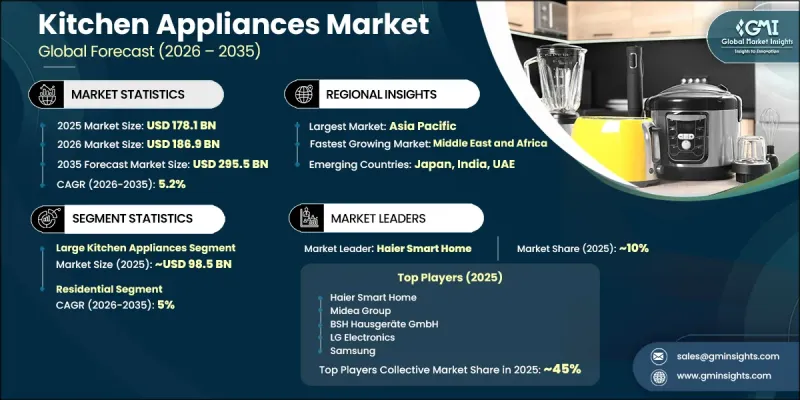
Industry is experiencing steady expansion due to ongoing urbanization, shifting consumer lifestyles, and rising household formation in emerging economies. As populations move toward urban centers, demand for refrigerators, cooking equipment, dishwashing systems, and compact electrical appliances continues to strengthen. In developed economies, appliance penetration is already high, yet replacement demand remains steady due to stricter energy efficiency regulations and the need for upgraded technologies. At the same time, increasing digital adoption in households is reshaping consumer expectations, with connected and intelligent appliances becoming more mainstream. Improvements in semiconductor affordability and the growing adoption of interoperability standards are accelerating the integration of smart features across mid-range and premium product categories. Competitive intensity among manufacturers is also pushing innovation in automation, efficiency, and user-centric design. Across global markets, rising emphasis on sustainability and reduced energy consumption is further influencing purchasing decisions, while advancements in intelligent home systems are supporting broader adoption of upgraded kitchen appliance ecosystems.
| Market Scope | |
|---|---|
| Start Year | 2025 |
| Forecast Year | 2026-2035 |
| Start Value | $178.1 Billion |
| Forecast Value | $295.5 Billion |
| CAGR | 5.2% |
The large kitchen appliances segment generated USD 98.5 billion in 2025 and is projected to grow at a CAGR of 4.8% from 2026 to 2035. This segment, which includes refrigerators, cooking equipment, dishwashing systems, range hoods, and related products, is undergoing a significant transformation, particularly in developed markets. The transition from conventional gas-based cooking systems to electric and induction-based technologies is gaining traction due to regulatory pressure, efficiency improvements, and changing consumer preferences. Refrigerators remain the dominant product category, contributing a substantial share of both revenue and installations, especially in mature markets where penetration levels are already high. The segment is increasingly defined by technological enhancement, with demand shifting toward more efficient, automated, and connected systems across premium product categories.
The residential segment accounted for 74.5% share in 2025 and is expected to grow at a CAGR of 5% between 2026 and 2035. Residential usage continues to dominate due to high household demand for essential and advanced kitchen appliances across both developed and developing economies. Meanwhile, the commercial segment is emerging as the fastest-expanding end-use category, supported by rapid growth in food service establishments, hospitality operations, healthcare facilities, and institutional catering. Expansion of quick-service restaurant networks across multiple regions is further driving demand for high-performance, durable appliances capable of handling continuous and intensive operations. Commercial-grade refrigeration systems, ovens, dishwashing units, and food preparation equipment are witnessing strong uptake due to operational efficiency requirements and large-scale usage intensity.
U.S. Kitchen Appliances Market was valued at USD 28.4 billion in 2025 and is projected to grow at a CAGR of 4.8% from 2026 to 2035. The country represents a mature and highly competitive landscape characterized by widespread household penetration and strong consumer awareness. Demand is increasingly shaped by preferences for advanced, energy-efficient, and digitally connected appliances, particularly among younger homeowner segments. The growing integration of smart technologies within home ecosystems is influencing purchasing behavior, while sustainability regulations and energy efficiency standards are encouraging continuous product innovation. Manufacturers are responding with upgraded designs that enhance convenience, reduce energy consumption, and align with evolving regulatory requirements.
Major companies operating in the Global Kitchen Appliances Industry include Whirlpool Corporation, LG Electronics, Haier Smart Home, Samsung Electronics, Electrolux Group, Midea Group, and BSH Hausgerate GmbH. Other significant players are Groupe SEB, Arcelik/Beko, Miele & Cie. KG, Panasonic Corporation, Gree Electric Appliances, Havells India, and Cuisinart. The competitive landscape also features SharkNinja, Breville Group, De'Longhi Group, Versuni, Viomi Technology, V-Guard Industries, and other emerging innovators shaping product development and market expansion strategies. Companies in the kitchen appliances market are focusing on strengthening their presence through continuous product innovation, particularly in smart and energy-efficient technologies. Manufacturers are investing heavily in connected appliance ecosystems that integrate seamlessly with digital home platforms. Strategic partnerships and collaborations with technology providers are helping accelerate the development of intelligent features and automation capabilities. Many players are expanding their distribution networks across emerging markets to capture rising demand driven by urbanization. Cost optimization through advanced manufacturing techniques and supply chain efficiencies is also a key priority. In addition, companies are emphasizing sustainable product design, including reduced energy consumption and recyclable materials. Strong after-sales service networks and extended warranty offerings are being used to improve customer retention.
Table of Contents
Chapter 1 Research methodology
- 1.1 Research approach
- 1.2 Quality Commitments
- 1.2.1 GMI AI policy & data integrity commitment
- 1.2.1.1 Source consistency protocol
- 1.2.1 GMI AI policy & data integrity commitment
- 1.3 Research trail & confidence scoring
- 1.3.1 Research trail components
- 1.3.2 Scoring components
- 1.4 Data Collection
- 1.4.1 Partial list of primary sources
- 1.5 Data mining sources
- 1.5.1 Paid sources
- 1.5.1.1 Sources, by region
- 1.5.1 Paid sources
- 1.6 Base estimates and calculations
- 1.6.1 Base year calculation
- 1.7 Forecast model
- 1.7.1 Quantified market impact analysis
- 1.7.1.1 Mathematical impact of growth parameters on forecast
- 1.7.1 Quantified market impact analysis
- 1.8 Research transparency addendum
- 1.8.1 Source attribution framework
- 1.8.2 Quality assurance metrics
- 1.8.3 Our commitment to trust
Chapter 2 Executive Summary
- 2.1 Industry 360° synopsis
- 2.2 Business trends
- 2.3 Regional
- 2.4 Product type
- 2.5 Technology
- 2.6 End use
- 2.7 Distribution channel
Chapter 3 Industry Insights
- 3.1 Industry ecosystem analysis
- 3.1.1 Supplier landscape
- 3.1.2 Profit margin analysis
- 3.1.3 Value addition at each stage
- 3.1.4 Factor affecting the value chain
- 3.2 Industry impact forces
- 3.2.1 Growth drivers
- 3.2.1.1 Rapid Urbanization and Household Formation in Emerging Markets
- 3.2.1.2 Smart Technology Integration, AI Adoption, and IoT Connectivity
- 3.2.1.3 Expansion of Commercial Food Service, QSR Growth, and Cloud Kitchen Networks
- 3.2.2 Industry pitfalls & challenges
- 3.2.2.1 High Upfront Cost of Smart and Premium Appliances
- 3.2.2.2 Market Saturation and Extended Replacement Cycles in Developed Economies
- 3.2.1 Growth drivers
- 3.3 Growth potential analysis
- 3.4 Future market trends
- 3.5 Technology and innovation landscape
- 3.5.1 Current technological trends
- 3.5.2 Emerging technologies
- 3.6 Price trends
- 3.6.1 By region
- 3.6.2 By product type
- 3.7 Regulatory landscape
- 3.7.1 Standards and compliance requirements
- 3.7.2 Regional regulatory frameworks
- 3.7.3 Certification standards
- 3.8 Porter's analysis
- 3.9 PESTEL analysis
- 3.10 Impact of AI & generative AI on the market
- 3.10.1 AI-driven disruption of existing business models
- 3.10.2 GenAI use cases & adoption roadmap by segment
- 3.10.3 Risks, limitations & regulatory considerations
- 3.11 Consumer behavior analysis
- 3.11.1 Demographic trends
- 3.11.2 Factors affecting buying decision
- 3.11.3 Consumer product adoption
- 3.11.4 Preferred distribution channel
- 3.11.5 Preferred price range
Chapter 4 Competitive Landscape, 2025
- 4.1 Introduction
- 4.2 Company market share analysis
- 4.2.1 By Region
- 4.2.1.1 North America
- 4.2.1.2 Europe
- 4.2.1.3 Asia Pacific
- 4.2.1.4 Latin America
- 4.2.1.5 Middle East & Africa
- 4.2.1 By Region
- 4.3 Company matrix analysis
- 4.4 Competitive analysis of major market players
- 4.5 Competitive positioning matrix
- 4.6 Key developments
- 4.6.1 Mergers & acquisitions
- 4.6.2 Partnerships & collaborations
- 4.6.3 New product launches
- 4.6.4 Expansion plans
Chapter 5 Market Estimates & Forecast, By Product Type, 2022 - 2035, (USD Billion) (Units)
- 5.1 Key trends
- 5.2 Large Kitchen Appliances
- 5.2.1 Refrigerators & Freezers
- 5.2.2 Cooking Appliances
- 5.2.3 Dishwashers
- 5.2.4 Range Hoods
- 5.2.5 Others
- 5.3 Small Kitchen Appliances
- 5.3.1 Food Processors
- 5.3.2 Juicers & Blenders
- 5.3.3 Coffee Makers
- 5.3.4 Grills & Roasters
- 5.3.5 Air Fryers
- 5.3.6 Electric Cookers
- 5.3.7 Toasters & Toaster Ovens
- 5.3.8 Electric Kettles
- 5.3.9 Countertop Ovens
- 5.3.10 Others
Chapter 6 Market Estimates & Forecast, By Technology, 2022 - 2035, (USD Billion) (Units)
- 6.1 Key trends
- 6.2 Conventional Appliances
- 6.3 Smart/Connected Appliances
Chapter 7 Market Estimates & Forecast, By End Use, 2022 - 2035, (USD Billion) (Units)
- 7.1 Key trends
- 7.2 Residential
- 7.3 Commercial
- 7.3.1 Hotels & Hospitality
- 7.3.2 Restaurants & Foodservice
- 7.3.3 Contract Catering
- 7.3.4 Others
Chapter 8 Market Estimates & Forecast, By Distribution Channel, 2022 - 2035, (USD Billion) (Units)
- 8.1 Key trends
- 8.2 Online
- 8.2.1 Company Websites
- 8.2.2 E-commerce Websites
- 8.3 Offline
- 8.3.1 Supermarkets and Hypermarkets
- 8.3.2 Specialty Stores
- 8.3.3 Others
Chapter 9 Market Estimates & Forecast, By Region, 2022 - 2035, (USD Billion) (Units)
- 9.1 Key trends
- 9.2 North America
- 9.2.1 U.S
- 9.2.2 Canada
- 9.3 Europe
- 9.3.1 Germany
- 9.3.2 UK
- 9.3.3 France
- 9.3.4 Italy
- 9.3.5 Spain
- 9.3.6 Sweden
- 9.3.7 Netherlands
- 9.4 Asia Pacific
- 9.4.1 China
- 9.4.2 India
- 9.4.3 Japan
- 9.4.4 South Korea
- 9.4.5 Australia
- 9.4.6 Indonesia
- 9.5 Latin America
- 9.5.1 Brazil
- 9.5.2 Mexico
- 9.5.3 Argentina
- 9.6 MEA
- 9.6.1 Saudi Arabia
- 9.6.2 UAE
- 9.6.3 South Africa
Chapter 10 Company Profiles
- 10.1 Global Players
- 10.1.1 Whirlpool Corporation
- 10.1.2 LG Electronics
- 10.1.3 Samsung Electronics
- 10.1.4 Haier Smart Home
- 10.1.5 Midea Group
- 10.1.6 BSH Hausgerate GmbH
- 10.1.7 Electrolux Group
- 10.2 Regional Players
- 10.2.1 Groupe SEB
- 10.2.2 Arcelik/Beko
- 10.2.3 Panasonic Corporation
- 10.2.4 Miele & Cie. KG
- 10.2.5 Gree Electric Appliances
- 10.2.6 Havells India
- 10.2.7 Cuisinart
- 10.3 Emerging Players & Innovators
- 10.3.1 SharkNinja
- 10.3.2 Breville Group
- 10.3.3 De'Longhi Group
- 10.3.4 Versuni
- 10.3.5 Viomi Technology
- 10.3.6 V-Guard Industries
- 10.3.7 OXO

