PUBLISHER: Global Market Insights Inc. | PRODUCT CODE: 2061445

PUBLISHER: Global Market Insights Inc. | PRODUCT CODE: 2061445
Mobile Light Tower Market Opportunity, Growth Drivers, Industry Trend Analysis, and Forecast 2026 - 2035
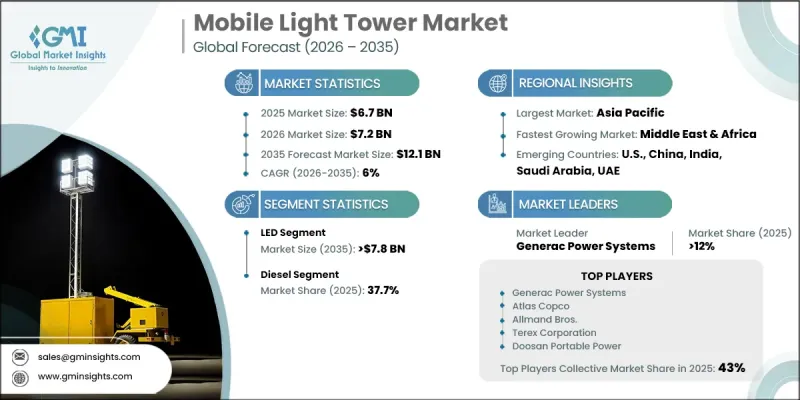
The Global Mobile Light Tower Market was valued at USD 6.7 billion in 2025 and is estimated to grow at a CAGR of 6% to reach USD 12.1 billion by 2035.
Market growth is driven by rising demand from construction, mining, and oil and gas operations that require reliable mobile lighting solutions for remote and nighttime activities. Expanding infrastructure development projects, along with increasing emphasis on worker safety during low-light operations, is further strengthening product adoption. The shift toward energy-efficient and sustainable lighting systems is also accelerating demand for LED and solar-powered mobile light towers. In parallel, the expansion of the rental equipment market, particularly in emerging economies, is improving accessibility and supporting wider deployment across end-use sectors. Technological advancements such as automation, remote monitoring, and extended operational durability are enhancing efficiency and boosting user preference. Additionally, growing demand for compact, weather-resistant, and fuel-efficient systems is shaping product innovation, especially for urban construction environments and off-grid applications where reliability and sustainability are critical.
| Market Scope | |
|---|---|
| Start Year | 2025 |
| Forecast Year | 2026-2035 |
| Start Value | $6.7 Billion |
| Forecast Value | $12.1 Billion |
| CAGR | 6% |
The LED segment is projected to reach USD 7.8 billion by 2035, supported by rising demand for energy-efficient lighting technologies across construction, mining, and event-related applications. LED-based mobile light towers are increasingly preferred due to lower energy consumption, extended operational lifespan, and reduced maintenance requirements compared to traditional lighting systems. Continued infrastructure expansion in developing regions is further reinforcing demand. In addition, the growing adoption of hybrid and solar-integrated LED systems is being driven by sustainability initiatives and the global transition toward lower-emission technologies.
The diesel-powered segment accounted for 37.7% share in 2025 and is expected to grow steadily at a CAGR of 4.5% through 2035. Strong demand from mining, oil and gas, and construction industries is supporting this segment, particularly in remote locations where stable grid access is limited. Diesel-based mobile light towers remain widely used due to their durability, high performance, and ability to operate under harsh conditions. Ongoing improvements in fuel efficiency and emission control technologies are also contributing to sustained demand, especially in regions facing stricter environmental compliance requirements.
U.S. Mobile Light Tower Market was valued at USD 1.4 billion in 2025 and is projected to exceed USD 2.1 billion by 2035. Growth in the country is supported by strong demand from construction, mining, and oil and gas activities, along with rising infrastructure development projects requiring efficient nighttime lighting solutions. Increasing adoption of LED and hybrid technologies is also supporting market expansion due to their sustainability advantages. In addition, the growing rental market for temporary lighting equipment is improving accessibility and driving wider usage across multiple industries.
Key players operating in the Global Mobile Light Tower Industry include Atlas Copco, Caterpillar, Generac Power Systems, Terex Corporation, Doosan Portable Power, United Rentals, The Will-Burt Company, Chicago Pneumatic, Larson Electronics, Allmand Bros., Progress Solar Solutions, Axiom Equipment Group, Boss LTR, DMI, Light Boy, Olikara Lighting Towers, Colorado Standby, Grandwatt Electric, LTA Projects, Aska Equipments, Youngman Richardson, and Alrouf. Companies in the mobile light tower market are increasingly focusing on developing energy-efficient lighting systems, particularly LED and hybrid solutions, to align with sustainability goals and reduce operational costs. Many players are expanding their rental service offerings to improve accessibility and capture demand from short-term construction and industrial projects. Investment in smart technologies such as remote monitoring, automation, and predictive maintenance is enhancing operational efficiency and equipment reliability. Manufacturers are also emphasizing rugged and weather-resistant designs to improve performance in harsh environments. Geographic expansion into emerging markets is strengthening revenue opportunities, while strategic partnerships with rental service providers and contractors are improving distribution reach. In addition, continuous product innovation aimed at improving fuel efficiency, reducing emissions, and enhancing portability is helping companies strengthen their competitive position in the global market.
Table of Contents
Chapter 1 Methodology & Scope
- 1.1 Research approach
- 1.2 Quality commitment
- 1.2.1 GMI AI policy & data integrity commitment
- 1.2.1.1 Source consistency protocol
- 1.2.1 GMI AI policy & data integrity commitment
- 1.3 Research Trail & Confidence Scoring
- 1.3.1 Research Trail Components
- 1.3.2 Scoring Components
- 1.4 Data Collection
- 1.4.1 Partial list of primary sources
- 1.5 Data mining sources
- 1.5.1 Paid sources
- 1.5.1.1 Sources, by region
- 1.5.1 Paid sources
- 1.6 Base estimates and calculations
- 1.6.1 Base year calculation for any one approach
- 1.7 Forecast model
- 1.8 Research transparency addendum
- 1.8.1 Source attribution framework
- 1.8.2 Quality assurance metrics
- 1.8.3 Our commitment to trust
- 1.8.3.1 Market definitions
Chapter 2 Executive Summary
- 2.1 Industry synopsis, 2022 - 2035
- 2.2 Business trends
- 2.3 Lighting trends
- 2.4 Power source trends
- 2.5 Technology trends
- 2.6 Application trends
- 2.7 Regional trends
Chapter 3 Industry Insights
- 3.1 Industry ecosystem analysis
- 3.2 Regulatory landscape
- 3.3 Industry impact forces
- 3.3.1 Growth drivers
- 3.3.2 Industry pitfalls & challenges
- 3.4 Growth potential analysis
- 3.5 Porter's analysis
- 3.5.1 Bargaining power of suppliers
- 3.5.2 Bargaining power of buyers
- 3.5.3 Threat of new entrants
- 3.5.4 Threat of substitutes
- 3.6 PESTEL analysis
- 3.7 Price trend analysis (USD/Unit)
- 3.8 Cost structure analysis of mobile light towers
- 3.9 Trade data analysis (Driven by Primary Research)
- 3.9.1 Import/export value trends (Driven by Primary Research)
- 3.9.2 Key trade corridors & tariff impact (Driven by Primary Research)
- 3.10 Production capacity & utilization (Driven by Primary Research)
- 3.10.1 Production capacity by region (Driven by Primary Research)
- 3.10.2 Utilization rates and expansion pipeline (Driven by Primary Research)
- 3.11 Impact of AI & generative AI on the market
- 3.11.1 AI-driven disruption of existing business models
- 3.11.2 GenAI use cases & adoption roadmap by segment
- 3.11.2.1 Predictive maintenance & fault detection
- 3.11.2.2 Digital twin simulation & testing
- 3.11.3 Risks, limitations & regulatory considerations
- 3.12 Emerging opportunities & trends
- 3.13 Investment analysis & future outlook
Chapter 4 Competitive Landscape, 2026
- 4.1 Introduction
- 4.2 Company market share analysis, by region, 2025
- 4.2.1 North America
- 4.2.2 Europe
- 4.2.3 Asia Pacific
- 4.2.4 Middle East & Africa
- 4.2.5 Latin America
- 4.3 Competitive positioning matrix
- 4.4 Key Developments
- 4.4.1 Mergers & acquisitions
- 4.4.2 Partnerships & collaborations
- 4.4.3 New product launches
- 4.4.4 Expansion plans and funding
Chapter 5 Market Size and Forecast, By Lighting, 2022 - 2035 (USD Million, '000 Units)
- 5.1 Key trends
- 5.2 Metal Halide
- 5.3 LED
- 5.4 Electric
- 5.5 Others
Chapter 6 Market Size and Forecast, By Power Source, 2022 - 2035 (USD Million, '000 Units)
- 6.1 Key trends
- 6.2 Diesel
- 6.3 Solar
- 6.4 Direct
- 6.5 Others
Chapter 7 Market Size and Forecast, By Technology, 2022 - 2035 (USD Million, '000 Units)
- 7.1 Key trends
- 7.2 Manual lifting system
- 7.3 Hydraulic lifting system
Chapter 8 Market Size and Forecast, By Application, 2022 - 2035 (USD Million, '000 Units)
- 8.1 Key trends
- 8.2 Construction
- 8.3 Infrastructure development
- 8.4 Oil & Gas
- 8.5 Mining
- 8.6 Military & defense
- 8.7 Emergency & disaster relief
- 8.8 Others
Chapter 9 Market Size and Forecast, By Region, 2022 - 2035 (USD Million, '000 Units)
- 9.1 Key trends
- 9.2 North America
- 9.2.1 U.S.
- 9.2.2 Canada
- 9.2.3 Mexico
- 9.3 Europe
- 9.3.1 Germany
- 9.3.2 UK
- 9.3.3 France
- 9.3.4 Italy
- 9.3.5 Spain
- 9.3.6 Russia
- 9.4 Asia Pacific
- 9.4.1 China
- 9.4.2 Japan
- 9.4.3 India
- 9.4.4 Australia
- 9.4.5 South Korea
- 9.5 Middle East & Africa
- 9.5.1 Saudi Arabia
- 9.5.2 UAE
- 9.5.3 Qatar
- 9.5.4 South Africa
- 9.6 Latin America
- 9.6.1 Brazil
- 9.6.2 Argentina
Chapter 10 Company Profiles
- 10.1 Alrouf
- 10.2 Allmand Bros.
- 10.3 Aska Equipments
- 10.4 Atlas Copco
- 10.5 Axiom Equipment Group
- 10.6 Boss LTR
- 10.7 Caterpillar
- 10.8 Chicago Pneumatic
- 10.9 Colorado Standby
- 10.10 DMI
- 10.11 Doosan Portable Power
- 10.12 Generac Power Systems
- 10.13 Grandwatt Electric
- 10.14 Larson Electronics
- 10.15 Light Boy
- 10.16 LTA Projects
- 10.17 Olikara Lighting Towers
- 10.18 Progress Solar Solutions
- 10.19 Terex Corporation
- 10.20 The Will-Burt Company
- 10.21 United Rentals
- 10.22 Youngman Richardson

