PUBLISHER: Global Market Insights Inc. | PRODUCT CODE: 2061448

PUBLISHER: Global Market Insights Inc. | PRODUCT CODE: 2061448
Microwave Oven Market Opportunity, Growth Drivers, Industry Trend Analysis, and Forecast 2026 - 2035
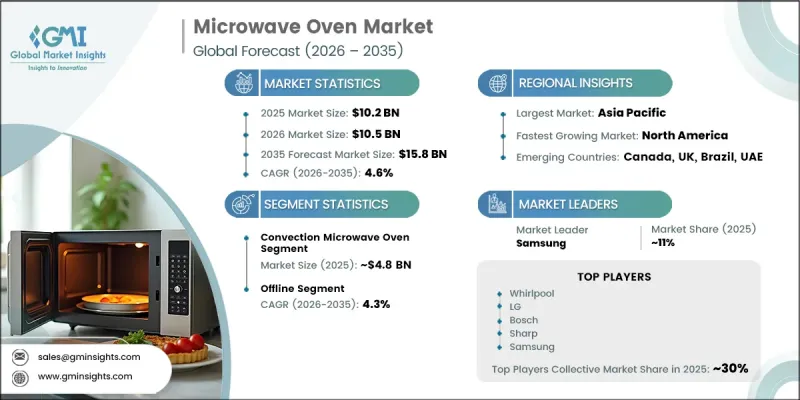
The Global Microwave Oven Market was valued at USD 10.2 billion in 2025 and is estimated to grow at a CAGR of 4.6% to reach USD 15.8 billion by 2035.
Market expansion is driven by the rising demand for convenient and time-saving kitchen appliances as consumers increasingly prioritize efficiency in daily meal preparation. Changing lifestyles, a growing number of working professionals, and the rise of dual-income households are significantly supporting adoption. Consumers are shifting toward advanced appliances that reduce cooking effort while offering enhanced functionality. Demand is also strengthening for multi-purpose microwave ovens that go beyond reheating and support grilling, baking, and convection-based cooking in a single unit. This reflects a broader trend toward compact, space-efficient kitchen solutions suitable for modern urban living. In parallel, smart home integration is reshaping product demand, with connected microwave ovens gaining traction due to app-based controls, voice-enabled functions, and automated cooking presets. Rising urbanization and higher disposable incomes are further reinforcing steady market growth across both developed and emerging economies.
| Market Scope | |
|---|---|
| Start Year | 2025 |
| Forecast Year | 2026-2035 |
| Start Value | $10.2 Billion |
| Forecast Value | $15.8 Billion |
| CAGR | 4.6% |
The convection microwave oven segment generated USD 4.8 billion in 2025 and is expected to grow at a CAGR of 5.1% from 2026 to 2035. This segment continues to expand as consumers increasingly prefer multifunctional appliances capable of baking, roasting, grilling, and reheating within a single device. Its popularity is strongly linked to urban living conditions where kitchen space is limited and consumers prioritize compact, all-in-one solutions. Growing interest in home cooking and baking activities is also contributing to sustained demand, supported by evolving food preferences and lifestyle changes.
The offline distribution channel accounted for 60% share in 2025 and is projected to grow at a CAGR of 4.3% from 2026 to 2035. Physical retail channels remain dominant as consumers prefer evaluating product quality, design, size, and features in person before making a purchase decision. Electronics retailers, specialty appliance stores, and large-format outlets play a crucial role in influencing buying behavior through direct demonstrations and expert assistance. Customers benefit from immediate product availability, installation support, and after-sales services, which further enhance trust and satisfaction in offline purchasing channels.
United States Microwave Oven Market captured USD 2.1 billion and is projected to grow at a CAGR of 4% from 2026 to 2035. Market growth in the country is supported by fast-paced lifestyles, a large working population, and a high share of dual-income households, all of which increase reliance on quick and efficient cooking appliances. Microwave ovens have become a standard household product due to their convenience and time-saving benefits. Strong retail infrastructure combined with well-developed e-commerce platforms further ensures easy product accessibility and encourages upgrades to advanced and feature-rich models.
Major companies operating in the Microwave Oven Market include Samsung Electronics Co., Ltd., LG Electronics Inc., Whirlpool Corporation, Panasonic Holdings Corporation, Midea Group Co., Ltd., Haier Group Corporation, Electrolux AB, Robert Bosch GmbH, Sharp Corporation, Arcelik A.S., Miele & Cie KG, GE Appliances (Haier-owned), Breville Group, Hamilton Beach Brands, Inc., Toshiba Lifestyle Products and Services Corporation, Godrej & Boyce Mfg. Co. Ltd., Galanz Enterprise Group, Vatti Corporation Limited, Smeg S.p.A., and Caso Design. Companies in the microwave oven market are actively focusing on product innovation, particularly the development of multifunctional and smart-enabled appliances that enhance cooking convenience and efficiency. Manufacturers are integrating IoT-based features, including mobile app control, voice assistance compatibility, and automated cooking programs to attract tech-savvy consumers. Strong emphasis is placed on premiumization through sleek designs, energy efficiency, and advanced cooking technologies. Firms are also expanding their distribution networks by strengthening both offline retail partnerships and online sales channels to improve market reach. Strategic collaborations with kitchen appliance retailers and e-commerce platforms are helping improve visibility and accessibility.
Table of Contents
Chapter 1 Methodology & Scope
- 1.1 Market scope and definition
- 1.2 Research design
- 1.2.1 Research approach
- 1.2.2 Data collection methods
- 1.3 Data mining sources
- 1.3.1 Global
- 1.3.2 Regional/Country
- 1.4 Base estimates and calculations
- 1.4.1 Base year calculation
- 1.4.2 Key trends for market estimation
- 1.5 Primary research and validation
- 1.5.1 Primary sources
- 1.6 Forecast model
- 1.7 Research assumptions and limitations
Chapter 2 Executive Summary
- 2.1 Industry 360° synopsis
- 2.2 Key market trends
- 2.2.1 Regional
- 2.2.2 Product type
- 2.2.3 Structure
- 2.2.4 Capacity
- 2.2.5 Power
- 2.2.6 Control type / technology
- 2.2.7 Price range
- 2.2.8 End-user
- 2.2.9 Distribution channel
Chapter 3 Industry Insights
- 3.1 Industry ecosystem analysis
- 3.1.1 Supplier landscape
- 3.1.2 Profit margin
- 3.1.3 Value addition at each stage
- 3.1.4 Factor affecting the value chain
- 3.2 Industry impact forces
- 3.2.1 Growth drivers
- 3.2.1.1 Increasing demand for convenient and time-saving cooking appliances
- 3.2.1.2 Strong demand for multi-functional microwave ovens
- 3.2.1.3 Advancements in smart technologies and IoT-enabled appliances
- 3.2.1.4 Growing popularity of modular and premium kitchen designs
- 3.2.2 Industry pitfalls & challenges
- 3.2.2.1 High competition from alternative cooking appliances
- 3.2.2.2 Lack of awareness about advanced cooking functionalities
- 3.2.3 Opportunities
- 3.2.3.1 Increasing adoption of smart and connected kitchen appliances
- 3.2.3.2 Rising preference for multi-functional appliances
- 3.2.1 Growth drivers
- 3.3 Growth potential analysis
- 3.4 Future market trends
- 3.5 Technology and innovation landscape
- 3.5.1 Current technological trends
- 3.5.2 Emerging technologies
- 3.6 Regulatory landscape
- 3.6.1 Standards and compliance requirements
- 3.6.2 Regional regulatory frameworks
- 3.6.3 Certification standards
- 3.7 Trade data analysis (HS Code 8516.50.0000)
- 3.7.1 Import/export volume & value trends
- 3.7.2 Key trade corridors & tariff impact
- 3.8 Pricing analysis
- 3.8.1 Historical price trend analysis (driven by primary research)
- 3.8.2 Pricing strategy by player type (premium / value / mass market)
- 3.9 Impact of AI & generative AI on the market
- 3.9.1 AI-driven disruption of existing business models
- 3.9.2 GenAI use cases & adoption roadmap by segment
- 3.9.3 Risks, limitations & regulatory considerations
- 3.10 Porter’s analysis
- 3.11 PESTEL analysis
- 3.12 Consumer buying behavior analysis
- 3.12.1 Demographic trends
- 3.12.2 Factors affecting buying decisions
- 3.12.3 Consumer product adoption
- 3.12.4 Preferred distribution channel
Chapter 4 Competitive Landscape, 2025
- 4.1 Introduction
- 4.2 Company market share analysis
- 4.2.1 By Region
- 4.2.1.1 North America
- 4.2.1.2 Europe
- 4.2.1.3 Asia Pacific
- 4.2.1.4 Latin America
- 4.2.1.5 Middle East & Africa
- 4.2.1 By Region
- 4.3 Company matrix analysis
- 4.4 Competitive analysis of major market players
- 4.5 Competitive positioning matrix
- 4.6 Key developments
- 4.6.1 Mergers & acquisitions
- 4.6.2 Partnerships & collaborations
- 4.6.3 New product launches
- 4.6.4 Expansion plans
Chapter 5 Market Estimates & Forecast, By Product Type, 2022 - 2035, (USD Billion) (Million Units)
- 5.1 Key trends
- 5.2 Convection microwave oven
- 5.3 Grill microwave oven
- 5.4 Solo microwave oven
Chapter 6 Market Estimates & Forecast, By Structure, 2022 - 2035, (USD Billion) (Million Units)
- 6.1 Key trends
- 6.2 Countertop microwave oven
- 6.3 Built-in microwave oven
- 6.4 Over-the-range (OTR)
Chapter 7 Market Estimates & Forecast, By Capacity, 2022 - 2035, (USD Billion) (Million Units)
- 7.1 Key trends
- 7.2 Upto 20 liters
- 7.3 21 - 25 liters
- 7.4 26 - 30 liters
- 7.5 Above 30 liters
Chapter 8 Market Estimates & Forecast, By Power, 2022 - 2035, (USD Billion) (Million Units)
- 8.1 Key trends
- 8.2 Low power (under 700W)
- 8.3 Medium power (700W-1000W)
- 8.4 High power (above 1000W)
Chapter 9 Market Estimates & Forecast, By Control Type / Technology, 2022 - 2035, (USD Billion) (Million Units)
- 9.1 Key trends
- 9.2 Manual control
- 9.3 Digital control
- 9.4 Smart
Chapter 10 Market Estimates & Forecast, By Price range, 2022 - 2035, (USD Billion) (Million Units)
- 10.1 Key trends
- 10.2 Low (Under USD 50)
- 10.3 Medium (USD 50 - USD 100)
- 10.4 High (Above USD 100)
Chapter 11 Market Estimates & Forecast, By End User, 2022 - 2035, (USD Billion) (Million Units)
- 11.1 Key trends
- 11.2 Residential
- 11.3 Commercial
- 11.3.1 Hotels and restaurants
- 11.3.2 Catering services
- 11.3.3 Corporate offices
- 11.3.4 Others (healthcare facilities, etc.)
Chapter 12 Market Estimates & Forecast, By Distribution Channel, 2022 - 2035, (USD Billion) (Million Units)
- 12.1 Key trends
- 12.2 Online
- 12.2.1 E-commerce websites
- 12.2.2 Company websites
- 12.3 Offline
- 12.3.1 Hypermarkets and supermarkets
- 12.3.2 Specialty stores
- 12.3.3 Others (department stores, individual stores, etc.)
Chapter 13 Market Estimates & Forecast, By Region, 2022 - 2035, (USD Billion) (Million Units)
- 13.1 Key trends
- 13.2 North America
- 13.2.1 U.S.
- 13.2.2 Canada
- 13.3 Europe
- 13.3.1 Germany
- 13.3.2 UK
- 13.3.3 France
- 13.3.4 Italy
- 13.3.5 Spain
- 13.4 Asia Pacific
- 13.4.1 China
- 13.4.2 India
- 13.4.3 Japan
- 13.4.4 South Korea
- 13.4.5 Australia
- 13.4.6 Indonesia
- 13.4.7 Malaysia
- 13.5 Latin America
- 13.5.1 Brazil
- 13.5.2 Mexico
- 13.5.3 Argentina
- 13.6 MEA
- 13.6.1 Saudi Arabia
- 13.6.2 UAE
- 13.6.3 South Africa
Chapter 14 Company Profiles
- 14.1 Top Global Players
- 14.1.1 Midea Group Co., Ltd.
- 14.1.2 Samsung Electronics Co., Ltd.
- 14.1.3 LG Electronics Inc.
- 14.1.4 Whirlpool Corporation
- 14.1.5 Panasonic Holdings Corporation
- 14.1.6 Electrolux AB
- 14.1.7 Haier Group Corporation
- 14.2 Regional Champions
- 14.2.1 Robert Bosch GmbH
- 14.2.2 Sharp Corporation
- 14.2.3 Godrej & Boyce Mfg. Co. Ltd.
- 14.2.4 Arcelik A.S.
- 14.2.5 Miele & Cie KG
- 14.2.6 GE Appliances (Haier-owned)
- 14.3 Emerging Players
- 14.3.1 Toshiba Lifestyle Products and Services Corporation
- 14.3.2 Breville Group
- 14.3.3 Hamilton Beach Brands, Inc.
- 14.3.4 Vatti Corporation Limited
- 14.3.5 Galanz Enterprise Group
- 14.3.6 Smeg S.p.A.
- 14.3.7 Caso Design

