PUBLISHER: Global Market Insights Inc. | PRODUCT CODE: 2061464

PUBLISHER: Global Market Insights Inc. | PRODUCT CODE: 2061464
Fabric Toys Market Opportunity, Growth Drivers, Industry Trend Analysis, and Forecast 2026 - 2035
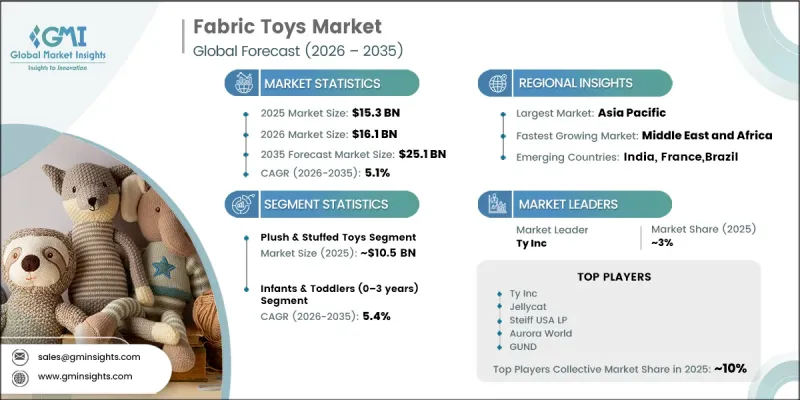
The Global Fabric Toys Market was estimated at USD 15.3 billion in 2025 and is estimated to grow at a CAGR of 5.1% to reach USD 25.1 billion by 2035.
Market growth is significantly influenced by the increasing participation of "kidult" consumers, including teenagers and adults, who are purchasing fabric toys for emotional comfort, collectible purposes, decorative appeal, and lifestyle-oriented use. Demand for fabric-based educational toys is also increasing as these products continue to gain wider adoption in structured early childhood learning programs and developmental activities. Emerging economies across the Asia Pacific, Latin America, the Middle East & Africa are witnessing steady market expansion due to rising disposable income levels and growing consumer spending on children's developmental products among middle-class households. Adult engagement in the toy industry is becoming a major source of revenue generation, particularly across premium fabric toy categories. Growing consumer preference for products associated with nostalgia, emotional well-being, aesthetic value, and collectability is further supporting market demand. The rapid influence of digital commerce platforms and social media-driven purchasing behavior is also accelerating sales growth across the global fabric toys industry.
| Market Scope | |
|---|---|
| Start Year | 2025 |
| Forecast Year | 2026-2035 |
| Start Value | $15.3 Billion |
| Forecast Value | $25.1 Billion |
| CAGR | 5.1% |
The plush and stuffed toys segment generated USD 10.5 billion in 2025 and is expected to grow at a CAGR of 4.8% from 2026 to 2035. Market growth within this category is supported by rising gifting demand, consistent growth in the global toy industry, and increasing consumer interest in premium collectible products. Traditional toy purchases for children continue to contribute a substantial portion of total market revenue across multiple regions. At the same time, the premium collectible segment aimed at older consumers is expanding at a significantly faster pace, contributing to higher product value and improved pricing dynamics across the market. Manufacturers are increasingly introducing premium-quality plush products with enhanced design aesthetics and differentiated branding strategies to attract a broader customer base.
The infants and toddlers segment, covering the 0-3 years age group, accounted for 34.4% share in 2025 and is forecast to grow at a CAGR of 5.4% through 2035. Parents, caregivers, and institutional buyers are increasingly investing in certified fabric toys designed to support early childhood development and sensory stimulation. Product purchasing decisions within this segment are strongly influenced by developmental suitability and compliance with strict safety standards. Soft fabric-based developmental products are designed to support sensory engagement and cognitive growth during early-stage childhood development while meeting recognized international safety and quality requirements. The increasing focus on educational play and child-safe materials is further strengthening demand within this age category.
U.S. Fabric Toys Market accounted for USD 2.9 billion in 2025 and is anticipated to register a CAGR of 4.4% between 2026 and 2035, maintaining its leading position within North America. The regional market is being shaped by a gradual decline in the child population resulting from lower birth rates, while adult participation in toy purchases continues to rise steadily. Strict regulatory standards governing children's products are encouraging manufacturers and importers to streamline product portfolios and optimize certification processes to manage compliance costs and supply chain challenges. Market consolidation activities among established plush toy companies are also contributing to stronger brand positioning, broader product portfolios, and increased competitiveness across the U.S. fabric toys industry.
Major companies operating in the Global Fabric Toys Market include Aurora World Inc., GUND Inc., Jellycat, Manhattan Toy Company, Squishmallows, Steiff USA LP, Ty Inc., Beverly Hills Teddy Bear Company, Corolle SAS, Doshin Co., Ltd., DOUGLAS Company Inc., Maileg, Trudi S.p.A., Vermont Teddy Bear Company, Animal Adventure, Cuddle Barn, FourBears, Goffa International Corp., Hazel Village, Squishable, and Teddy Mountain LLC. Companies participating in the fabric toys market are implementing multiple strategic initiatives to strengthen their market position and expand customer engagement globally. Leading manufacturers are focusing on premium product innovation, collectible toy launches, and emotionally driven branding strategies to attract both children and adult consumers. Businesses are also increasing investments in sustainable materials, eco-friendly production methods, and child-safe certifications to align with evolving consumer preferences and regulatory requirements. In addition, companies are expanding digital marketing activities and leveraging social commerce platforms to improve brand visibility and strengthen direct-to-consumer sales channels. Strategic partnerships, acquisitions, and portfolio diversification initiatives are further helping market participants increase global reach and enhance competitive positioning.
Table of Contents
Chapter 1 Research methodology
- 1.1 Research approach
- 1.2 Quality Commitments
- 1.2.1 GMI AI policy & data integrity commitment
- 1.2.1.1 Source consistency protocol
- 1.2.1 GMI AI policy & data integrity commitment
- 1.3 Research trail & confidence scoring
- 1.3.1 Research trail components
- 1.3.2 Scoring components
- 1.4 Data Collection
- 1.4.1 Partial list of primary sources
- 1.5 Data mining sources
- 1.5.1 Paid sources
- 1.5.1.1 Sources, by region
- 1.5.1 Paid sources
- 1.6 Base estimates and calculations
- 1.6.1 Base year calculation
- 1.7 Forecast model
- 1.7.1 Quantified market impact analysis
- 1.7.1.1 Mathematical impact of growth parameters on forecast
- 1.7.1 Quantified market impact analysis
- 1.8 Research transparency addendum
- 1.8.1 Source attribution framework
- 1.8.2 Quality assurance metrics
- 1.8.3 Our commitment to trust
Chapter 2 Executive Summary
- 2.1 Industry 360° synopsis
- 2.2 Business trends
- 2.3 Regional
- 2.4 Product type
- 2.5 Age group
- 2.6 Price
- 2.7 Material type
- 2.8 Distribution channel
Chapter 3 Industry Insights
- 3.1 Industry ecosystem analysis
- 3.1.1 Supplier landscape
- 3.1.2 Manufacturers
- 3.1.3 Distributors
- 3.1.4 Retailers
- 3.1.5 Profit margin analysis
- 3.1.6 Value addition at each stage
- 3.1.7 Factor affecting the value chain
- 3.2 Industry impact forces
- 3.2.1 Growth drivers
- 3.2.1.1 Rising Demand from the "Kidult" Consumer Segment
- 3.2.1.2 Expanding Early Childhood Education and Institutional Demand
- 3.2.1.3 IP Licensing and Entertainment Franchise Collaborations
- 3.2.2 Industry pitfalls & challenges
- 3.2.2.1 Raw Material Cost Volatility and Supply Chain Concentration
- 3.2.2.2 Evolving Global Toy Safety Regulations
- 3.2.1 Growth drivers
- 3.3 Growth potential analysis
- 3.4 Future market trends
- 3.5 Technology and innovation landscape
- 3.5.1 Current technological trends
- 3.5.2 Emerging technologies
- 3.6 Price trends
- 3.6.1 By region
- 3.6.2 By product type
- 3.7 Trade data analysis
- 3.8 Regulatory landscape
- 3.8.1 Standards and compliance requirements
- 3.8.2 Regional regulatory frameworks
- 3.8.3 Certification standards
- 3.9 Porter's analysis
- 3.10 PESTEL analysis
- 3.11 Impact of AI & generative AI on the market
- 3.11.1 AI-driven disruption of existing business models
- 3.11.2 GenAI use cases & adoption roadmap by segment
- 3.11.3 Risks, limitations & regulatory considerations
- 3.12 Consumer behavior analysis
- 3.12.1 Demographic trends
- 3.12.2 Factors affecting buying decision
- 3.12.3 Consumer product adoption
- 3.12.4 Preferred distribution channel
- 3.12.5 Preferred price range
Chapter 4 Competitive Landscape, 2025
- 4.1 Introduction
- 4.2 Company market share analysis
- 4.2.1 By Region
- 4.2.1.1 North America
- 4.2.1.2 Europe
- 4.2.1.3 Asia Pacific
- 4.2.1.4 Latin America
- 4.2.1.5 Middle East & Africa
- 4.2.1 By Region
- 4.3 Company matrix analysis
- 4.4 Competitive analysis of major market players
- 4.5 Competitive positioning matrix
- 4.6 Key developments
- 4.6.1 Mergers & acquisitions
- 4.6.2 Partnerships & collaborations
- 4.6.3 New product launches
- 4.6.4 Expansion plans
Chapter 5 Market Estimates & Forecast, By Product Type, 2022 - 2035, (USD Billion) (Units)
- 5.1 Key trends
- 5.2 Plush & Stuffed Toys
- 5.3 Soft Dolls & Rag Dolls
- 5.4 Fabric Educational Toys
- 5.5 Hand Puppets & Finger Puppets
- 5.6 Soft Musical Toys
- 5.7 Others
Chapter 6 Market Estimates & Forecast, By Age Group, 2022 - 2035, (USD Billion) (Units)
- 6.1 Key trends
- 6.2 Infants & Toddlers (0-3 years)
- 6.3 Preschool (3-6 years)
- 6.4 School Age (6-12 years)
- 6.5 Teens & Adults (12+ years)
Chapter 7 Market Estimates & Forecast, By Price, 2022 - 2035, (USD Billion) (Units)
- 7.1 Key trends
- 7.2 High
- 7.3 Medium
- 7.4 Low
Chapter 8 Market Estimates & Forecast, By Material Type, 2022 - 2035, (USD Billion) (Units)
- 8.1 Key trends
- 8.2 Cotton
- 8.3 Polyester
- 8.4 Wool
- 8.5 Hemp
- 8.6 Blended Fabric
- 8.7 Others
Chapter 9 Market Estimates & Forecast, By Distribution Channel, 2022 - 2035, (USD Billion) (Units)
- 9.1 Key trends
- 9.2 Online
- 9.2.1 Company Websites
- 9.2.2 E-commerce Websites
- 9.3 Offline
- 9.3.1 Supermarkets and Hypermarkets
- 9.3.2 Specialty Stores
- 9.3.3 Others
Chapter 10 Market Estimates & Forecast, By Region, 2022 - 2035, (USD Billion) (Units)
- 10.1 Key trends
- 10.2 North America
- 10.2.1 U.S
- 10.2.2 Canada
- 10.3 Europe
- 10.3.1 Germany
- 10.3.2 UK
- 10.3.3 France
- 10.3.4 Italy
- 10.3.5 Spain
- 10.3.6 Sweden
- 10.3.7 Netherlands
- 10.4 Asia Pacific
- 10.4.1 China
- 10.4.2 India
- 10.4.3 Japan
- 10.4.4 South Korea
- 10.4.5 Australia
- 10.4.6 Indonesia
- 10.5 Latin America
- 10.5.1 Brazil
- 10.5.2 Mexico
- 10.5.3 Argentina
- 10.6 MEA
- 10.6.1 Saudi Arabia
- 10.6.2 UAE
- 10.6.3 South Africa
Chapter 11 Company Profiles
- 11.1 Global Players
- 11.1.1 Aurora World Inc.
- 11.1.2 GUND Inc.
- 11.1.3 Jellycat
- 11.1.4 Manhattan Toy Company
- 11.1.5 Squishmallows
- 11.1.6 Steiff USA LP
- 11.1.7 Ty Inc.
- 11.2 Regional Players
- 11.2.1 Beverly Hills Teddy Bear Company
- 11.2.2 Corolle SAS
- 11.2.3 Doshin Co Ltd
- 11.2.4 DOUGLAS Company Inc.
- 11.2.5 Maileg
- 11.2.6 Trudi S.p.A.
- 11.2.7 Vermont Teddy Bear Company
- 11.3 Emerging Players & Innovators
- 11.3.1 Animal Adventure
- 11.3.2 Cuddle Barn
- 11.3.3 FourBears
- 11.3.4 Goffa International Corp.
- 11.3.5 Hazel Village
- 11.3.6 Squishable
- 11.3.7 Teddy Mountain LLC

