PUBLISHER: Global Market Insights Inc. | PRODUCT CODE: 2061470

PUBLISHER: Global Market Insights Inc. | PRODUCT CODE: 2061470
Recreational Vehicle Parks Market Opportunity, Growth Drivers, Industry Trend Analysis, and Forecast 2026 - 2035
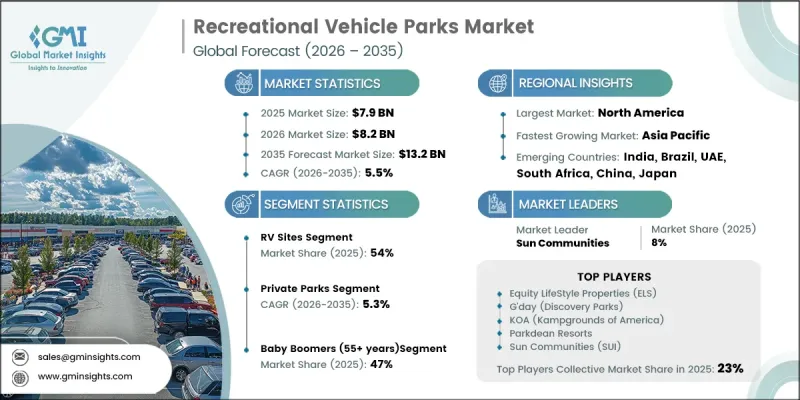
The Global Recreational Vehicle Parks Market was valued at USD 7.9 billion in 2025 and is estimated to grow at a CAGR of 5.5% to reach USD 13.2 billion by 2035.
Rising consumer preference for domestic travel and outdoor tourism experiences is playing a major role in driving market growth worldwide. Travelers are increasingly choosing nature-focused destinations, rural tourism, and outdoor recreational experiences over conventional accommodation options. The growing popularity of remote and flexible working arrangements is also expanding the customer base for recreational vehicle parks, as working professionals seek travel-friendly locations equipped with reliable internet connectivity and dedicated workspaces. In addition, the increasing demand for premium travel experiences has accelerated the development of luxury RV resorts and upscale glamping destinations designed for experience-oriented consumers with higher spending capacity. Modern RV parks are evolving beyond traditional camping environments by incorporating luxury amenities and comfort-driven hospitality services that appeal to a broader demographic of travelers. The growing popularity of premium outdoor accommodations among younger consumers and first-time travelers is further contributing to market expansion. Increasing investment in enhanced guest experiences and high-end recreational infrastructure continues to support the long-term growth of the recreational vehicle parks industry.
| Market Scope | |
|---|---|
| Start Year | 2025 |
| Forecast Year | 2026-2035 |
| Start Value | $7.9 Billion |
| Forecast Value | $13.2 Billion |
| CAGR | 5.5% |
The RV sites segment accounted for 54% share in 2025 and is anticipated to grow at a CAGR of 5.4% from 2026 to 2035. Operators are increasingly upgrading RV sites with advanced utility connections, including high-capacity electrical systems, water access, sewer connectivity, and high-speed internet infrastructure to support modern recreational vehicles equipped with residential-style features. Market participants are also shifting operational strategies toward monthly and seasonal rental models to generate more stable revenue streams and accommodate the growing demand from long-term travelers, retirees, and remote workers. The increasing emphasis on convenience, connectivity, and extended-stay accommodations is significantly influencing the development of modern RV site infrastructure worldwide.
The private parks segment held a 71.7% share in 2025 and is projected to grow at a CAGR of 5.3% during 2035. The segment is experiencing strong consolidation activity as institutional investors, real estate investment groups, and private equity firms continue acquiring independent RV parks to establish larger and more profitable property portfolios. Private operators are increasingly focusing on premium guest amenities, enhanced customer experiences, and advanced pricing strategies designed to maximize occupancy rates and improve revenue generation per site. The growing trend toward portfolio expansion and operational standardization is also helping private park operators improve efficiency, strengthen market positioning, and expand access to investment capital.
U.S. Recreational Vehicle Parks Market reached USD 3.1 billion in 2025 and is expected to grow at a CAGR of 5.7% from 2026 to 2035, maintaining its dominant position across North America. Market growth in the country is being supported by rising consolidation activities involving private investment firms and large property operators acquiring independent RV parks to improve operational scale and profitability. The increasing adoption of remote working lifestyles is also transforming the U.S. recreational vehicle park landscape by driving higher demand for long-term stays and full-time RV residency options. Recreational vehicle parks are increasingly adapting to evolving consumer preferences by investing in high-speed internet infrastructure, flexible accommodation options, and work-friendly amenities designed to support extended occupancy and recurring revenue generation. Growing interest in outdoor travel experiences and premium recreational accommodations continues to support strong demand across the U.S. market.
Major companies operating in the Global Recreational Vehicle Parks Market include Discovery Parks, Equity LifeStyle Properties (ELS), Huttopia, Ingenia Communities, KOA (Kampgrounds of America), Landal GreenParks, Parkdean Resorts, Roompot Parks, Sun Communities (SUI), and Westgate Resorts (RV/Glamping). Companies operating in the recreational vehicle parks industry are implementing several strategic initiatives to strengthen their market presence and improve long-term competitiveness. Leading operators are increasing investments in luxury amenities, premium guest experiences, and modern infrastructure upgrades to attract a broader customer base and enhance occupancy rates. Businesses are also focusing on expanding long-term stay offerings and improving digital connectivity features to accommodate the growing population of remote workers and full-time travelers. Strategic acquisitions, portfolio consolidation, and partnerships with investment firms are helping companies expand regional presence and improve operational efficiency. In addition, market participants are emphasizing technology integration, dynamic pricing models, and customer experience optimization to increase revenue generation and guest retention. The growing demand for upscale outdoor accommodations and experience-driven travel continues to encourage innovation and expansion throughout the recreational vehicle parks market.
Table of Contents
Chapter 1 Methodology
- 1.1 Research approach
- 1.2 Quality Commitments
- 1.2.1 GMI AI policy & data integrity commitment
- 1.2.1.1 Source consistency protocol
- 1.2.1 GMI AI policy & data integrity commitment
- 1.3 Research Trail & Confidence Scoring
- 1.3.1 Research Trail Components
- 1.3.2 Scoring Components
- 1.4 Data Collection
- 1.4.1 Partial list of primary sources
- 1.5 Data mining sources
- 1.5.1 Paid sources
- 1.5.1.1 Sources, by region
- 1.5.1 Paid sources
- 1.6 Base estimates and calculations
- 1.6.1 Base year calculation
- 1.7 Forecast model
- 1.7.1 Quantified market impact analysis
- 1.7.1.1 Mathematical impact of growth parameters on forecast
- 1.7.1 Quantified market impact analysis
- 1.8 Research transparency addendum
- 1.8.1 Source attribution framework
- 1.8.2 Quality assurance metrics
- 1.8.3 Our commitment to trust
Chapter 2 Executive Summary
- 2.1 Industry 360° synopsis
- 2.2 Key market trends
- 2.2.1 Regional
- 2.2.2 Park type
- 2.2.3 Ownership
- 2.2.4 Age group
- 2.2.5 Amenities & services
- 2.2.6 Revenue model
- 2.2.7 End use
- 2.3 TAM analysis, 2026-2035
- 2.4 CXO perspectives: Strategic imperatives
Chapter 3 Industry Insights
- 3.1 Industry ecosystem analysis
- 3.1.1 Supplier landscape
- 3.1.2 Profit margin
- 3.1.3 Cost structure
- 3.1.4 Value addition at each stage
- 3.1.5 Factor affecting the value chain
- 3.1.6 Disruptions
- 3.2 Industry impact forces
- 3.2.1 Growth drivers
- 3.2.1.1 Rising participation in RV travel and camping
- 3.2.1.2 Growth in domestic and nature-based tourism
- 3.2.1.3 Increasing adoption of remote work and full-time RV living
- 3.2.1.4 Expansion of luxury RV resorts and glamping facilities
- 3.2.2 Industry pitfalls and challenges
- 3.2.2.1 High land acquisition and infrastructure development costs
- 3.2.2.2 Seasonal demand fluctuations and weather dependency
- 3.2.3 Market opportunities
- 3.2.3.1 Development of premium and experience-based RV resorts
- 3.2.3.2 Integration of digital booking and smart park management solutions
- 3.2.3.3 Expansion into underserved rural and scenic destinations
- 3.2.3.4 Adoption of sustainable infrastructure and EV charging facilities
- 3.2.1 Growth drivers
- 3.3 Growth potential analysis
- 3.4 Technology and innovation landscape
- 3.4.1 Current technological trends
- 3.4.2 Emerging technologies
- 3.5 Pricing Analysis (Driven by Primary Research)
- 3.5.1 Historical Price Trend Analysis
- 3.5.2 Pricing Strategy by Player Type
- 3.6 Regulatory landscape
- 3.6.1 North America
- 3.6.1.1 National Park Service (NPS)
- 3.6.1.2 U.S. Environmental Protection Agency (EPA)
- 3.6.2 Europe
- 3.6.2.1 European Commission (DG Environment)
- 3.6.2.2 European Consumer Protection Cooperation (CPC) Network
- 3.6.3 Asia Pacific
- 3.6.3.1 Ministry of Culture and Tourism (China)
- 3.6.3.2 Ministry of Tourism (India)
- 3.6.4 Latin America
- 3.6.4.1 Ministerio do Turismo (Brazil)
- 3.6.4.2 Secretaria de Turismo (Mexico - SECTUR)
- 3.6.5 Middle East & Africa
- 3.6.5.1 Ministry of Economy and Tourism (UAE)
- 3.6.5.2 South African National Parks (SANParks)
- 3.6.1 North America
- 3.7 Porter's analysis
- 3.8 PESTEL analysis
- 3.9 Patent analysis (Driven by Primary Research)
- 3.10 Impact of AI & Generative AI on the Market
- 3.10.1 AI-driven disruption of existing business models
- 3.10.2 Gen AI use cases & adoption roadmap by segment
- 3.10.3 Risks, limitations & regulatory considerations
- 3.11 Sustainability and environmental aspects
- 3.11.1 Sustainable practices
- 3.11.2 Waste reduction strategies
- 3.11.3 Energy efficiency in production
- 3.11.4 Eco-friendly initiatives
- 3.11.5 Carbon footprint considerations
- 3.12 Forecast assumptions & scenario analysis (Driven by primary research)
- 3.12.1 Base Case - key macro & industry variables driving CAGR
- 3.12.2 Optimistic Scenarios - Favorable macro and industry tailwinds
- 3.12.3 Pessimistic Scenario - Macroeconomic slowdown or industry headwinds
Chapter 4 Competitive Landscape, 2025
- 4.1 Introduction
- 4.2 Company market share analysis
- 4.2.1 North America
- 4.2.2 Europe
- 4.2.3 Asia Pacific
- 4.2.4 LATAM
- 4.2.5 MEA
- 4.3 Competitive analysis of major market players
- 4.4 Competitive positioning matrix
- 4.5 Key developments
- 4.5.1 Mergers & acquisitions
- 4.5.2 Partnerships & collaborations
- 4.5.3 New product launches
- 4.5.4 Expansion plans and funding
- 4.6 Company tier benchmarking
- 4.6.1 Tier classification criteria & qualifying thresholds
- 4.6.2 Tier positioning matrix by revenue, geography & innovation
Chapter 5 Market Estimates & Forecast, By Park Type, 2022 - 2035 ($Mn)
- 5.1 Key trends
- 5.2 RV sites
- 5.3 Tent camps
- 5.4 Glamping sites
Chapter 6 Market Estimates & Forecast, By Ownership, 2022 - 2035 ($Mn)
- 6.1 Key trends
- 6.2 Public parks
- 6.3 Private parks
- 6.4 Non-profit parks
Chapter 7 Market Estimates & Forecast, By Age Group, 2022 - 2035 ($Mn)
- 7.1 Key trends
- 7.2 Baby Boomers (55+ years)
- 7.3 Generation X (40-54 years)
- 7.4 Millennials (25-39 years)
Chapter 8 Market Estimates & Forecast, By Amenities & Services, 2022 - 2035 ($Mn)
- 8.1 Key trends
- 8.2 Basic
- 8.3 Mid-range
- 8.4 Luxury
- 8.5 Specialized
Chapter 9 Market Estimates & Forecast, By Revenue Model, 2022 - 2035 ($Mn)
- 9.1 Key trends
- 9.2 Entry-fee based
- 9.3 Subscription-based
- 9.4 Free entry
Chapter 10 Market Estimates & Forecast, By End use, 2022 - 2035 ($Mn)
- 10.1 Key trends
- 10.2 Family
- 10.3 Groups
- 10.4 Individuals
Chapter 11 Market Estimates & Forecast, By Region, 2022 - 2035 ($Mn)
- 11.1 Key trends
- 11.2 North America
- 11.2.1 U.S.
- 11.2.2 Canada
- 11.3 Europe
- 11.3.1 Germany
- 11.3.2 UK
- 11.3.3 France
- 11.3.4 Italy
- 11.3.5 Spain
- 11.3.6 Russia
- 11.3.7 Netherlands
- 11.4 Asia Pacific
- 11.4.1 China
- 11.4.2 India
- 11.4.3 Japan
- 11.4.4 South Korea
- 11.4.5 Australia
- 11.4.6 Vietnam
- 11.4.7 Indonesia
- 11.5 Latin America
- 11.5.1 Brazil
- 11.5.2 Mexico
- 11.5.3 Argentina
- 11.6 MEA
- 11.6.1 South Africa
- 11.6.2 Saudi Arabia
- 11.6.3 UAE
Chapter 12 Company Profiles
- 12.1 Global players
- 12.1.1 Equity LifeStyle Properties (ELS)
- 12.1.2 G'day Group (Discovery Parks)
- 12.1.3 Huttopia
- 12.1.4 Ingenia Communities
- 12.1.5 KOA (Kampgrounds of America)
- 12.1.6 Landal GreenParks
- 12.1.7 Parkdean Resorts
- 12.1.8 Roompot Parks
- 12.1.9 Sun Communities (SUI)
- 12.1.10 Westgate Resorts
- 12.2 Regional players
- 12.2.1 BIG4 Holiday Parks
- 12.2.2 Jellystone Park Camp-Resorts
- 12.2.3 NRMA Parks & Resorts
- 12.2.4 Parkbridge
- 12.2.5 RVC Outdoor Destinations
- 12.2.6 Sun Outdoors
- 12.2.7 Thousand Trails (Encore RV Resorts)
- 12.3 Emerging players
- 12.3.1 AutoCamp
- 12.3.2 Under Canvas
- 12.3.3 Camp Margaritaville RV Resort

