
PUBLISHER: Global Market Insights Inc. | PRODUCT CODE: 2061483

PUBLISHER: Global Market Insights Inc. | PRODUCT CODE: 2061483
Generative AI in Automotive Market Opportunity, Growth Drivers, Industry Trend Analysis, and Forecast 2026 - 2035
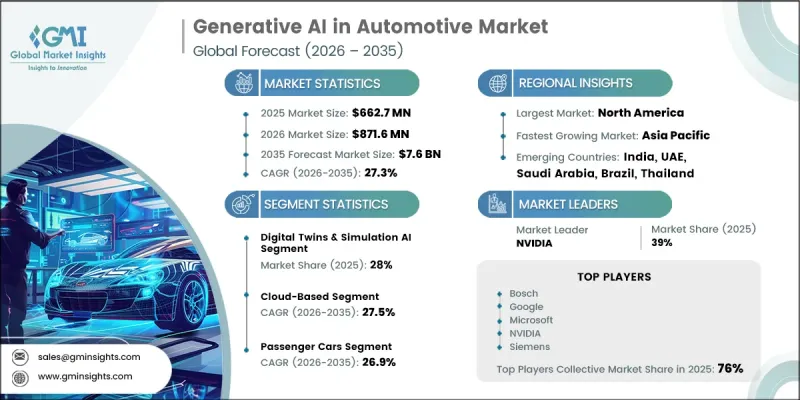
The Global Generative AI In Automotive Market was valued at USD 662.7 million in 2025 and is estimated to grow at a CAGR of 27.3% to reach USD 7.6 billion in 2035.
The market is experiencing rapid expansion as the automotive industry increasingly shifts toward software-defined vehicle architectures, where digital systems play a central role in design, manufacturing, diagnostics, and user experience. Generative AI enables major advancements by automating software code generation, testing workflows, validation processes, and requirements engineering while also accelerating development cycles through continuous over-the-air update capabilities. The growing complexity of next-generation vehicles is increasing reliance on AI-driven solutions to manage software-intensive ecosystems efficiently. In addition, generative AI is transforming autonomous mobility development by producing synthetic environments that replicate rare and complex driving scenarios, significantly reducing dependency on physical testing. This improves training efficiency and enhances model robustness. At the same time, rising consumer expectations for intelligent in-vehicle experiences are driving adoption of natural language models that enable conversational interaction, personalized recommendations, smart navigation, and advanced infotainment features, collectively reshaping the automotive cockpit into a digital experience hub.
| Market Scope | |
|---|---|
| Start Year | 2025 |
| Forecast Year | 2026-2035 |
| Start Value | $662.7 Million |
| Forecast Value | $7.6 Billion |
| CAGR | 27.3% |
The digital twins & simulation AI segment held a 28% share in 2025 and is projected to grow at a CAGR of 26.6% from 2026 to 2035. This segment focuses on creating virtual replicas of vehicles, production systems, and driving environments to enable continuous simulation and testing. In the generative AI automotive ecosystem, these tools are widely used for validating autonomous driving systems, forecasting maintenance requirements, and optimizing manufacturing workflows. Their ability to reduce reliance on physical testing while enhancing development speed and innovation efficiency is driving strong adoption.
The cloud-based deployment segment held a 48.2% share in 2025 and is expected to grow at a CAGR of 27.5% through 2035. Cloud infrastructure enables automotive companies to access scalable computing resources for training and deploying generative AI models, including large language models, synthetic data engines, and digital twin systems. This deployment approach supports real-time system updates, global collaboration across engineering teams, and flexible cost structures. It is widely used for autonomous driving simulations and in-vehicle AI applications within software-defined automotive ecosystems.
United States Generative AI In Automotive Market reached USD 198.8 million in 2025 and is projected to grow at a CAGR of 26.1% from 2026 to 2035. The country remains a key hub for innovation in AI-driven mobility, supported by advanced autonomous driving development programs and strong collaboration between automotive and technology companies. The integration of high-performance computing and AI platforms is accelerating simulation, training, and deployment of next-generation mobility solutions. Regulatory frameworks governing autonomous driving systems are also encouraging the use of AI-based validation and testing technologies, further supporting market expansion.
Major companies operating in the Global Generative AI In Automotive Industry include Autodesk, Amazon Web Services, Baidu, Bosch, Google, Microsoft, NVIDIA, PTC, Qualcomm, and Siemens. Companies operating in the generative AI in automotive market are focusing on strengthening their position through heavy investment in AI model development tailored for automotive-grade applications such as autonomous driving, predictive maintenance, and in-vehicle experience systems. They are expanding cloud-native AI platforms to provide scalable computing infrastructure for training and deploying large-scale generative models. Strategic collaborations with automakers, semiconductor firms, and mobility service providers are being prioritized to accelerate ecosystem integration. Firms are also investing in digital twin technologies and simulation environments to improve testing efficiency and reduce development cycles. Another key strategy includes integrating generative AI with edge computing systems to enable real-time vehicle intelligence and decision-making. Companies are further focusing on enhancing data security, model accuracy, and regulatory compliance to support safe deployment in autonomous systems.
Table of Contents
Chapter 1 Methodology
- 1.1 Research approach
- 1.2 Quality Commitments
- 1.2.1 GMI AI policy & data integrity commitment
- 1.2.1.1 Source consistency protocol
- 1.2.1 GMI AI policy & data integrity commitment
- 1.3 Research Trail & Confidence Scoring
- 1.3.1 Research Trail Components
- 1.3.2 Scoring Components
- 1.4 Data Collection
- 1.4.1 Partial list of primary sources
- 1.5 Data mining sources
- 1.5.1 Paid sources
- 1.5.1.1 Sources, by region
- 1.5.1 Paid sources
- 1.6 Base estimates and calculations
- 1.6.1 Base year calculation
- 1.7 Forecast model
- 1.7.1 Quantified market impact analysis
- 1.7.1.1 Mathematical impact of growth parameters on forecast
- 1.7.1 Quantified market impact analysis
- 1.8 Research transparency addendum
- 1.8.1 Source attribution framework
- 1.8.2 Quality assurance metrics
- 1.8.3 Our commitment to trust
Chapter 2 Executive Summary
- 2.1 Industry 360° synopsis
- 2.2 Key market trends
- 2.2.1 Regional
- 2.2.2 Technology
- 2.2.3 Application
- 2.2.4 Vehicle
- 2.2.5 Deployment mode
- 2.2.6 End use
- 2.3 TAM analysis, 2026-2035
- 2.4 CXO perspectives: Strategic imperatives
Chapter 3 Industry Insights
- 3.1 Industry ecosystem analysis
- 3.1.1 Supplier landscape
- 3.1.2 Profit margin
- 3.1.3 Cost structure
- 3.1.4 Value addition at each stage
- 3.1.5 Factor affecting the value chain
- 3.1.6 Disruptions
- 3.2 Industry impact forces
- 3.2.1 Growth drivers
- 3.2.1.1 Software-defined vehicle adoption growth
- 3.2.1.2 Autonomous driving data demand
- 3.2.1.3 OEM cost optimization pressure
- 3.2.1.4 In-Vehicle AI assistant expansion
- 3.2.2 Industry pitfalls and challenges
- 3.2.2.1 Vehicle data privacy concerns
- 3.2.2.2 High AI infrastructure costs
- 3.2.3 Market opportunities
- 3.2.3.1 Generative vehicle design adoption
- 3.2.3.2 Commercial fleet AI expansion
- 3.2.3.3 Emerging market deployment potential
- 3.2.3.4 Cross-industry automotive AI solutions
- 3.2.1 Growth drivers
- 3.3 Growth potential analysis
- 3.4 Technology and innovation landscape
- 3.4.1 Current technological trends
- 3.4.2 Emerging technologies
- 3.5 Cost breakdown analysis
- 3.6 Regulatory landscape
- 3.6.1 North America
- 3.6.1.1 National Institute of Standards and Technology
- 3.6.1.2 Innovation, Science and Economic Development Canada
- 3.6.2 Europe
- 3.6.2.1 European Commission
- 3.6.2.2 European Telecommunications Standards Institute
- 3.6.3 Asia Pacific
- 3.6.3.1 Ministry of Industry and Information Technology
- 3.6.3.2 Ministry of Economy, Trade and Industry
- 3.6.4 Latin America
- 3.6.4.1 Ministry of Science, Technology and Innovation
- 3.6.4.2 National Institute of Statistics and Geography
- 3.6.5 Middle East & Africa
- 3.6.5.1 Saudi Data and Artificial Intelligence Authority
- 3.6.5.2 Department of Communications and Digital Technologies
- 3.6.1 North America
- 3.7 Porter’s analysis
- 3.8 PESTEL analysis
- 3.9 Patent analysis (Driven by Primary Research)
- 3.10 Impact of AI & Generative AI on the Market
- 3.10.1 AI-driven disruption of existing business models
- 3.10.2 Gen AI use cases & adoption roadmap by segment
- 3.10.3 Risks, limitations & regulatory considerations
- 3.11 Sustainability and environmental aspects
- 3.11.1 Sustainable practices
- 3.11.2 Waste reduction strategies
- 3.11.3 Energy efficiency in production
- 3.11.4 Eco-friendly initiatives
- 3.11.5 Carbon footprint considerations
- 3.12 Forecast assumptions & scenario analysis (Driven by primary research)
- 3.12.1 Base Case - key macro & industry variables driving CAGR
- 3.12.2 Optimistic Scenarios - Favorable macro and industry tailwinds
- 3.12.3 Pessimistic Scenario - Macroeconomic slowdown or industry headwinds
Chapter 4 Competitive Landscape, 2025
- 4.1 Introduction
- 4.2 Company market share analysis
- 4.2.1 North America
- 4.2.2 Europe
- 4.2.3 Asia Pacific
- 4.2.4 LATAM
- 4.2.5 MEA
- 4.3 Competitive analysis of major market players
- 4.4 Competitive positioning matrix
- 4.5 Key developments
- 4.5.1 Mergers & acquisitions
- 4.5.2 Partnerships & collaborations
- 4.5.3 New product launches
- 4.5.4 Expansion plans and funding
- 4.6 4.6 Company tier benchmarking
- 4.6.1 Tier classification criteria & qualifying thresholds
- 4.6.2 Tier positioning matrix by revenue, geography & innovation
Chapter 5 Market Estimates and Forecast, By Technology, 2022 - 2035 ($ Million)
- 5.1 Key trends
- 5.2 Large Language Models (LLMs) & NLP
- 5.3 Generative Design & Computer Vision
- 5.4 Synthetic Data Generation
- 5.5 Digital Twins & Simulation AI
- 5.6 AI Agents & Copilots
Chapter 6 Market Estimates and Forecast, By Application, 2022 - 2035 ($ Million)
- 6.1 Key trends
- 6.2 Vehicle Design & Engineering
- 6.3 Autonomous Driving & ADAS Development
- 6.4 Manufacturing & Quality Control
- 6.5 Software Development & Testing
- 6.6 In-Vehicle Experience & Customer Interaction
- 6.7 Supply Chain & Procurement
- 6.8 Predictive Maintenance & Diagnostics
Chapter 7 Market Estimates and Forecast, By Vehicle, 2022 - 2035 ($ Million)
- 7.1 Key trends
- 7.2 Passenger cars
- 7.2.1 Sedan
- 7.2.2 SUV
- 7.2.3 Hatchback
- 7.3 Commercial Vehicles
- 7.3.1 LCV
- 7.3.2 MCV
- 7.3.3 HCV
Chapter 8 Market Estimates and Forecast, By Deployment Mode, 2022 - 2035 ($ Million)
- 8.1 Key trends
- 8.2 Cloud-Based
- 8.3 On-Premises
- 8.4 Hybrid
Chapter 9 Market Estimates and Forecast, By End Use, 2022 - 2035 ($ Million)
- 9.1 Key trends
- 9.2 Automotive OEMs
- 9.3 Tier-1 & Tier-2 Suppliers
- 9.4 Automotive Software & Technology Providers
- 9.5 Fleet Operators & Aftermarket Service Providers
Chapter 10 Market Estimates & Forecast, By Region, 2022 - 2035 ($Mn)
- 10.1 Key trends
- 10.2 North America
- 10.2.1 U.S.
- 10.2.2 Canada
- 10.3 Europe
- 10.3.1 Germany
- 10.3.2 UK
- 10.3.3 France
- 10.3.4 Italy
- 10.3.5 Spain
- 10.3.6 Russia
- 10.3.7 Netherlands
- 10.3.8 Norway
- 10.3.9 Sweden
- 10.4 Asia Pacific
- 10.4.1 China
- 10.4.2 India
- 10.4.3 Japan
- 10.4.4 South Korea
- 10.4.5 Australia
- 10.4.6 Thailand
- 10.4.7 Indonesia
- 10.4.8 Singapore
- 10.4.9 Malaysia
- 10.5 Latin America
- 10.5.1 Brazil
- 10.5.2 Mexico
- 10.5.3 Argentina
- 10.6 MEA
- 10.6.1 South Africa
- 10.6.2 Saudi Arabia
- 10.6.3 UAE
Chapter 11 Company Profiles
- 11.1 Global players
- 11.1.1 Autodesk
- 11.1.2 Bosch
- 11.1.3 Google
- 11.1.4 Microsoft
- 11.1.5 Mobileye
- 11.1.6 NVIDIA
- 11.1.7 PTC
- 11.1.8 Qualcomm
- 11.1.9 Siemens
- 11.1.10 Tesla
- 11.2 Regional players
- 11.2.1 Baidu
- 11.2.2 BYD
- 11.2.3 Huawei
- 11.2.4 KPIT Technologies
- 11.2.5 Pony.ai
- 11.2.6 Xpeng
- 11.3 Emerging players
- 11.3.1 Aurora Innovation
- 11.3.2 Waabi
- 11.3.3 Wayve

